
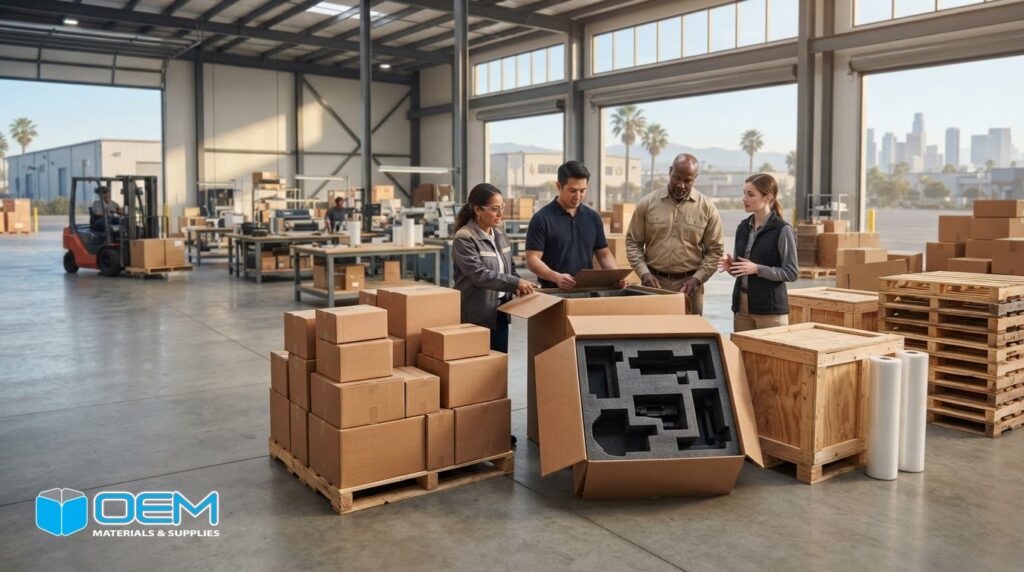
Buying packaging from a national catalog distributor feels simple until freight surcharges, transit damage, and pallet-choked aisles drain your operating budget. Plant managers and procurement specialists across Southern California know how frustrating it is to pay catalog markups for rigid stock sizes that require endless void fill. That is why sourcing practical alternatives to uline for bulk boxes los angeles manufacturing facilities need has become an urgent operational priority.
You shouldn’t have to sacrifice plant floor space just to store weeks of bulky corrugated inventory, nor should your team settle for generic containers that leave precision assemblies vulnerable. This guide evaluates the top regional packaging partners serving Los Angeles County and surrounding manufacturing hubs. We examine how custom converting, vendor-managed inventory, and scheduled local deliveries can lower your total landed packaging costs while keeping your production lines moving efficiently.
Key Takeaways
- Explore how moving to alternatives to uline for bulk boxes los angeles operations rely on reduces freight surcharges through localized delivery networks.
- Discover why verifying board grade, burst strength, and Edge Crush Test ratings ensures packaging integrity for sensitive industrial components.
- Compare rigid catalog distributor pricing against regional converting partners that build custom box dimensions for complex assemblies.
- Learn how vendor-managed inventory and just-in-time delivery free up valuable floor space in busy Southern California plants.
- Understand the operational advantages of integrating protective foam, crating, and corrugated packaging under a single regional supplier.
Why Los Angeles Manufacturers Seek Alternatives to National Catalog Distributors
High-volume industrial plants face operational hurdles when relying on standard catalog suppliers. While buying off-the-shelf packaging works for occasional retail parcels, operations in Torrance, El Monte, and the City of Industry require predictable supply lines and engineered protection. Plant buyers quickly realize that catalog distributors build their business models around retail convenience, leaving high-volume manufacturers to deal with inflated line items and storage headaches. Searching for practical alternatives to uline for bulk boxes los angeles operations require is often the first step toward correcting these systemic shipping inefficiencies.
The True Cost of Catalog Box Markups and Freight
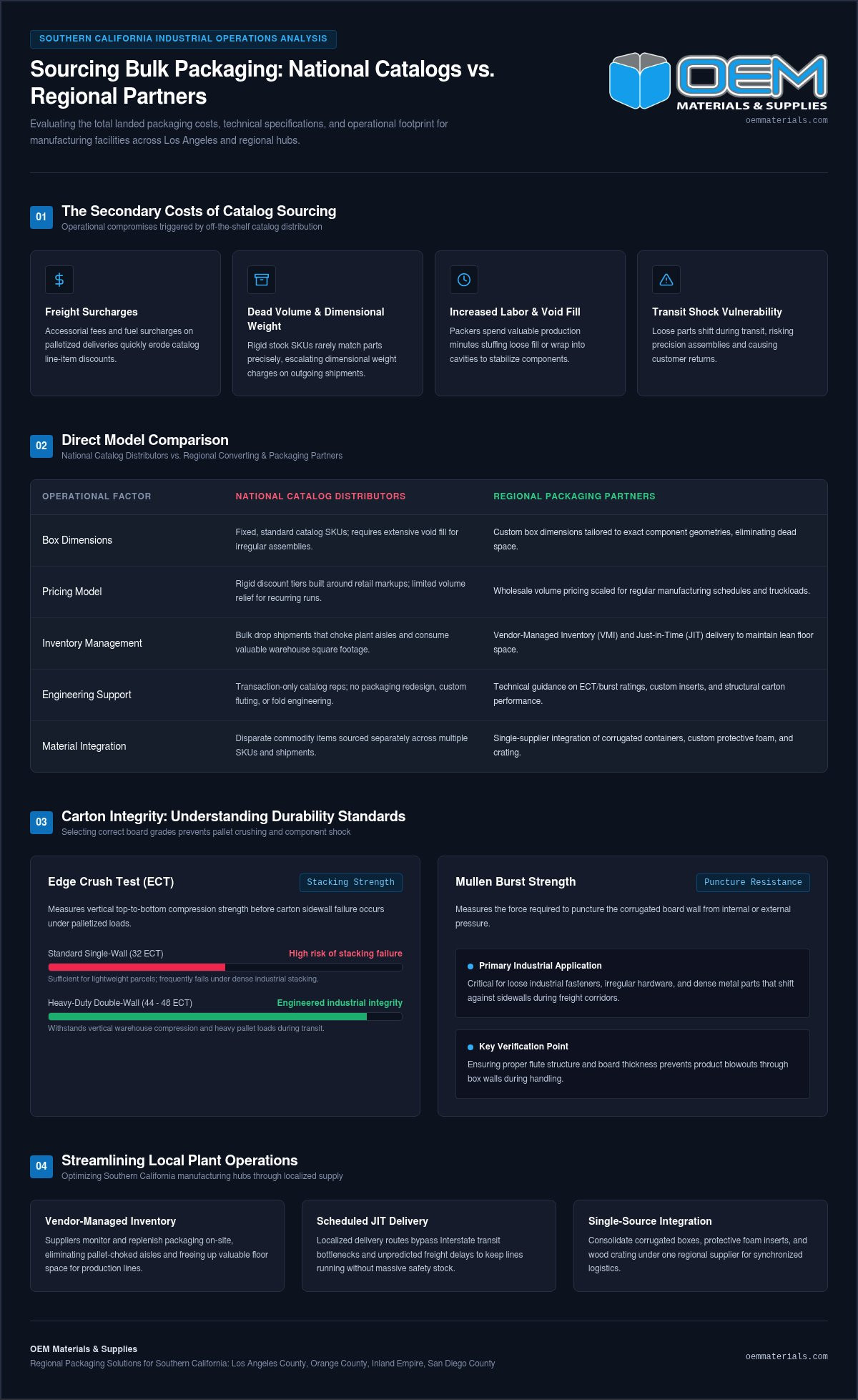
Catalog distributors add steep freight accessorial charges and fuel surcharges when dispatching palletized loads across Southern California. When ordering heavy-duty cartons built from industrial-grade corrugated fiberboard, transport fees quickly erode line-item margins. Catalog discount tiers are rigid. They rarely provide genuine wholesale relief for operations purchasing truckload quantities or recurring monthly runs. Procurement managers find themselves paying retail markups disguised as bulk tier discounts.
Limitations of One-Size-Fits-All Stock Packaging
Standardized catalog SKUs force packing teams into compromises that trigger secondary operational costs. Packing an aerospace component or medical subassembly into a stock box creates excess space, driving up dimensional weight surcharges on outgoing freight.
- Excessive Void Fill: Packers spend valuable minutes pumping bubble wrap or loose fill into empty cavities, raising unit labor times.
- Transit Shock Damage: Loose parts shift during highway transit, risking delicate internal assemblies and leading to customer returns.
- Lack of Technical Guidance: Catalog reps cannot redesign box fluting, insert custom folds, or engineer integrated protective packaging.
Transitioning from generic catalog suppliers to specialized corrugated boxes engineered for exact product geometries eliminates dead shipping volume. For operations evaluating alternatives to uline for bulk boxes los angeles industrial hubs require, working directly with a regional partner replaces generic catalog limitations with structural packaging that protects parts and reduces outbound freight spend.
Key Criteria for Evaluating Bulk Corrugated Box Suppliers in Southern California
Procurement teams shifting away from commodity catalogs cannot simply swap one vendor website for another. Industrial packaging demands structural performance that protects assemblies during transport, handling, and warehouse stacking. When vetting alternatives to uline for bulk boxes los angeles manufacturers rely on, evaluating specific material standards and local operational capabilities ensures your production lines stay protected without incurring hidden supply chain bottlenecks.
Structural Integrity and ECT Ratings for Heavy Industrial Loads
Standard catalog descriptions often gloss over the critical distinction between burst strength and top-to-bottom compression resistance. Standards promoted across the corrugated packaging industry measure carton durability through two distinct metrics:
- Edge Crush Test (ECT): Evaluates stacking strength and how much vertical compression a carton withstands before sidewall failure. Standard 32 ECT single-wall cartons often fail under heavy pallet stacking, whereas 44 ECT or 48 ECT double-wall constructions handle industrial density.
- Mullen Burst Strength: Measures the puncture resistance of the box wall under internal pressure, which is vital for heavy, irregular metal parts or loose industrial fasteners.
Matching the specific board fluting and wall construction to your product mass prevents carton crushing on pallets and eliminates costly transit damage across California freight corridors.
Geographic Proximity and Local Fleet Logistics
Freight distance matters. Sourcing corrugated packaging from suppliers with converting plants outside Southern California exposes your facility to Interstate transit bottlenecks and unpredictable carrier schedules. Partnering with a manufacturer operating dedicated delivery routes throughout Los Angeles County, Orange County, and the Inland Empire provides reliable fulfillment windows. Sourcing packaging locally protects assembly schedules from regional transport disruptions while lowering delivery accessorials.
Integrated Protective Packaging Capabilities
Heavy machinery, sensitive aerospace electronics, and delicate diagnostic devices require more than outer corrugate. Sourcing cartons from one supplier, foam corner blocks from a second, and cushioning from a third multiplies administrative work. Working with a converter capable of manufacturing heavy-duty boxes alongside custom foam inserts and wood crates streamlines plant purchasing. If you are comparing local manufacturing partners to consolidate your packaging supply line, you can request a quote tailored to your specific box configurations and production schedules.
Catalog Distributors vs. Regional Packaging Partners: A Direct Comparison
Choosing between a national catalog vendor and a regional converter comes down to how your facility manages operating costs. Catalog resellers operate on fixed transaction models, pushing pre-made stock cartons through standard web portals. Regional manufacturing partners integrate directly into your production schedules. For operations researching alternatives to uline for bulk boxes los angeles industrial corridors require, understanding these structural differences reveals where hidden packaging expenses originate.
| Operational Factor | National Catalog Distributors | Regional Packaging Partners |
|---|---|---|
| Sizing Flexibility | Restricted to static catalog dimensions | Custom engineered to exact part geometry |
| Freight Structure | Third-party LTL or parcel with published surcharges | Dedicated regional delivery fleet routes |
| Technical Support | Call center order entry clerks | Packaging engineers and CAD specialists |
| Inventory Control | Plant must store all delivered stock cartons | Managed replenishment and staged local runs |
Cost Structure and Unit Economics Breakdown
Published catalog tiers favor low-volume, transactional buyers. When production lines consume thousands of master cartons per month, paying catalog margins drastically inflates overall material spend. Tailoring carton dimensions directly to your product eliminates dead shipping air, which directly lowers cube size and carrier dimensional weight fees. Total landed packaging cost reductions depend heavily on your exact carton dimensions, substrate specifications, and overall shipment volumes.
Engineering Support and Prototyping Speed
Catalog companies treat corrugated packaging as an off-the-shelf commodity. If your aerospace assembly vibrates inside a standard carton or an automotive component punctures a sidewall, a web catalog offers no engineering remediation. Regional partners utilize structural design tables and rapid CAD sampling to test custom flute profiles and integrated interior supports before production runs begin. Working through custom packaging design gives your engineering team direct access to packaging specialists who ensure structural compliance from the initial sample run.
Plant managers seeking true alternatives to uline for bulk boxes los angeles hubs need can leverage this engineering access to streamline packaging lines. Eliminating manual box cutting and excess internal wrapping on the plant floor shortens pack times while ensuring components arrive intact.
Streamlining Plant Operations with Local Inventory and Warehouse Programs
Storing pallet loads of corrugated containers on an active shop floor chokes operational throughput. Bulk boxes consume massive cubic volume relative to their weight. When production lines must compete with stacks of empty cartons for square footage, material handling slows down and forklift congestion increases. Industrial buyers looking for viable alternatives to uline for bulk boxes los angeles plants depend on increasingly focus on local warehousing strategies that reclaim this critical floor capacity.
Overcoming Warehouse Space Constraints in Los Angeles
Southern California industrial real estate commands a premium. Dedicating high-bay warehouse positions or active assembly staging areas to empty cardboard drives up overhead. Storing weeks of bulky corrugated inventory ties up capital and limits manufacturing throughput. A regional supply partner warehouses safety stock off-site in regional hubs, transferring corrugated inventory to your facility only as production schedules dictate.
Implementing Vendor-Managed Inventory and Just-in-Time Deliveries
Modern assembly plants avoid stockouts without cluttering staging aisles through structured inventory replenishment. Rather than forcing your team to audit pallet counts manually, structured packaging VMI programs automate tracking and reordering based on mutually agreed minimum and maximum stocking levels.
- Consumption Tracking: Local account reps monitor inventory levels right at your plant or through linked replenishment data.
- Shift-Level Drop-offs: Implementing JIT packaging services coordinates box deliveries directly with active assembly shifts, keeping staging docks clear.
- Buffer Safety Reserves: Regional facilities hold reserve cartons locally, protecting your lines against unexpected spikes in component output.
This approach transforms packaging from a passive storage headache into an agile logistical asset. By aligning order cycles with plant usage, purchasing teams avoid sudden shortages while eliminating excess handling labor on the receiving dock. If your facility is running out of space and needs dependable alternatives to uline for bulk boxes los angeles operations require, request a quote to configure a dedicated local inventory replenishment plan.
Sourcing Industrial Corrugated Solutions with OEM Materials & Supplies
Operating as an integrated converter and supply partner, OEM Materials & Supplies delivers packaging built specifically for heavy manufacturing and advanced assembly lines. Rather than acting as a standard transactional reseller, the team provides complete converting capabilities tailored to regional aerospace, medical device, electronics, and automotive facilities. When evaluating practical alternatives to uline for bulk boxes los angeles operations require, partnering directly with a Southern California manufacturer gives you the engineering flexibility that national catalog vendors cannot provide.
Custom and Stock Corrugated Capabilities
Production facilities need diverse box formats to accommodate evolving product lines. Through local converting facilities, OEM Materials & Supplies manufactures heavy-duty corrugated boxes ranging from regular slotted containers (RSC) to complex die-cut designs and multi-depth styles. In addition to custom manufacturing, local warehouses maintain ready inventory of standard industrial cartons. This setup allows plants throughout Los Angeles, Orange County, San Diego, and Riverside to secure fast replenishment without enduring long cross-country transit lines.
Beyond corrugated cartons, plants can consolidate their full packaging footprint under one roof:
- Custom die-cut and fabricated protective foam inserts
- Heavy-duty wood shipping crates and plastic pallets
- Industrial-grade stretch film and edge protectors
- Engineered packaging kits combining containers with cushioning
How to Request an Industrial Packaging Assessment
Transitioning away from generic catalog ordering is simple and straightforward. Accurately assessing your requirements requires specific operational data to establish optimal board grades and physical dimensions. Providing the following technical criteria ensures an accurate evaluation:
- Internal Carton Dimensions: Exact length, width, and depth measurements tailored to your assembly or finished goods.
- Payload Mass and Stacking Needs: Total component weight alongside pallet height and warehouse rack configurations.
- Annual and Batch Volumes: Expected monthly usage to schedule dedicated delivery runs or establish off-site safety buffers.
Once your specifications are submitted, packaging engineers evaluate the application, produce physical CAD samples, and assist with transport testing to confirm structural performance under dynamic load conditions. For manufacturing teams looking to eliminate retail markups and build a dependable regional supply chain, the best alternatives to uline for bulk boxes los angeles facilities rely on start with custom manufacturing support. Reach out to our team and request a quote to get started on your facility assessment.
Upgrade Your Southern California Packaging Supply Line
Relying on standard catalog distributors forces your operation to absorb unnecessary freight charges, excess void fill, and severe floor congestion. Choosing practical alternatives to uline for bulk boxes los angeles manufacturers rely on gives your facility direct access to regional converting power, custom ECT board grades, and synchronized delivery schedules. By partnering with a local supplier that understands industrial requirements, you protect fragile assemblies while reclaiming valuable warehouse square footage.
OEM Materials & Supplies supports production teams across Los Angeles, Orange County, San Diego, and Riverside with engineered protective packaging. Whether your lines require custom-cut boxes, specialized foam inserts, or an automated vendor-managed inventory program, our team provides practical manufacturing solutions that keep production moving without interruption. Request a custom packaging quote from OEM Materials & Supplies today, and let our technical specialists design a resilient, cost-effective packaging program built around your exact assembly specs.
Frequently Asked Questions
Why should Los Angeles manufacturers look for alternatives to Uline for bulk boxes?
National catalog distributors charge high freight accessorials and apply rigid pricing tiers designed for low-volume commercial buyers. Seeking specialized alternatives to uline for bulk boxes los angeles operations require helps plants bypass retail markups. Working with a regional packaging manufacturer provides access to tailored board grades, custom dimensional engineering, and scheduled local deliveries that lower total landed costs across Southern California.
Can a local packaging manufacturer match the delivery speed of national catalog suppliers?
Yes, regional packaging converters often outperform national catalogs through localized distribution routes. Instead of waiting for long-haul freight carriers, plants in Los Angeles, Orange County, Riverside, and San Diego receive direct drop-offs from dedicated regional fleets. Setting up structured release schedules ensures your assembly floor receives pallet loads exactly when production begins, preventing costly transit delays.
What specifications are required to order custom corrugated boxes in bulk?
You need internal carton dimensions, payload weight, stacking height, and estimated annual carton volume. Packaging engineers use these figures to determine whether your application requires single-wall, double-wall, or heavy-duty triple-wall construction. Sharing whether parts require protective foam inserts, specialized die cuts, or specific edge protection ensures the finished container withstands handling without carton failure.
How does custom box sizing reduce overall shipping costs compared to standard catalog boxes?
Right-sizing boxes removes dead interior space, which directly cuts dimensional weight penalties imposed by commercial freight carriers. Eliminating oversized cavities also slashes the amount of void fill, air pillows, or kraft paper your packing team handles. Faster packing cycles lower bench labor times, while precise box dimensions keep fragile parts from shifting and suffering transit damage.
What is the minimum volume required to switch from catalog ordering to a custom corrugated program?
Volume thresholds depend heavily on carton dimensions, style complexity, and material board grade. While standard catalog distributors target single-bundle buyers, industrial converting programs typically deliver the highest cost savings on pallet-tier or recurring production runs. Sourcing alternatives to uline for bulk boxes los angeles facilities use makes clear economic sense whenever monthly usage creates persistent catalog freight surcharges.
How does a vendor-managed inventory program work for industrial shipping cartons?
A supplier monitors your packaging consumption and maintains agreed minimum and maximum reserve levels in a regional warehouse. When stock dips toward the minimum threshold, replenishment pallets are automatically dispatched to your receiving dock. This eliminates emergency reorders, stabilizes cash flow, and frees valuable square footage on your production floor for core manufacturing tasks.
Does OEM Materials & Supplies provide complete protective packaging beyond corrugated cartons?
Yes, OEM Materials & Supplies manufactures and supplies complete industrial protective packaging programs across Southern California. In addition to custom and stock corrugated containers, the business provides custom-engineered foam inserts, wood crates, plastic pallets, stretch film, edge protectors, mailing tubes, and cushioning materials. Plants can consolidate multiple packaging line items under a single regional purchase order.