
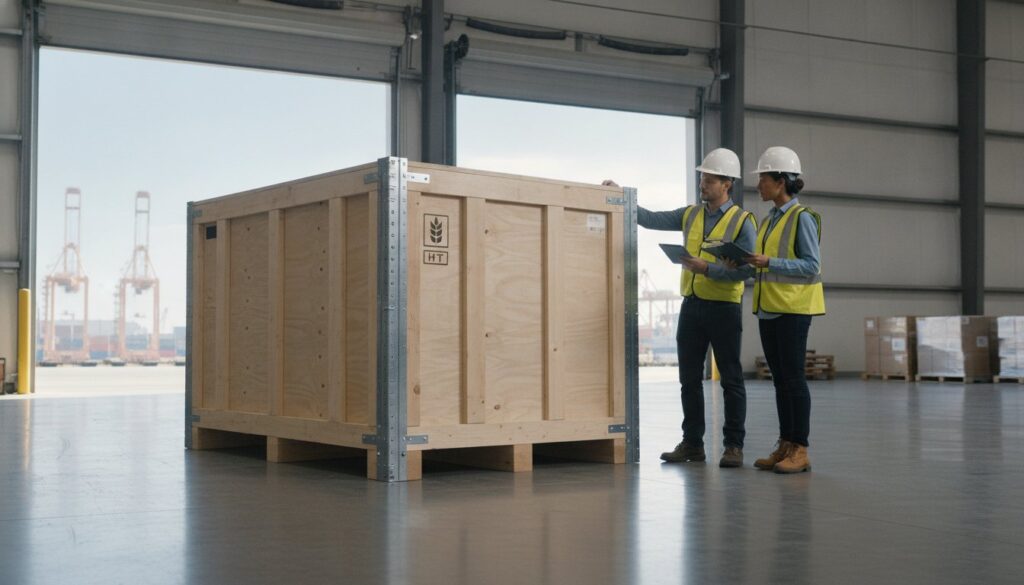
In June 2026, the Port of Los Angeles processed over 1 million TEUs, marking a record 13% year-over-year increase in cargo volume. This massive surge in activity means your high-value industrial machinery faces more handling risks than ever before. Securing the right heavy duty wood crates for shipping los angeles is no longer a simple procurement task; it’s a critical engineering requirement to protect your capital investments. You already know that a single structural failure during ocean or freight transit leads to more than just repair costs; it creates project delays and erodes client trust.
This guide provides the technical roadmap to specify, design, and source engineered wood crates that ensure zero-damage delivery. You will learn how to maintain strict compliance with ISPM 15 heat-treatment standards while reducing the high labor costs often associated with on-site crating. We will examine how a local Southern California partner can streamline your procurement through custom-engineered solutions, from reinforced bases to integrated cushioning, specifically designed for the most demanding industrial applications.
Key Takeaways
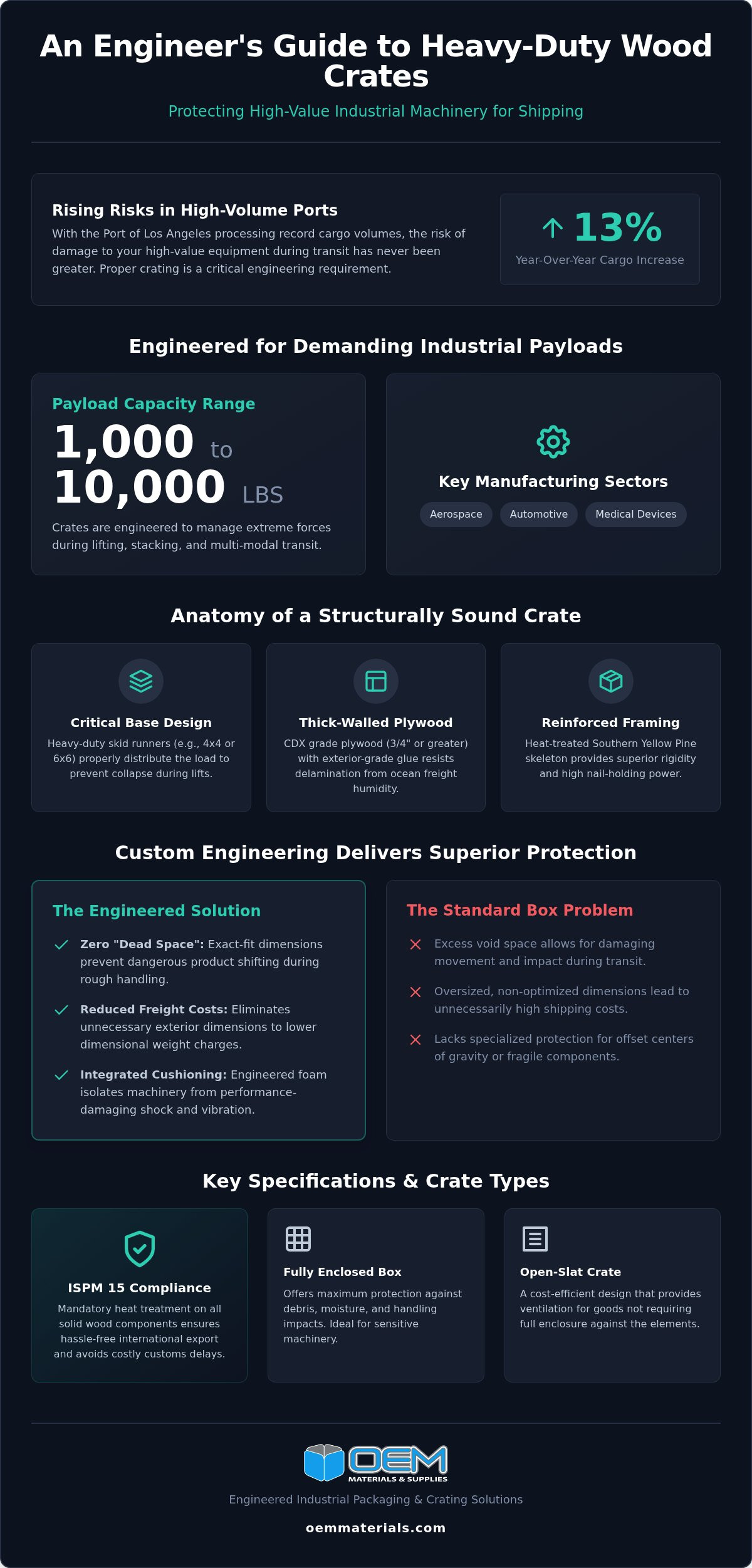
- Identify the engineering specifications required for industrial payloads ranging from 1,000 to 10,000 lbs, including requirements for thick-walled plywood and reinforced framing.
- Understand how custom-engineered dimensions and internal components prevent product shifting and damage during rough handling.
- Compare the cost-efficiency of open-slat crates for ventilated goods against the maximum debris protection offered by fully enclosed wooden boxes.
- Ensure international shipping compliance by sourcing heavy duty wood crates for shipping los angeles that meet mandatory ISPM 15 heat-treatment standards.
- Leverage a local Southern California partner to streamline procurement through scalable production, from initial prototypes to high-volume manufacturing runs.
Defining Heavy Duty Wood Crate Specifications for Industrial Loads
A heavy-duty wood crate is a structural transport enclosure engineered to maintain its physical integrity under static and dynamic payloads exceeding 1,000 lbs and scaling up to 10,000 lbs. Unlike standard shipping boxes, these units function as specialized equipment designed to withstand the rigors of global supply chains. For manufacturers sourcing heavy duty wood crates for shipping los angeles, the primary focus must be on the transfer of weight. The crate doesn’t just hold a product; it manages the forces exerted during lifting, stacking, and transit.
Structural integrity depends on the synergy between thick-walled plywood and heat-treated solid wood framing. The base design is the most critical element. It must feature heavy-duty skid runners and rubbing strips to facilitate safe handling with forklifts and heavy-lift cranes. Proper Wooden crate construction ensures that the load is distributed across the base members rather than the side panels, preventing structural collapse during high-velocity movements or vertical lifts at the Port of Los Angeles.
Load Weight and Structural Engineering Requirements
Engineering a crate begins with calculating the difference between static and dynamic loads. A crate sitting in a warehouse (static) faces far less stress than one being jolted on a cargo ship or truck (dynamic). Industrial machinery often has an offset center of gravity, which requires specific reinforcement. We use thicker plywood panels, often 3/4 inch or greater, and 4×4 or 6×6 skid runners to provide a stable foundation. For top-heavy equipment, we integrate internal “K-bracing” and vertical supports to prevent the crate from racking or tipping during sharp turns in transit.
Material Selection: Plywood vs. Solid Wood Framing
The choice of materials directly impacts both durability and cost. We typically utilize CDX grade plywood for exterior panels. The “X” denotes exterior-grade glue, which ensures the layers don’t delaminate when exposed to the high humidity typical of ocean freight. For the internal skeleton, Southern Yellow Pine is the industry standard due to its high density and exceptional nail-holding power. While this provides the rigidity for multi-ton loads, the versatility of wood is also showcased by WoodSnap, which specializes in printing high-quality custom photos directly onto sustainably sourced birch.
Moisture content is another technical variable that cannot be ignored. We prioritize lumber with a moisture content below 19% to prevent warping, shrinking, or the development of mold during long-term storage. Using heavy duty wood crates for shipping los angeles built with seasoned, heat-treated lumber ensures your packaging remains dimensionally stable from the assembly floor to the final international destination.
Engineering Custom Crates for Los Angeles Manufacturers
Los Angeles serves as a primary hub for aerospace, automotive, and medical device manufacturing. These sectors produce high-precision instruments that require more than a standard wooden box. They require an engineered system. Custom design ensures the crate dimensions match the product footprint exactly, which is the first line of defense against transit damage. When a crate is built to the specific dimensions of a machine, it eliminates the “dead space” that allows for dangerous shifting during rough ocean or rail handling. Utilizing custom packaging design reduces total shipping volume by eliminating unnecessary exterior dimensions, which directly lowers dimensional weight freight costs.
For local manufacturers, heavy duty wood crates for shipping los angeles must often meet rigorous industry-specific standards. Aerospace components, for example, may require specialized bracing to protect sensitive flight surfaces. Medical equipment often demands clean-room-compatible materials or specific internal access points. We treat every crate as a precision tool. This approach ensures that the internal components, from blocking and bracing to tie-down points, work in unison to immobilize the payload. If you’re unsure how to specify these technical requirements, you can consult with our engineering team for a tailored assessment.
Integrating Engineered Foam and Cushioning
High-value industrial machinery is frequently susceptible to vibration and shock. We integrate foam packaging to isolate these forces. Selecting the correct foam density is a technical calculation based on the fragility and weight of the machine. For instance, high-density polyethylene foam is ideal for heavy-duty load-bearing, while softer polyurethane foam provides superior deceleration for lighter, sensitive electronics. Custom-cut inserts secure product protrusions and delicate components, ensuring that even if the crate is tilted or jolted, the machine remains suspended in a protective “floating” environment.
Hardware Options for Reusability and Access
Modern logistics often require crates to be more than just disposable containers. Trade show equipment and calibrated testing tools need reusable enclosures. We incorporate heavy-duty hinges and recessed butterfly latches to facilitate multiple opening and closing cycles without degrading the wood’s integrity. Recessed handles are a critical ergonomic choice; they provide a secure grip for warehouse personnel while preventing snagging during high-density stacking. For wheeled equipment, we design integrated ramps. This allows a single operator to roll machinery into the crate safely, eliminating the need for complex rigging or external lift gates. Every hardware choice is made to comply with ISPM 15 export standards, ensuring that the finished product is ready for immediate international deployment.
Comparing Crate Types: Open-Slat vs. Fully Enclosed Boxes
Selecting the correct enclosure style is a strategic decision that balances physical security with logistical efficiency. For businesses utilizing heavy duty wood crates for shipping los angeles, the two primary options are open-slat designs and fully enclosed boxes. Each serves a specific functional purpose. Open-slat crates utilize spaced lumber to create a skeletal frame, while fully enclosed boxes use solid plywood or lumber panels to create a total barrier. The choice you make directly influences the final weight of the shipment and the level of protection against environmental contaminants. For extremely heavy or high-value payloads, steel-reinforced crates represent the gold standard, providing maximum structural rigidity for multi-ton industrial assets.
When to Specify Open-Slat Shipping Crates
Open-slat crates are the most efficient choice for items that don’t require protection from dust, debris, or moisture. These crates are ideal for large industrial components that already have weather-resistant coatings or solid metal frames. Because they use less lumber, they are lighter and more cost-effective than their solid-walled counterparts. This weight reduction is a significant advantage for air freight shipments leaving LAX, where dimensional weight and actual weight dictate the bottom line. Additionally, the open design allows customs officials to perform visual inspections without dismantling the packaging. This transparency helps maintain compliance with ISPM 15 export standards and can prevent unnecessary delays at international ports of entry.
Maximum Protection with Fully Enclosed Wood Boxes
Fully enclosed boxes provide the highest level of security for sensitive or high-value machinery. They are essential for international ocean freight, where exposure to salt air and high humidity can cause rapid corrosion on exposed metal surfaces. By creating a sealed environment, these boxes allow for the effective use of vapor barriers and desiccant packs. They also provide a robust physical barrier against theft and tampering during the multiple hand-offs typical of global transit. Inside these enclosures, you can integrate various cushioning materials to prevent surface abrasion and absorb localized impacts. While fully enclosed boxes increase the total shipping weight, the investment is necessary for any equipment that requires a “clean” delivery state or total isolation from the external environment. Choosing the right configuration ensures your cargo arrives in the same condition it left your facility.
Logistics and Compliance: ISPM 15 and Export Standards
Exporting industrial machinery from Southern California involves navigating a strict landscape of international regulations. All heavy duty wood crates for shipping los angeles destined for international trade must adhere to ISPM 15 standards to prevent the cross-border spread of timber pests. Non-compliance is not a minor hurdle; it results in immediate quarantine, potential destruction of the packaging at the shipper’s expense, and significant fines at the destination port. To verify compliance, every crate must feature a permanent IPPC mark. As of July 2026, this mark must be applied via a heat-stamped branded mark on at least two opposing sides, as ink stamps are no longer considered compliant. The official IPPC stamp serves as a passport for your cargo, indicating the country of origin, the certified producer code, and the treatment method used.
Heat Treatment and International Certification
The core requirement for ISPM 15 compliance is Heat Treatment (HT). This process requires heating the wood’s core to a minimum of 56 degrees Celsius (132.8 degrees Fahrenheit) for at least 30 continuous minutes. This industrial standard has largely replaced chemical fumigation methods, which are restricted or banned in many regions like the European Union. When shipping through the Port of Los Angeles, documentation proving this treatment is essential for customs clearance. We ensure that all wood components, including the pallets used as crate bases, meet these rigorous standards. Furthermore, a zero-tolerance policy for bark is now in effect; any visible bark on your shipping materials can lead to the immediate rejection of your entire shipment.
Blocking and Bracing for Heavy Load Stabilization
Structural failure often occurs not because the crate broke, but because the load shifted. Heavy machinery requires aggressive blocking and bracing to anchor the equipment directly to the crate’s base. We use custom-cut lumber chocks and K-braces to immobilize the machine, ensuring that weight is distributed evenly across the skid runners. This prevents the crate from tipping during high-velocity movements on a container ship. For internal components and smaller parts, we utilize high-tension strapping and stretch film to prevent secondary movement. This multi-layered approach to stabilization ensures that your equipment remains stationary regardless of the transit conditions. If you need a technical review of your current blocking and bracing protocols, contact our engineering team for a consultation.
Proper weight distribution is equally critical for safety during lifting. We clearly mark the center of gravity on the exterior of the crate to guide crane operators and forklift drivers. This simple technical detail prevents accidents during the loading process at busy terminals. By combining ISPM 15 compliance with advanced stabilization techniques, we eliminate the primary risks associated with international industrial logistics.
Sourcing Custom Wood Crates in Los Angeles: The OEM Advantage
OEM Materials & Supplies functions as a seasoned industry partner for manufacturers who require precision and scalability. We provide local engineering support to ensure that every crate is a functional remedy for your specific logistical challenges. By sourcing heavy duty wood crates for shipping los angeles through a local provider, you eliminate the friction of long-distance communication and high freight costs for the empty packaging. Our production capabilities are fully scalable. We handle everything from rapid prototypes for new product launches to high-volume crate programs for established production lines.
Efficiency is the core of our design philosophy. We don’t just sell wood; we provide integrated solutions that combine crates with foam packaging, corrugated internal components, and high-performance stretch film. This comprehensive approach reduces your total cost of ownership. By optimizing the internal and external packaging components simultaneously, we minimize dimensional weight while maximizing protection. It’s a methodical process designed to deliver results, not just containers. Our goal is to ensure your high-value assets reach their destination with zero damage.
Vendor-Managed Inventory for Large-Scale Operations
Large-scale manufacturing requires a constant supply of packaging materials without the burden of excessive on-site storage. Our packaging VMI programs ensure you never experience a stock-out of critical shipping crates. We stock your custom crates off-site and provide JIT packaging deliveries based on your actual production schedule. This service stabilizes your packaging costs for long-term projects and frees up valuable warehouse floor space for your primary manufacturing operations. It’s a strategic move that transforms your packaging from a potential bottleneck into a streamlined asset.
Local Support for SoCal Manufacturing Hubs
Our presence in Southern California allows us to serve the industrial hubs of Los Angeles, Orange County, Riverside, and San Diego with speed and accuracy. We offer on-site consultations to evaluate your current shipping damage risks and identify technical opportunities for optimization. This grounded, face-to-face approach ensures that your heavy duty wood crates for shipping los angeles are perfectly aligned with your operational requirements. If you’re ready to secure your supply chain with an authoritative expert, request a quote for your next heavy-duty project today.
Securing Your Industrial Assets for Global Transit
Securing multi-ton industrial machinery requires more than a simple wooden enclosure; it demands an engineered system designed for the rigors of global logistics. You’ve seen how precise structural specifications and mandatory heat-treatment standards form the foundation of a zero-damage shipping strategy. By integrating custom cushioning and expert blocking and bracing, you mitigate the dynamic risks inherent in ocean and rail transit. Maintaining compliance and physical integrity is essential for avoiding costly port delays and product loss.
OEM Materials provides the technical expertise and local Southern California engineering support necessary to protect your capital investments. We specialize in aerospace and medical packaging, ensuring every heavy duty wood crates for shipping los angeles project meets the most rigorous industry standards. Our ISPM 15 compliant export solutions are built for reliability and operational efficiency. Whether you need rapid prototypes or high-volume production runs, our team is ready to stabilize your supply chain and reduce your total cost of ownership.
Take the next step in optimizing your industrial logistics. Request a Quote for Custom Heavy Duty Wood Crates today to ensure your cargo arrives in peak condition. We look forward to serving as your dependable packaging partner.
Frequently Asked Questions
What is the difference between a wood box and a wood crate?
A wood box features six solid sides that completely enclose the contents, while a crate is a structural frame often used for open-slat designs. Industrial engineers distinguish them by their load-bearing method. A crate’s strength comes from its skeletal framework, whereas a box provides a total protective barrier against dust and external debris. Both can be engineered for heavy-duty applications depending on the payload requirements.
Do I need ISPM 15 certification for domestic shipping within the US?
ISPM 15 certification is not required for domestic shipping within the contiguous United States. This regulation specifically targets international trade to prevent the cross-border spread of timber pests. However, many manufacturers choose to use heat-treated lumber for domestic shipments anyway. This ensures the wood is seasoned and dimensionally stable, which reduces the risk of warping during long-term storage or transit.
How much weight can a standard heavy-duty wood crate hold?
Heavy-duty crates are engineered to support payloads ranging from 1,000 lbs to over 10,000 lbs. The specific capacity is determined by the thickness of the plywood panels and the dimensions of the skid runners. When sourcing heavy duty wood crates for shipping los angeles, you must provide the exact weight and footprint of your machinery. This allows engineers to reinforce the base to withstand dynamic forces during lifting.
Can wood crates be reused for multiple shipments?
Wood crates can be reused if they’re designed with durable hardware like recessed butterfly latches and heavy-duty hinges. Reusable crates are a cost-effective solution for trade shows or recurring internal plant transfers. You should inspect the structural joints, fasteners, and skid runners for damage before every reuse. Maintaining the structural integrity of the frame is critical for ensuring continued safety during multi-leg transit cycles.
What is the typical lead time for a custom wood crate in Los Angeles?
Typical lead times for custom-engineered crates in the Los Angeles area range from three to seven business days. This timeline accounts for technical design, material procurement, and final assembly. High-volume programs or complex designs requiring specialized internal cushioning may require additional time for prototype validation. Local sourcing helps minimize these timelines by eliminating long-distance freight delays for the empty enclosures.
How do I calculate the shipping weight of a large wood crate?
Calculate the crate weight by determining the total board footage of the lumber and the square footage of the plywood panels. Different wood species have different densities; Southern Yellow Pine is significantly heavier than Spruce-Pine-Fir. Engineers use these material densities plus the weight of internal hardware to provide an accurate tare weight. This figure is then added to your product weight for final freight calculations.
What materials are used to prevent moisture damage inside a wood crate?
Moisture damage is prevented using vapor barrier bags, desiccant packs, and specialized rust-inhibiting films. For ocean freight, we often recommend fully enclosed heavy duty wood crates for shipping los angeles that include a heat-sealed foil liner. This creates a controlled internal environment that isolates the machinery from salt air and humidity. These materials are essential for preventing corrosion on precision-machined metal surfaces during long voyages.
Does OEM Materials offer on-site crating services for large machinery?
Logistics managers should verify specific service capabilities during the initial engineering consultation. While many industrial providers focus on the high-volume manufacturing and JIT delivery of engineered packaging, on-site assembly requirements depend on the scale of the machinery and the facility’s rigging capabilities. We recommend discussing your facility’s specific loading constraints to determine the most efficient crating and stabilization workflow for your equipment.