
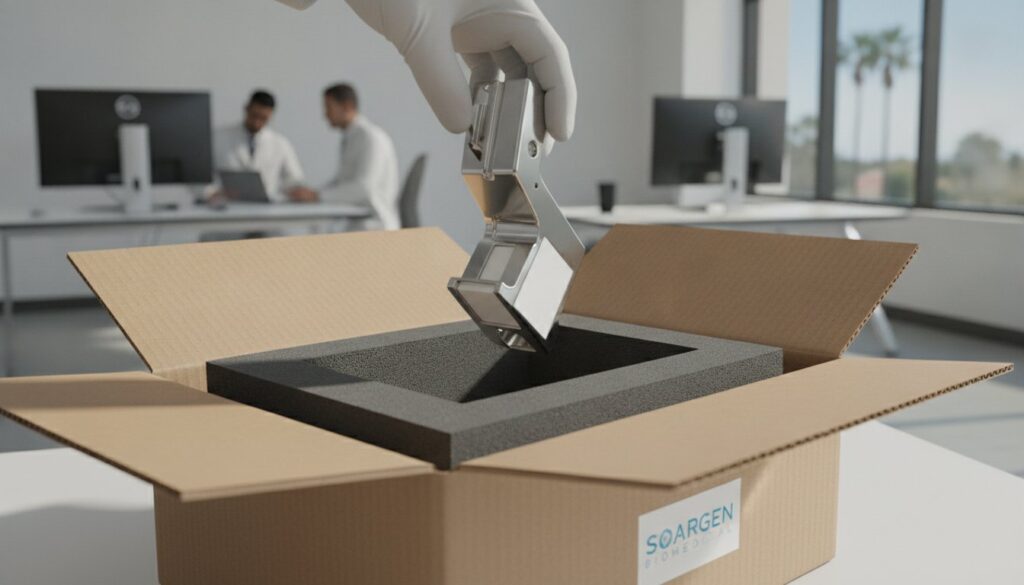
A single damaged medical component or aerospace part represents more than just a lost unit; it often triggers a cascade of logistical failures and rejected shipments that erode your bottom line. Manufacturing professionals in Southern California understand that standard off-the-shelf packaging rarely provides the precision required for high-value goods. By implementing custom die cut inserts San Diego OEMs can significantly reduce transit damage while simultaneously lowering freight costs through optimized footprint designs.
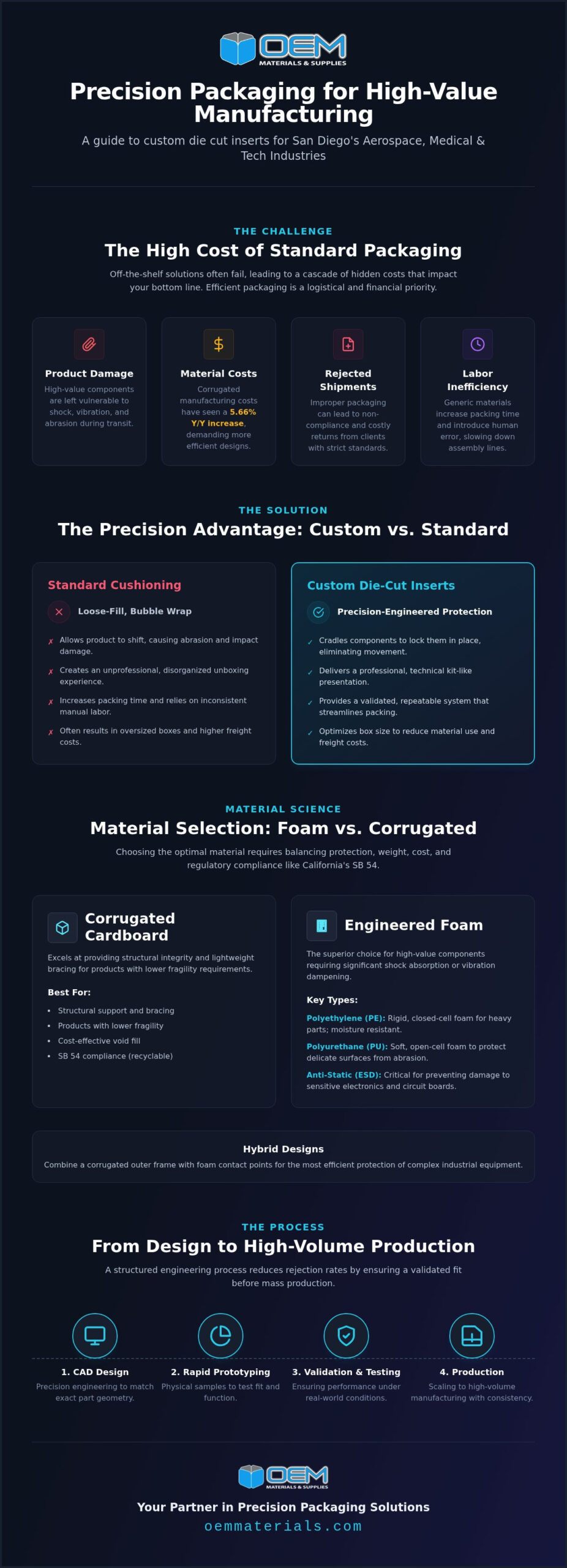
With the May 2026 implementation of California SB 54 and the recent 5.66 percent year-over-year increase in corrugated manufacturing costs, the need for efficient, compliant packaging is a logistical priority. This guide explores how precision-engineered die-cut inserts protect sensitive components, streamline assembly lines through kitting, and leverage local prototyping to keep your production moving. You will learn how to validate a packaging system that meets rigorous industrial standards while managing the realities of rising material prices and new regulatory requirements.
Key Takeaways
- Learn how precision engineered custom die cut inserts san diego protect sensitive components in high-tech sectors like biotech and aerospace.
- Compare the performance characteristics of corrugated cardboard and engineered foam to select the most cost-effective material for your specific product geometry.
- Discover how rapid prototyping and CAD design reduce rejection rates by ensuring a validated fit before moving to high-volume production.
- Understand the logistics advantages of partnering with a local Southern California supplier to reduce freight costs and improve lead times.
- Identify opportunities to streamline assembly through organized kitting and specialized medical device packaging solutions.
The Role of Custom Die Cut Inserts in San Diego High-Tech Manufacturing
Custom die-cut inserts aren’t just filler material; they are precision-engineered components designed to match the exact geometry of high-value parts. The die cutting process allows for high-tolerance cavities that cradle sensitive items with surgical accuracy. For manufacturers in Southern California, where biotech and aerospace industries dominate, these inserts are essential for maintaining product integrity. Generic solutions often fail because they don’t account for the specific shock, vibration, or electrostatic discharge requirements of complex electronics and medical instruments.
Procurement teams often make the mistake of focusing solely on the unit price of packaging. A more effective approach involves analyzing the total cost of ownership. This calculation includes the cost of product rejections, labor spent on inefficient packing lines, and the freight impact of oversized boxes. High-quality custom die cut inserts san diego help mitigate these hidden expenses by providing a validated, repeatable protection system that streamlines the entire outbound logistics process.
Custom Protection vs. Standard Cushioning
Standard materials like loose-fill peanuts or bubble wrap frequently shift during transit. This movement leads to surface abrasion or internal component failure that standard cushioning cannot prevent. Engineered inserts lock the product in place, eliminating the variables of human error during packing. Beyond physical safety, custom fitment provides a professional, organized presentation. In high-end B2B sectors, an unboxing experience that looks like a technical kit rather than a pile of scrap material builds significant trust with your end user.
San Diego’s Manufacturing Landscape and Packaging Needs
Innovation hubs in Carlsbad, Miramar, and La Jolla produce some of the most complex hardware in the world. Shipping these items through the busy logistics corridors of Southern California requires packaging that can withstand frequent handling and diverse environments. Utilizing professional custom packaging design ensures that your custom die cut inserts san diego are optimized for both the specific product weight and the intended shipping route. This local engineering support allows for faster iterations and a packaging system that actually performs under real-world pressure.
Material Selection for Die Cut Packaging: Foam vs. Corrugated
Selecting the optimal material for your packaging requires a balance between physical protection, weight, and regulatory compliance. For many custom die cut inserts san diego manufacturers, the choice often comes down to corrugated cardboard or engineered foam. Corrugated inserts excel at providing structural integrity and lightweight bracing for products with lower fragility. Conversely, foam is the superior choice for high-value components that require significant shock absorption or vibration dampening during transit. Hybrid designs, which utilize a corrugated outer frame with foam contact points, often provide the most efficient protection for complex industrial equipment.
Environmental regulations are also driving material selection in 2026. Under California SB 54, producers must ensure all single-use packaging is recyclable or compostable by 2032, with significant progress required as early as this year. Corrugated materials are naturally positioned for compliance, while foam manufacturers are increasingly turning to recyclable polyethylene or reusable closed-cell designs. When evaluating these options, it is helpful to speak with a packaging specialist to determine which material meets both your protection needs and these evolving state mandates.
Engineered Foam Types: PE, PU, and ESD-Safe
Engineered foam provides a high level of customization for fragile items. Polyethylene (PE) is a closed-cell foam that offers rigid support and excellent moisture resistance, making it ideal for heavy aerospace parts. Polyurethane (PU) is an open-cell, softer material designed to protect delicate surfaces from abrasion. For San Diego’s electronics and biotech sectors, anti-static (ESD) foam is a critical requirement to prevent electrostatic discharge from damaging sensitive circuit boards. You can review specific technical specs for these foam packaging options to match the right density to your product weight.
Corrugated Inserts for Structural Integrity
Die-cut corrugated inserts provide exceptional bracing and organization through partitions and heavy-duty dividers. The strength of these inserts is determined by the flute selection. E-flute is often used for smaller, intricate die-cuts that require a clean finish, while B-flute offers more cushioning and stacking strength for larger industrial kits. Maintaining compliance with FDA packaging and labeling regulations is particularly important for medical device manufacturers using corrugated kits to organize surgical components. For a deeper look at material strength and flute types, refer to our corrugated boxes guide.
Industry-Specific Protection for Aerospace and Medical Device Shipments
High-value manufacturing in Southern California requires more than just physical protection; it demands adherence to stringent industry standards. For firms utilizing custom die cut inserts san diego, the engineering must account for specific environmental stressors like vibration, temperature fluctuations, and electrostatic discharge. These precision inserts serve as a critical bridge between the production floor and the end user, ensuring that complex assemblies arrive in the exact condition they left the factory. Proper design also ensures compliance with federal packaging and transportation regulations, which govern the safety and compatibility of industrial shipments.
In the automotive sector, the focus often shifts toward durability and reusability. Reusable dunnage, often made from heavy-duty die-cut plastics or treated corrugated materials, allows for the safe transport of heavy components between assembly plants. This circular approach reduces material waste and lowers the long-term cost per shipment, provided the inserts are engineered for hundreds of cycles without losing structural integrity. This level of durability is essential for managing the high-volume logistics common in the regional automotive supply chain.
Aerospace and Defense: Precision and ESD Protection
San Diego is a primary hub for the national defense supply chain, housing major contractors and specialized avionics manufacturers. Protecting sensitive flight hardware requires specialized ESD-safe materials that prevent static buildup during handling and transit. Beyond electronics, aerospace packaging often utilizes shadow boards. These are custom die-cut foam inserts that provide a visual inventory of parts and tools. This organization prevents Foreign Object Debris (FOD) issues by ensuring every component is accounted for before a kit is moved to the hangar or assembly line. This methodical approach to organization is a hallmark of reliable aerospace logistics.
Life Sciences and Medical Devices
For the medical device industry, packaging must prioritize cleanliness and non-abrasive contact. Surgical kits and diagnostic equipment often feature intricate geometries that require a soft touch to avoid damaging sterile barriers or sensitive finishes. Utilizing high-quality cushioning materials within a die-cut framework allows for organized kitting. This enables medical professionals to access tools in a specific procedural order, reducing setup time in the operating room. When sourcing custom die cut inserts san diego, biotech firms look for materials that won’t flake or outgas, maintaining the purity of the device’s environment. These engineered solutions are essential for high-stakes medical logistics where a single scratched lens or bent probe can lead to a costly rejection.
The Design and Prototyping Process for Custom Inserts
Engineering a high-performance package begins with precise data collection. We don’t rely on approximate measurements; we utilize 3D models and CAD software to ensure every cavity in our custom die cut inserts san diego matches your product’s unique profile. This digital foundation allows for rapid iterations, helping engineers identify potential failure points before a single piece of material is cut. Once the design is finalized, rapid prototyping provides a physical sample for immediate fitment testing.
Validation is a critical step that separates commodity packaging from engineered solutions. We recommend subjecting prototypes to transit simulations, including drop testing and vibration analysis, to confirm the material density and fitment provide adequate deceleration during impacts. This rigorous approach ensures that the finalized custom die cut inserts san diego perform as expected in the real world. A validated design reduces the risk of costly damage claims and ensures that your internal quality standards are maintained through every shipment.
From CAD Modeling to CNC Routing
Digital modeling allows us to account for delicate protrusions, cable management, and user access points within a single insert. For San Diego manufacturers working on tight development cycles, CNC routing offers a fast path to functional prototypes without the upfront cost of traditional tooling. This agility is essential for verifying fit and function in real-time. If you have specific dimensions or a CAD file ready for review, you can request a quote to start the engineering process.
Streamlining Assembly with Kitting and VMI
Custom inserts do more than protect; they optimize the speed of your packing line. By utilizing pre-assembled kits, your team avoids the time-consuming process of folding complex corrugated partitions or taping loose foam pieces. Implementing Vendor Managed Inventory (VMI) ensures that these kits are always in stock without cluttering your floor space. When paired with Just-In-Time (JIT) packaging, you can maintain high-volume production schedules while minimizing the footprint of your packaging materials.
Optimizing Your San Diego Supply Chain with Local Packaging Support
Partnering with a regional supplier for custom die cut inserts san diego provides a strategic advantage that extends across the Southern California corridor. Having a partner with a footprint spanning from San Diego through Orange County and into Los Angeles ensures that your packaging design is informed by the specific logistics routes of the West Coast. A single-source provider can coordinate the production of corrugated boxes, foam inserts, and plastic pallets to ensure every component works in unison. This holistic approach eliminates the friction of managing multiple vendors and reduces the risk of fitment issues between different packaging layers. When choosing a partner, manufacturers should use the following checklist to ensure technical competence:
- Does the supplier offer in-house engineering to accelerate development?
- Can they handle specialized materials for high-value aerospace or medical applications?
- Do they provide value-added services like kitting and vendor-managed inventory to streamline your floor space?
- Is their facility close enough to allow for immediate site visits and design consultations?
Reducing Total Packaging Costs
Precision engineering directly impacts your freight spend. When using custom die cut inserts san diego companies can often move to smaller outer containers. Reducing the external dimensions of a package lowers its dimensional (DIM) weight; a primary driver of shipping costs in 2026. Additionally, efficient insert designs minimize the labor required on the packing line. When components snap into place without the need for excessive tape or loose cushioning, throughput increases and the likelihood of human error decreases. These savings, combined with the avoidance of costly product returns, lead to a significantly lower total cost of ownership. Note that actual cost reductions depend on your specific product requirements and chosen shipping methods.
Why Local Partnerships Matter for San Diego OEMs
Proximity enables a level of collaboration that remote vendors cannot match. Face-to-face consultations in Carlsbad or site visits to a facility in Miramar allow packaging engineers to see the production line in action. This firsthand knowledge leads to better-informed designs that account for how parts are handled before they reach the shipping dock. Local support also means faster response times when production schedules shift or design changes occur. Being in the same region as your supplier ensures that your packaging remains a facilitator of growth rather than a logistical bottleneck.
Secure Your High-Value Shipments with Engineered Precision
Effective industrial packaging is a balance of technical expertise and logistical efficiency. By moving beyond standard cushioning and adopting custom die cut inserts san diego, manufacturers can protect sensitive aerospace and medical components while meeting strict regulatory standards. These engineered solutions do more than just prevent transit damage; they streamline assembly lines and reduce the total cost of ownership by optimizing dimensional weight and labor requirements.
As material costs and environmental regulations evolve, having a local partner for rapid prototyping and high-volume production is essential. OEM Materials & Supplies provides the expert engineering support needed for complex product geometries and offers reliable Southern California delivery. We invite you to request a custom packaging quote for your San Diego facility to begin improving your supply chain efficiency. Providing specific data points such as product weight, dimensions, and fragility will help our team design a validated system tailored to your needs. We look forward to helping you optimize your manufacturing logistics and build a more resilient distribution network.
Frequently Asked Questions
What is die cutting in industrial packaging?
Die cutting is a manufacturing process that uses a specialized tool, known as a die, to cut, shape, or score materials like corrugated board and engineered foam with high precision. This technique allows for the creation of intricate internal cavities that match the exact dimensions of a product. In industrial packaging, it is the primary method for producing inserts that provide repeatable, high-tolerance protection for sensitive components.
How much do custom die-cut inserts cost in San Diego?
The cost of custom inserts is determined by material selection, design complexity, and total order volume. Unit prices vary significantly between lightweight corrugated partitions and high-density engineered foam. While there are typically upfront costs for engineering and tooling, these are often offset by the reduction in product damage and lower labor costs on the packing line. Each project requires a specific evaluation to determine the most efficient price point.
What is the best foam material for protecting electronics?
Anti-static (ESD) foam is the industry standard for electronics because it prevents electrostatic discharge from damaging sensitive circuit boards. Within this category, polyethylene (PE) is often chosen for its rigid support and durability, while polyurethane (PU) is used for its soft, non-abrasive cushioning. The final selection depends on the fragility of the component and the vibration dampening required for your specific shipping route.
Can custom inserts be made from sustainable or recyclable materials?
Yes, corrugated inserts are fully recyclable and are frequently manufactured from post-consumer content. For foam requirements, recyclable polyethylene or reusable closed-cell designs are available to help manufacturers comply with California SB 54 mandates. These sustainable options ensure that high-value protection does not come at the expense of environmental responsibility or regulatory compliance.
What is the typical lead time for a custom packaging prototype?
Lead times for prototypes depend on the complexity of the part and the material selected. Utilizing CNC routing allows for the rapid production of physical samples without the need for permanent tooling. Working with a local San Diego supplier often shortens this window by facilitating faster design iterations and allowing for same-day site visits to verify fitment and function.
Do I need to pay for tooling for every custom insert order?
Tooling is generally a one-time upfront investment for high-volume production runs that require physical steel-rule dies. For small batches or initial prototypes, CNC routing is a cost-effective alternative that eliminates the need for tooling entirely. Once a die is created for your specific design, it can be stored and reused for all subsequent orders of that part, keeping your recurring costs lower.
How do custom inserts help with dimensional weight (DIM) shipping costs?
Custom inserts enable a tighter fit around your product, which allows for the use of a smaller outer shipping container. Carriers calculate freight costs based on the volume of the box, so reducing the exterior dimensions directly lowers the dimensional weight of the shipment. This optimization is a key strategy for controlling freight expenses, particularly for bulky but lightweight industrial goods. For logistics teams aiming to refine their fulfillment process, you can discover more about Custom Packaging Manufacturing and Sales and explore efficient techniques for secondary packaging assembly.
What information do I need to provide for a custom insert quote?
To receive an accurate quote for custom die cut inserts san diego, you should provide the product dimensions, weight, and fragility requirements. Providing a CAD file or a physical sample of the item allows our engineers to design the most precise fitment. Additionally, specifying your estimated annual usage and preferred shipping methods helps us recommend the most economical material and production process for your facility.