
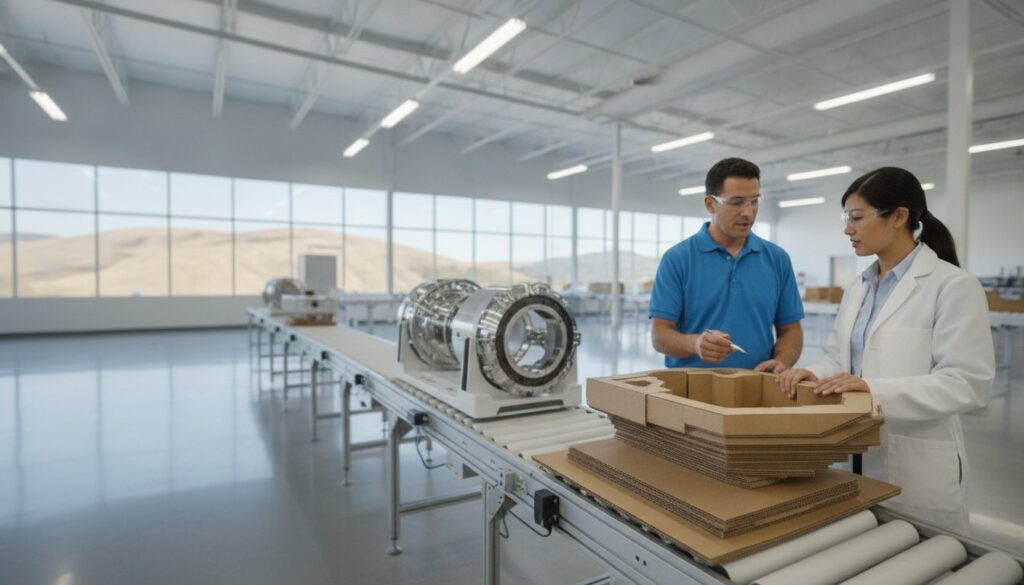
A single packaging failure can halt an entire production line, turning a routine shipment into a costly logistical bottleneck. For industrial OEMs in sectors like aerospace and medical device manufacturing, a box is not just a commodity; it is a critical component of the assembly process. Many procurement professionals struggle with corrugated packaging box manufacturers that fail to meet technical specifications or provide consistent delivery schedules, leading to avoidable product damage and expensive downtime.
We understand that your priority is maintaining a lean, efficient supply chain without compromising on protection. This guide explains how to evaluate manufacturers based on material strength, custom engineering capabilities, and inventory management. You will learn how the right local partner in Southern California can reduce your total cost of ownership through vendor-managed inventory and precision-engineered solutions. We will examine the specific criteria required to ensure your packaging supports, rather than hinders, your operational goals.
Key Takeaways
- Learn to differentiate between industrial-grade corrugated and general-purpose retail boxes to ensure your components are fully protected during transit.
- Understand the technical differences between ECT and Mullen test ratings to select corrugated packaging box manufacturers capable of meeting your specific load requirements.
- Evaluate how custom die-cut designs can lower your total cost of ownership by reducing assembly labor and minimizing shipping damage.
- Identify the advantages of Vendor Managed Inventory (VMI) programs for maintaining a consistent supply of packaging materials without bloating your warehouse space.
- Discover the benefits of partnering with a local Southern California specialist for rapid prototyping and integrated foam packaging solutions.
Selecting the Right Corrugated Packaging Box Manufacturer for Industrial Applications
Transitioning from a commodity mindset to an engineered packaging strategy is essential for operational efficiency. Leading corrugated packaging box manufacturers act as consultants rather than simple vendors. They analyze how a box interacts with the product, the pallet, and the vibration of the transport vehicle. By applying Corrugated box design principles, a manufacturer can optimize the packaging for stacking strength and puncture resistance. This technical approach prevents the hidden costs associated with product damage and shipping claims.
The Difference Between Stock and Custom Industrial Boxes
Stock boxes are often a false economy for industrial manufacturers. Using a “close enough” size results in wasted internal volume, which requires excessive void fill like bubble wrap or foam. This adds material cost and increases labor time on the packing line. Custom-dimensioned boxes eliminate these inefficiencies. A perfectly fitted box reduces the overall shipping footprint, lowering freight charges based on dimensional weight. More importantly, custom designs ensure that sensitive equipment remains stationary during transit, which significantly improves product safety.
Why Regional SoCal Expertise Matters for OEMs
Proximity is a strategic advantage in supply chain management. For manufacturers in Orange County and Los Angeles, sourcing from local corrugated packaging box manufacturers reduces lead times from weeks to days. High freight costs associated with shipping bulky empty boxes are also minimized when your partner is located nearby in San Diego or Riverside. Local expertise allows for face-to-face design consultations. This is invaluable when developing complex prototypes for new product launches. Engineers can review physical samples and make immediate adjustments before committing to a high-volume production run.
Understanding Industrial Corrugated Specifications: Strength and Durability
Engineering a shipping container requires more than picking a size. It demands an understanding of how the material reacts under industrial stress. Selecting a material based solely on price often overlooks the technical specifications for performance required in heavy manufacturing environments. The right choice prevents box failure during long-term warehouse storage or high-vibration transport.
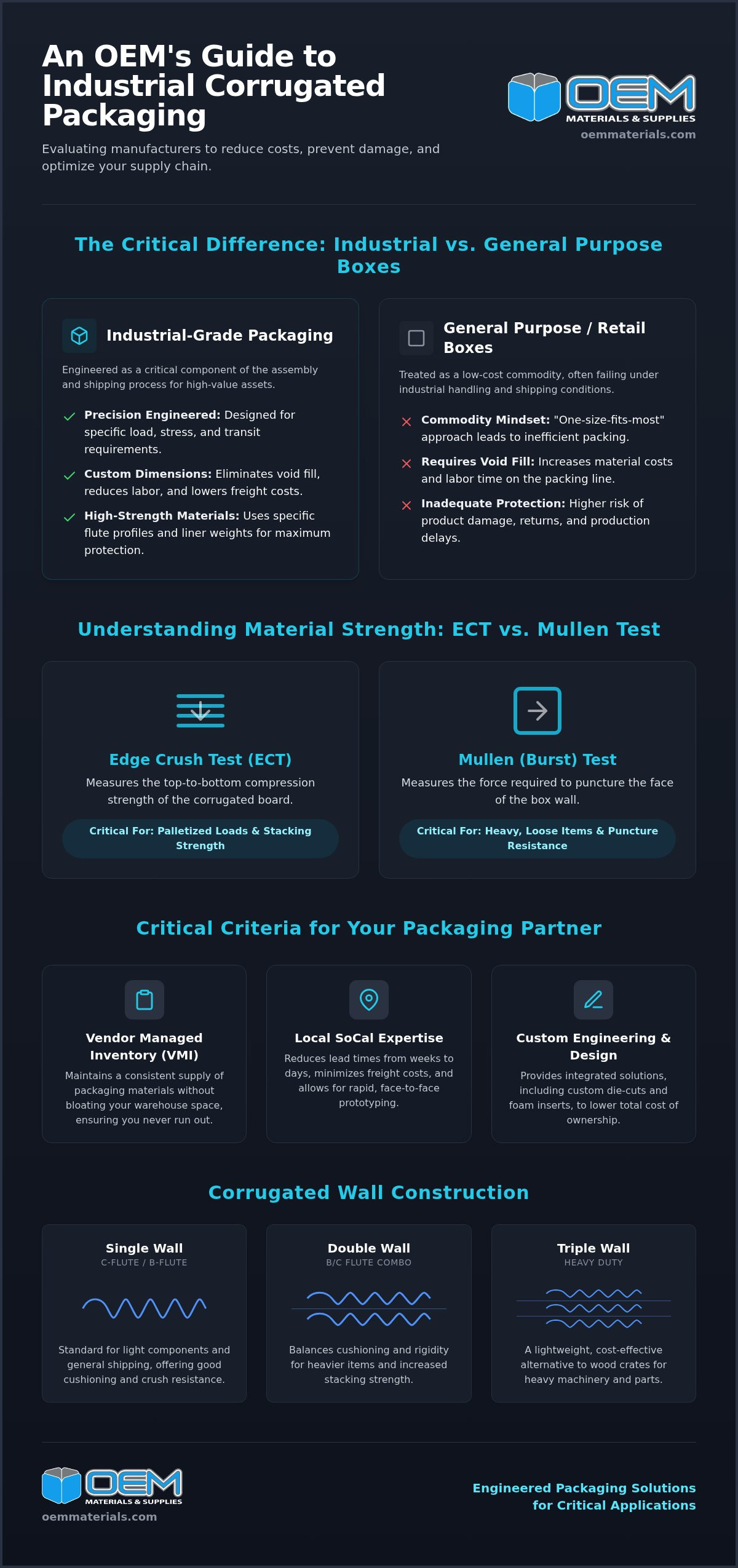
Most industrial corrugated packaging box manufacturers focus on two primary metrics: the Edge Crush Test (ECT) and the Mullen (Burst) Test. ECT measures top-to-bottom compression strength. This is the critical number for palletized loads where boxes are stacked several layers high. The Mullen Test measures the force needed to puncture the box wall. It’s more relevant for heavy, loose items that might shift and pierce the container from the inside. Choosing between them depends entirely on your shipping method and product weight.
Wall construction ranges from single-wall for light components to triple-wall for heavy machinery. Triple-wall corrugated often serves as a lightweight, cost-effective alternative to wood crates. Fluting profiles also play a role. C-flute is the industrial standard for general shipping, while B-flute provides a flatter surface for better printing and higher crush resistance. Combining different flutes in double-wall boxes allows for a balance of cushioning and structural rigidity.
ECT Ratings and Pallet Stacking Performance
Stacking strength isn’t a static number. Environmental factors in Southern California, such as coastal humidity in San Diego or Los Angeles, can significantly degrade corrugated integrity. Moisture softens the fibers, leading to pallet lean or total stack collapse. To combat this, procurement teams must account for safety factors when calculating ECT requirements. Using high-quality stretch film for pallet wrapping and edge protectors also helps distribute the load, but the box remains the primary foundation of the stack.
Material Selection for Specialized Industries
Niche industries require specialized material properties. For electronics, anti-static (ESD) coatings prevent electrostatic discharge from damaging sensitive circuit boards. Medical device manufacturers often require high-purity liners that meet strict cleanliness standards for sterile environments. Aerospace OEMs frequently utilize triple-wall corrugated to transport large, heavy components that require maximum puncture resistance. If you aren’t sure which material fits your application, consulting with corrugated packaging box manufacturers during the design phase can prevent costly over-engineering or catastrophic product damage.
Comparing Custom Manufacturing vs. Stock Box Suppliers
Procurement teams often fall into the trap of comparing unit prices without considering the total logistical cost. While stock boxes from catalog suppliers appear cheaper on a purchase order, they frequently carry hidden expenses that erode profit margins. Industrial corrugated packaging box manufacturers provide custom solutions that address these inefficiencies by aligning the packaging design with the specific requirements of the product and the shipping environment.
Labor efficiency is a primary driver of cost savings in high-volume manufacturing. Stock boxes often require extensive manual assembly and the addition of significant void fill to prevent product movement. In contrast, custom die-cut designs can be engineered for rapid assembly on the production line. This reduces the time spent at each packing station, allowing your team to move more units through the facility with less manual effort. For industries like medical device manufacturing or electronics, these labor savings often outweigh the slightly higher initial cost of a custom-engineered box.
Reducing Dimensional Weight and Shipping Costs
Carriers charge based on the amount of space a package occupies in the truck, not just its physical weight. This is known as dimensional weight (DIM). Using an oversized stock box means you’re paying to ship air. By partnering with corrugated packaging box manufacturers to create right-sized containers, OEMs can significantly reduce DIM weight surcharges. Some industrial clients report freight savings of 15% to 20% after optimizing their box dimensions; however, actual results depend on specific variables such as product dimensions, weight, and carrier contracts. Precise tolerances are also vital for automated packing lines where even a fraction of an inch of variance can cause equipment jams and production delays.
Integration with Protective Foam and Inserts
Fragile components require more than just a sturdy outer shell. The most effective industrial packaging combines corrugated strength with engineered foam inserts. Sourcing these components from a single partner ensures that the box and the foam work together as a unified system. This integrated approach simplifies the procurement process and guarantees that tolerances remain consistent across all components. During the prototyping phase, we can develop a complete packaging kit that includes the box, custom foam cushioning, and edge protectors. This holistic design process ensures that sensitive aerospace parts or medical instruments remain secure from the moment they leave the assembly line until they reach the end user.
Critical Evaluation Criteria for Your Packaging Supply Chain Partner
Reliability in an industrial supply chain is measured by more than just a delivery date. It requires technical proficiency and the ability to scale alongside your production volume. Top-tier corrugated packaging box manufacturers should offer comprehensive design and prototyping capabilities to ensure that every container meets the structural requirements of your specific product. For OEMs in the medical and aerospace sectors, verifying quality control standards and ISO compliance is non-negotiable. These certifications ensure that materials remain consistent and that the manufacturing process adheres to rigorous safety and performance guidelines.
Beyond the production line, maintaining the safety of the physical plant is equally critical. For manufacturers looking to ensure their facilities meet all regulatory standards, they can explore Property Compliance Surveys and Services to identify and mitigate potential environmental or structural risks.
A partner must be capable of supporting the entire product lifecycle. This starts with rapid prototyping to test designs against real-world shipping stresses and ends with high-volume production runs. The ability to pivot quickly between these stages without a drop in quality is a hallmark of a seasoned industry partner. If your current supplier cannot provide this level of integration, it’s often a sign that your packaging strategy is vulnerable to disruption. Working with local corrugated packaging box manufacturers allows for faster iterations and more responsive service when production demands shift unexpectedly.
Vendor Managed Inventory (VMI) and JIT Delivery
Industrial facilities in Southern California often face high real estate costs, making warehouse space a premium asset. Vendor Managed Inventory (VMI) programs address this challenge by shifting the burden of storage and tracking to the supplier. Instead of stocking months of packaging, your partner maintains the stock and delivers it on a Just-In-Time (JIT) basis. This approach eliminates warehouse clutter and reduces the overhead associated with inventory management. By using data-driven tracking, reorder points are automated, ensuring that you never face a production line stoppage due to a packaging shortage.
Kitting and Assembly Services
Efficiency on the assembly line is often hindered by the time spent gathering various packaging components. Integrated kitting and assembly services streamline these operations by providing pre-assembled kits that include the corrugated box, custom foam inserts, and edge protectors. This “one-box” solution allows your packing team to focus on the product rather than searching for individual SKUs in the warehouse. Kitting significantly reduces the number of SKUs procurement teams must manage, simplifying the ordering process and reducing the risk of missing components at the packing station. To optimize your assembly line flow, you should contact an experienced packaging partner to discuss a custom kitting strategy.
Southern California represents one of the densest manufacturing regions in the country. For OEMs operating in this area, the logistical distance between your facility and your corrugated packaging box manufacturers directly impacts your operational agility. Local proximity allows for rapid response times that national suppliers simply cannot match. Whether you need an emergency order to prevent a line stoppage or a quick design iteration for a new prototype, having a partner in the same region is a distinct competitive advantage.
OEM Materials & Supplies serves as a dedicated partner for manufacturers throughout Los Angeles, Orange County, and San Diego. Our process begins with a technical assessment of your product requirements and ends with a fully managed inventory program. This local presence ensures that we understand the specific shipping challenges of the region, from the humidity fluctuations of coastal San Diego to the high-volume throughput requirements of Inland Empire distribution centers. By keeping production and storage local, we minimize the lead times and freight costs associated with long-distance sourcing.
Serving the Industrial Hubs of SoCal
The requirements of the Irvine and Orange County medical corridors demand a high level of precision and material purity. We provide specialized corrugated solutions that meet the strict standards for medical device packaging, ensuring components remain secure and protected throughout the supply chain. In Los Angeles and San Diego, our focus shifts to the aerospace and defense sectors. These industries require heavy-duty corrugated materials, such as triple-wall constructions, to secure large and sensitive components during transit. For high-volume distribution centers in Riverside and the Inland Empire, we offer logistics support that prioritizes speed and structural integrity, utilizing stretch film for pallet wrapping and edge protectors to stabilize massive palletized loads.
The OEM Materials Advantage: Reliability and Expertise
We position ourselves as a seasoned industry partner rather than a simple commodity vendor. Our commitment to industrial-grade durability means that every box is engineered for the specific rigors of your supply chain. We take a solution-oriented approach to complex packaging challenges, integrating custom foam packaging and wood crates when standard corrugated isn’t enough. By managing the design, prototyping, and inventory phases in-house, we provide a seamless experience that allows your team to focus on production. If you are ready to optimize your packaging efficiency and reduce shipping damage, contact our engineering team for a custom corrugated consultation. We will review your product dimensions, weight, and annual usage to provide a tailored recommendation that supports your long-term growth.
Optimizing Your Industrial Packaging Strategy
Industrial packaging is a high-stakes component of your assembly line. Selecting the right partner among corrugated packaging box manufacturers requires a focus on technical durability and supply chain reliability. By prioritizing custom-engineered designs over stock sizes, you can eliminate shipping damage and reduce the hidden costs of wasted warehouse space. Our specialized VMI programs and custom engineering for the aerospace and medical sectors provide the precision required for complex manufacturing environments.
A reliable local partner ensures your production flow remains uninterrupted. With local delivery across Los Angeles, Orange County, and San Diego, we provide the rapid response times necessary for just-in-time manufacturing. Transitioning to a managed inventory model allows your team to focus on production while we handle the logistics of your corrugated boxes, foam packaging, and protective inserts. We’re ready to help you lower your total cost of ownership through smarter design and efficient inventory management.
Ready to improve your shipping efficiency? Request a Custom Industrial Packaging Quote Today. Please provide your product dimensions, weight, fragility, and annual usage so our engineering team can develop an accurate recommendation. We look forward to supporting your next production run with dependable, industrial-grade solutions.
Frequently Asked Questions
What is the difference between a box manufacturer and a packaging distributor?
A box manufacturer maintains direct control over the production equipment, allowing for precise customization of material grades and fluting profiles. Packaging distributors typically act as resellers of stock items, which limits your ability to engineer specific structural requirements. Working directly with corrugated packaging box manufacturers ensures that your packaging is built to your exact industrial specifications rather than being adapted from a pre-existing catalog.
How do I determine the correct ECT rating for my industrial product?
The correct Edge Crush Test (ECT) rating is determined by calculating the total weight of the stacked pallet and the height of the stack. You must account for the weight of the bottom box, which bears the entire load of the layers above it. Environmental factors such as humidity in Southern California coastal transit and the duration of storage also influence the required strength. We recommend using a higher safety factor for heavy aerospace or automotive components to prevent box failure.
Can a corrugated manufacturer also provide custom foam inserts?
Yes, integrated manufacturers like OEM Materials specialize in combining corrugated outer shells with engineered foam inserts. This approach ensures that the cushioning material and the box are designed as a single, cohesive protection system. Sourcing both components from one supplier eliminates tolerance issues and simplifies your procurement process. It’s especially beneficial for fragile medical devices or sensitive electronics that require precise positioning within the container.
What are the benefits of Vendor Managed Inventory (VMI) for packaging?
VMI programs reduce your total cost of ownership by eliminating the need for large on-site storage areas and reducing administrative overhead. Your supplier monitors stock levels and delivers packaging on a Just-In-Time basis, which frees up valuable warehouse space in high-cost regions like Orange County. This system prevents production delays caused by unexpected packaging shortages and automates the reordering process based on your actual usage data.
How long does the prototyping process take for a custom industrial box?
The timeframe for a custom prototype depends on the complexity of the design and the specific materials required. For most industrial applications in Southern California, physical samples can be produced quickly once the engineering specifications are finalized. This allows your team to test the structural integrity and fit before committing to a full production run. You should contact our team directly to verify current lead times for your specific project requirements.
Do you offer short-run manufacturing for specialized aerospace parts?
Yes, we support both short-run prototypes and high-volume production cycles to meet the needs of specialized sectors. Many aerospace and defense projects require small quantities of highly engineered packaging that general wholesale suppliers won’t produce. We maintain the flexibility to handle these niche requirements while ensuring the materials meet the rigorous durability standards necessary for high-value industrial assets.
What information do I need to provide for a custom packaging quote?
To receive an accurate recommendation, you should provide the physical dimensions, weight, and fragility of the product. It is also helpful to include your annual usage estimates and a description of the shipping environment, such as whether the items will be palletized or shipped individually. This data allows corrugated packaging box manufacturers to select the appropriate ECT rating, fluting profile, and linerboard weight for your specific application.
How does custom packaging reduce my total shipping costs?
Custom packaging reduces costs by optimizing the dimensional weight (DIM) of your shipments and minimizing the need for expensive void fill. Right-sized boxes ensure you aren’t paying carriers to ship empty space, which can lead to significant freight savings. Additionally, engineered designs reduce labor time on the assembly line and lower the financial impact of product damage and returns. Results always depend on variables like product dimensions and carrier contracts.