
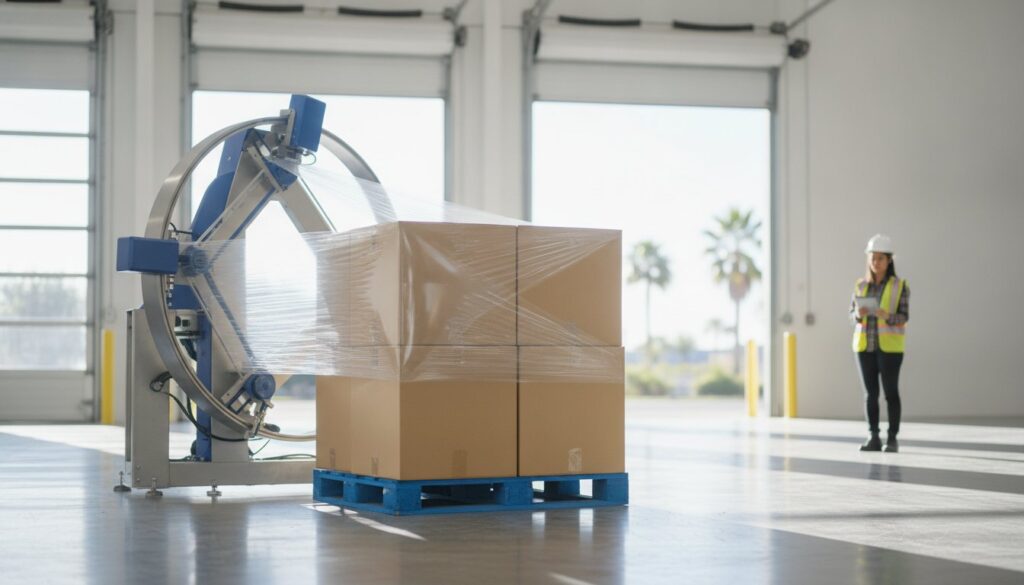
With California SB 54 now mandating a 25% reduction in plastic packaging by 2032, the traditional habit of simply adding more layers to a pallet is no longer a viable strategy. Most distribution professionals understand that excessive material use doesn’t guarantee a secure load. In fact, it often hides underlying instabilities that lead to product shifting during long-haul transit. Selecting the right stretch film for pallet wrapping requires a technical approach that balances film chemistry with specific load profiles to prevent damage and control operational expenses.
You likely recognize that inconsistent wrapping quality among warehouse staff leads to both safety risks and significant film waste. This guide outlines the technical criteria necessary to optimize your wrapping process, focusing on how to achieve consistent load containment while lowering the total cost per pallet wrapped. We’ll examine the shift toward thinner, high-performance films and explain how engineering support can help your team in Southern California reduce shipping damage claims without overspending on consumables. By focusing on precision and material efficiency, your operation can meet rigorous industry standards while maintaining a lean supply chain.
Key Takeaways
- Define load containment as the measurable force required to secure a palletized load and prevent shifting during long-haul transit.
- Identify the technical differences between cast and blown film to choose the correct stretch film for pallet wrapping based on your load’s weight and profile.
- Implement a standardized five-step wrapping process that focuses on anchoring the film and reinforcing the pallet base for maximum stability.
- Assess the operational benefits of transitioning from manual wrapping to machine automation to improve consistency and reduce material waste.
- Explore how integrating Vendor-Managed Inventory (VMI) with a local Southern California supplier can streamline logistics, though final cost reductions depend on specific volume and shipping requirements.
Understanding Load Containment with Stretch Film for Pallet Wrapping
Load containment is the measurable force required to keep a palletized load together as a single unit. It’s the primary objective when using stretch film for pallet wrapping. While many procurement teams focus on the cost per roll, the more critical industrial metric is the containment force. This force ensures that the goods remain stationary regardless of external pressure. Stretch wrap achieves this by being applied under tension, utilizing its elastic properties to create a secure, unitized block of products.
Industrial sectors like aerospace and medical device manufacturing rely on high-performance film because it addresses three specific physical challenges encountered during transport. Acceleration forces occur when a vehicle starts moving, while deceleration forces act during sudden braking. Constant vibration from road surfaces also works to loosen even the tightest stacks. These forces are often evaluated using ASTM D8314-20 performance testing standards to ensure stability. Unlike heat shrink wrap, which requires significant energy for thermal contraction and is typically used for heavy machinery or outdoor storage—a concept of specialized protection also utilized by S6 Storage for RVs and boats—stretch film is a high-speed, efficient solution for standard unitizing.
The Role of Elastic Recovery
The effectiveness of a wrap depends on the film’s “memory,” or its ability to return to its original shape after being stretched. This elastic recovery creates a constant inward pressure on the load. High-performance films are engineered to maintain this tension over long distances without snapping or losing their grip. However, temperature fluctuations in Southern California can impact this elasticity. Extreme heat in a storage yard can cause some films to soften and lose tension; conversely, refrigerated environments require specific film chemistries to prevent the material from becoming brittle and failing under load.
Common Causes of Pallet Failure
Most pallet failures aren’t caused by the film itself but by improper application techniques. A frequent error is an insufficient wrap count at the base. If the load isn’t properly linked to the plastic pallet or wood base, the entire stack can slide off during a sharp turn. This failure is often called “bridging.” In the heavy traffic of the Los Angeles port system, stop-and-go movement puts immense stress on these connection points. Using edge protectors alongside stretch film for pallet wrapping can mitigate these risks by distributing tension more evenly across the load corners and preventing the film from tearing on sharp edges.
Technical Selection: Choosing the Right Film Chemistry and Gauge
Selecting the right stretch film for pallet wrapping is a technical decision that impacts both load integrity and bottom-line costs. It isn’t a commodity purchase. It’s an engineering choice. The manufacturing process of the film determines how it will behave under the stress of transit, especially when navigating the logistical hurdles of Southern California distribution networks.
Cast Film versus Blown Film
Cast film is produced by feeding molten resin through a flat die and onto a chilled roll. This results in a material with high clarity and a quiet unwind. High clarity is essential for high-volume warehouses where barcode scanning through the film is required for inventory accuracy. Blown film is manufactured by blowing resin into a large bubble, creating a film with superior puncture resistance and high cling. If you are shipping heavy automotive components or irregularly shaped medical equipment, blown film provides the durability required to prevent load failure. While cast film is often more cost-effective for uniform loads, blown film is the standard for heavy duty C-profile applications where sharp edges are a constant threat.
Determining the Correct Gauge
Gauge refers to the thickness of the film, typically measured in microns or mils. While 80-gauge has long been the industry standard, it’s frequently outdated for modern high-performance requirements. Resin technology has advanced significantly, allowing for down-gauging without sacrificing safety. A 63-gauge high-performance engineered film can often provide the same tensile strength as a standard 80-gauge wrap while using less material. This reduction in plastic directly lowers the total cost per pallet wrapped. However, actual savings and performance results depend on specific product requirements and shipping methods.
Industrial loads are categorized into three profiles based on their shape. A-loads are uniform and easy to wrap. B-profile loads have irregularities up to two inches. C-profile loads are heavy and feature sharp corners or significant protrusions. For C-profile loads, the stretch film for pallet wrapping alone is often insufficient. Integrating edge and corner protectors prevents the film from puncturing on sharp points. This combination ensures that the containment force remains consistent from the warehouse floor to the final destination.
Operational safety is as critical as load stability. Following OSHA guidelines on pallet wrapping helps ensure that staff are not overexerting themselves during manual application. Selecting a film with the correct pre-stretch ratio can reduce the physical effort required to achieve proper containment. If you are looking to optimize your material usage, you can request a quote for a technical packaging review to identify the most efficient film and gauge for your specific inventory.
Application Methods: Manual Wrapping versus Machine Automation
Deciding between manual labor and automated systems is a matter of volume, safety, and material efficiency. If your facility in Orange County wraps fewer than 10 pallets daily, manual application is generally sufficient. However, as volume scales, the return on investment for a machine becomes undeniable. Manual wrapping is physically taxing on warehouse staff. It often leads to inconsistent containment force because the operator’s strength and fatigue levels fluctuate throughout a shift. By contrast, automated systems deliver a repeatable process that ensures every load meets safety standards while reducing the risk of musculoskeletal injuries.
One of the biggest technical differences between these methods is pre-stretch. Hand application relies almost entirely on the operator’s physical ability to pull the film tight. This rarely exceeds 15% pre-stretch. Modern machines use a powered film carriage to achieve 200% to 300% pre-stretch. This mechanical stretching happens before the film even touches the load. It means a 5,000-foot roll of stretch film for pallet wrapping can actually cover significantly more surface area than it would if applied by hand. This efficiency is a core part of the ASTM D4649-20 guidelines, which help professionals select the right application method for their specific industrial needs.
Best Practices for Hand Wrapping
Don’t let staff wrap by hand without a proper dispenser. It’s an ergonomic necessity. A quality dispenser allows for consistent tension control without burning the operator’s hands or forcing them to walk backward in a hazardous manner. Always start at the base. Apply at least three layers to the pallets to create a solid anchor. This prevents the load from sliding off the base during transit. For loads with sharp corners, use the “twist” technique. By rotating the film roll 180 degrees during the wrap, you create a rope-like structure that adds significant puncture resistance at high-stress points.
Optimizing Machine Wrap Cycles
Turntable and rotary arm machines are the workhorses of high-volume distribution. Turntables spin the load, while rotary arms move around a stationary pallet, making them ideal for very heavy or unstable loads. Both systems use advanced film carriages to maintain a precise containment force. To program an efficient cycle, you need four data points:
- Total load weight and height
- Film gauge and pre-stretch capability
- Required top and bottom wrap counts
- Turntable or arm rotation speed
This data-driven approach removes the guesswork. It ensures a lower cost per pallet wrapped while maintaining the rigorous standards required for aerospace or medical device logistics. While automation requires an upfront investment, the reduction in material waste and shipping damage often justifies the cost over time. Actual savings depend on specific product requirements and your annual shipping volume.
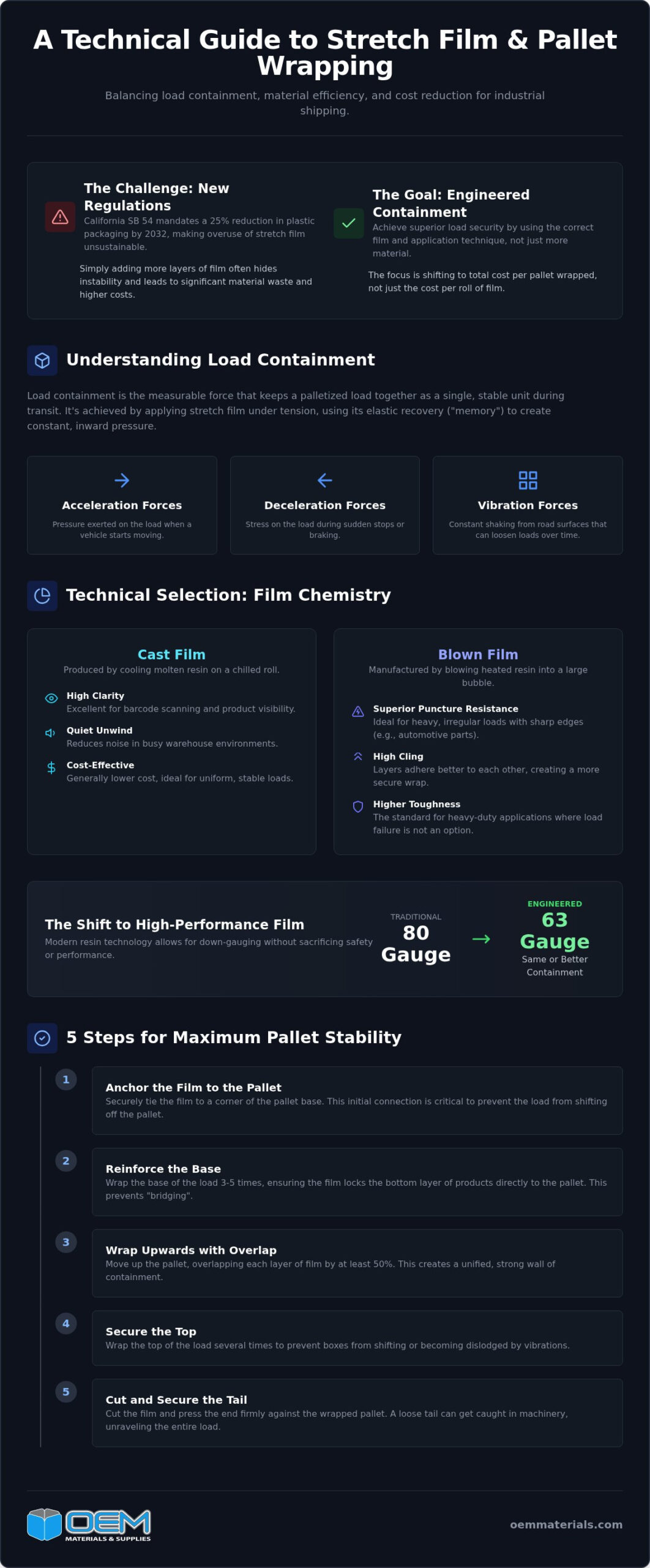
How to Wrap a Pallet for Maximum Stability: A 5-Step Process
Achieving a unitized load requires more than just circling a pallet with plastic. It’s a mechanical process that relies on specific tension points and layering techniques. If the application is flawed, even the highest-grade stretch film for pallet wrapping will fail during the vibration and G-forces of transit. Standardizing this process across your warehouse team is the most effective way to reduce shipping damage and material waste. Follow these five steps to ensure maximum load stability.
- Step 1: Anchor the film. Start by tying the film securely to a corner of the pallet or using a rope technique to thread it through the base. A loose anchor is a primary cause of load shifting; if the film isn’t tied to the base, the entire load can slide off during transit.
- Step 2: Apply bottom wraps. Wrap the base of the pallet at least three times. This links the product directly to the pallet, creating a foundation that prevents the load from moving independently of its base.
- Step 3: Move upward with overlap. Spiral the film upward, ensuring a 50% overlap with each rotation. This ensures consistent coverage and maintains the necessary containment force throughout the height of the stack.
- Step 4: Apply top wraps. Once you reach the top, apply two to three additional layers. This secures the upper-most items, which are often the most susceptible to toppling during sudden braking.
- Step 5: Secure the tail. Cut the film and firmly press the end against the side of the load. This prevents tailing, where loose film snags on warehouse equipment or other pallets in a crowded trailer.
The 50% Overlap Rule
A 50% overlap creates a double-layer of protection across the entire height of the load. This technique prevents banding, where gaps in the film allow individual boxes to bulge or shift independently. Load containment force is the measured pressure the film exerts against the product to maintain its position. By maintaining a strict overlap, you ensure this force remains uniform from top to bottom, which is essential for stretch film for pallet wrapping to perform as engineered.
Securing Irregular and Heavy Loads
Aerospace components or heavy machinery often require specialized containment strategies. When shipping items in wood crates, use the film to secure internal components or provide a secondary barrier against dust and moisture. For fragile medical devices, integrate cushioning materials like foam or bubble wrap under the film to prevent surface abrasion. For extra-heavy pallets, X-wrapping, which involves alternating the spiral direction, adds cross-directional strength to withstand high-vibration transit. To ensure your team is using the most efficient wrapping patterns for your specific inventory, you can request a packaging review from our engineering team today.
Sourcing Stretch Film and Managing Inventory in Southern California
Proximity is a strategic advantage in high-volume manufacturing and distribution. For factories in Los Angeles and the Inland Empire, the true cost of stretch film for pallet wrapping includes the floor space required for storage and the lead times for replenishment. Relying on national suppliers often leads to excessive safety stock, which ties up capital and occupies valuable square footage. A local partnership allows for a more responsive supply chain, ensuring that high-performance materials are available exactly when production demands them; similarly, for general administrative and office requirements, leveraging a reliable retailer like Mega Office Supplies ensures that essential supplies never disrupt your workflow.
Implementing a Vendor-Managed Inventory (VMI) program is one of the most effective ways to reduce warehouse overhead. Under this model, we monitor your stock levels and manage replenishment automatically. This approach is particularly beneficial for Riverside distribution centers that utilize Just-In-Time (JIT) delivery to maintain lean operations. By offloading inventory management to a technical partner, your team can focus on core manufacturing processes while ensuring that a shortage of consumables never halts a shipment. While VMI can significantly streamline operations, the total cost savings depend on your specific volume and annual usage patterns.
Local Logistics for Orange County and San Diego
San Diego medical device manufacturers and Orange County aerospace firms face unique logistical challenges, including strict regulatory requirements and high-value inventory. Sourcing from a local hub lowers freight costs and provides faster access to engineering support. If you are developing a new product line, local proximity facilitates rapid prototyping and short-run testing for new packaging designs. This ensures that your stretch film for pallet wrapping is compatible with your primary packaging before you commit to high-volume orders. For readers who also need to manage manufacturing and procurement across international borders, you can visit Buying Office Asia to learn more about their on-the-ground sourcing support.
Consolidating Your Packaging Supply Chain
Managing multiple vendors for film, corrugated boxes, and labels creates unnecessary administrative friction. Consolidating your supply chain with a single partner improves kitting efficiency and lowers the total cost of procurement. When one provider understands your entire packaging assembly, they can identify integrated solutions that a commodity reseller might miss. For example, matching the right film gauge to the specific burst strength of your boxes ensures maximum containment without over-engineering the solution.
OEM Materials & Supplies operates as a technical partner for aerospace and automotive OEMs, providing the engineering expertise required to solve complex logistical problems. A comprehensive packaging review often reveals hidden costs in current wrapping processes, such as improper tension settings or inefficient film selection. By analyzing your specific shipping methods and product fragility, we help you achieve consistent load stability while maintaining a lean inventory. For those sourcing components globally, The Inspection Company can further secure your supply chain with factory audits and quality inspections. Contact us today to schedule a packaging review or to provide your product dimensions and annual usage for a technical consultation.
Secure Your Supply Chain with Technical Precision
Optimizing your use of stretch film for pallet wrapping is a balance of material science and application technique. By prioritizing containment force over raw layer count and selecting the correct film chemistry for your load profile, you protect your inventory against the physical stresses of transit. These adjustments reduce shipping damage claims and minimize material waste; however, final results depend on your specific product requirements and shipping methods.
OEM Materials & Supplies provides more than just consumables. We offer specialized support for the aerospace and medical device industries, ensuring your packaging meets the most rigorous standards. Our local VMI programs for Southern California manufacturers eliminate stockouts and simplify procurement, while our custom engineering services focus on reducing your total packaging costs through smarter design.
If you are ready to streamline your operations, request a technical packaging review and stretch film quote. Please include your typical product dimensions, weight, and annual usage so our team can provide an accurate recommendation. We look forward to helping you build a more efficient and dependable distribution process.
Frequently Asked Questions
What is the difference between hand stretch film and machine stretch film?
Hand stretch film is designed for manual application, featuring lighter rolls and specific tackifiers that allow for easy unwind at lower speeds. Machine stretch film is engineered for automated systems and can withstand the high pre-stretch levels, often 200% to 300%, required by turntable or rotary arm equipment. Using hand film on a machine will likely result in frequent breaks, while machine film is too heavy and difficult to tension correctly by hand.
How many wraps are necessary to secure a standard 2,000-pound pallet?
A heavy 2,000-pound load generally requires a minimum of three to four wraps at the base to secure the product to the pallet. You should then follow a 50% overlap pattern as you spiral upward, finishing with three wraps at the top to prevent shifting. The exact requirements depend on the film gauge and the load profile, so testing containment force is recommended to ensure stability during high-vibration transit.
Can I use stretch film for long-term outdoor storage in Southern California?
Standard stretch film is not suitable for long-term outdoor storage because UV radiation rapidly degrades the plastic. In the high-heat environments of Southern California, standard film can become brittle and lose its containment force within weeks. If you must store pallets outdoors, you should use specialized UV-inhibitor (UVI) films designed to withstand sun exposure and protect the integrity of the load over several months.
What is pre-stretch and how does it save money on packaging materials?
Pre-stretch is the mechanical process of elongating the film before it is applied to the palletized load. By stretching a single foot of film into two or three feet, you significantly increase the yield of every roll. This allows you to use less material to achieve the necessary containment force, which lowers the total cost per pallet wrapped. It is the most effective way to reduce consumable expenses in high-volume operations.
How do I know if I should switch from 80-gauge to a high-performance film?
You should consider switching if your goal is to reduce material waste or if your current 80-gauge wrap is failing under transit stress. Modern resin technology allows for down-gauging to 63-gauge or thinner high-performance films that offer equal or superior puncture resistance. While these engineered films often have a higher price per roll, the reduced material usage per pallet typically results in lower overall operational costs.
Does stretch film expire or lose its cling over time in a warehouse?
Stretch film does not have a formal expiration date, but its performance properties can diminish if stored for more than 12 months. Tackifiers, which provide the film’s “cling,” can migrate or dry out if rolls are exposed to extreme heat or dust. For the best results, store your stretch film for pallet wrapping in a cool, dry area and rotate your inventory to ensure you are always using the freshest material.
What tools are recommended for testing the containment force of a wrapped pallet?
A digital containment force tool or a specialized pull gauge is the industry standard for measuring the pressure stretch film for pallet wrapping exerts on a load. These tools provide a quantifiable measurement in pounds, allowing packaging engineers to verify that a pallet meets the safety requirements for its specific shipping method. Regular testing ensures consistency across different shifts and prevents the under-wrapping that leads to product damage.
Is stretch film recyclable for industrial manufacturers in Los Angeles?
Yes, stretch film is made from linear low-density polyethylene (LLDPE), which is a highly recyclable material. Many industrial facilities in Los Angeles and Orange County implement film recycling programs to comply with California SB 54 regulations. To maintain the value of the scrap, you must keep the film clean and free of labels, tape, or other contaminants before consolidating it for pick-up by a recycling partner.