
Does your current packaging strategy actually protect your bottom line, or is it simply an accepted cost of doing business? In sectors like aerospace and medical device manufacturing, relying on generic cushioning often leads to high rates of transit damage and expensive product replacements. You understand that every damaged shipment represents more than just a loss of inventory; it signifies wasted labor and a compromised reputation with your clients. Utilizing precision-engineered foam inserts ensures that your components remain secure regardless of the shipping environment.
This guide provides the technical framework needed to select the right materials and design configurations for your specific industrial applications. You’ll learn how to evaluate foam density and cell structure to eliminate damage while optimizing your packing process through custom kitting. We will also examine how partnering with a local Southern California supplier for rapid prototyping can reduce lead times and improve overall supply chain reliability. By the end of this article, you will have the specifications required to transition from basic commodity packaging to a high-performance protective system.
Key Takeaways
- Compare the structural differences between polyethylene and polyurethane to select the optimal material for your product’s weight and sensitivity.
- Evaluate various fabrication methods like die-cutting to balance production speed with the complexity of your packaging design.
- Understand the rigorous packaging standards required for the aerospace and medical industries to ensure full compliance and protection.
- Learn how custom foam inserts integrate with kitting and vendor-managed inventory services to streamline your assembly line and reduce overhead.
- Explore how local prototyping in Southern California accelerates your design cycle and ensures a precise fit for every component.
Understanding the Role of Industrial Foam Inserts in Protection
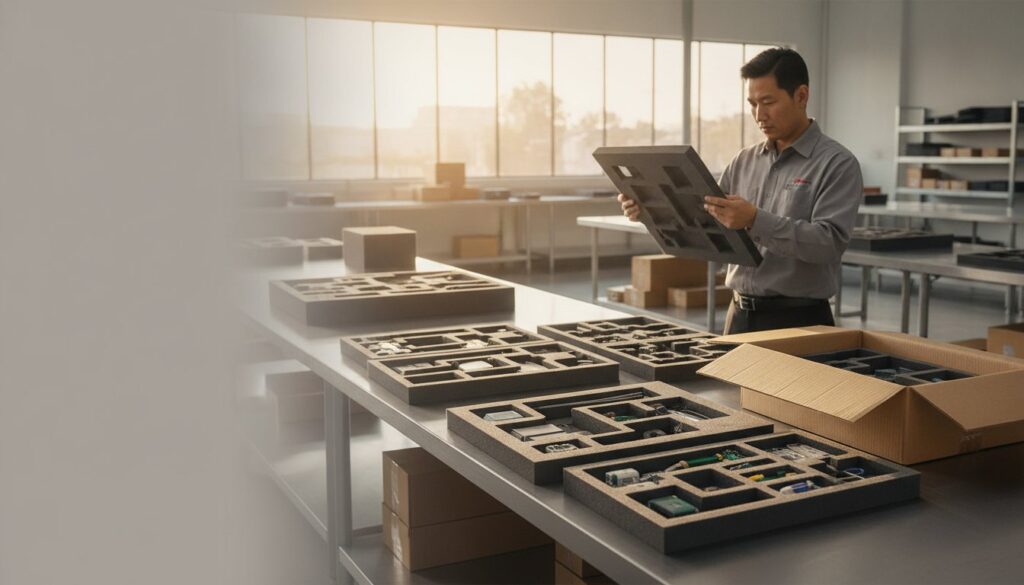
Foam inserts are precision-cut materials designed to immobilize and cushion products. Unlike loose-fill materials like packing peanuts or crumpled paper, these inserts provide repeatable and predictable protection tailored to specific product geometries. This consistency is vital for high-value sectors like aerospace and medical devices where even minor movement can result in critical failure. By utilizing custom-engineered foam inserts, manufacturers create a reliable defensive barrier that absorbs mechanical shock and mitigates the effects of transit vibration. Because the protection is integrated into the design, it eliminates the variability found with manual wrapping or manual void-fill methods.
Shock Absorption vs. Vibration Dampening
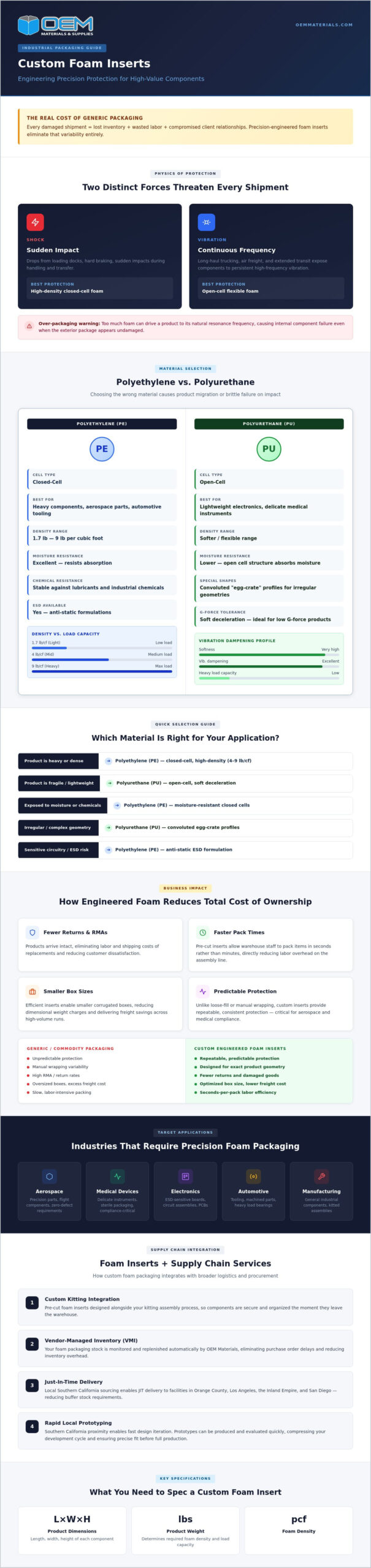
Protecting a shipment requires addressing two distinct physical forces: shock and vibration. Shock occurs during sudden impacts, such as a package being dropped from a loading dock or shifting during hard braking. Vibration is a constant force experienced during long-haul trucking or air freight. The foam’s cell structure determines how it dissipates this energy. High-density, closed-cell foams typically offer better shock protection for heavy items by resisting compression. Conversely, open-cell foams often excel at dampening high-frequency vibrations. It’s a common mistake to assume that more foam is always better. Over-packaging can actually cause a product to reach its natural resonance frequency; this leads to internal component failure even if the exterior of the package remains pristine.
The Impact of Foam on Total Cost of Ownership
The value of engineered foam extends far beyond the price per unit. High-performance cushioning materials directly reduce the total cost of ownership by lowering the frequency of returns and RMAs. When products arrive intact, you eliminate the labor and shipping costs associated with processing replacements and managing customer dissatisfaction. Additionally, custom inserts significantly streamline the assembly line. Pre-cut foam allows warehouse staff to pack items in seconds rather than minutes, which reduces labor overhead. Because these inserts are designed for maximum efficiency, they often allow for smaller corrugated boxes. This reduction in package volume minimizes dimensional weight charges, leading to substantial freight savings over high-volume production runs.
Comparing Core Materials: Polyethylene vs. Polyurethane
Selecting the correct polymer base is the most critical step in engineering effective foam inserts. The choice typically comes down to two primary categories: Polyethylene (PE) and Polyurethane (PU). Each material interacts differently with mechanical forces and environmental factors. While one offers structural rigidity for heavy loads, the other provides soft deceleration for fragile items. Choosing the wrong material can lead to product migration within the box or, worse, brittle failure during impact. For a technical deep dive into specific material data and performance metrics, we recommend reviewing our packaging foam comparison guide.
Polyethylene Foam for Heavy Duty Applications
Polyethylene is a closed-cell foam known for its high strength-to-weight ratio and exceptional durability. It’s the industry standard for heavy components, aerospace parts, and automotive tooling manufactured throughout Southern California. Because the cells are closed, PE resists moisture absorption and remains stable when exposed to chemicals or lubricants common in industrial environments. Engineers specify PE by density, typically measured in pounds per cubic foot (pcf). Common densities range from 1.7 lb to 9 lb, with higher densities providing greater load-bearing capacity for massive industrial parts. This material is also available in anti-static (ESD) formulations to protect sensitive circuitry from electrostatic discharge during transit.
Polyurethane Foam for Delicate Cushioning
Polyurethane is an open-cell foam that offers a much softer, more flexible feel than polyethylene. It’s ideally suited for lightweight electronics and delicate medical instruments that cannot withstand high G-forces. PU foam is highly versatile and can be fabricated into convoluted, or “egg-crate,” shapes to provide multi-point contact protection for irregular geometries. Within the PU category, you’ll encounter “charcoal” foam, which is popular for its professional appearance, and “ester” (polyester) variants. Polyester polyurethane is often preferred in high-end applications for its superior physical properties and resistance to certain hydrocarbons. Its soft nature allows it to cradle sensitive items without applying excessive surface pressure.
Selecting between these materials requires a precise understanding of your product’s fragility and the specific stresses of your supply chain. If you’re currently dealing with transit damage or are unsure which material type fits your application, you can speak with our engineering team to review your specific product dimensions and protective requirements.
Engineering and Fabrication Methods for Custom Inserts
Once you’ve selected the appropriate material, the focus shifts to the fabrication method. This decision is primarily driven by your anticipated production volume, the geometric complexity of the product, and the thickness of the material. Engineering foam inserts is a data-driven process that relies on cushioning curves. These curves provide a graphical representation of how a specific foam type and thickness will react under impact. By analyzing these curves against the fragile G-force rating of your component, engineers can determine the exact amount of foam needed to prevent internal damage. This precision prevents the common mistake of using too much material, which increases both shipping volume and freight costs. For a comprehensive overview of material selection and design strategies, our guide to custom foam packaging for engineered industrial protection provides an in-depth professional framework.
Die-Cutting for Scalable Production
Die-cutting remains the most efficient method for high-volume custom foam packaging. The process involves creating a steel rule die, a custom-made tool that precisely punches the desired shape from foam planks or rolls. It’s a high-speed fabrication technique that ensures every insert is identical, which is critical for automated assembly lines. While there is an upfront investment for the die itself, the significant reduction in per-unit labor and material costs makes it the preferred choice for large manufacturing runs. For businesses in Orange County or the Inland Empire looking to scale, die-cutting offers the best balance of speed and repeatability.
CNC Routing and Precision Prototyping
When production volumes are lower or the design requires complex 3D cavities, CNC routing and water-jet cutting provide a superior alternative. These methods use computer-controlled tools to carve or cut the foam directly from a digital CAD file. Because no physical tooling is required, setup times are minimal. This makes CNC fabrication ideal for precision prototyping. Aerospace and electronics firms in San Diego and Los Angeles frequently utilize this service to test multiple iterations of a design. Prototyping is a vital step in the engineering cycle; it allows you to verify that the foam inserts provide the necessary clearance and protection before you move to full-scale production. It’s a flexible solution that accommodates rapid design changes without the cost of new dies.
The choice of fabrication method also impacts your lead times. While die-cutting requires time for tool creation, CNC methods can often move from design to finished part in a matter of days. This agility is essential for manufacturers managing tight launch schedules or those who need to quickly adapt to component changes. By choosing the right fabrication partner, you can ensure your protective packaging evolves as fast as your product design.
Industry Specific Standards and Requirements
Standard packaging often fails in specialized industrial environments. While basic cushioning might prevent a break, it may not meet the rigorous regulatory or chemical compatibility standards required by specific sectors. In the aerospace industry, for example, foam inserts must withstand more than just physical impact; they are often exposed to harsh chemicals, lubricants, and extreme temperature fluctuations during transport. Using a material that degrades when exposed to hydraulic fluid can lead to catastrophic packaging failure and contaminated components. Engineering for these environments requires a deep understanding of polymer stability and long-term durability.
Medical and Life Science Packaging
Medical device manufacturers in Orange County and Los Angeles face unique challenges regarding cleanliness and surface protection. Surgical instruments often feature highly polished surfaces that are susceptible to microscopic abrasions. For these applications, we utilize non-abrasive, closed-cell foams that do not produce dust or lint. It’s also critical to ensure that materials do not outgas, as chemical vapors can compromise sterile environments or react with sensitive coatings. Many procurement teams also hold misconceptions about what constitutes adequate protection in a sterile field; understanding the specific requirements of medical grade foam packaging can help you avoid costly regulatory delays and instrument damage during transit. These precision inserts are frequently integrated into custom corrugated boxes to provide a complete secondary packaging solution that maintains organized presentation and product integrity from the cleanroom to the operating room.
Electronics and ESD Considerations
Electrostatic discharge is a silent killer in the electronics supply chain. A latent component failure caused by a static strike during transit might not be discovered until the product is in the end user’s hands. To prevent this, electronics packaging must prioritize ESD protection. Anti-static foam inserts, typically identified by their pink color, are treated with chemical additives that prevent the buildup of static charges on the foam’s surface. For comprehensive protection, these inserts are often used in conjunction with other cushioning materials and static shielding bags. This multi-layered approach ensures that delicate circuit boards are protected from both physical G-forces and electrical discharge.
Meeting these industry-specific requirements is not a matter of guesswork. It requires documented material performance and a partner who understands the compliance landscape of your specific field. If your product requires specialized ESD protection or cleanroom-compatible materials, contact our engineering team for a technical consultation. We can help you identify the specific foam grades that meet your industry standards while optimizing your overall packaging footprint.
Optimizing the Supply Chain with Custom Foam Solutions
Engineering high-performance foam inserts is only half the battle. To realize true operational efficiency, these components must be integrated into a broader supply chain strategy. Manufacturers often struggle with the bulky nature of foam, which consumes valuable floor space and complicates inventory management. By moving beyond a simple vendor-customer relationship and adopting a partnership model, you can transform your packaging from a storage headache into a streamlined workflow. This transition focuses on how the material moves through your facility rather than just how it performs in a box. Working with a qualified wholesale industrial packaging supplier who understands the regional logistics landscape of Southern California is essential to achieving this level of operational integration.
Kitting and Assembly Services
Packing stations are frequently the primary bottleneck in a manufacturing facility. Providing warehouse staff with loose foam inserts and flat corrugated boxes forces them to spend time on manual assembly rather than shipping. Our kitting services solve this by delivering pre-assembled packaging kits directly to your line. These kits arrive with the foam already seated in the box; this allows your team to simply drop the product in and seal it. This approach significantly reduces labor overhead for manufacturers in Orange County and Riverside. It also simplifies procurement by consolidating multiple line items into a single, easy-to-track SKU.
Inventory Management and Logistics
High-growth manufacturers in the Inland Empire and San Diego County often face the challenge of balancing inventory levels with available warehouse space. Implementing packaging VMI (Vendor-Managed Inventory) ensures that critical protective components are always in stock without tying up your internal resources. We monitor your usage levels and replenish stock automatically. This eliminates the risk of line shutdowns due to packaging shortages and allows your team to focus on production rather than reordering supplies.
Utilizing JIT packaging services allows you to optimize cash flow by receiving materials exactly when they are needed. Because we are a local Southern California supplier, we provide rapid response times that nationwide distributors cannot match. Maintaining a local supply chain improves your overall resilience against global logistics disruptions. It also reduces the freight costs associated with transporting large volumes of foam planks across the country. By aligning your foam design with a robust delivery schedule, you ensure that your protection is as efficient as the product it contains.
Advancing Your Industrial Packaging Strategy
Protecting high-value components requires a shift from generic cushioning to engineered solutions. By selecting the optimal material density for your foam inserts and utilizing precise fabrication methods like die-cutting, you can eliminate transit damage while reducing total shipping volume. Integrating these custom components into a broader kitting or VMI program further optimizes your facility’s workflow by reducing labor overhead and floor space requirements.
OEM Materials & Supplies provides expert design and engineering for the aerospace, medical, and electronics sectors. We offer dedicated local service throughout Southern California alongside nationwide shipping capabilities to support your growing operations. Our team is ready to help you implement full-service kitting and assembly programs that lower your total cost of ownership. Contact OEM Materials & Supplies today for a custom foam packaging consultation. We look forward to helping you secure your supply chain and improve your operational efficiency.
Frequently Asked Questions
What is the difference between open-cell and closed-cell foam inserts?
The primary difference lies in the cell structure; closed-cell foam features sealed cells that resist moisture, while open-cell foam has interconnected pores that allow air to pass through. Closed-cell polyethylene provides superior structural support and chemical resistance for heavy industrial parts. Open-cell polyurethane is the standard choice for lightweight, fragile instruments that require soft deceleration and maximum flexibility during transit.
How do I determine the correct foam density for my product weight?
Determining density requires matching the product weight to the foam’s load-bearing capacity. You must analyze cushioning curves to ensure the foam doesn’t bottom out or provide too much resistance. High-density foam inserts are required for heavy automotive or aerospace parts. Lighter densities work best. They are ideal for delicate electronics with a lower G-force tolerance.
Can custom foam inserts be reused for multiple shipments?
Closed-cell foam inserts are highly reusable because they return to their original shape after multiple impacts without permanent compression. This durability makes them ideal for internal manufacturing loops or returnable shipping programs between facilities. While open-cell foam can be reused, it is more susceptible to tearing over time. Choosing high-density polyethylene will maximize the lifespan of your packaging if your supply chain involves frequent round-trip shipments.
Is anti-static foam necessary for all electronic components?
Anti-static foam is necessary for any component susceptible to damage from electrostatic discharge, including circuit boards, sensors, and microprocessors. Standard foams can generate static through friction. This leads to latent component failure that might not be discovered until the product reaches the end user. Electronics manufacturers in Southern California use anti-static versions to ensure long-term device reliability and prevent expensive RMAs.
What information is needed to get a quote for a custom foam insert?
To provide an accurate quote, we require the physical dimensions, weight, and fragility of your product. Providing a CAD file or a physical sample allows our engineering team to design a precise fit that minimizes material waste. You should also specify your estimated annual usage and any environmental factors like chemical exposure. This data ensures we recommend the most cost-effective material and fabrication method for your specific production volume.
Are there eco-friendly or recyclable foam insert options available?
Recyclable options like polyethylene are widely available and can be processed in many industrial recycling programs throughout Southern California. Some manufacturers also opt for bio-based or partially recycled content foams to meet corporate sustainability goals. It’s important to verify that the chosen material still meets the protective requirements of your specific component. We can help you evaluate materials that balance environmental responsibility with high-performance protection.
How long does the prototyping process take for a custom foam design?
The prototyping process for a custom design typically takes between three to five business days once the initial CAD design is finalized. Utilizing CNC routing or water-jet cutting allows us to create precise samples without expensive tooling. This speed is essential. Firms in Los Angeles and Orange County often need to validate designs quickly to meet tight launch schedules or rapid production changes.
Can foam inserts be integrated directly into corrugated shipping boxes?
Foam components are frequently integrated directly into corrugated shipping boxes to create pre-assembled packaging kits. This integration eliminates the need for your warehouse staff to manually assemble multiple packaging layers, which significantly reduces labor costs. By receiving boxes with the inserts already installed, your team can move products through the packing station much faster. This approach is a standard solution for optimizing high-volume industrial assembly lines. Manufacturers evaluating this approach should also consider the broader criteria for selecting a wholesale industrial packaging supplier in Southern California to ensure technical compliance, logistics efficiency, and total cost of ownership are all addressed.