
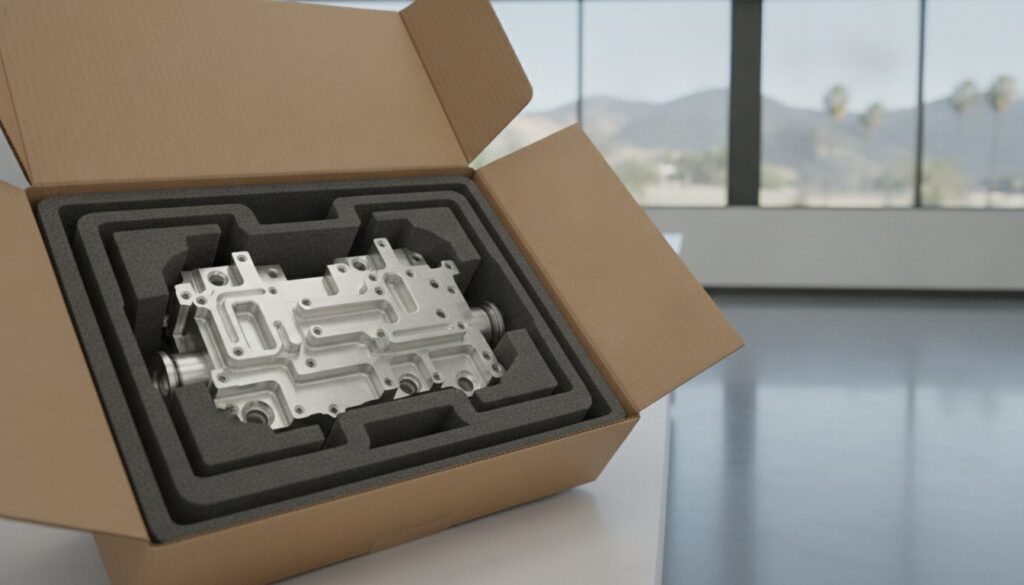
Industrial packaging is often treated as a commodity, but for high-value components, it is a critical engineering requirement. A single damaged shipment does more than just hurt your bottom line; it disrupts production schedules and strains customer relationships. You likely recognize that off-the-shelf solutions rarely provide the precision needed for complex aerospace or medical assemblies. Inefficient packing processes and frequent transit damage suggest your current protection isn’t meeting the rigorous demands of your supply chain.
Implementing engineered custom foam packaging is the most effective way to eliminate these vulnerabilities and reduce your total cost of ownership. This guide provides a professional framework for selecting the right materials and design strategies to protect your inventory. We will examine the technical differences between polyethylene, polyurethane, and crosslinked foams, the benefits of integrated kitting services, and how a local Southern California partner can support your operations through vendor-managed inventory and just-in-time delivery. By the end, you will understand how to transform your packaging from a necessary expense into a strategic operational advantage that streamlines your assembly line and secures your product through every stage of transit.
Key Takeaways
- Understand why engineered inserts offer more reliable protection against shock and vibration than generic cushioning.
- Differentiate between polyethylene and polyurethane foam to select the correct material based on product weight and fragility.
- Learn how technical design and CAD modeling ensure custom foam packaging fits complex industrial components with precision.
- Identify specialized applications for aerospace and medical sectors, including high-density and cleanroom-compatible foam options.
- Optimize logistics costs for Southern California facilities by implementing vendor-managed inventory and just-in-time delivery programs.
What is Custom Foam Packaging and Why Do Industrial OEMs Need It?
Custom foam packaging refers to engineered inserts designed to match the exact geometry and fragility of a specific industrial component. It’s a technical solution for protecting high-value assets during transit, storage, and assembly. Unlike generic cushioning materials that merely fill empty space, these inserts are engineered to mitigate specific physical threats like multi-axis shock, high-frequency vibration, and surface abrasion. For an Original Equipment Manufacturer (OEM), the packaging is as much a part of the product’s success as the internal circuitry or mechanical housing.
For manufacturers in Southern California, particularly those serving the aerospace, medical device, and electronics sectors in Orange County and Los Angeles, precision is a requirement. Shipping a sensitive medical instrument or a mission-critical aerospace part requires protection that is both repeatable and reliable. Custom foam packaging ensures that every unit leaves the facility with the same level of security. This consistency eliminates the variability inherent in manual packing methods and significantly reduces the risk of costly shipping damage.
The Difference Between Stock and Custom Engineered Foam
Relying on stock foam sheets or “pick and pluck” variants requires your warehouse team to manually cut and fit material for every shipment. This process creates inconsistent protection levels and drives up labor overhead. Engineered foam inserts are different. They are precision-cut using CNC routing, die-cutting, or water-jet technology based on professional custom packaging design. These inserts eliminate movement within the outer corrugated boxes by creating a form-fitting cavity for the part. Many industrial designs incorporate multiple foam densities to protect different parts of a single product.
Total Cost of Ownership in Industrial Packaging
Procurement managers often focus on the unit price of a foam insert, but the material cost is only a fraction of the actual expense. A true assessment considers the total cost of ownership, which includes labor hours, damage claim rates, and logistical efficiency. Custom inserts often allow for a smaller overall footprint. This optimization can lead to significant savings by reducing dimensional weight shipping charges. Custom foam reduces the total cost of ownership by minimizing the overall footprint of the secondary packaging while simultaneously accelerating the assembly line kitting process. Integrating these custom solutions with packaging VMI programs helps facilities in San Diego and Riverside maintain leaner inventory levels without risking stockouts of critical materials.
Selecting the Right Foam Material: Polyethylene vs. Polyurethane
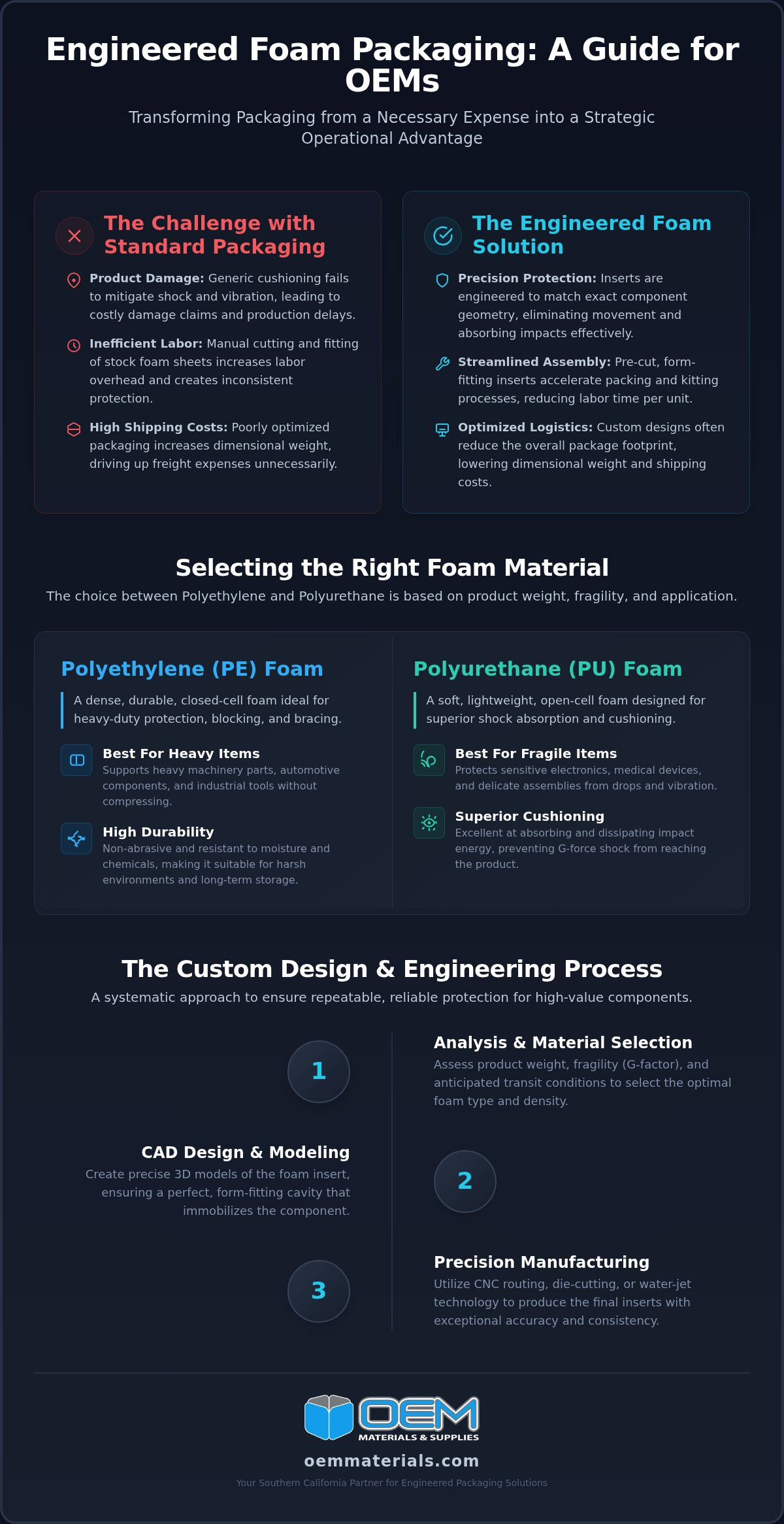
Choosing the correct material for custom foam packaging is a decision rooted in physics. The selection process requires an understanding of a product’s fragility rating, often called the G-factor, and the anticipated drop height it will encounter during transit. If the foam is too rigid, shock transfers directly to the component. If it’s too soft, the product will bottom out against the outer container. Balancing these variables ensures optimal deceleration and protection for high-value industrial goods.
Industrial applications typically rely on three primary foam categories: polyethylene, polyurethane, and crosslinked polyethylene. Each material offers distinct performance characteristics regarding cell structure, density, and chemical resistance. For a technical deep dive into material specifications, our packaging foam comparison provides data on load-bearing capacities and recovery rates to match the foam to the specific logistical environment.
When to Choose Polyethylene for Heavy Duty Protection
Polyethylene (PE) is a closed-cell foam characterized by its high strength and durability. It’s the standard choice for heavy machinery parts, automotive components, and industrial tools that require significant support. Because PE is non-abrasive and resistant to moisture and chemicals, it performs exceptionally well in harsh warehouse environments or long-term sea freight. Its primary function is blocking and bracing. It prevents heavy loads from shifting within wood crates or corrugated boxes. For high-volume production, PE is often die-cut into precise shapes to create repeatable, rugged protection. When scaling up to high-volume orders, understanding the procurement strategies for bulk foam packaging inserts for manufacturing can help you reduce unit costs while maintaining the consistency your production line demands.
Polyurethane and Anti-Static Foam for Electronics
Polyurethane (PU) foam is an open-cell, softer material designed for lightweight or highly fragile items. It provides excellent cushioning by allowing for gentle deceleration during impact. This makes it the preferred choice for delicate instrumentation and electronics. In industrial settings, PU is often treated with anti-static additives to protect sensitive circuit boards from electrostatic discharge (ESD). You’ll typically see this as pink anti-static foam, which indicates a temporary chemical treatment, or charcoal ESD foam for more permanent protection. Selecting the right ESD foam ensures that your custom foam packaging protects not just the physical exterior, but the sensitive internal circuitry as well.
For medical device manufacturers in the Orange County and San Diego medical corridors, Crosslinked Polyethylene (XLPE) is often the superior option. It features an extremely fine-cell structure that is aesthetically pleasing and highly resistant to debris shedding. This makes XLPE ideal for cleanroom environments where particulate contamination must be avoided. Many procurement teams hold misconceptions about what qualifies as medical grade foam packaging and whether standard industrial materials meet the biocompatibility and cleanliness standards required for sterile applications. If you’re unsure which density or material fits your specific application, you can request a prototype or technical consultation to verify performance before moving to high-volume production.
The Custom Design and Engineering Process
Moving from a raw component to a finished custom foam packaging solution requires a methodical engineering approach. The process begins with a technical assessment. Engineers evaluate the physical dimensions, weight distribution, and fragility of the product. This stage identifies sensitive protrusions or surface finishes that require specific clearance or non-abrasive contact points. By establishing these parameters early, the design team can calculate the exact foam volume and density needed to meet the G-factor requirements discussed previously.
Once the technical requirements are established, the project moves into CAD design and 3D modeling. This digital environment allows for high-precision mapping of the foam insert to the product geometry. It ensures that the final assembly accounts for every connector, handle, or delicate sensor. This precision is what separates engineered protection from generic cushioning. It eliminates the guesswork on the assembly line and ensures every part is secured exactly as intended.
Prototyping and Drop Testing
Rapid prototyping is the bridge between digital design and physical reality. Physical samples allow your operations team to verify the snugness of the fit and the ease of insertion for warehouse staff. If a part is difficult to pack, labor costs increase and the risk of improper assembly rises. Prototyping is the most critical stage for preventing costly design errors in high-volume runs. These samples are often placed inside custom corrugated boxes for drop testing. This testing simulates real-world shipping conditions to ensure the foam absorbs impact effectively and prevents the product from bottoming out.
Die-Cutting vs. CNC Routing for Custom Inserts
The transition to production involves selecting the right fabrication method. Die-cutting is highly efficient for high-volume orders with consistent shapes. It uses a custom steel-rule die to stamp out foam shapes quickly. It’s the most cost-effective option for large runs despite the initial tooling expense. CNC routing offers extreme precision for complex, multi-layered inserts without the need for custom tooling. This method is ideal for prototypes or lower-volume runs where geometry is intricate. The choice between these methods impacts lead times and initial setup costs. CNC routing typically offers faster turnaround for initial batches, while die-cutting provides the lowest unit cost for sustained production. By selecting the right fabrication process, you ensure that your custom foam packaging remains both precise and economically viable.
Comparing Custom Foam Applications by Industry
Industry standards are not universal. The custom foam packaging requirements for a medical device manufacturer in San Diego differ significantly from those of an aerospace contractor in Los Angeles. While the fundamental goal remains protection, the specific regulatory and environmental stressors of each sector dictate the engineering approach. In Southern California, where high-tech manufacturing is concentrated, matching the foam material to the industry standard is essential for both operational compliance and product integrity.
Electronics OEMs in Orange County and the Inland Empire face specific challenges related to electrostatic discharge. Sensitive circuit boards and diagnostic sensors can suffer internal component failure from static charges that are invisible to the naked eye. For these applications, ESD-safe foam is a non-negotiable requirement. Similarly, automotive suppliers often prioritize durability and recyclability. They frequently utilize reusable foam dunnage for internal plant transport. These custom inserts are designed for high-frequency use, allowing parts to move between Tier 1 suppliers and assembly lines with minimal material waste.
Medical Device and Cleanroom Packaging Standards
Medical device manufacturers require foam that meets strict cleanliness and biocompatibility standards. Standard foams can shed particulates or “dust,” which is unacceptable in sterile environments or during surgical kit assembly. Crosslinked Polyethylene (XLPE) is the preferred material in this sector due to its extremely fine cell structure and chemical inertness. It is non-dusting and resistant to microbial growth, ensuring that the packaging doesn’t compromise the device’s sterility. Understanding the common misconceptions around medical grade foam packaging requirements can help your team avoid costly regulatory delays and select materials that align with ISO 13485:2016 and FDA standards. If you’re developing kits for diagnostic equipment or surgical tools, incorporating the right sterile packaging for medical devices ensures your product arrives ready for clinical use without contamination risk.
Aerospace and Defense Logistics
Aerospace and defense components are often oversized, heavy, and exceptionally high-value. These parts require high-density PE foam to provide the necessary blocking and bracing during long-distance transit. Many aerospace applications must also meet specific military or federal specifications (Mil-Spec) regarding flame retardancy and density consistency. For international shipments, these custom foam inserts are frequently integrated into heavy-duty wood crates. This combination provides a rugged, weather-resistant exterior with a precision-engineered interior that secures the part against multi-axis shocks and high-frequency vibration during air or sea freight.
Every industry has a unique set of variables that influence packaging performance. If you’re dealing with strict regulatory requirements or high-value shipments, it’s vital to work with a partner who understands these technical nuances. You can request a quote for industry-specific packaging solutions to see how an engineered approach can stabilize your supply chain and reduce damage claims.
Optimizing Your SoCal Supply Chain with VMI and JIT Delivery
Custom foam packaging is notoriously bulky. Storing high volumes of precision-engineered inserts on-site consumes valuable floor space that could otherwise be used for manufacturing or finished goods. For facilities in Los Angeles, Riverside, or Orange County, where industrial real estate is at a premium, managing large inventories of packaging materials is an operational burden. Transitioning to a managed supply chain model allows you to reclaim that space while ensuring your production lines never stall due to material shortages.
Local Southern California suppliers provide faster response times for design changes and urgent production spikes. When your engineering team modifies a part, a local partner can prototype and deliver updated foam inserts in a fraction of the time required by distant vendors. This proximity is the foundation of a reliable Just-In-Time (JIT) delivery system. It ensures that foam inserts and boxes arrive at your facility exactly when they are needed for the assembly process, rather than sitting in a warehouse for weeks. This logistical precision is critical for maintaining lean operations in competitive sectors like aerospace and medical device manufacturing.
The Benefits of Vendor-Managed Inventory (VMI)
A local packaging VMI program shifts the responsibility of stock management to the supplier. Instead of manual counts and reactive ordering, automated replenishment is used based on your actual usage data. This approach eliminates the risk of stockouts while reducing the capital tied up in slow-moving inventory. Purchasing managers can focus on strategic procurement while we ensure that the specific foam densities and profiles required for your production line are always available. It’s a method that prioritizes operational stability over simple transaction-based purchasing, providing a buffer against supply chain volatility. For a comprehensive framework on aligning procurement strategy with production demands, our guide to bulk foam packaging inserts for manufacturing outlines how to structure high-volume orders to minimize overhead and maximize throughput.
Reducing Labor Through Pre-Assembled Packaging Kits
Labor costs often represent a larger portion of the packaging budget than the materials themselves. Integrating foam with kitting and assembly services allows your team to focus on high-value manufacturing tasks rather than folding boxes and fitting inserts. Shipping custom foam packaging pre-inserted into corrugated boxes saves significant time per unit on the packing line. These pre-assembled kits arrive via JIT delivery, synchronized with your production schedule. This logistical coordination ensures that protection arrives only when it is needed, further streamlining the workflow in your Riverside or San Diego facility. If you are ready to evaluate a managed solution, please contact us for a tailored kitting proposal by providing your annual usage, product weight, and dimensions.
Secure Your Supply Chain with Engineered Protection
Transitioning from generic cushioning to engineered custom foam packaging ensures repeatable protection for high-value industrial components. By selecting the correct material density and utilizing technical CAD design, you reduce transit damage and minimize the labor required on the packing line. Our local Southern California support in Los Angeles, Orange County, and San Diego provides the fast response times necessary for rapid prototyping and high-volume production cycles.
Integrating these custom solutions with our VMI and JIT delivery options further optimizes your operations by reclaiming warehouse space and simplifying procurement. Our expert design and engineering team understands the rigorous standards of the aerospace, medical, and electronics sectors. We’re ready to help you transform your packaging from a logistical hurdle into a strategic asset that protects your bottom line. Results in cost savings and damage reduction depend on your specific product dimensions, materials, and shipping requirements.
Request a Custom Foam Packaging Quote and Prototype today to receive a technical recommendation. Please include your product dimensions, weight, and annual usage to ensure an accurate and professional proposal. We look forward to partnering with you to streamline your industrial packaging process.
Frequently Asked Questions
What is the most cost-effective foam for high-volume custom packaging?
Polyethylene (PE) foam is generally the most cost-effective material for high-volume orders due to its durability and compatibility with high-speed die-cutting. This fabrication method allows for rapid production cycles and a low unit cost once the initial tooling is established. While polyurethane is suitable for lighter items, the structural integrity of PE makes it the standard for most industrial manufacturing applications.
Can custom foam inserts be reused for internal plant logistics?
Yes, custom foam inserts are frequently designed as reusable dunnage for internal plant logistics and closed-loop supply chains. High-density polyethylene and crosslinked polyethylene are particularly effective for this purpose because they resist moisture, oils, and common industrial chemicals. Utilizing reusable foam helps Southern California manufacturers reduce material waste and lower their long-term packaging spend within local production loops.
Is anti-static foam required for all electronic component shipping?
Anti-static foam isn’t required for every electronic part, but it’s essential for any component sensitive to electrostatic discharge (ESD). Sensitive items like circuit boards, microprocessors, and sensors should always be protected with pink or charcoal ESD-safe foam to prevent latent damage. For non-sensitive hardware or metal housings, standard custom foam packaging materials may be used without the risk of electrical failure.
How long does the prototyping process take for a custom foam insert?
The prototyping process typically takes between three to seven business days depending on the complexity of the design. Simple inserts can often be sampled quickly using CNC routing, while intricate, multi-material assemblies may require additional engineering time. Rapid prototyping is a critical step that allows your team to verify the fit and protection levels before moving into high-volume production.
Which foam material is best for protecting class A painted surfaces?
Crosslinked Polyethylene (XLPE) is the superior material for protecting class A painted surfaces and high-gloss finishes. Its extremely fine, closed-cell structure is non-abrasive, which prevents the surface scratching or “rub marks” often caused by coarser foams. XLPE is also non-dusting and chemically inert, making it the preferred choice for automotive and medical OEMs with strict surface integrity requirements.
What information is needed to get an accurate quote for custom foam?
To provide an accurate quote, we require the product’s physical dimensions, weight, and fragility rating. It’s also helpful to provide your estimated annual usage and details about the shipping environment, such as whether the product will be palletized or sent via small parcel. Sharing a CAD file or a physical sample of the part ensures our engineering team can design the most precise and cost-effective solution.
Do you provide custom foam packaging services in Orange County and San Diego?
Yes, we provide full-service support to manufacturers throughout Orange County, San Diego County, and the Inland Empire. Our local presence allows for on-site consultations and rapid delivery of prototypes to facilities in cities like Irvine, Carlsbad, and Riverside. This local support is essential for companies utilizing our vendor-managed inventory (VMI) and just-in-time (JIT) delivery programs to streamline their operations.
How does foam density affect the protection of heavy industrial parts?
Foam density determines the load-bearing capacity of the insert; heavier parts require higher density foam to prevent the product from bottoming out during an impact. If the density is too low, the foam will compress completely upon impact, transferring the shock directly to the part. Correctly engineered custom foam packaging balances density with the product’s weight to ensure the foam decelerates the item safely without failing.