
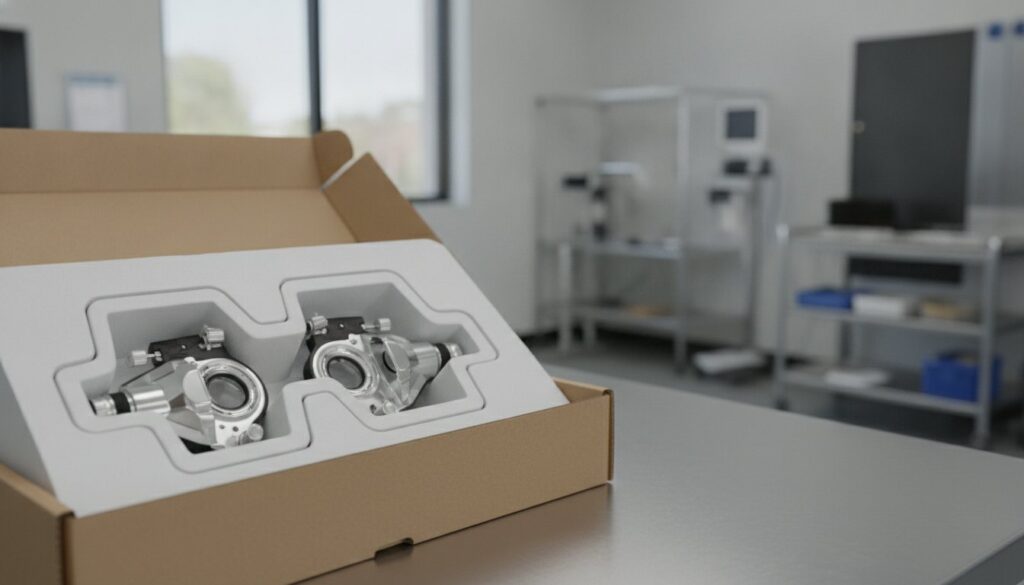
Does your current packaging strategy distinguish between standard industrial protection and the rigorous requirements of a sterile field? Many procurement teams assume that any high-density foam provides sufficient protection for sensitive devices, but this misconception often leads to high rates of instrument damage during transit. Utilizing the wrong medical grade foam packaging can result in more than just physical breakage; it can lead to regulatory delays and increased labor costs for complex kitting processes.
You know that navigating FDA master files and biocompatibility ratings is a complex task, particularly as the FDA aligns more closely with ISO 13485:2016 standards. This article identifies the specific misconceptions currently costing your medical device supply chain and explains how engineered foam inserts protect both your sensitive products and your bottom line. We will analyze five common industrial myths to help you achieve zero-damage transit for sensitive medical optics while standardizing cleanroom-compatible packaging for your Southern California operations. Understanding these nuances allows you to lower total landed costs through better engineering and more efficient material selection.
Key Takeaways
- Understand why fixed material formulations and documented biocompatibility are essential for medical grade foam packaging to prevent outgassing and particulate shedding in cleanroom environments.
- Learn why foam density and cell structure provide superior instrument protection compared to raw thickness, preventing sensitive devices from bottoming out during heavy impacts.
- Discover how custom die-cut inserts reduce total landed costs by replacing labor-intensive manual wrapping with high-speed, repeatable packing processes.
- Identify the critical difference between shock absorption and vibration dampening to ensure sensitive medical optics remain calibrated throughout the supply chain.
- Transition from commodity purchasing to a strategic ROI model that accounts for damage rates, returns, and assembly efficiency in your Southern California facility.
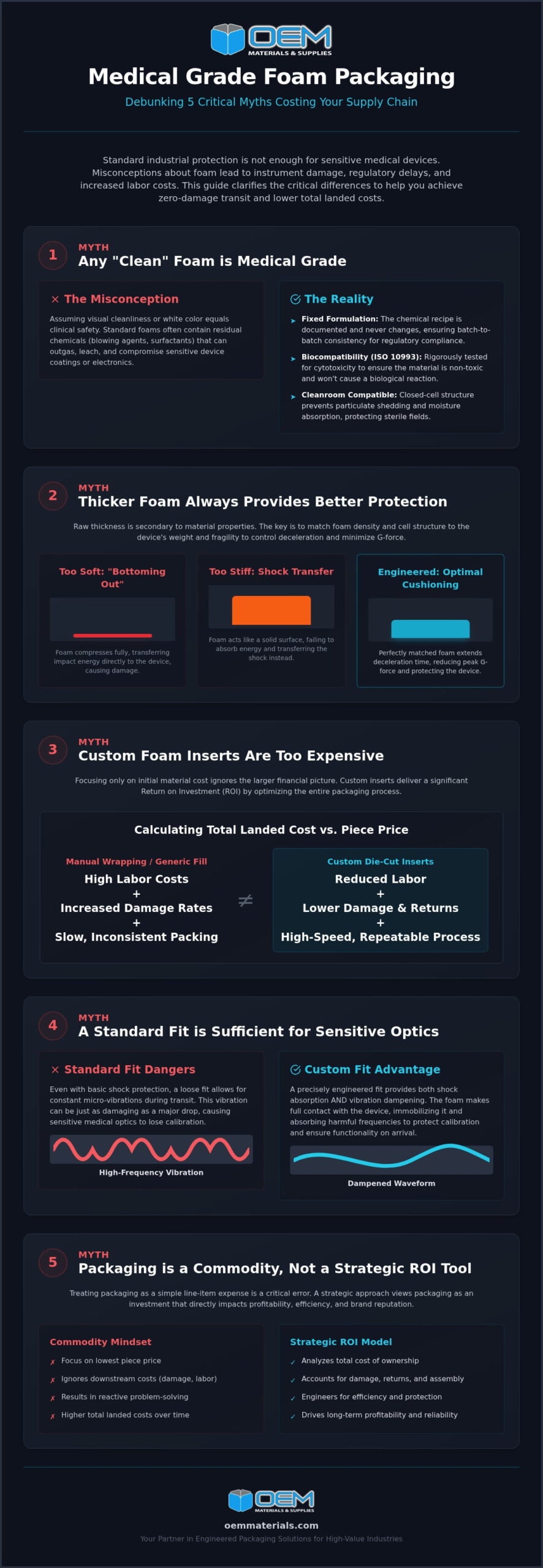
Myth 1: Any Clean Foam Qualifies as Medical Grade Foam Packaging
A common error in medical device procurement is the assumption that visual cleanliness equals clinical safety. Many labs and manufacturing facilities in Orange County and San Diego rely on standard industrial foams because they look clean or come in a neutral white color. This is a dangerous oversight. Medical grade foam packaging is a certified material tested specifically for cytotoxicity and long-term stability to ensure it does not interact with the device. It is not a commodity; it is an engineered component designed for high-stakes environments.
Standard industrial polymeric foam often contains residual chemicals from the manufacturing process, such as blowing agents, surfactants, or dyes. These substances can outgas or leach into the device over time, compromising the integrity of sensitive coatings or electronic components. Unlike standard materials, medical grade options utilize a fixed formulation. This means the chemical recipe never changes, ensuring that the material remains consistent across every production batch and meets strict regulatory requirements.
Understanding Biocompatibility and ISO 10993
Biocompatibility is the primary differentiator between industrial and medical materials. ISO 10993 standards require rigorous testing to ensure that the packaging material does not cause a biological reaction when it comes into contact with a device or a patient. Cytotoxicity testing is a critical part of this process, as it measures whether the material contains toxins that could kill or inhibit the growth of cells.
Relying on a fixed formulation is vital for maintaining these standards. If a foam manufacturer alters their chemical mix to reduce costs, the material’s biocompatibility status is immediately voided. This is why a simple FDA registration of a formulation is not the same as having a medical grade status. A medical grade designation implies that the material has been specifically tested and validated for use in healthcare applications where stability and safety are non-negotiable.
Cleanroom Compatibility and Particulate Control
Cleanroom environments in Los Angeles and the Inland Empire require packaging that does not contribute to environmental contamination. Standard open-cell foams are often unsuitable because they act as dust traps, holding and then releasing particulates during handling. This shedding can contaminate sterile fields or interfere with the function of sensitive medical optics.
Closed-cell polyethylene is often the preferred choice for these applications. It offers excellent moisture and chemical resistance while remaining virtually particulate-free. When integrated into a custom packaging design, these materials provide a stable environment for the device. The closed-cell structure prevents the absorption of liquids and ensures the foam can be wiped down or sterilized without losing its physical properties, making it an essential tool for maintaining strict cleanroom protocols.
Myth 2: Thicker Foam Always Provides Better Instrument Protection
Engineers often fall into the trap of equating thickness with safety. In reality, raw dimensions are secondary to material density and cell structure. If you select a medical grade foam packaging material that is too soft for the weight of your device, “bottoming out” occurs. During a drop, the foam compresses fully, and the impact energy travels directly into the instrument. Conversely, over-packaging with overly stiff foam is equally dangerous. Stiff foam doesn’t compress enough, acting like a solid surface that transfers shock rather than absorbing it. For specific technical data on how to select the right material, consult our industrial guide to foam inserts.
The Physics of Deceleration and G-Force
Foam protects by extending the time of deceleration. A longer impact duration reduces the peak G-force experienced by the device. This is critical when calculating the “Fragility Factor” for sensitive medical optics or high-value electronics. High-performance medical grade foam packaging must meet FDA recognized consensus standards to ensure consistent protective qualities across different shipping environments. Often, a one-inch layer of high-density Polyethylene provides better protection than three inches of low-density Polyurethane. The goal is to match the foam’s deflection rate to the specific fragility of your product, ensuring the material absorbs energy before it reaches the component.
Polyethylene vs. Polyurethane in Medical Applications
Choosing between materials depends on the kit’s weight and complexity. Polyethylene (PE) foam is a closed-cell material that supports heavy surgical kits and multi-component trays without collapsing. It is the standard for rigid protection in Southern California medical hubs like Irvine and Carlsbad. Polyurethane (PU) foam is an open-cell, softer material. It excels at protecting lightweight, high-value sensors where vibration dampening is the primary concern. You can explore our full range of cushioning materials to find the right balance for your specific application. If you are unsure which density fits your product’s fragility, request a quote for an engineering consultation to review your product dimensions and weight.
Myth 3: Custom Foam Inserts are Too Expensive for High-Volume Runs
Industrial OEMs often hesitate to move from manual wrapping to custom engineered solutions because they perceive upfront tooling costs as a barrier. This is a narrow view of cost management. While standard rolls of bubble wrap or loose-fill materials seem cheaper on a per-unit basis, they introduce significant hidden expenses in the form of excessive labor and increased warehouse footprints. Transitioning to custom medical grade foam packaging allows manufacturers to shift from a variable labor model to a fixed material model, which is far more predictable at scale. In Southern California’s competitive manufacturing hubs, floor space is a premium; eliminating bulky rolls of generic cushioning in favor of stackable, ready-to-use inserts can reclaim valuable square footage for production.
The cost of a steel rule die is often amortized within the first few thousand units, making the per-part cost negligible for high-volume runs. By choosing custom inserts, you also eliminate the variability of human error during the packing process. Every device is protected exactly the same way, every time, reducing the risk of transit damage that can derail an entire supply chain. This consistency is vital for maintaining the high standards required by the medical industry. For a comprehensive framework on managing procurement at scale, our guide on bulk foam packaging inserts for manufacturing provides the technical and logistical insights needed to optimize high-volume sourcing decisions.
Scalable Manufacturing: Die-Cutting vs. CNC Routing
Choosing the right fabrication method is essential for balancing speed and precision. Different production volumes require different technical approaches to ensure cost-effectiveness:
- Die-cutting: This is the gold standard for high-speed, high-volume medical packaging, allowing for rapid, repeatable strikes across large sheets of material.
- CNC routing: Provides precision depth control for complex, multi-layered surgical instruments without the need for physical dies, ideal for mid-volume runs.
- Water-jet cutting: Offers clean, heat-free edges for specialized medical polymers that might be sensitive to thermal distortion during the cutting process.
These technologies ensure that whether you are operating in Orange County or San Diego, your packaging remains consistent and scalable as your production needs grow.
Labor Efficiency on the Assembly Line
The most immediate impact of custom foam is felt on the assembly line. Manually wrapping a sensitive device in multiple layers of film can take minutes; dropping it into a precision-cut cavity takes seconds. By utilizing pre-assembled packaging kits, your team can focus on quality control rather than struggling with tape and rolls of cushioning. This standardization also benefits the end-user. Healthcare professionals in hospital settings value a predictable, clean unboxing experience, which is a priority often highlighted by the Sterilization Packaging Manufacturers Council. Industrial reports suggest that some facilities have achieved up to 30 percent labor cost savings by implementing custom kitting. These results demonstrate that engineered inserts are a strategic investment that pays for itself through operational speed.
Myth 4: Standard Fit is Sufficient for Sensitive Medical Optics
Many engineers believe that a “snug fit” is the gold standard for securing high-value instruments. If the device does not move within the box, it must be safe. However, for sensitive medical optics, a tight fit can actually be a liability. If the medical grade foam packaging is too rigid or fits too tightly against the device chassis, it acts as a direct bridge for high-frequency vibrations. Instead of isolating the product, the packaging transmits every engine rumble and road bump directly into the internal components. A truly engineered solution balances a secure hold with the necessary clearance to allow the foam to do its job.
It is essential to distinguish between shock absorption and vibration dampening. Shock absorption handles the sudden, high-energy impact of a drop. Vibration dampening manages the constant, low-amplitude oscillation that occurs during long-haul transit. Custom engineered inserts eliminate the micro-movements that cause surface abrasion while providing the necessary “give” to dissipate energy. In the engineering phase, we define the fragility factor as the maximum acceleration a medical device can survive before internal damage occurs. Designing for this factor requires more than just a tight pocket; it requires a calculated material response.
Combatting Harmonic Resonance in Transit
Transit environments, especially air freight and long-distance trucking, generate specific harmonic frequencies. These vibrations can be subtle but persistent enough to loosen internal screws, misalign optical lenses, or crack delicate solder joints in diagnostic equipment. Using open-cell Polyurethane (PU) foam allows engineers to “tune out” these specific frequencies. By selecting a material with the correct damping coefficient, you create a buffer that absorbs the energy of the vibration before it can resonate within the device. This technical approach ensures that even if a truck vibrates at a specific frequency for several hours, the sensitive electronics inside remain stable.
Surface Protection and Abrasion Resistance
Standard foams can be abrasive at a microscopic level. For Class III medical devices with high-polish surgical steel or precision-ground optical lenses, even a tiny amount of friction can cause permanent scuffing. Cross-linked Polyethylene (XLPE) is the preferred choice for these applications. XLPE has a smooth, non-abrasive surface and a closed-cell structure that resists shedding. This material provides the necessary support without the risk of scratching delicate surfaces. When you integrate these specialized materials into your foam packaging strategy, you protect both the aesthetic and functional integrity of the instrument. If your current damage rates for sensitive optics are higher than zero, request a quote for a technical consultation to review your current insert design and material specs.
Myth 5: Packaging is a Commodity, Not a Strategic ROI Tool
Procurement departments often treat packaging as a simple line-item expense to be minimized. This commodity mindset is a mistake in the medical device sector. When you focus solely on the per-unit price of foam, you ignore the Total Landed Cost model. This model accounts for instrument damage, the administrative cost of processing returns, and the hidden drain of inefficient labor. High-quality medical grade foam packaging is a strategic engineering asset that pays for itself by protecting your balance sheet from these variables. If a cheaper material leads to even a marginal increase in transit damage, the resulting costs far outweigh the initial savings on the material price. Procurement teams looking to build a more rigorous cost justification can benefit from reviewing the strategic framework outlined in our high-volume procurement guide for bulk foam packaging inserts, which addresses how to align material selection with both transit realities and warehouse efficiency goals.
Efficiency is built through integration. When custom foam inserts are designed alongside corrugated boxes as a unified system, you streamline your entire supply chain. This approach reduces the total number of packaging components your warehouse team must manage. It also ensures that every shipping container is optimized for the specific dimensions of the device, which can lower freight costs by reducing dimensional weight. In high-stakes manufacturing, precision in packaging is a direct contributor to operational stability.
Vendor Managed Inventory (VMI) for SoCal OEMs
Stockouts of critical packaging materials can halt production lines and delay life-saving device shipments. For manufacturers in Orange County and San Diego, VMI programs offer a functional remedy to this logistical challenge. These programs eliminate the need for your team to manually track inventory levels or issue frequent purchase orders. By shifting the responsibility of stock management to your supplier, you free up valuable warehouse space and reduce administrative overhead. Automated replenishment ensures that your medical grade foam packaging is always on hand when the production schedule demands it, supporting a true just-in-time manufacturing environment.
The Value of a Local Southern California Partner
Geography matters when it comes to engineering and logistics. Partnering with a local supplier in Los Angeles or the Inland Empire provides a level of agility that distant vendors cannot match. You gain access to rapid prototyping for new medical device launches, allowing you to test and refine insert designs in days rather than weeks. Sourcing foam inserts near your assembly facility also significantly lowers freight costs and reduces the carbon footprint of your supply chain. This proximity fosters a collaborative relationship where your packaging partner acts as a seasoned industry guide rather than a mere vendor. To see how engineered foam can optimize your specific medical kit, request a custom foam insert prototype and quote today. Please be prepared to provide product dimensions, weight, and annual usage to facilitate an accurate recommendation.
Optimize Your Supply Chain Performance with Engineered Foam
Misconceptions about medical grade foam packaging often lead to unnecessary transit damage and inflated labor costs. It’s vital to prioritize material density, biocompatibility, and custom engineering over raw thickness or simple snug fits. These strategic shifts move your packaging from a basic commodity to a high-performance ROI tool that protects your sensitive optics and your bottom line. Standardizing your process with precision inserts reduces human error and ensures every kit arrives in pristine condition.
OEM Materials & Supplies has provided specialized support for aerospace and medical OEMs for over 30 years. Our local Southern California manufacturing facilities serve Orange County, Los Angeles, and San Diego with rapid prototyping and precision fabrication. We offer comprehensive VMI and kitting services designed to eliminate stockouts and reduce your total landed costs. Request a custom medical grade foam packaging quote today to begin your engineering consultation. Please have your product dimensions and annual usage requirements ready so our team can provide an accurate recommendation. We look forward to helping you secure your next innovation.
Frequently Asked Questions
Is medical grade foam recyclable for industrial users in California?
Most polyethylene based medical grade foam packaging is recyclable through industrial scrap programs in California. However, foam that has been contaminated in a clinical setting is treated as medical waste and cannot enter the standard recycling stream. Industrial users in Orange County or Los Angeles can often coordinate with local recyclers for clean manufacturing scrap. It’s best to verify with your specific recycler regarding their requirements for cross-linked vs. non-cross-linked materials.
What is the difference between open-cell and closed-cell medical foam?
Closed-cell foam consists of sealed cells that resist moisture and provide high structural support for heavy instruments. Open-cell foam has interconnected pores, making it softer and better suited for vibration dampening and protecting lightweight, fragile components. While closed-cell Polyethylene is the standard for surgical trays, open-cell Polyurethane is often used for sensitive diagnostic sensors that require maximum cushioning and energy dissipation.
Can custom foam inserts be used in sterile barrier systems?
Custom foam inserts are frequently used within sterile barrier systems, provided the material is compatible with the intended sterilization method. Ethylene Oxide (EtO) and Gamma radiation are common methods that require specific foam formulations to prevent degradation or toxic byproduct formation. You must ensure the material has been tested for particulate shedding to maintain the integrity of the sterile field when the medical professional opens the kit.
How do I determine the fragility factor of my medical device?
Determining the fragility factor requires identifying the maximum acceleration, measured in Gs, that a device can withstand before malfunctioning. This is typically established through controlled drop testing or by reviewing the engineering specifications of internal components like circuit boards or optical lenses. We use this data to calculate the exact thickness and density of foam required to decelerate the device safely during an impact.
What certifications should I look for in a medical foam supplier?
You should prioritize suppliers with ISO 13485 certification for quality management systems and materials that comply with ISO 10993 for biocompatibility. These standards ensure the supplier maintains rigorous documentation and traceability for every batch of medical grade foam packaging. It’s also beneficial to work with partners who follow FDA Quality Management System Regulations to ensure full compliance with current medical device manufacturing requirements.
Are anti-static foam inserts necessary for all medical electronics?
Anti-static or Electrostatic Discharge (ESD) foam is necessary for any medical device containing microprocessors or sensitive integrated circuits. While not all medical electronics require it, those used in diagnostic imaging or patient monitoring are highly susceptible to static damage during transit. Using ESD-safe materials prevents the buildup of static electricity that can occur when devices rub against standard foam surfaces during shipping.
How long does it take to develop a custom foam prototype for a new device?
Developing a custom foam prototype typically takes between three to five business days once the final CAD files or physical device samples are received. Our Southern California facility uses rapid prototyping technology to create precise samples for fit testing and drop validation. This speed allows your engineering team to iterate quickly during the design phase without delaying the overall product launch timeline.
Do you provide foam inserts for wood crates used in large medical machinery?
We provide heavy-duty foam cushioning specifically engineered for wood crates used to transport large medical machinery like MRI components or lab centrifuges. These inserts are designed to handle high static loads and provide long-term stability during international shipping. By combining custom wood crates with high-density foam blocking and bracing, we ensure that even the heaviest medical equipment remains isolated from shock and vibration.