
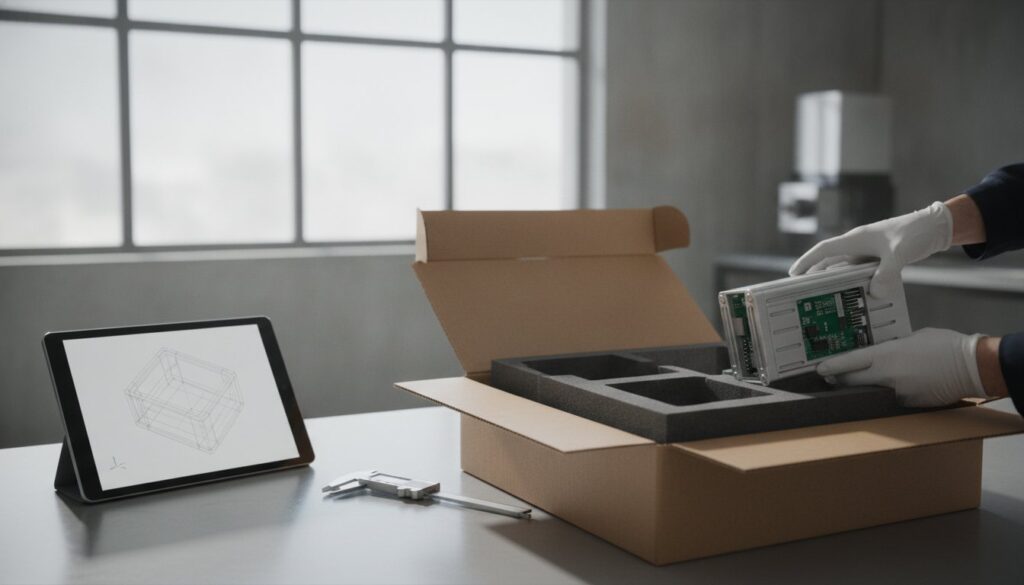
Effective shock absorption is an engineering calculation, not a material purchase; success depends on matching material density to product fragility. If you’re managing a supply chain in Southern California or across the country, you know that selecting the right shock absorbent packaging materials is now a requirement for operational stability rather than a simple procurement task. Concealed transit damage and escalating dimensional weight charges erode customer trust and eat into margins already squeezed by the 30 percent surge in resin prices seen since February 2026.
You need a strategy that moves beyond commodity reselling to achieve near-zero damage rates. This guide will show you how to master the technical criteria for selecting protective supplies to shield sensitive equipment while optimizing your industrial supply chain. We’ll examine the performance differences between polyethylene and polyurethane foam, address the latest regulatory impacts like California SB 54, and explain how a structured vendor-managed inventory program can reclaim valuable warehouse space in tight markets like Orange County and Los Angeles.
Key Takeaways
- Differentiate between shock and vibration to select materials that provide the precise deceleration needed to protect sensitive internal components from failure.
- Compare the technical specifications of various shock absorbent packaging materials to ensure your selection offers the correct memory and impact resistance for your specific shipping environment.
- Master the science of cushion curves and foam density to prevent “bottoming out” while avoiding the excessive dimensional weight charges associated with over-packaging.
- Address regional logistics challenges by selecting materials that withstand Inland Empire humidity and the rigorous vibration of transit between San Diego and Los Angeles ports.
- Implement value-added services like Vendor Managed Inventory (VMI) to solve the storage challenges of bulky foam and improve packing speed through custom kitting.
The Physics of Protective Packaging: Shock vs. Vibration
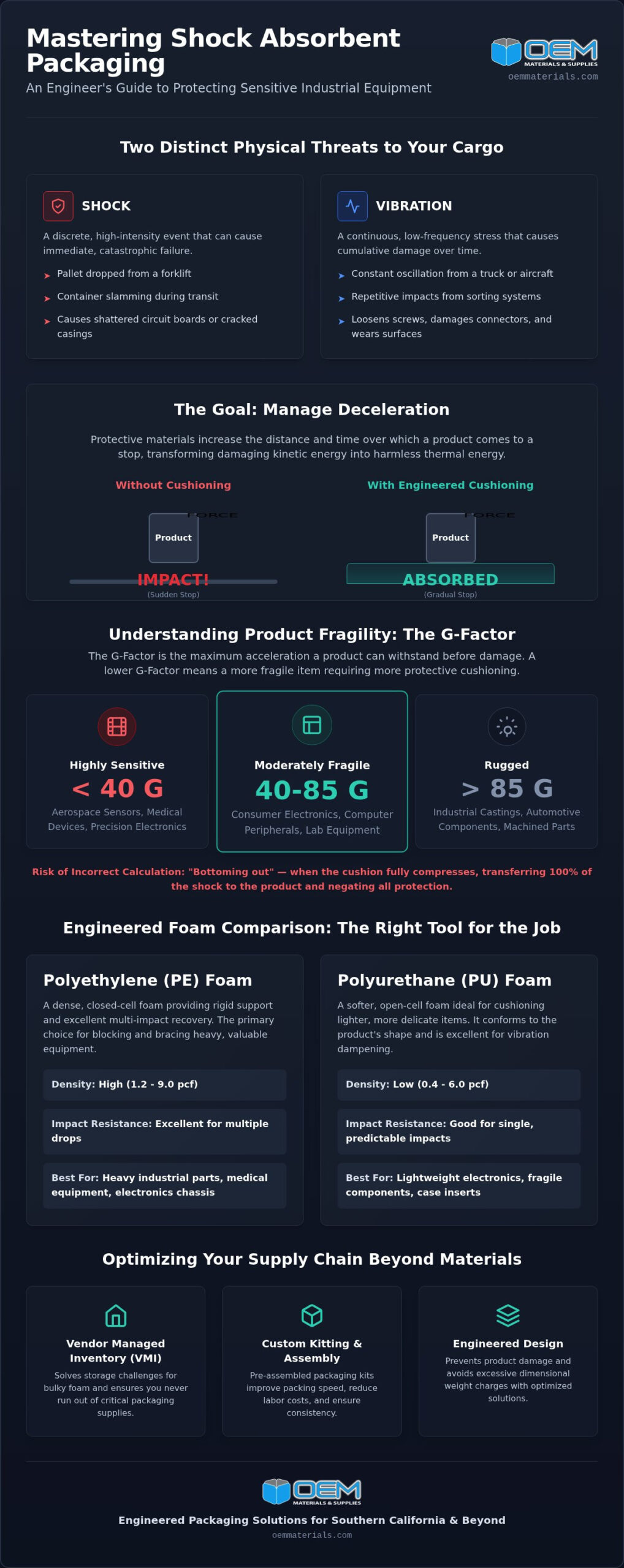
Shock and vibration represent two distinct physical threats to your cargo. Shock is a discrete, high-intensity event, such as a pallet dropped from a forklift or a container slamming during rail humping. Vibration is a continuous, low-frequency stress caused by the constant oscillation of a truck or aircraft during transit. While both lead to product failure, they require different engineering approaches. Vibration might loosen a screw over three hundred miles, but a single shock event can shatter a circuit board in milliseconds.
The primary goal of shock absorbent packaging materials is to manage deceleration. When a package hits the ground, it stops instantly. Without cushioning, the product inside also stops at that same rate, experiencing a massive spike in force. Protective materials work by increasing the distance and time over which the product comes to a stop. This process transforms kinetic impact energy into thermal energy, which is dissipated through the material’s cell structure or fiber arrangement. Think of it as a mechanical fuse that absorbs the “hit” so your equipment doesn’t have to.
Relying on surface protection like thin wraps or standard corrugated walls is often insufficient for sensitive industrial equipment. While these prevent cosmetic scratches, they do little to shield internal components from the G-forces generated during a drop. True protection requires an engineered system that accounts for the specific fragility of the item. Scuff-free arrivals don’t matter if the internal calibration is ruined by a high-impact deceleration event.
Understanding Fragility and G-Factor
Every product has a G-factor, which is the maximum acceleration it can withstand before damage occurs. Highly sensitive electronics, aerospace sensors, or medical devices often have a G-factor below 40G, meaning they require significant cushioning to survive even a standard drop. In contrast, heavy industrial castings or automotive components might handle 100G or more. Fragility ratings dictate the required thickness and density of Package cushioning materials. If the G-factor is low, you need a material that allows for more displacement to spread the force. If you get this calculation wrong, the product may “bottom out,” hitting the hard outer container and negating the protection entirely.
Drop Height Standards in Industrial Shipping
Industrial shipping environments are rarely gentle. Standardized testing protocols from the International Safe Transit Association (ISTA) simulate these conditions by defining specific drop heights based on package weight. A 20 pound box handled manually is statistically more likely to be dropped from a greater height than a 500 pound crate moved by a pallet jack. Manual handling requires shock absorbent packaging materials with high energy absorption, while automated sorting systems often subject packages to repetitive, lower-intensity impacts. Our team integrates these variables into a Custom Packaging Design to ensure your solution is neither under-engineered nor excessively bulky. Precision here prevents both product damage and unnecessary dimensional weight charges.
Comparing Industrial Shock Absorbent Packaging Materials
Selecting the right shock absorbent packaging materials requires balancing material memory against the anticipated transit cycle. Memory refers to a material’s ability to return to its original shape after an impact. For products moving through complex LTL networks where multiple drops are likely, multi-impact materials like high-density foam are essential. Conversely, for a single, predictable journey, single-impact materials like honeycomb or molded pulp may provide sufficient protection at a lower cost-per-cubic-foot.
Environmental compliance is also a major factor for modern manufacturers, especially with the 2026 deadlines for California SB 54 and SB 343. These laws require a strategic shift toward materials that are either widely recyclable or part of a verified source reduction plan. Evaluating your risk profile against these regulatory requirements ensures your packaging is both protective and compliant. It’s about finding the intersection of durability, cost, and legal adherence.
Engineered Foam: Polyethylene vs. Polyurethane
Foam selection is typically a choice between Polyethylene (PE) and Polyurethane (PU). Polyethylene is a closed-cell material known for its rigidity and moisture resistance. It excels at protecting heavy industrial components and aerospace parts that require high load-bearing capacity. For sensitive electronics that need a softer touch, Polyurethane is the preferred open-cell option. Its flexibility allows it to cradle lightweight items, providing excellent vibration dampening. For medical devices or class-A surfaces where scratching is a concern, Cross-linked Polyethylene (XLPE) offers a non-abrasive, cleanroom-compatible solution. You can explore our full range of Foam Packaging to find the density that fits your fragility rating.
Corrugated and Fiber-Based Shock Absorption
While foam provides the primary cushion, the outer container acts as the first line of defense. Double-wall and triple-wall Corrugated Boxes provide structural shock barriers that resist puncturing and compression during stacking. Inside the box, fiber-based solutions like molded pulp and honeycomb inserts offer sustainable alternatives for blocking and bracing. These materials are particularly effective for heavy-duty applications where the goal is to prevent the product from shifting. If you are unsure which material combination will best protect your specific payload, you can request a technical consultation and quote from our engineering team.
Engineering the Solution: Density and Geometry
Precision engineering ensures that shock absorbent packaging materials perform exactly as intended. It isn’t a matter of simply filling space. Engineers utilize cushion curves to identify how a specific foam density reacts to the anticipated G-force of an impact. If the material is too soft for the payload, it compresses completely; this is known as “bottoming out,” which transfers the full force directly into the product. If the material is too rigid, it acts as a hard surface, failing to provide the necessary deceleration for lighter items.
Custom die-cut geometries are required for irregular industrial parts to ensure the load is supported at its strongest structural points. This prevents the product from shifting and ensures the cushion is positioned where it can do the most work. In electronics and medical manufacturing, these designs frequently integrate ESD (Electrostatic Discharge) protection. Anti-static additives are blended into the foam during production to shield sensitive components from static damage while the physical structure absorbs mechanical shock.
Calculating Cushion Thickness
Determining the correct thickness begins with calculating the static loading. This is the product’s weight divided by the bearing area, which is the surface area in direct contact with the foam. Matching this value to the material’s specific cushion curve prevents over-packaging and “air shipping.” While optimizing material volume can lower dimensional weight charges, actual cost savings and performance results depend on specific variables such as product dimensions, materials, and shipping requirements.
Blocking and Bracing Techniques
Heavy machinery often requires more than just a soft cushion to survive transit. Blocking and bracing techniques use rigid materials to eliminate internal movement within the outer container. We often employ a combination of Edge Protectors and internal cushioning to distribute strap tension and prevent corner crush. Hybrid designs that integrate wood crates with precision foam inserts provide the structural rigidity needed for stacking while maintaining the high-level shock absorption required for sensitive internal components.
Regional Logistics Challenges for SoCal Manufacturers
Southern California manufacturers face unique environmental and logistical stressors that aren’t addressed in generic packaging guides. In the Inland Empire, summer temperatures frequently exceed 100 degrees Fahrenheit, a factor that can accelerate the degradation of certain shock absorbent packaging materials. High heat can cause some adhesives to fail or lower-quality foams to lose their structural integrity. It’s vital to choose materials that maintain their specific cushion curves even under thermal stress to ensure long-term reliability in regional warehouses.
Logistics corridors between the Port of Los Angeles, Long Beach, and San Diego are high-vibration environments. Heavy drayage traffic and frequent stops subject cargo to continuous low-frequency stress. While previous sections of this guide discussed discrete shock events, regional transit requires a focus on vibration dampening. Using multi-layered solutions that combine corrugated outer walls with precision-fit foam inserts ensures that sensitive components arrive without the internal fatigue caused by hours of road oscillation. This is particularly important for high-volume distribution where cargo is subject to the rigorous handling of regional LTL networks.
Less Than Truckload (LTL) shipping in regional distribution centers often involves multiple touches at various hubs. Every time a pallet is moved by a forklift, the risk of a high-impact drop or side-impact collision increases. Industrial buyers in Los Angeles and Orange County must account for these “hidden” impacts by specifying the density of their protective supplies to survive the worst-case scenario of a hub-and-spoke delivery system.
Aerospace and Defense Material Standards
The aerospace hubs in Orange County and the South Bay require strict adherence to mil-spec standards. High-precision instrumentation is susceptible to micro-vibrations that can ruin calibration or damage delicate soldering. We provide custom Crates engineered with specialized shock mounts and polyethylene foam to meet these rigorous requirements. These designs ensure that even the most delicate aerospace assemblies remain isolated from external forces during transit across the country or through local testing facilities.
Medical Device and Life Science Packaging
For the life science sector, cleanliness is as important as physical protection. We supply cleanroom-compatible Cushioning Materials that don’t shed particles or outgas chemicals. These materials protect sterile medical containers during rapid transit, ensuring the mechanical integrity of the device is maintained without compromising the sterile field. This is critical for manufacturers operating in the specialized tech corridors of San Diego and Irvine where regulatory compliance is non-negotiable. To ensure your packaging meets these regional and industry-specific requirements, contact us for a technical quote based on your specific transit profile.
Optimizing Supply Chain Efficiency with Protective Solutions
Industrial procurement often over-emphasizes the unit price of shock absorbent packaging materials, frequently overlooking the impact of labor and warehouse overhead. A true Total Cost of Ownership (TCO) analysis reveals that the most expensive packaging is often the one that slows down the production line or consumes excessive floor space. By shifting from a commodity-based purchasing model to an engineered protective system, facilities can eliminate the hidden costs of inefficient packing processes. It is important to understand that total cost savings and labor reductions are not fixed; they depend on specific variables such as product dimensions, material selection, and unique shipping requirements.
Streamlining the movement of goods requires a partner that understands how packaging interacts with the entire warehouse ecosystem. Reducing the number of touches required to secure a payload doesn’t just lower the risk of human error; it directly increases the volume of shipments your team can process per shift. This operational speed is a critical advantage in high-volume manufacturing environments where throughput is the primary driver of profitability.
Kitting and Assembly Services
Consolidating various protective components into a single, pre-assembled SKU removes the complexity from the packing station. Instead of warehouse staff pulling separate foam inserts, corrugated sleeves, and edge protectors from different bins, they receive a unified kit ready for the product. OEM Materials & Supplies provides these kitting services to help electronics and automotive manufacturers reduce assembly time and eliminate packing errors. This approach ensures that every item is secured exactly as engineered, though the specific labor gains will vary based on your existing workflow and product complexity.
VMI and JIT for Large-Scale Manufacturers
Bulky protective supplies present a significant storage challenge in Southern California, where industrial vacancy rates in Los Angeles County and Orange County remain near historic lows. OEM Materials & Supplies manages these inventory levels through our Packaging VMI Services. We monitor your usage and replenish stock automatically, which prevents stockouts and eliminates the need for you to warehouse months of bulky foam. Utilizing JIT Packaging allows facilities in the Inland Empire and San Diego to reclaim square footage for production, transforming the supply chain into a leaner, more responsive operation.
Securing Your Industrial Supply Chain for 2026
Mastering the technical selection of shock absorbent packaging materials is a strategic requirement for maintaining operational stability. Success depends on matching material density to product fragility while accounting for the rigorous vibration and heat stressors of Southern California logistics. Transitioning from commodity purchasing to an engineered approach allows your facility to eliminate concealed damage and reduce dimensional weight charges. By integrating custom foam inserts with structural corrugated designs, you protect both your product and your profit margins.
OEM Materials & Supplies provides expert packaging design for the aerospace, medical, and automotive sectors. Our team specializes in rapid prototyping and scalable high-volume production to meet the specific requirements of manufacturers in Orange County, Los Angeles, and the Inland Empire. We offer local support through VMI programs that reclaim your warehouse floor space and ensure you never face a stockout of critical protective supplies.
To optimize your packing speed and protect your sensitive equipment, Request a Custom Packaging Prototype and Quote today. Providing your product dimensions, weight, and annual usage allows our engineers to facilitate an accurate technical recommendation. We look forward to helping you build a more resilient and efficient industrial supply chain.
Frequently Asked Questions
What is the most effective shock absorbent packaging material for heavy machinery?
High-density polyethylene (PE) foam is the most effective choice for heavy machinery due to its superior load-bearing capacity and rigidity. When paired with custom wood crates or triple-wall corrugated boxes, PE foam provides the structural support needed to prevent heavy components from shifting during transit. This combination ensures the payload remains isolated from the high-impact forces typical of flatbed or LTL shipping environments.
How do I calculate the correct foam density for my product?
You calculate the correct foam density by determining the static loading, which is the product’s weight divided by its total bearing area in contact with the foam. Once you have this value, you must match it against a material-specific cushion curve to ensure the G-force remains within your product’s fragility limits. This engineering approach prevents the material from “bottoming out” and failing to protect the item during a drop.
What is the difference between open-cell and closed-cell foam for shock absorption?
Closed-cell foam features sealed cells that provide high rigidity and moisture resistance, making it ideal for heavy industrial loads and aerospace parts. Open-cell foam has interconnected pores that offer greater flexibility and vibration dampening for lightweight, highly sensitive items like medical instruments. Closed-cell materials are generally more durable for repeated impacts, while open-cell options provide a softer, more compliant cushion.
Are there sustainable alternatives to plastic-based shock absorbent materials?
Molded pulp, honeycomb inserts, and multi-wall corrugated structures are the primary sustainable alternatives to traditional shock absorbent packaging materials. These fiber-based solutions help Southern California manufacturers comply with SB 54 and SB 343 by utilizing widely recyclable or compostable materials. While they offer excellent blocking and bracing, they are typically best suited for single-impact transit profiles rather than complex, multi-stop distribution routes.
How does dimensional weight affect the choice of protective packaging?
Dimensional weight charges are triggered when the exterior volume of a package is high relative to its actual weight, often caused by over-packaging or inefficient material selection. Choosing shock absorbent packaging materials with the correct density allows you to use thinner cushioning without sacrificing protection. This technical optimization reduces the overall box dimensions, lowering your shipping costs while maintaining the safety of the internal components.
Can custom foam inserts be reused for multiple shipping cycles?
Custom foam inserts can be reused for multiple shipping cycles if they are manufactured from materials with high physical “memory,” such as polyethylene or cross-linked polyethylene. These materials return to their original shape after impact, unlike expanded polystyrene (EPS) which deforms permanently after a single shock event. Reusable inserts are ideal for closed-loop supply chains or internal transit between San Diego and Los Angeles facilities.
What are the ISTA standards for shock and vibration testing?
ISTA 3A and 3E are the most common industrial standards for simulating the shock and vibration stresses of the global supply chain. These protocols use laboratory testing to replicate drops, compression, and atmospheric stress. Our designs also reference ASTM D1596 for dynamic shock cushioning and ASTM D4168 for foam-in-place materials to ensure your protective system meets verified performance benchmarks before it leaves the warehouse.
How do I protect sensitive electronics from both shock and ESD?
To protect sensitive electronics, you should use anti-static or conductive foam inserts that provide both mechanical cushioning and electrostatic discharge (ESD) protection. These materials are treated with chemical additives that prevent the buildup of static electricity during handling and transit. Combining these specialized foams with ESD-shielding corrugated boxes creates a comprehensive protective environment for high-value circuit boards, sensors, and medical devices.