
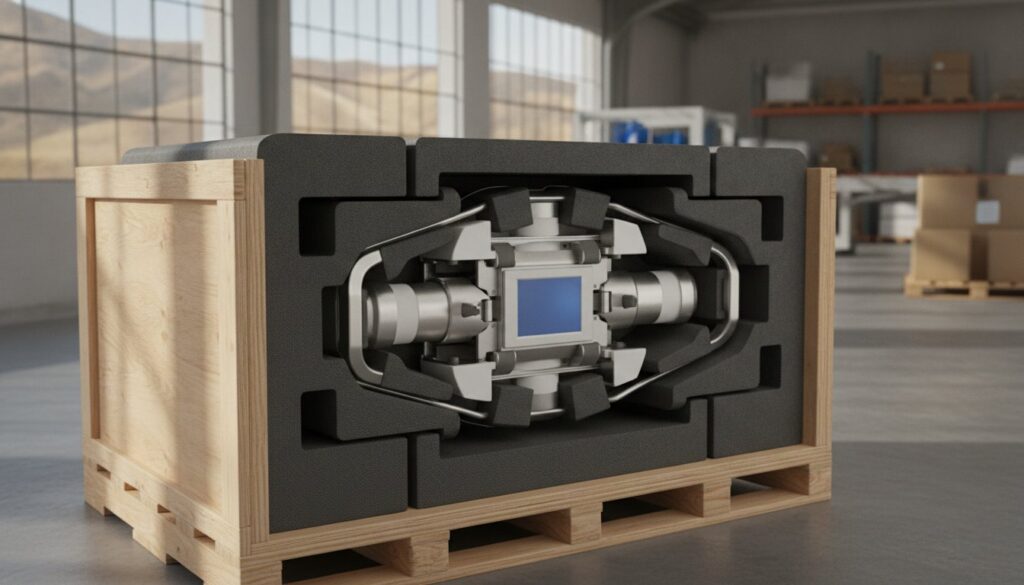
Relying on standard cushioning for a fifty thousand dollar medical laser isn’t a packaging strategy; it’s a gamble that your balance sheet can’t afford to lose. Sourcing high-quality custom foam inserts for cases riverside has become a critical priority for local manufacturers facing an 8.75 percent increase in foam product pricing since 2025. You already know that every piece of equipment damaged in transit represents more than just a lost product. It is a cascade of high labor costs, wasted administrative time, and strained client relationships that disrupt your entire supply chain.
This guide will show you how to select the precise foam densities and engineering processes required to safeguard high-value industrial assets while optimizing your packing floor efficiency. We will examine the technical differences between materials like polyethylene and polyurethane, the impact of Riverside’s latest warehouse zoning laws, and how local vendor-managed inventory can eliminate your packaging shortages. By matching material science to your specific shipping environment, you can reduce damage rates and secure a more reliable flow of critical supplies.
Key Takeaways
- Custom inserts eliminate internal movement and reduce the labor time required for manual wrapping or loose-fill packing workflows.
- Effective material selection involves choosing polyethylene for heavy-duty durability or polyurethane for delicate, high-sensitivity electronics.
- Understanding the technical differences between CNC routing and die-cutting for custom foam inserts for cases riverside helps balance prototype precision with high-volume production costs.
- Partnering with a local Riverside supplier facilitates on-site design consultations and reduces the lead times associated with long-distance shipping.
- Combining engineered foam with custom corrugated packaging or wood crates through a vendor-managed inventory program ensures consistent protection and prevents inventory shortages.
The Role of Custom Foam Inserts in Industrial Protection
Industrial protection is a matter of physics and precision. Standard cushioning often fails because it allows for internal migration, which leads to secondary impact damage. By contrast, custom foam inserts for cases riverside create a secure, form-fitting environment that locks high-value components in place. This level of stabilization is non-negotiable for sectors like aerospace and medical manufacturing, where even a minor shift in transit can knock a sensitive instrument out of calibration. These inserts aren’t just padding; they’re an engineered barrier between your product and the rigors of the supply chain.
Beyond physical safety, these inserts serve as a professional interface for your brand. A medical device delivered in a custom-cut, high-density foam insert communicates a level of care and technical competence that loose-fill materials cannot match. These solutions also offer a significant sustainability advantage. Unlike single-use bubble wrap or plastic film, engineered foam is durable enough for years of reuse in closed-loop shipping systems. This helps Riverside businesses reduce their environmental footprint and long-term material costs while maintaining high standards of protection.
Reducing Product Damage and Liability
When a shipment faces rough handling, the energy transferred to the product determines whether it arrives functional or as a liability. Precision fitment ensures that shock is absorbed and distributed across the entire surface of the foam rather than concentrated on the product’s most fragile points. Understanding Polyurethane foam properties is essential for this engineering phase; the material cell structure must be matched to the weight and fragility of the item. For a manufacturer of high-end electronics or aerospace components, the cost of a single damaged unit often far outweighs the investment in a custom packaging design. Effective protection isn’t just about padding. It’s about mitigating the risk of expensive returns and lost client trust.
Streamlining Warehouse Operations
Efficiency in the warehouse is frequently lost to inconsistent, manual packing methods. Engineered foam inserts solve this by standardizing the workflow. Instead of requiring staff to wrap items in multiple layers of plastic or tape, the packing process becomes a simple task of placing the product into a pre-cut cavity. This reduces labor hours and ensures that every package meets a consistent quality standard regardless of who is on the packing line. By optimizing the internal layout, we can also help you minimize the outer case dimensions. This optimization is a practical remedy for rising shipping costs, as it reduces the dimensional weight of your shipments without compromising the safety of the contents. Standardized inserts also simplify inventory management, making it easier to track usage rates and maintain lean operations.
Technical Material Selection: Polyethylene vs. Polyurethane
Material selection is the foundation of any effective industrial packaging strategy. It’s not merely a choice between “hard” or “soft” padding. It’s an engineering decision based on the fragility, weight, and surface sensitivity of your equipment. When designing custom foam inserts for cases riverside, the choice between open-cell and closed-cell polymers determines the longevity of both the insert and the equipment it protects. Selecting the wrong density can lead to “bottoming out” during a drop, where the foam compresses completely and transfers the full force of impact directly to your product.
Polyethylene for Heavy-Duty Applications
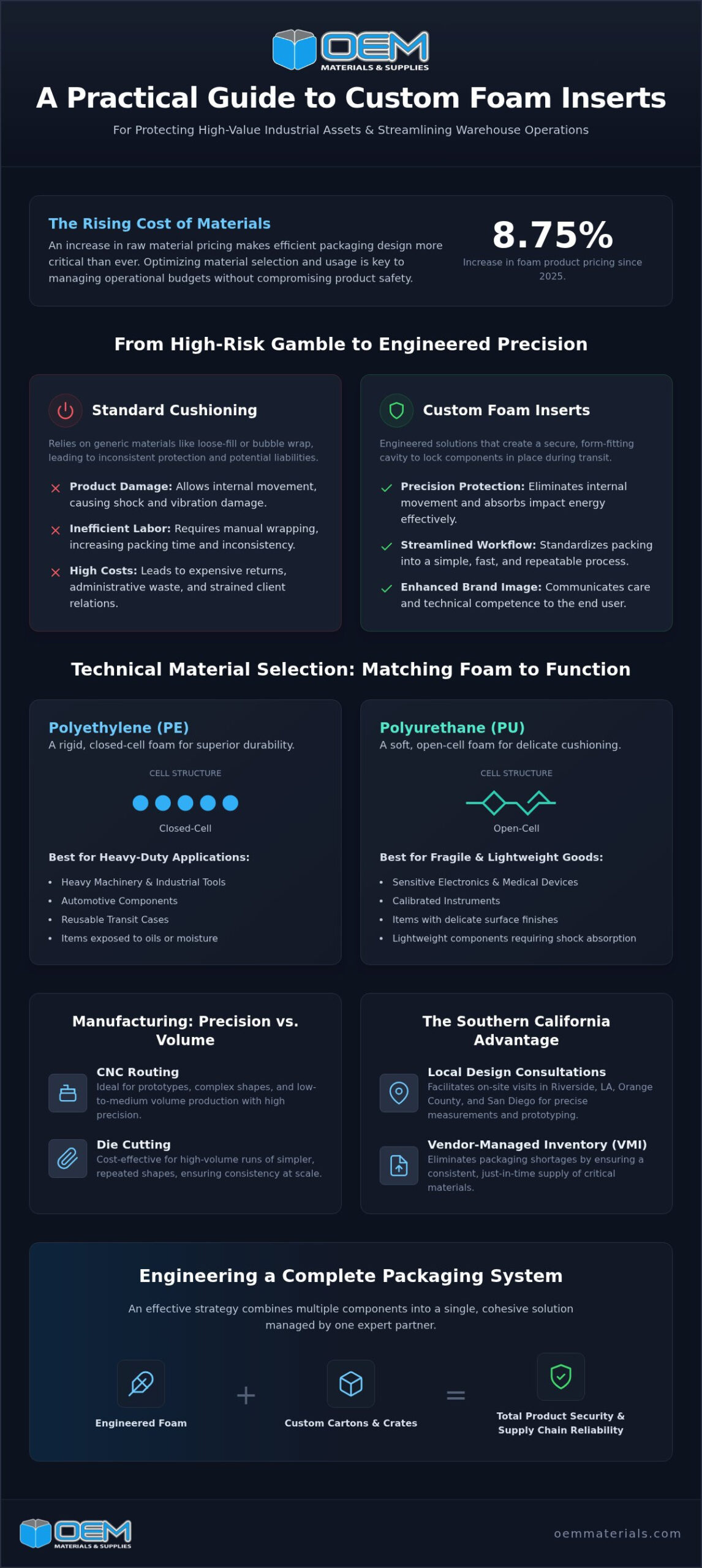
Polyethylene (PE) is a closed-cell foam characterized by its rigidity and high load-bearing capacity. It is the industry standard for protecting heavy machinery, automotive components, and industrial tools. Because the cells are sealed, PE does not absorb water, oils, or chemicals. This makes it an excellent choice for reusable transit cases that may be exposed to harsh environments or industrial fluids. Its durability ensures the cavities maintain their shape over hundreds of use cycles, preventing the equipment from loosening over time. For manufacturers in the Inland Empire handling heavy metal parts, polyethylene provides the structural integrity required to prevent shifting during transit.
Polyurethane for Fragile and Lightweight Goods
Polyurethane (PU) is an open-cell foam, offering a much softer and more flexible structure than polyethylene. It is specifically engineered for high-fragility, low-weight items like delicate electronics, glass optics, and certain medical instruments. The open-cell nature allows the foam to compress easily, providing a “pillowy” deceleration that protects sensitive internal components from high-frequency vibrations. PU is often used in convoluted, or “egg-crate,” configurations to provide versatile protection for various item shapes within a single case. While it’s generally more cost-effective for one-way shipping, its superior cushioning properties make it indispensable for items that cannot withstand even minor G-force spikes.
For specialized applications, engineers often turn to cross-linked polyethylene (XLPE). This material has an extremely fine cell structure and a smooth, non-abrasive surface, which is critical for protecting Class A surfaces and medical devices that are prone to scratching. Additionally, for electronics manufacturing, we offer anti-static and conductive foam variants to mitigate the risk of electrostatic discharge. To ensure consistent performance across these materials, we adhere to ASTM D3574 foam testing standards, which provide the technical data needed to verify tensile strength and indentation force deflection. Choosing the right material grade requires balancing weight, fragility, and environmental exposure. You can request a technical consultation to determine which material grade fits your specific industrial application.
Manufacturing Processes for Custom Case Inserts
The manufacturing method used to produce your packaging is just as critical as the material itself. Selecting the wrong process can lead to unnecessary tooling expenses or inconsistent tolerances that compromise product safety. When engineering custom foam inserts for cases riverside, we evaluate the complexity of your equipment and the total annual usage to determine the most cost-effective production path. Modern fabrication techniques allow us to maintain tight tolerances, ensuring that every sensitive component fits securely within its designated cavity without the risk of shifting during transit.
Adhering to the technical benchmarks set by PMMI, The Association for Packaging and Processing Technologies, we utilize a range of advanced cutting and assembly methods. These processes are designed to minimize material waste and maximize the structural integrity of the final insert. Whether you need a single prototype for a high-value aerospace instrument or thousands of units for a medical device launch, the choice of manufacturing process will dictate your final unit cost and lead time.
CNC Routing for Prototyping and Short Runs
CNC routing is the optimal solution for complex 3D shapes and low-volume production runs. This process uses a computer-controlled drill bit to carve precise cavities directly into foam blocks. Because it’s a digital process, it requires no physical dies or expensive tooling, allowing for rapid design iterations. It is particularly effective for aerospace kitting applications where different components require varying depths within a single insert. If your product design is still evolving, CNC routing provides the flexibility to make adjustments without the financial penalty of discarding specialized tools.
Die-Cutting for High-Volume Programs
For high-volume production, die-cutting remains the most efficient remedy for high unit costs. This method uses a steel-rule die to punch shapes out of foam sheets, similar to a heavy-duty industrial cookie cutter. While there is an initial investment in the die, the speed of production significantly lowers the cost per unit on orders exceeding 500 units. Die-cutting ensures perfect repeatability across large batches, making it ideal for standardized electronics or automotive parts kits. We often integrate these die-cut components with custom corrugated boxes to create a complete, ready-to-ship packaging solution for high-volume distribution programs.
For exceptionally thick foam blocks or designs requiring perfectly vertical, clean edges, waterjet cutting is used. This process employs a high-pressure stream of water to slice through material without the heat or friction that can sometimes distort foam cells. Additionally, for multi-depth tool organization, we use laminating processes to bond layers of different colored foams together. This creates a high-visibility “shadow board” effect, which is a practical tool for inventory management and foreign object debris (FOD) prevention in manufacturing environments.
Sourcing Custom Foam Inserts in Riverside and Southern California
Logistics and proximity play a decisive role in the success of any manufacturing operation. Sourcing custom foam inserts for cases riverside allows your engineering and procurement teams to work directly with a local partner who understands the specific industrial landscape of the Inland Empire. Proximity to major distribution hubs in Riverside and San Bernardino means lower transit costs and significantly faster turnaround times for prototypes and production runs. When you eliminate the delays of cross-country shipping, you gain the agility needed to respond to sudden changes in production demand or design specifications.
Local sourcing also facilitates on-site design consultations. For complex industrial packaging projects, a physical review of the equipment often reveals nuances that a digital file might miss. Our engineers can visit your facility in Orange County, Los Angeles, or the Inland Empire to ensure that every tolerance is accounted for before the first cut is made. This hands-on approach reduces the risk of errors and shortens the development cycle. Additionally, by sourcing from a regional supplier, your company effectively reduces its carbon footprint by minimizing the fuel consumption associated with long-haul logistics.
Inventory Management and JIT Delivery
Warehouse space is a premium asset that should be reserved for finished goods rather than bulky packaging materials. Our Just-in-Time (JIT) packaging solutions are designed to solve this specific logistical challenge. By delivering custom foam inserts according to your actual production schedule, we prevent warehouse clutter and free up valuable floor space. Our local delivery routes serve the entire Southern California region, providing a reliable flow of materials that keeps your packing lines moving without the burden of excessive on-hand inventory. This methodical approach ensures that your supply chain remains lean and responsive.
Vendor-Managed Inventory (VMI) for Foam
Managing multiple packaging SKUs can place a heavy administrative burden on purchasing departments. Outsourcing this tracking to a trusted partner through VMI services ensures constant availability of critical supplies. We monitor your stock levels and automatically trigger replenishment orders based on pre-set minimums, effectively eliminating the risk of stockouts. This system reduces administrative overhead and allows your team to focus on core manufacturing objectives. If you are ready to optimize your supply chain, you can request a quote to see how our local presence can improve your operational efficiency.
Engineering Your Solution with OEM Materials & Supplies
OEM Materials & Supplies functions as a technical partner rather than a simple reseller. We provide end-to-end engineering support for custom foam inserts for cases riverside, ensuring that every packaging component is optimized for the specific environmental stresses of your supply chain. Our team specializes in integrating foam protection with a broader range of industrial materials, including corrugated boxes, wood crates, and heavy-duty pallets. This holistic approach ensures that your medical devices, aerospace components, or sensitive electronics are protected from the moment they leave the assembly line until they reach the end user.
Collaborative problem-solving is at the core of our business model. We understand that industrial buyers face complex logistical challenges, such as reconciling the need for high-level protection with the pressure to reduce material waste and labor costs. By leveraging our expertise in specialized sectors, we help you design a system that maximizes protection while streamlining your packing floor workflows. This partnership approach transforms packaging from a recurring expense into a strategic asset that safeguards your brand’s reputation.
The Custom Design and Prototyping Process
Our engineering workflow is methodical and data-driven. We follow a three-step process to move your project from concept to production:
- Step 1: Product Assessment and Fragility Analysis. We begin by evaluating the physical dimensions, weight, and critical sensitivity of your equipment. This analysis determines the G-force thresholds your product can withstand during transit.
- Step 2: Material Selection. Based on the fragility data, we select the appropriate polymer. This involves choosing between the durability of polyethylene or the delicate cushioning of polyurethane to match the item’s surface sensitivity and load-bearing requirements.
- Step 3: CAD Design and Rapid Prototyping. Our designers create precise digital models for fitment testing. We produce physical prototypes quickly, allowing your team to verify the design and fit within the actual case before committing to a full production run.
Requesting an Industrial Quote
Securing an accurate quote for custom foam inserts for cases riverside requires specific operational data. To provide the most functional remedy for your packaging needs, our team requires the exact product dimensions, the total weight of the item, and your projected annual usage. Understanding annual volume is particularly critical; it helps us determine whether CNC routing or die-cutting provides the best balance between upfront tooling costs and long-term unit pricing.
When evaluating your packaging budget, consider the total cost of ownership rather than just the initial material price. A cheaper, non-engineered solution often leads to higher costs through product damage, increased labor for manual packing, and excessive shipping fees due to oversized boxes. Investing in precision-engineered inserts reduces these hidden expenses and builds a more resilient supply chain. You can request a quote today to begin a consultation with our Southern California engineering team.
Optimizing Your Industrial Supply Chain
Securing high-value equipment requires more than just padding. It’s about the precise alignment of material science and logistical efficiency. As we have examined, the choice between polyethylene and polyurethane, coupled with the right manufacturing process, directly impacts both product safety and operational costs. By sourcing custom foam inserts for cases riverside from a local Southern California partner, you gain access to rapid prototyping and specialized expertise in the aerospace, medical, and electronics sectors.
Integrating value-added services like vendor-managed inventory (VMI) and just-in-time (JIT) delivery allows your team to focus on core production while we manage the complexities of your packaging supply chain. This collaborative approach reduces material waste, stabilizes your packing workflow, and ensures that your critical equipment arrives in perfect calibration. We’re ready to help you engineer a reliable, scalable solution that meets your rigorous industry standards. To begin your design consultation, please request a quote for custom foam inserts. Providing your product dimensions, weight, and annual usage will help our engineering team deliver an accurate recommendation for your project.
Frequently Asked Questions
What is the best foam for heavy industrial tools in Riverside?
High-density polyethylene foam is the most effective choice for heavy industrial tools and machinery parts. Its closed-cell structure provides the structural integrity needed to support significant weight without bottoming out during impact. This material is also resistant to chemicals, oils, and moisture, making it ideal for the demanding environments found in Riverside manufacturing facilities and distribution centers.
How much does a custom foam insert for a case cost?
The cost of a custom foam insert depends on several specific variables, including the foam grade, cavity complexity, and total production volume. While high-volume die-cutting reduces the per-unit price, initial tooling costs must be factored into the budget. We recommend providing your annual usage and product dimensions to receive a tailored analysis that accounts for your specific material and shipping requirements.
Can you design foam inserts for cases I already own?
We can engineer custom foam inserts for cases riverside that you already have in your warehouse inventory. Our designers take precise measurements of your existing containers to ensure a flush, secure fit that prevents internal movement. This is a practical remedy for companies looking to upgrade their internal protection and professional presentation without the expense of purchasing entirely new outer shells.
What are the lead times for custom foam prototypes?
Lead times for custom foam prototypes typically range from a few business days to a week, depending on the complexity of the design. Our rapid prototyping capabilities allow for quick iterations to verify fitment and protection levels before moving to full-scale production. You should contact our engineering team directly to verify current turnaround times based on your specific project requirements and material availability.
Do you offer anti-static foam for electronics packaging?
We provide both anti-static and conductive foam options specifically designed for electronics packaging and cleanroom environments. These materials are essential for preventing electrostatic discharge from damaging sensitive internal components during transit or storage. We often utilize pink anti-static polyurethane for lightweight circuit boards and specialized black conductive polyethylene for heavier electronic assemblies that require more structural support.
Is there a minimum order quantity for custom die-cut foam?
Minimum order quantities for custom die-cut foam vary based on the material type and the complexity of the steel-rule die. Generally, die-cutting becomes the most cost-effective manufacturing process for orders exceeding 500 units due to the initial tooling investment. For smaller batches or complex 3D prototypes, CNC routing is often the better solution because it eliminates the need for physical tooling entirely.
How do I measure my product for a custom foam insert?
To measure your product for a custom insert, record the maximum length, width, and depth of the item at its widest points. Providing a 3D CAD file is the most accurate method, as it allows our engineers to account for irregular shapes and delicate protrusions. We also consider the static loading of the product to ensure the foam density is correctly matched to the item weight.
Do you provide on-site consultations for Riverside manufacturers?
We offer on-site design consultations for manufacturers located in Riverside and the surrounding Inland Empire. A physical assessment of your equipment and packing workflow allows us to identify potential efficiency gains and protection gaps that a digital file might miss. This collaborative approach ensures the final packaging solution integrates seamlessly with your existing warehouse operations and reduces overall labor time.