
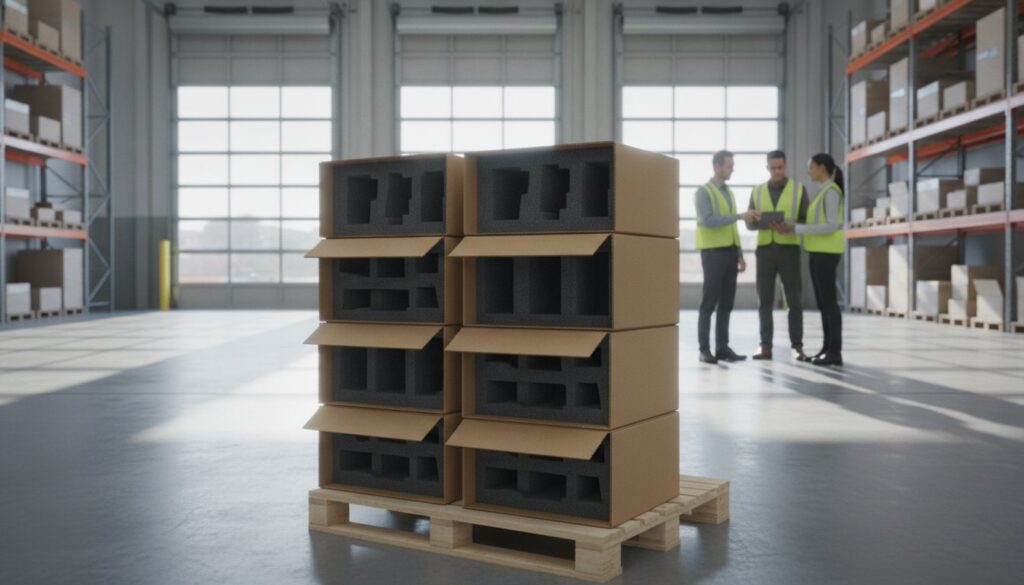
A poorly engineered foam insert is more than a packaging failure; it’s a direct tax on your manufacturing throughput and bottom line. When sourcing bulk foam packaging inserts for manufacturing, the difference between a functional cushion and a precision-engineered component determines whether your assembly line stays on schedule or grinds to a halt due to inconsistent tolerances. You likely recognize that high labor costs during kitting and the constant pressure of storage space constraints are often the result of reactive procurement rather than strategic planning.
This guide provides the technical framework and logistical insights needed to master high-volume foam procurement while reducing product damage and operational overhead. We’ll examine how to align material selection with transit realities, optimize warehouse footprints through Just-in-Time (JIT) delivery, and ensure technical compliance for sensitive aerospace and medical applications. This overview provides a clear path to transforming your packaging from a commodity expense into a streamlined asset for your Southern California operations.
Key Takeaways
- Determine the optimal material density and cell structure to balance moisture resistance with G-force protection for high-value electronics and aerospace parts.
- Choose between die-cutting and CNC routing based on your production volume to balance precision requirements with per-unit manufacturing costs.
- Leverage Vendor-Managed Inventory (VMI) and Just-in-Time (JIT) delivery to eliminate warehouse bottlenecks caused by the large physical footprint of bulk foam packaging inserts for manufacturing.
- Reduce assembly line labor costs by integrating custom foam inserts into pre-configured packaging kits designed for rapid, error-free kitting.
- Evaluate potential partners based on their ability to provide technical material compliance and consistent batch quality for large-scale industrial programs.
The Role of Engineered Foam Inserts in Modern Manufacturing
Industrial production requires more than just a box. It demands a repeatable, high-precision solution. Bulk foam packaging inserts for manufacturing are technical components that dictate the success of your logistics chain. While generic foam might vary in density or dimension from one batch to the next, engineered inserts maintain strict tolerances. This consistency ensures that every unit coming off the line fits into its protective housing without force or adjustment. In high-volume environments, this reliability prevents the micro-delays that eventually lead to significant production bottlenecks.
The financial impact of hidden packaging costs often outweighs the price of the material itself. Inefficient inserts drive up labor expenses through increased handling time. If a packer must struggle with a poorly cut insert, those extra seconds per box add up to hundreds of man-hours over a large production run. Additionally, inconsistent Package cushioning can lead to expensive returns and damaged reputations. Transitioning from generic cushioning to engineered bulk foam packaging inserts for manufacturing allows you to control these variables. It moves your procurement strategy from reactive damage control to proactive operational optimization.
Beyond Basic Protection: Operational Efficiency
Engineered inserts do more than protect; they optimize the kitting process. By designing foam to serve as an assembly jig, you provide workers with a clear, intuitive template for part placement. This reduces touch time per package, which is a critical metric for high-speed manufacturing lines. When these inserts are perfectly paired with corrugated boxes, the entire packaging workflow becomes a streamlined extension of the assembly line. This synergy reduces the physical footprint of the packing station and allows for faster throughput without increasing headcount.
Industry-Specific Requirements
Specific industries have rigid requirements that commodity foam cannot meet. In the aerospace sector, precision fit is mandatory for mission-critical hardware to prevent vibration damage during transit. Medical device companies require cleanroom-compatible materials that won’t shed particles or compromise sterile devices. Electronics manufacturers rely on specialized ESD foam to bleed off static charges that could destroy sensitive components. Each of these applications requires a partner who understands material science and regulatory compliance. We provide these technical solutions for OEMs across Southern California, ensuring that rigorous specifications are met at every scale.
Technical Material Selection: Polyethylene vs. Polyurethane
Specifying the correct polymer is the most critical decision in the procurement process. Selecting bulk foam packaging inserts for manufacturing requires an understanding of how material density correlates with G-force protection. Density isn’t just about weight; it dictates the deceleration rate of a product during a drop. If the foam is too soft, the product bottoms out. If it’s too rigid, the shock transfers directly to the internal components. Achieving the right balance ensures your sensitive electronics or heavy industrial parts arrive without internal calibration shifts or surface marring.
Material structure also impacts long-term durability and environmental resistance. Closed-cell foams provide a moisture barrier and superior load-bearing capacity, while open-cell foams offer high-performance cushioning for lightweight, fragile items. For a deeper dive into these technical differences, you can review our Packaging Foam Comparison for detailed engineering data. Choosing the right material profile early in the design phase prevents costly over-packaging or, worse, under-protection.
Polyethylene (PE) for Heavy-Duty Protection
Polyethylene is a closed-cell, chemically inert foam that serves as the industry standard for high-vibration industrial environments. It’s exceptionally durable and resists the absorption of oils and lubricants, making it ideal for automotive and heavy machinery sectors. For mission-critical applications in the medical and aerospace fields, we often recommend Cross-linked polyethylene (XLPE). This material features a finer cell structure that won’t shed particles, ensuring cleanliness in sensitive environments while maintaining high-level impact protection.
Polyurethane (PU) for Fragile Components
Polyurethane is an open-cell foam known for its versatility and soft touch. It’s the preferred choice for delicate instruments, glass components, and lightweight electronics that require a gentle “cradle” rather than rigid support. PU is available in various formats, including solid sheets and convoluted (egg-crate) profiles for bulk shipping. To protect computer chips and circuit boards, we provide anti-static (ESD) formulations that prevent the buildup of triboelectric charges during transit. If you’re unsure which formulation fits your specific G-force requirements, you can request a technical consultation to review your product specifications.
Operational efficiency in Southern California manufacturing hubs depends on these technical nuances. Whether you are shipping from Orange County or distributing across the Inland Empire, matching the foam chemistry to the transit environment is the only way to guarantee repeatable results across high-volume batches.
Specifying Custom Foam Inserts for High-Volume Programs
High-volume production demands a rigorous engineering phase to prevent cascading failures across your supply chain. When procuring bulk foam packaging inserts for manufacturing, you must move beyond basic measurements and adopt a data-driven specification process. Precision begins with CAD design. These digital files allow for the creation of rapid prototypes, giving your engineering team the opportunity to verify fit and function before committing to a full production run. This proactive approach identifies interference points or insufficient cushioning that could otherwise lead to widespread product damage.
To secure an accurate technical quote, procurement professionals should provide the exact dimensions, weight, and “fragility level” of the component. Fragility is typically measured in Gs, representing the maximum acceleration the product can withstand without failure. This metric dictates the required foam thickness and density. For manufacturers in Los Angeles County or the Inland Empire, getting these specifications right the first time is the only way to avoid the hidden costs of transit damage and line stoppages.
The Engineering and Design Process
Industrial validation requires more than a visual inspection. We utilize iterative testing, including drop tests and vibration analysis, to ensure your components remain secure under the specific stresses of your distribution model. Designing for multi-pack configurations is another critical step. By maximizing shipping container density, you reduce the total number of shipments and lower your overall freight spend. For a comprehensive look at these engineering standards, refer to our Industrial Guide to Foam Inserts.
Cost Optimization Strategies
Efficiency in bulk procurement is often found in the material you don’t use. We utilize advanced nesting techniques during the die-cutting process to minimize material waste and lower the per-unit price for high-volume runs. While CNC routing is an excellent choice for rapid prototyping or low-volume aerospace parts, die-cutting remains the superior method for manufacturing thousands of identical inserts with high repeatability. This process ensures that the first insert in a batch is identical to the ten-thousandth.
Standardizing foam footprints across multiple product lines is another effective way to leverage volume pricing. If a single insert design can accommodate three different product SKUs through modular cutouts, you consolidate your inventory and increase your purchasing power. This strategy is particularly effective for Southern California OEMs looking to streamline their warehouse operations in Orange County and San Diego County. By reducing the number of unique packaging components, you simplify the assembly process and reduce the risk of kitting errors on the production floor.
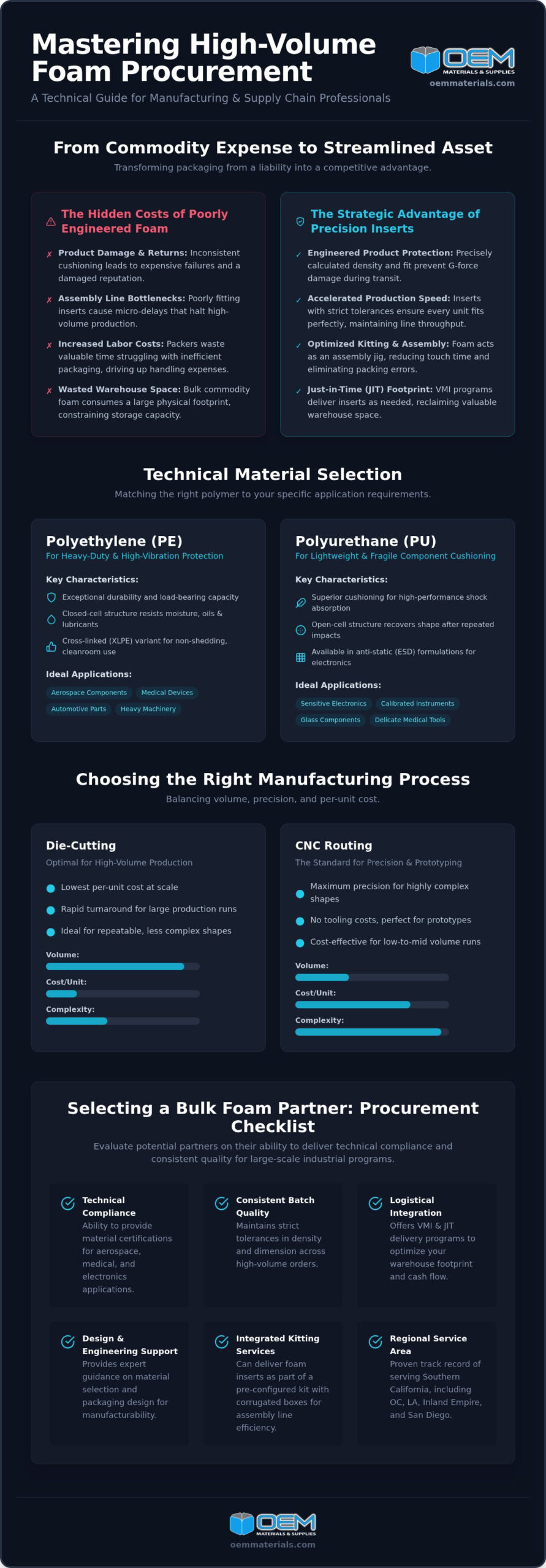
Logistical Integration: VMI and JIT for Bulk Foam
Bulk foam is notoriously difficult to store. Because it’s lightweight yet voluminous, it consumes expensive pallet positions that would be better utilized for finished inventory or high-value raw materials. For operations managers, managing the large physical footprint of bulk foam packaging inserts for manufacturing often leads to warehouse bottlenecks and increased overhead. This logistical paradox requires a move away from traditional bulk ordering toward a more integrated supply chain model.
Implementing a Vendor-Managed Inventory (VMI) program allows you to offload the storage burden to a partner who understands your production rhythms. Instead of dedicating hundreds of square feet to empty boxes and foam, you receive exactly what you need for the week’s production. This Just-In-Time (JIT) approach ensures that your packaging arrives in sync with your assembly schedule, maximizing cash flow and minimizing the risk of inventory obsolescence. By aligning packaging arrivals with actual production demand, you eliminate the “dead space” in your warehouse.
Southern California Supply Chain Advantages
Manufacturers in the Southern California region face unique real estate and logistical constraints. Sourcing from a regional partner provides a distinct edge for factories in Los Angeles, Orange County, and San Diego. Regional proximity drastically reduces lead times and eliminates the high freight costs associated with shipping “air” across the country. For facilities in Riverside and the Inland Empire, local emergency stock management allows for rapid production ramps without the 4-6 week lead times typical of distant suppliers. This local responsiveness is critical when market demand shifts unexpectedly.
Kitting and Assembly Services
Reducing internal labor is the next step in optimizing your secondary packaging process. We provide kitting and assembly services that deliver pre-configured solutions directly to your production floor. By pre-inserting foam into corrugated boxes, you save significant “touch time” on the assembly line. These custom packaging kits can combine foam, boxes, and stretch film into a single, ready-to-use SKU. This “one-touch” philosophy reduces packaging waste at the point of assembly and ensures that your line workers focus on high-value tasks rather than manual material handling. To see how these logistical strategies can be applied to your specific volume requirements, request a quote today.
Selecting a Bulk Foam Partner: Procurement Checklist
Selecting a supplier for bulk foam packaging inserts for manufacturing is a strategic decision that directly impacts the reliability of your distribution network. A technical partner should provide more than a price list; they must offer engineering depth and material expertise. Verifying certifications is the first step in the vetting process. For the aerospace and medical sectors, material compliance is a baseline requirement. You must ensure your partner can provide documented proof of medical-grade purity, aerospace-spec tolerances, or ESD-compliance for sensitive electronics. Scalability is equally critical. A partner must demonstrate the production capacity to handle rapid ramps without sacrificing batch consistency or lead times. Engaging in a Custom Foam Packaging design consultation allows you to identify these technical requirements before they become production bottlenecks.
Quality Control and Batch Consistency
High-volume manufacturing relies on repeatable accuracy. If you utilize automated assembly lines, even a minor dimensional variance in a foam insert can cause a machine jam or a misaligned component. Standardized testing protocols for foam density and cell structure are essential to ensure that the protection levels remain identical from the first pallet to the last. We maintain strict sourcing standards to ensure long-term reliability for our partners. Consistent material sourcing prevents the performance drift that often occurs when suppliers switch to lower-grade resins to save on costs. This stability is vital for manufacturers in Los Angeles County and Orange County who operate on lean margins and cannot afford the downtime associated with defective packaging.
Next Steps for Manufacturing Procurement
Moving from a technical specification to a production-ready solution requires a structured approach. To facilitate an accurate quote, procurement teams should gather specific technical data including the weight, dimensions, and fragility rating of the product. We recommend requesting a prototype for line-testing and transit validation before committing to high-volume production. This phase allows your team to verify that the bulk foam packaging inserts for manufacturing perform as expected under real-world stress conditions.
If you are looking to optimize your packaging supply chain in San Diego County or the Inland Empire, contact OEM Materials & Supplies for a high-volume manufacturing quote. We provide technical consultations to help you navigate material selection and logistical integration. Please provide your product dimensions, component weight, and estimated annual usage to help our engineering team develop a solution that reduces damage rates and lowers your total cost of ownership.
Optimizing Your High-Volume Packaging Strategy
Effective procurement requires a shift from viewing foam as a simple commodity to treating it as a precision-engineered component. By aligning material density with product fragility and leveraging logistical strategies like VMI, you can significantly reduce both transit damage and warehouse overhead. High-volume programs succeed when engineering consistency is matched with supply chain reliability. If you support aerospace hardware in Los Angeles or medical device manufacturing in Orange County, securing the right bulk foam packaging inserts for manufacturing is essential for maintaining assembly line speed.
We provide full-service design and engineering support to ensure your specific requirements are met across every production batch. Our team at OEM Materials & Supplies serves automotive, medical, and aerospace OEMs with JIT delivery programs across Southern California, including San Diego and the Inland Empire. To move your project from a CAD design to a high-volume production run, Request a Technical Consultation for Bulk Foam Inserts. Providing your annual usage and product dimensions will allow us to develop an accurate recommendation for your facility. We look forward to partnering with you to streamline your industrial packaging operations.
Frequently Asked Questions
What is the most cost-effective foam for high-volume manufacturing?
Polyethylene (PE) is generally the most cost-effective material for high-volume industrial runs. Its closed-cell structure provides high-level protection while remaining compatible with high-speed die-cutting processes. This manufacturing efficiency lowers the per-unit cost compared to complex multi-layer designs. The total cost of ownership also depends on nesting techniques used during production to minimize material scrap and maximize the number of inserts per foam sheet.
How do I choose between polyethylene and polyurethane foam inserts?
Base your selection on product weight and sensitivity. Polyethylene is a rigid, closed-cell foam ideal for heavy industrial components or aerospace parts that require firm support and moisture resistance. In contrast, Polyurethane is a soft, open-cell foam designed to cradle lightweight, fragile instruments. If your product has finished surfaces prone to scratching, Polyethylene’s non-abrasive properties often make it the superior technical choice for industrial applications.
Can custom foam inserts be designed to work with automated assembly lines?
Yes, custom inserts are frequently engineered to integrate with automated assembly and robotic kitting systems. Achieving this requires strict dimensional tolerances and CAD-driven designs that ensure every insert is identical. By maintaining these tolerances, manufacturers can use foam as a precision jig, allowing sensors and robotic arms to identify part orientation accurately. This level of precision is critical for high-speed electronics and automotive production lines.
What technical data do I need to provide for a bulk foam insert quote?
To receive an accurate technical quote, you should provide the physical dimensions, total weight, and fragility rating of your product. Knowing the fragility, or G-force limit, helps engineers determine the necessary foam density and thickness. You should also include your estimated annual usage. This data allows your supplier to recommend the most efficient manufacturing method, such as die-cutting for high-volume orders versus CNC routing for prototypes.
How does Vendor-Managed Inventory (VMI) work for bulky foam packaging?
Vendor-Managed Inventory (VMI) allows your supplier to take responsibility for maintaining your stock levels. For bulky items, this means your partner stores the bulk of the inventory at their facility and delivers bulk foam packaging inserts for manufacturing only when your production schedule requires them. This just-in-time approach eliminates warehouse bottlenecks and frees up valuable floor space in Southern California facilities where real estate costs are high.
Are there anti-static foam options for high-volume electronics shipping?
Specialized anti-static and ESD-safe foams are available for high-volume electronics shipping. These materials are chemically treated to prevent the buildup of static electricity, which can destroy sensitive microchips and circuit boards. You can choose between pink anti-static polyurethane for cushioning or black conductive polyethylene for more rigid support. These options ensure that your components remain safe from both physical impact and triboelectric discharge during the transit process.
What are the typical lead times for custom foam prototypes in Southern California?
Lead times for custom prototypes in Southern California typically range from three to seven business days, depending on the complexity of the design. Because we serve hubs like Orange County and the Inland Empire, local prototyping avoids the delays associated with long-distance shipping. Rapid prototyping allows your engineering team to perform immediate drop tests and fit-checks, ensuring the design is validated before you commit to a high-volume manufacturing run.
How do custom foam inserts reduce overall shipping costs?
Custom foam inserts reduce shipping costs by optimizing the dimensional weight of your packages. By precisely cradling the product, you can often use smaller corrugated boxes and eliminate the need for excessive filler materials like bubble wrap or packing peanuts. Additionally, reducing damage rates through better engineering lowers the significant costs associated with returns, replacements, and secondary freight. This efficiency improves your overall logistics margins across large-scale distribution programs.