
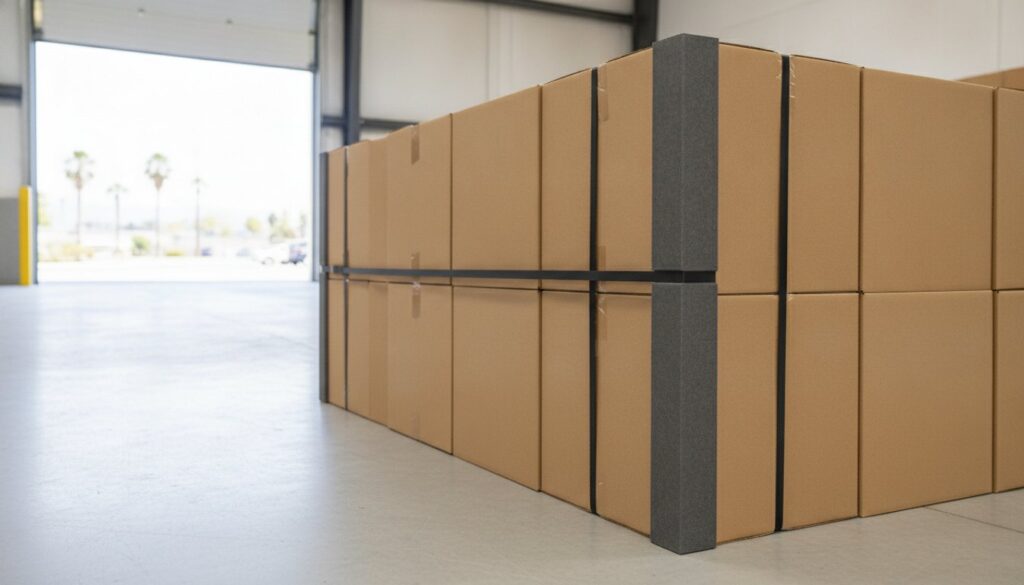
A single over-tensioned strap can compromise the structural integrity of an entire pallet before it even leaves the loading dock. When operations teams apply the force necessary to prevent shifting during Southern California transit, they often inadvertently crush the very products they are trying to protect. You understand that maintaining the balance between load stability and product safety is a constant challenge for high-volume distribution centers. Utilizing the correct edge protectors for shipping orange county logistics ensures your vertical strength remains intact while allowing for the tension required to secure heavy loads.
Standardizing your palletizing procedures is the most effective way to reach a goal of zero shipping damage reports. With new regulations like California SB 54 mandating a 25 percent reduction in single-use plastics, selecting high-grade, recyclable paperboard protection is now a compliance necessity as well as a logistical one. This guide provides the technical insights needed to select the appropriate material thickness and length for your specific application. We will examine how to integrate these structural components into your workflow to stabilize loads, reduce material waste, and secure a reliable local supply chain that supports your manufacturing requirements across the Inland Empire and Orange County.
Key Takeaways
- Understand how edge protectors provide structural reinforcement by distributing strapping tension across a wider surface area to prevent product crushing.
- Compare the performance of paperboard, plastic, and foam edge protectors for shipping orange county distribution to match the right material to your specific load requirements.
- Identify specialized packaging specifications for the Southern California electronics and medical device sectors, including the use of cleanroom-compatible materials.
- Learn the correct sequencing for applying edge guards and stretch film to optimize vertical stacking strength and stabilize pallet loads during transit.
- Leverage local supply partnerships and vendor-managed inventory programs to reduce on-site storage costs and ensure a consistent supply of packaging materials.
Understanding the Impact of Edge Protection on Load Integrity
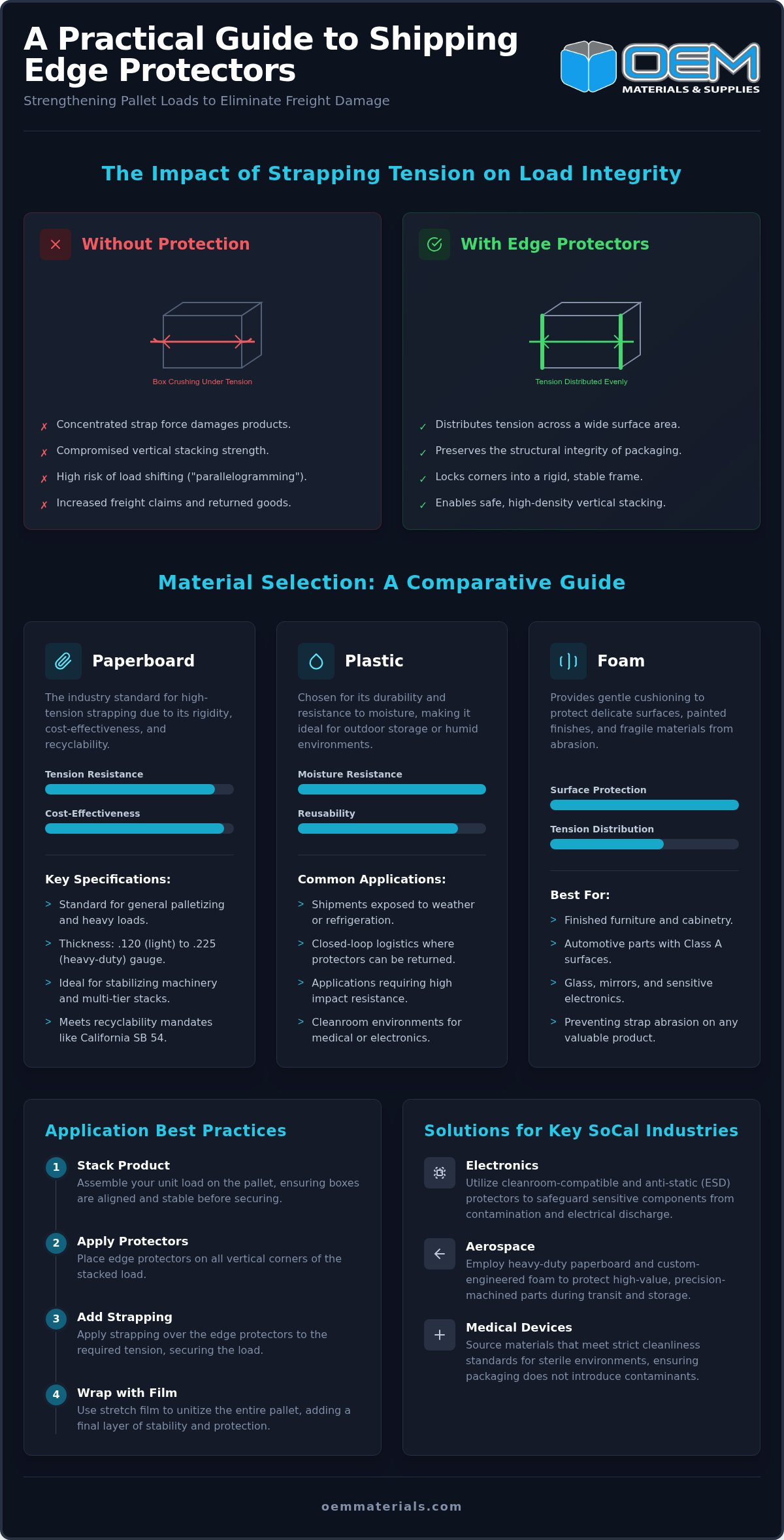
Edge protectors are not merely accessories for packaging; they are essential structural reinforcements for industrial shipments. In any high-volume unit load environment, the corners of a pallet are the most vulnerable points of failure. When operations teams apply high-tension strapping to secure a load, the force concentrates on these narrow edges. Without reinforcement, the strap often bites into the corrugated boxes or the product itself. Utilizing heavy-duty edge protectors for shipping orange county logistics allows you to distribute this tension across a significantly wider surface area. This engineering approach prevents the “sawing” effect of strapping and maintains the load’s structural profile during transit.
Selecting the right edge protectors for shipping orange county distribution centers is often the difference between a successful delivery and a rejected shipment. Carriers maintain strict requirements for load stabilization to ensure safety and efficiency. Meeting these standards reduces the frequency of insurance claims and prevents the logistical burden of processing returns. Beyond transit, these components are vital for warehouse safety. With Orange County industrial real estate rates reaching $17.09 per square foot in early 2026, maximizing vertical space is a financial necessity. Edge protectors provide the vertical compression strength needed to stack pallets safely without the bottom layers collapsing under the weight of the inventory above.
The Role of Edge Protectors in Pallet Stabilization
Stabilization involves more than just keeping items on a pallet; it requires maintaining “squareness.” When a truck makes an abrupt stop or a sharp turn on the 5 or 405 freeways, dynamic forces shift the weight of the load. If the corners aren’t reinforced, the entire pallet can “parallelogram” or lean to one side. This shifting leads to punctures, crushed corners, and potential warehouse accidents during unloading. Load stabilization refers to the maintenance of a pallet’s geometric integrity and vertical compression strength during dynamic transit forces. By locking the corners into a rigid frame, you ensure the load remains centered and stable throughout the entire supply chain.
Cost Benefits of Reducing Freight Damage
The visible cost of a damaged product is only a small fraction of the total loss. Hidden expenses include the labor required to inspect and re-process returned goods, the administrative time spent on insurance claims, and the cost of replacement shipping. For manufacturers in the aerospace or medical device sectors, damage isn’t just a financial loss; it’s a threat to long-term contracts. Reliability builds trust. When your customers consistently receive pristine shipments, you eliminate the friction that leads procurement managers to seek alternative vendors. Properly implemented protection also lowers labor costs in your receiving department, as workers don’t have to spend hours documenting damage or sorting through unstable, dangerous pallets.
Material Selection: Cardboard vs. Plastic vs. Foam Protectors
Selecting the correct material for your edge protection is a technical decision based on the specific requirements of your product and its transit environment. While paperboard is the most common industrial choice, specific applications in the Orange County medical and aerospace sectors often require specialized plastic or foam alternatives. Choosing the wrong material leads to surface abrasions, moisture damage, or structural failure under high strapping tension. You must evaluate the fragility and surface finish of your goods before finalizing your inventory of edge protectors for shipping orange county distribution cycles.
Paperboard Grades and Thickness Specifications
Paperboard protectors are the industry standard for high-tension strapping applications because of their rigid structure and predictable performance. Thickness typically ranges from light-duty .120 gauge for standard retail cartons to heavy-duty .225 gauge for stabilizing heavy machinery or multi-tier pallet loads. V-board designs are specifically engineered for corner reinforcement, providing a structural spine that prevents the corners of boxes from collapsing when stacked. From a sustainability perspective, these materials are highly desirable for Southern California manufacturers. Most paperboard protectors are fully recyclable, helping your operation comply with California SB 54 requirements for reducing single-use waste. If you are unsure which gauge your load requires, you can request a quote to get a technical recommendation based on your specific weight and dimensions.
Specialized Plastic and Foam Applications
Plastic edge guards offer unique advantages for internal logistics and environments where moisture is a factor. Unlike paperboard, plastic does not lose its structural integrity in high-humidity conditions or refrigerated storage. These guards are also effective at preventing steel or poly strapping from cutting into soft packaging materials like stretch wrap or flexible plastic containers. For high-value, sensitive components, foam packaging solutions provide a non-abrasive buffer that prevents scratches on polished surfaces.
Foam corner blocks are frequently utilized for medical devices and aerospace parts that require shock absorption as well as edge protection. These materials are often validated through ISTA Test Procedures to ensure they maintain their protective properties under the stresses of vibration and impact. While paperboard provides the best tension distribution, foam and plastic serve as critical solutions for delicate surface protection and specialized environmental conditions where traditional cardboard would fail. Standardizing the right material across your packing line reduces labor errors and ensures every shipment meets your quality standards.
Selecting Edge Protectors for Orange County Industrial Sectors
Precision is the baseline for manufacturing in the Irvine and Anaheim corridors. Standard, off the shelf packaging solutions often fail to meet the rigorous demands of Southern California’s high tech industrial sectors. When you are moving sensitive electronics or heavy aerospace components, the choice of reinforcement must be as engineered as the product itself. Procuring the right edge protectors for shipping orange county inventory requires a nuanced understanding of these localized industrial requirements. You must balance the need for maximum structural integrity with the weight constraints of regional freight to keep distribution costs manageable.
Aerospace and Automotive Requirements
Aerospace components moving through the Long Beach ports or being distributed from Inland Empire hubs require exceptional load stability. Large scale machined parts often have irregular dimensions that standard protectors cannot accommodate. Utilizing custom length edge guards allows you to secure these high value metal components without leaving vulnerable gaps in the packaging profile. For heavy machinery that exceeds the capacity of standard corrugated solutions, integrating these protectors with custom crates provides a rigid framework that prevents internal shifting. Adhering to DLA packaging and shipping standards is often mandatory for defense related aerospace contracts. These standards emphasize the necessity of commercial packaging practices that maintain unit load integrity throughout complex supply chains.
Medical Device and Electronics Shipping
The medical device sector in Orange County operates under strict compliance standards that extend to the shipping dock. Sterile environments require packaging materials that do not shed fibers or harbor contaminants. In these applications, non-abrasive plastic or specialized foam edge protection is preferred over standard paperboard. These materials protect the delicate exterior finishes of diagnostic equipment from the friction caused by transit vibrations. Integration is key for electronics shipping. By combining edge guards with precision cushioning materials, you create a multi layered defense system. The edge protectors maintain the “box” shape under strapping pressure, while the internal cushioning absorbs the G-forces of transit. This synergy is essential for eliminating the micro-cracks and board failures that plague sensitive electronic assemblies.
Efficiency in regional SoCal distribution also depends on material weight. Every ounce added to a pallet increases the fuel surcharge and overall freight expense. Selecting the highest grade material at the thinnest possible gauge allows you to maintain protection levels while minimizing the impact on your shipping budget. We work with operations managers to verify that their choice of edge protectors for shipping orange county logistics meets both the technical protection requirements and the financial goals of the organization. This data driven approach ensures your packaging remains a value added component of your supply chain rather than a recurring overhead loss.
Practical Guidance: Integrating Protectors with Strapping and Film
Correct application is as critical as material selection. Even the highest grade components will fail if the sequencing and placement are incorrect. When securing a pallet, vertical protectors serve as structural columns, providing the reinforcement necessary to prevent the crushing of bottom layer boxes when loads are double stacked. This is a common failure point in high volume distribution centers where warehouse space is at a premium. By utilizing edge protectors for shipping orange county inventory, you ensure that the tension from poly or steel strapping is distributed vertically through the protector rather than horizontally through your product.
Horizontal protectors are equally vital for securing the top layer of a pallet. Without them, over tensioned straps often bite into the upper corners of the corrugated boxes, leading to compromised structural integrity before the truck even leaves the dock. The sequence of application must be disciplined. You should place the edge guards first, secure them with initial strapping to lock the frame in place, and then apply the final wrap. This methodical approach creates a unified unit load that resists shifting during the frequent stops and starts of local Southern California transit.
Optimizing Pallet Wrapping Procedures
Edge protectors significantly improve the performance of stretch film by maintaining the square footprint of the pallet. Without corner reinforcement, high performance film can cause an “hour glassing” effect, where the center of the load is pulled inward while the top and bottom corners remain loose and vulnerable. To secure a standard 48×40 pallet effectively, follow this procedure:
- Align vertical protectors on all four corners, ensuring they extend from the pallet base to the top of the load.
- Place horizontal guards along the top edges if you are using cross strapping.
- Apply tensioned strapping to secure the protectors firmly against the load.
- Apply stretch wrap starting at the base, overlapping the film by 50 percent as you move upward to seal the protectors into the load.
Tooling for High Volume Operations
Consistency is the primary challenge in high volume warehouse environments. For operations moving diverse product lines, edge protector cutters allow staff to trim standard lengths to match the specific height of custom loads on the fly. This reduces material waste and ensures every corner is fully protected. While manual application is standard for many, automated applicators can be integrated into high speed wrap lines to increase throughput and ensure precise placement every time. Training your staff on these consistent placement techniques is essential for maintaining uniform load integrity across all shifts. To optimize your palletizing workflow and receive a technical assessment of your current packing line, request a quote for a customized protection strategy tailored to your specific edge protectors for shipping orange county requirements.
Sourcing Local Edge Protectors in Orange County
Proximity is a strategic asset in modern supply chain management. Storing bulky packaging materials like edge protectors consumes valuable floor space in facilities across Anaheim, Irvine, and Santa Ana. With Orange County industrial real estate rates averaging $17.09 per square foot in early 2026, every pallet position used for packaging inventory represents a significant overhead cost. Selecting a local partner for edge protectors for shipping orange county distribution ensures your supply chain remains lean and responsive. Just-in-time delivery models allow you to receive materials exactly when they are needed for the production floor, effectively turning your supplier’s warehouse into your own off-site inventory reserve.
Local expertise also facilitates on-site packaging audits. We visit manufacturing facilities to observe the packing line in action, identifying common issues like material waste from over-wrapping or damage risks caused by improper corner reinforcement. These audits often reveal that a simple change in material gauge or length can yield better protection while reducing overall material consumption. When your product dimensions are unique, a local partner can provide custom design services and rapid prototyping for specialized inserts, ensuring your edge protectors for shipping orange county logistics are perfectly calibrated to your specific unit loads.
The VMI Advantage for SoCal Manufacturers
Stockouts of critical shipping supplies can halt an entire production line. Our VMI services eliminate this risk by placing the responsibility for inventory replenishment on the supplier. We monitor your usage levels and restock your edge protectors, stretch film, and corrugated boxes before they reach a critical low. This proactive approach consolidates billing and significantly reduces procurement overhead, as your team no longer needs to spend hours managing multiple purchase orders for commodity items. For industries with seasonal manufacturing peaks, VMI ensures that inventory levels are automatically optimized to meet increased demand without requiring manual intervention from your purchasing department.
Partnering with OEM Materials & Supplies
Reliability is the foundation of a successful industrial partnership. By working with OEM Materials & Supplies, you gain direct access to experienced packaging engineers who understand the complexities of Southern California’s aerospace, medical, and electronics sectors. We don’t just provide materials; we provide engineered solutions that integrate seamlessly with your existing custom corrugated and foam packaging. This holistic view of the shipping container ensures that every component, from the external edge guards to the internal cushioning, works in unison to prevent damage. To receive a technical recommendation and a quote tailored to your operation, please contact us with your product dimensions, weight, and estimated annual usage. Our team will provide a detailed assessment of the material grades and thicknesses required to stabilize your pallet loads and protect your bottom line.
Optimizing Your Distribution Strategy with Engineered Protection
Achieving zero shipping damage requires a shift from viewing packaging as a commodity to treating it as a structural requirement. Implementing the correct edge protectors for shipping orange county loads ensures that your vertical stacking strength remains consistent while protecting your high-value inventory from strapping tension. Whether you are moving sensitive medical electronics in Irvine or heavy aerospace machined parts through the Inland Empire; the synergy between material selection and application sequencing is the key to maintaining unit load integrity.
OEM Materials & Supplies supports your operations with local Orange County inventory for rapid fulfillment and specialized solutions for the most demanding industrial sectors. We offer expert on-site packaging audits to identify material waste and eliminate damage risks before they impact your bottom line. Our team is ready to help you standardize your palletizing procedures and reduce warehouse overhead through vendor-managed inventory programs that prevent costly stockouts.
To receive a technical assessment and a customized proposal, please request a quote for industrial edge protectors today. Providing your product dimensions, approximate weight, and annual usage data will allow our engineers to provide the most accurate recommendation for your facility. We look forward to securing your supply chain.
Frequently Asked Questions
What is the most common size for industrial edge protectors?
Standard industrial edge protectors typically utilize leg lengths of 2 inches by 2 inches or 3 inches by 3 inches. Common thicknesses include .120, .160, and .225 gauge, depending on the required vertical compression strength. While 48 inch lengths are standard for 48×40 pallets, custom lengths are frequently produced to match specific load heights. Selecting the correct gauge is essential for distributing strapping tension without adding unnecessary material weight to the shipment.
Can edge protectors be recycled after use?
Paperboard edge protectors are fully recyclable and are generally treated as standard corrugated waste in Southern California facilities. This high recyclability helps manufacturers comply with California SB 54 regulations regarding single use packaging waste. Plastic guards are often designed for reusability in closed loop internal logistics; while foam protectors require specific recycling streams based on the resin type used. Most distribution centers find paperboard the most cost effective and sustainable choice for one way shipping.
Do edge protectors actually increase the stacking strength of a pallet?
Edge protectors significantly increase stacking strength by serving as structural columns at the corners of a pallet. These components transfer the weight of upper pallets directly down to the pallet base rather than through the walls of the boxes. This prevents the bottom layer from buckling under load, which is a common cause of warehouse accidents. Utilizing high grade edge protectors for shipping orange county inventory allows for safer double stacking in high density storage environments.
How do I choose between cardboard and plastic corner guards?
Choose paperboard for high tension strapping and one way shipping where recyclability is prioritized. Cardboard provides superior resistance to strap bite and is the industrial standard for most manufacturing sectors. Plastic corner guards are better suited for moisture prone environments, such as refrigerated storage, or for protecting soft packaging from being cut by poly strapping. Plastic is also preferred when you need a reusable solution for moving components between local assembly plants.
What is the difference between an edge protector and a corner guard?
Edge protectors cover the entire length of an edge to provide structural reinforcement, while corner guards or corner blocks protect only the specific 90 degree vertex. Edge protectors are primarily used for load stabilization and stacking strength across the full height of a pallet. Corner guards are often smaller, focused on preventing impact damage to a specific point. For most industrial shipments, full length edge protection is necessary to maintain the squareness of the load during transit.
How many edge protectors do I need for a standard pallet load?
A standard pallet load typically requires four vertical edge protectors, one for each corner, to ensure basic stability. If you are double stacking or using heavy strapping across the top of the load, you should add four horizontal protectors along the upper edges. This configuration creates a rigid frame that protects all vulnerable points. The specific count depends on your load height and the sensitivity of the product being shipped through the Southern California distribution network.
Can I get custom-printed edge protectors for branding?
Yes, custom printing is available for both paperboard and plastic protectors to enhance branding or communicate handling instructions. Many manufacturers print warnings such as “Do Not Double Stack” or “Fragile” directly onto the guards to ensure high value items are handled correctly during transit. This eliminates the need for additional labels and ensures that critical safety information remains visible even if the outer stretch film is removed during the receiving process at the customer’s facility.
What is the lead time for bulk orders in Orange County?
Lead times for stock edge protectors for shipping orange county facilities are typically one to two business days due to our local inventory. Custom sizes or printed orders require additional processing time depending on the specific dimensions and annual usage requirements. Local sourcing allows Southern California manufacturers to avoid the long transit delays associated with national suppliers. We recommend utilizing our vendor managed inventory services to ensure your warehouse never experiences a stockout of critical protection materials.