

The true cost of your industrial packaging isn’t found on the invoice for a corrugated box; it’s hidden in the labor hours spent on kitting and the replacement costs of damaged shipments. Most operations managers recognize that a low-cost vendor often results in expensive problems like inventory stockouts or inconsistent material quality that halts production lines. Understanding how to choose an industrial packaging partner requires looking beyond unit prices to find a consultant that prioritizes long-term operational efficiency.
Finding a reliable supplier means evaluating their ability to handle technical requirements for fragile or heavy parts while offering value-added services like vendor-managed inventory. This guide details how to evaluate technical capabilities, logistical services, and industry expertise to find a packaging partner that reduces total costs and improves supply chain efficiency. We will examine the specific criteria necessary to vet a supplier, from rapid prototyping in Southern California to high-volume manufacturing for the aerospace, medical, and electronics sectors.
Key Takeaways
- Learn why a strategic partnership is essential for uncovering hidden costs like shipping damage and excessive warehouse labor.
- Discover how custom-engineered materials like specialized foam inserts and wood crates protect heavy or fragile industrial components.
- Understand how to choose an industrial packaging partner that integrates directly with your production schedule through VMI and kitting services.
- Identify the specific technical requirements needed for high-compliance sectors, including aerospace, medical devices, and electronics.
- Learn the key audit steps to verify a supplier’s ability to scale from initial prototypes to high-volume production.
Shifting from a Packaging Vendor to a Strategic Partner
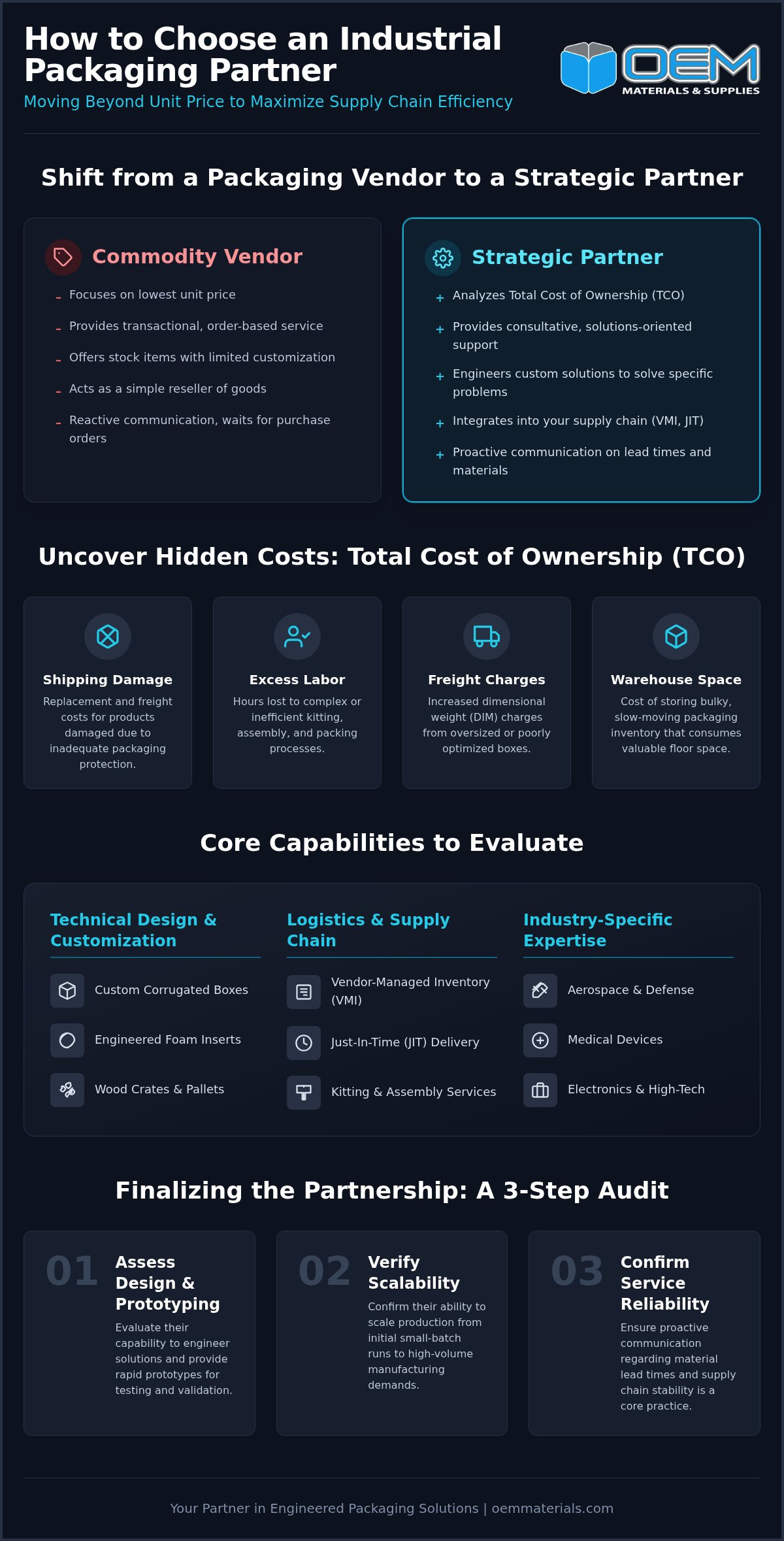
Buying a corrugated box is a simple transaction. Developing a relationship with a strategic partner is an investment in your operational bottom line. When evaluating how to choose an industrial packaging partner, the focus must shift from unit price to the total value of the supply chain. A commodity vendor simply waits for a purchase order and ships what is requested. A partner analyzes your specific workflow to identify where material waste or excessive labor is eroding your margins. Understanding how to choose an industrial packaging partner means looking for a supplier that manages your inventory as effectively as they manage their own production schedules.
Price per unit is a misleading metric for procurement professionals. It doesn’t account for the replacement cost of a product damaged because of inadequate cushioning materials or the hours warehouse staff spend struggling with poorly designed crates. A strategic partner acts as a consultant, helping you mitigate risks like material shortages or sudden lead time shifts that can halt a production line. They provide stability in an unpredictable market by securing raw materials and offering technical expertise that a basic reseller cannot match.
The Impact of Packaging on Total Cost of Ownership
Total cost of ownership (TCO) includes every dollar spent from the moment a box arrives at your facility in Orange County until the final product reaches the end user. Inefficient packing processes often lead to high labor costs that far outweigh any savings on material prices. If your team takes five minutes to assemble a kit when a custom design could do it in two, you’re losing money. Analyzing your TCO helps identify where optimized dimensions can reduce freight and dimensional weight charges. Key factors that influence TCO include:
- Replacement and freight costs for shipping damage and returns.
- Labor hours associated with complex kitting and assembly.
- Dimensional weight charges from oversized or unoptimized boxes.
- The cost of warehouse space used to store bulky, slow-moving inventory.
Identifying Gaps in Your Current Supply Chain
Many manufacturers in the Inland Empire and San Diego County realize their current supplier is insufficient when production scales or technical requirements become more complex. If your vendor only executes orders without providing custom packaging design support, they are a bottleneck rather than an asset. A sophisticated partner functions similarly to a contract packager, offering technical expertise that prevents stockouts and quality issues. Proactive communication regarding material lead times is a hallmark of a reliable partner. If you’re constantly chasing your supplier for updates on stretch film or tape, your current supply chain has a significant gap in reliability and service.
Evaluating Technical Design and Customization Capabilities
High-value industrial parts require more than stock solutions. When deciding how to choose an industrial packaging partner, technical proficiency in material science is non-negotiable. A partner should understand the interaction between different substrates to ensure maximum protection with minimum material volume. This expertise often aligns with standards set by the Industrial Packaging Alliance of North America. It’s about creating a cohesive system where primary and secondary packaging work together to eliminate movement and absorb shock. A supplier that handles both levels of packaging ensures that your internal components aren’t just sitting in a box but are secured within an engineered environment.
Engineering for Protection: Corrugated and Foam Synergy
Selecting the appropriate fluting for corrugated boxes is the first step in managing heavy-duty loads. However, corrugated alone is rarely enough for sensitive aerospace or medical components. This is where engineered foam inserts become critical. Polyethylene or polyurethane foams are shaped to the exact geometry of your part, providing deceleration during impact. For multi-component shipments, integrating edge and corner protectors ensures that even if the outer container is compromised, the structural integrity of the internal load remains intact. This synergy between materials prevents shipping damage that often results in costly returns and production delays.
Prototyping and Testing for Industrial Applications
Theoretical design is only the starting point. Rapid prototyping allows engineers to physically handle the packaging before committing to high-volume production. This is especially vital for manufacturers in Southern California who need to move quickly from R&D to market. A capable partner performs rigorous drop tests and vibration analysis to simulate the harsh conditions of the LTL (Less-Than-Truckload) shipping environment. These tests verify that the design holds up under real-world stress.
Effective custom packaging design doesn’t just protect; it optimizes. Over-engineering leads to excess material costs and higher shipping fees. By precisely matching the material density to the product’s fragility, a partner helps you achieve a lower total cost of ownership. If you have specific dimensions or weight requirements, you can request a quote to see how an engineered approach compares to your current stock solution. This level of technical scrutiny is a primary factor in how to choose an industrial packaging partner that can truly scale with your business.
Assessing Logistics, VMI, and Supply Chain Integration
A technically superior design is only effective if the materials are available exactly when the production line requires them. When evaluating how to choose an industrial packaging partner, you must look at their ability to integrate with your specific logistics framework. A vendor that simply drops off a truckload of pallets once a month creates a storage burden and ties up capital in sitting inventory. A true partner manages the flow of materials to match your actual output, reducing the footprint of packaging on your production floor and ensuring your warehouse remains organized and efficient.
Regional delivery networks are essential for maintaining this level of support. For manufacturers in the Inland Empire, Orange County, and San Diego County, proximity allows for rapid response to production surges or design changes. This logistical agility prevents the delays common with suppliers who ship from across the country. By leveraging a partner to handle labor-intensive prep work and inventory tracking, you can reallocate your internal resources toward core manufacturing activities.
Vendor Managed Inventory (VMI) and JIT Delivery
Inventory stockouts are a primary pain point that can halt a production line. Implementing VMI services shifts the responsibility of monitoring stock levels to the supplier. Your partner tracks usage and replenishes items like corrugated boxes or stretch film before they run out. This eliminates the administrative overhead of constant reordering and prevents emergency shipments that inflate freight costs.
The benefits of Just-In-Time (JIT) packaging delivery are particularly valuable for lean manufacturing environments. By utilizing a partner’s regional warehouse space, you free up square footage that would otherwise be consumed by bulky packaging materials. This approach is supported by efficiency standards often discussed by organizations like the Reusable Industrial Packaging Association, which focuses on the lifecycle and management of industrial containers. JIT delivery ensures that materials arrive in the precise quantities needed for the day’s production run, minimizing waste and maximizing floor space.
Kitting and Assembly Services to Reduce Labor Costs
Moving assembly off your production line and into the hands of your supplier is a high-impact strategy for cost reduction. When you receive complete Packaging Kits containing all necessary components, your warehouse team can focus on packing rather than hunting for individual pieces. A kit might include custom foam, edge protectors, and the outer container, all delivered as a single unit ready for immediate use.
In Southern California, speed-to-market is a critical competitive advantage for industries like electronics and medical device manufacturing. For example, a company in Los Angeles County might use kitting to streamline the fulfillment of complex assemblies. By receiving pre-assembled kits, they significantly reduce the time spent at the pack-out station. This allows for higher daily throughput without the need for additional headcount. This level of logistical integration is a primary factor in how to choose an industrial packaging partner that functions as an extension of your own operation.
Industry-Specific Expertise and Regional Reliability
Generic packaging vendors often prioritize volume over precision. In high-compliance sectors, this lack of specialization leads to rejected shipments or catastrophic product failure. When determining how to choose an industrial packaging partner, you must evaluate their specific experience with the regulatory and technical standards of your industry. For example, electronic components require precise Electrostatic Discharge (ESD) protection to prevent latent damage during transit. Similarly, shipping heavy machinery requires a partner who understands load distribution and the structural integrity of wood crates and plastic pallets.
A partner’s ability to handle oversized equipment or high-value instrumentation is a benchmark of their reliability. They should act as a consultant that understands the difference between a standard shipping container and a specialized industrial solution. This expertise ensures that your packaging meets both internal quality standards and external compliance requirements. Reliability isn’t just about making a box; it’s about understanding the environment that box will inhabit.
Specialized Requirements for Aerospace, Medical, and Electronics
The medical and aerospace sectors operate under rigorous quality management systems. A supplier must understand the nuances of sterile packaging for medical devices to ensure that the integrity of the product is maintained from the cleanroom to the operating room. Generic suppliers often fail here because they lack the controlled environments or material knowledge necessary for such sensitive applications.
Aerospace instrumentation requires a different level of engineering. Custom foam inserts must be designed with specific G-force ratings in mind to protect delicate sensors and electronics. Cleanroom-compatible packaging is another critical requirement. Materials must be low-sloughing and free of contaminants that could compromise electronic component manufacturing. If your supplier doesn’t understand these distinctions, your product safety is at risk.
The Importance of Local Southern California Support
Geographic proximity is a strategic asset. Working with a supplier located within the Southern California manufacturing corridor provides advantages that a nationwide vendor cannot replicate. Whether your facility is in Orange County, Los Angeles County, or San Diego County, local support means faster response times for design changes and urgent orders. You don’t have to wait for a shipment to cross several state lines while your production line sits idle.
Local proximity directly reduces freight costs and transit times within the Inland Empire and surrounding areas. It also facilitates on-site consultations where an engineer can physically inspect your production line to suggest improvements. Rapid physical prototyping becomes much more efficient when the design team is only a short drive away. This local presence is a vital component in how to choose an industrial packaging partner that can keep pace with the speed of SoCal industry. If you’re ready to evaluate a partner that understands these regional and technical demands, you can request a quote for custom industrial packaging to begin the process.
Finalizing the Partnership: Selection Criteria
The process of how to choose an industrial packaging partner concludes with a formal audit of their manufacturing capabilities and quality management systems. A facility visit is non-negotiable. It allows you to verify that their production standards align with your technical requirements. You should look for organized assembly areas, clear labeling, and rigorous quality control checkpoints. Establishing communication protocols at this stage is vital. You need to know who your primary point of contact will be and how they handle urgent design revisions or production spikes in facilities across Orange County or the Inland Empire.
Checking references within your specific industrial sector provides a level of security that a brochure cannot. If you are in the medical device or aerospace field, speak with other firms that have used their solutions for high-compliance applications. Ask about their consistency in material quality and their responsiveness during supply chain disruptions. This final due diligence ensures that the partner you select can perform reliably under the pressure of real-world manufacturing schedules.
Scalability and Capacity for High-Volume Programs
A partner might excel at producing a handful of prototypes but struggle when asked to scale to high-volume runs. You must evaluate their capacity to handle seasonal surges or rapid growth without compromising lead times. This requires a diverse material supply chain and a wide range of offerings, including corrugated packaging and wood product solutions. A supplier with limited resources creates a single-source failure risk that can jeopardize your entire production line. Ensure their equipment and labor force are capable of sustaining high-volume programs over several years.
Requesting a Quote: The Data Your Partner Needs
To receive an accurate and functional recommendation, you must provide comprehensive data during the quoting phase. Vague requests lead to generic solutions that may not protect your parts or fit your budget. When you are ready to move forward, prepare the following information:
- Exact product dimensions, weight, and identified fragile points for a design review.
- Annual usage estimates and typical order quantities for accurate pricing.
- Primary objectives, such as cost reduction, damage prevention, or labor efficiency.
Providing this data allows your partner to perform a technical analysis rather than just a price comparison. It enables them to suggest the most efficient materials and logistical programs for your specific application. Understanding how to choose an industrial packaging partner is about finding a guide that uses this data to optimize your entire supply chain from the first prototype to the final shipment.
Optimizing Your Industrial Supply Chain
Selecting a partner is about more than just finding a box manufacturer. It requires a thorough evaluation of technical design capabilities and logistical services like VMI and kitting that directly lower labor costs. By focusing on the total cost of ownership rather than unit price, you can eliminate hidden expenses related to product damage and inventory stockouts. Understanding how to choose an industrial packaging partner allows you to secure a supply chain that is resilient, scalable, and technically sound.
OEM Materials & Supplies specializes in serving the high-compliance aerospace, medical, and electronics sectors throughout Orange County, Los Angeles, San Diego, and Riverside. Our full-service programs are designed to streamline your operations and provide the expert design support required for complex assemblies. Ready to improve your operational efficiency? Contact OEM Materials & Supplies for a Custom Packaging Consultation to discuss your specific product dimensions, weight, and annual usage requirements. We look forward to helping you build a more efficient packaging workflow.
Frequently Asked Questions
What is the difference between a packaging vendor and a packaging partner?
A packaging vendor typically operates on a transactional basis, focusing solely on the unit price of items like corrugated boxes. In contrast, a packaging partner acts as a consultant to optimize your entire supply chain. They analyze your workflow to identify hidden costs and provide engineered solutions. Understanding this distinction is a critical step in how to choose an industrial packaging partner that adds long-term value to your operation.
How can a packaging partner help reduce my shipping damage?
A partner reduces damage by engineering protection around the specific fragile points of your product. They utilize materials like polyethylene foam and custom-sized crates to absorb shock and prevent movement. By conducting vibration and drop tests during the design phase, they ensure the packaging survives the LTL shipping environment. This technical approach prevents the high costs associated with returns and replacement shipments.
What is Vendor Managed Inventory (VMI) in the context of packaging?
Vendor Managed Inventory is a logistical program where your supplier takes responsibility for maintaining your packaging stock levels. The partner monitors your usage and replenishes items like stretch film or edge protectors before a stockout occurs on your floor. This service frees up your warehouse space and reduces the time your purchasing department spends on repetitive ordering tasks. It ensures that your production line never stops because of a packaging shortage.
Should I choose a local packaging supplier or a national distributor?
Local suppliers are generally preferable for manufacturers in Southern California because they offer significantly faster response times. A supplier in the Inland Empire or San Diego County can provide on-site consultations and rapid prototyping that a national distributor cannot replicate. Proximity also reduces freight costs and transit times, which is essential for maintaining a lean, Just-In-Time manufacturing schedule.
Can a packaging partner help with both custom design and stock supplies?
A full-service partner provides a comprehensive range of both custom and stock materials. They can design complex packaging kits for sensitive electronics while also supplying standard items like mailing tubes and packing tape. This consolidation allows you to manage all your requirements through a single point of contact. It simplifies your procurement process and ensures consistent quality across all your packaging components.
What information do I need to provide for a custom packaging quote?
To receive an accurate quote, you must provide the product’s exact dimensions, weight, and fragility. It’s also helpful to specify your annual usage and typical order quantities for the project. This data allows the design team to select the appropriate corrugated fluting and foam density. Providing detailed information is essential when you are learning how to choose an industrial packaging partner that can meet your specific budgetary and protection goals.
How does kitting and assembly service benefit my manufacturing line?
Kitting and assembly services move the labor of preparing packaging off your production floor. Your staff receives a single unit containing the box, foam inserts, and any necessary protectors ready for immediate use. This process reduces the time spent at the pack-out station and lowers your internal labor costs. It allows your team to focus on their core manufacturing tasks rather than folding boxes and inserting foam.
Why is material engineering important for industrial packaging?
Material engineering is the science of matching packaging properties to the physical requirements of the product. It prevents over-engineering, which adds unnecessary material costs and shipping weight. By selecting the right density of foam or the correct grade of corrugated board, engineers ensure the product remains safe without wasting resources. This precision is vital for high-compliance industries like aerospace and medical device manufacturing.