
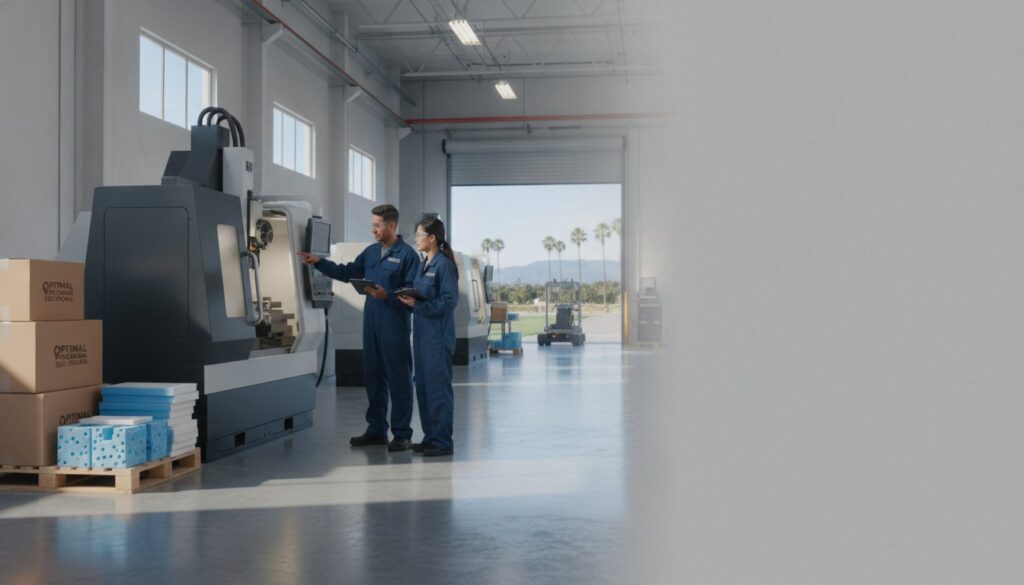
If you are paying upwards of $28 per square foot for Class A industrial space in Los Angeles, why is so much of that premium real estate occupied by stacks of empty corrugated boxes? It is a logical question for any operations manager facing the dual pressure of rising lease rates and the strict logistics regulations introduced under California AB 98. You likely already know that every pallet of packaging material sitting idle represents tied-up capital and wasted square footage that could be used for actual production.
Implementing VMI packaging programs in Los Angeles allows you to shift the burden of inventory management to a specialized partner who understands the local supply chain. We recognize that manual ordering processes and frequent stockouts create unnecessary friction in your workflow. This article outlines how a structured vendor-managed inventory program reduces carrying costs and ensures just-in-time delivery for your custom foam and corrugated needs. You will learn how to automate your replenishment cycles, optimize your warehouse footprint, and redirect your labor force toward high-value manufacturing tasks instead of counting boxes.
Key Takeaways
- VMI packaging programs los angeles transfer the responsibility of inventory monitoring and replenishment to your supplier, significantly reducing the administrative burden on procurement teams.
- Implementing a managed inventory system eliminates production delays caused by stockouts, which is critical for precision industries such as aerospace and medical device manufacturing.
- Total cost of ownership decreases when you account for lower carrying costs and reduced insurance premiums, rather than focusing solely on the unit price of corrugated boxes.
- Partnering with a local Southern California supplier ensures reliable just-in-time delivery and provides access to technical expertise for custom foam and crate design.
- A successful transition starts with a comprehensive data audit of annual usage and an optimization of packaging specifications to reduce material waste.
What is a VMI Packaging Program for Industrial Manufacturers?
A Vendor Managed Inventory (VMI) program is a strategic partnership where the supplier assumes full responsibility for maintaining agreed upon stock levels at the customer’s facility. Instead of a purchasing manager monitoring floor stock and issuing individual purchase orders, the packaging partner manages the entire replenishment cycle. To understand the technical framework of this model, procurement professionals often reference the baseline standards for What is a VMI Packaging Program for Industrial Manufacturers? as a starting point for supply chain optimization. This shift moves the administrative and logistical burden away from your internal team, allowing you to focus on core production goals.
While many confuse VMI with traditional just-in-time (JIT) delivery, the two models differ significantly in execution. JIT focuses on the timing of deliveries to reduce inventory, but the buyer still retains the responsibility for ordering. In contrast, VMI packaging programs los angeles rely on the supplier to monitor usage and trigger shipments automatically. This model is particularly effective for bulky items like corrugated boxes, custom foam packaging, and high volume shipping supplies that otherwise consume massive amounts of floor space.
The Core Mechanics of Packaging VMI
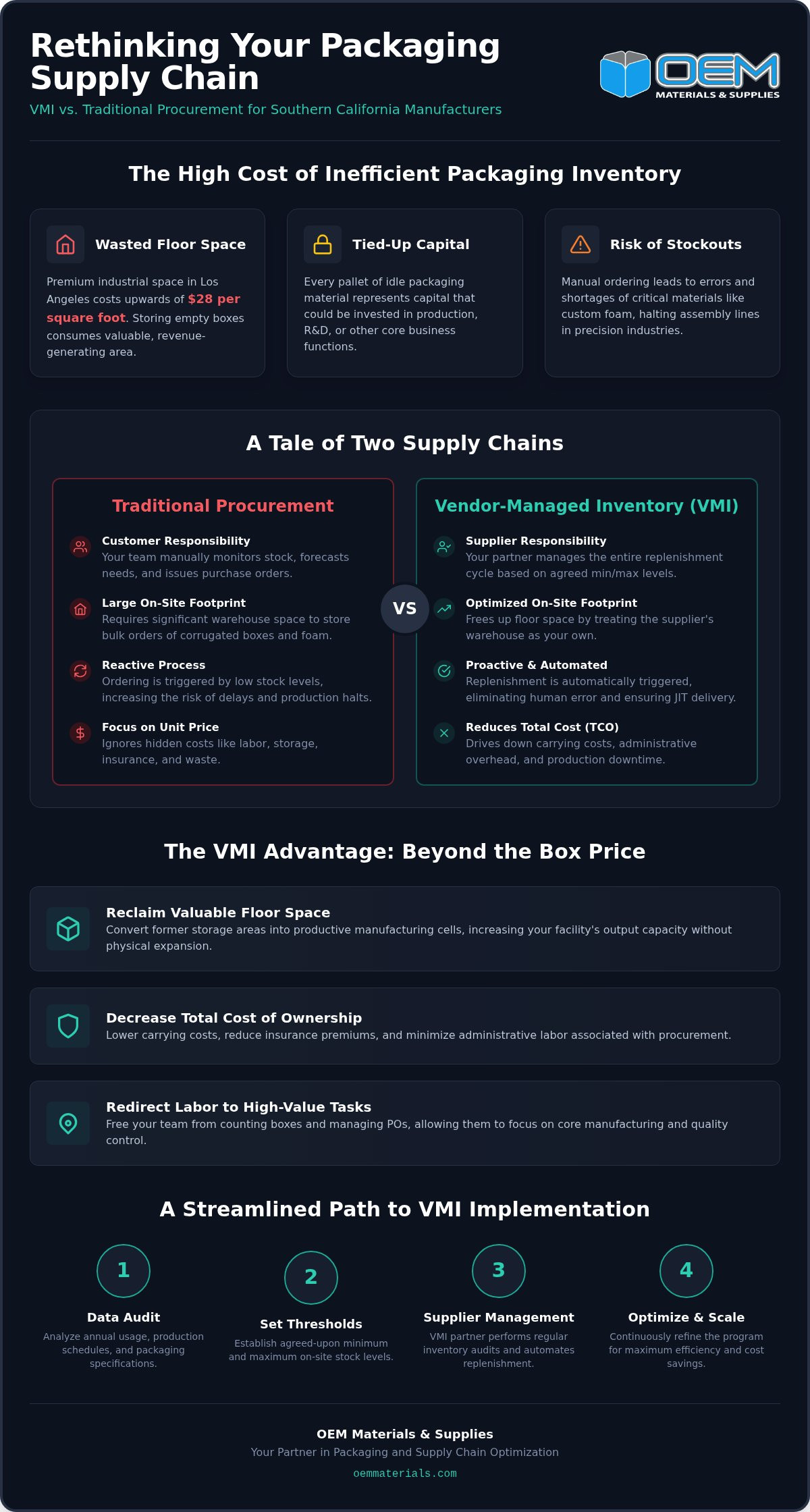
The system operates through a structured framework of minimum and maximum stock levels. We establish these thresholds by analyzing your annual usage data and production schedules. Once these levels are set, the supplier performs regularly scheduled inventory audits on your floor. When stock hits the predetermined minimum, a replenishment order is triggered without any manual intervention from your procurement department. This automation eliminates the risk of human error in the ordering process and ensures your assembly lines never stop due to a lack of packaging materials.
Why Los Angeles Manufacturers Prioritize VMI
Operating in Southern California presents unique logistical hurdles that make VMI a necessity rather than a luxury. With average industrial lease rates in Los Angeles hovering between $18.77 and $19.00 per square foot, dedicated warehouse space is an expensive asset. Manufacturers can’t afford to use that premium square footage for storing mountains of empty boxes. By leveraging a VMI partner, you effectively treat the supplier’s warehouse as your own, reclaiming valuable floor space for revenue generating machinery.
Regional regulations like California Assembly Bill 98 (AB 98) have also tightened the requirements for logistics facilities, making it harder to expand existing footprints. VMI provides a functional remedy by optimizing your current space. It also mitigates the risk of supply chain disruptions in busy corridors like the Inland Empire and Los Angeles County. By keeping a buffer of stock managed by a local partner, you insulate your operation from the volatility of port delays or freight shortages.
Operational Benefits of VMI Programs in Southern California
Operational efficiency in the Los Angeles basin requires a lean approach to every square foot of your facility. When primary floor space is occupied by mountains of empty corrugated boxes, your production capacity is artificially capped. VMI packaging programs los angeles offer a functional remedy by shifting the storage burden of bulky materials to the supplier. This transition is particularly valuable as manufacturers navigate the strict standards of California Assembly Bill 98, which imposes new distance and expansion restrictions on logistics facilities. By optimizing your current footprint, you avoid the logistical and legal hurdles of seeking new warehouse space.
Reliability is the cornerstone of high-precision sectors such as aerospace and medical device manufacturing. In these industries, a single missing component or a stockout of custom foam inserts can halt an entire production line. Vendor-managed inventory eliminates these bottlenecks by utilizing automated replenishment cycles. We monitor your usage in real time, ensuring that critical materials are always available without requiring your procurement team to track every pallet. This level of supply chain visibility allows warehouse managers to focus on throughput rather than replenishment logistics.
Space Reclamation and Efficiency
Reclaiming floor space is the most direct way to increase production capacity without signing a new lease. When you offload the storage of wood crates and large-scale cushioning materials to a managed program, you convert dead storage areas into active manufacturing zones. This strategy also reduces the need for expensive third-party logistics (3PL) off-site storage, which often introduces unnecessary freight costs and handling risks. By keeping only the immediate inventory required for the next production cycle, you maintain a cleaner, safer, and more organized facility. This transition to just-in-time packaging delivery ensures your floor remains dedicated to revenue-generating activities.
Labor Optimization and Kitting
Manual inventory management is a labor-intensive process that distracts your skilled workforce from their primary tasks. Warehouse staff often spend hours conducting cycle counts, receiving shipments, and organizing packaging supplies. A structured VMI program from OEM Materials & Supplies automates these functions, freeing up labor for assembly and quality control. This is especially beneficial for electronics and automotive assembly lines that rely on specialized packaging kits. By receiving pre-assembled kitting solutions exactly when they are needed, you streamline your internal workflow and reduce the time spent on sub-assembly. If your current replenishment process feels fragmented, you might consider how a tailored inventory assessment can identify these hidden labor drains.
VMI vs. Traditional Procurement: A Financial Comparison
Traditional procurement strategies often fail because they focus exclusively on the unit price of a box or a roll of stretch film. This narrow view ignores the Total Cost of Ownership (TCO), which accounts for every dollar spent from the moment an order is placed until the packaging leaves your facility. In high cost markets like Southern California, the purchase price is only a fraction of the actual expense. When you factor in the labor required to manage dozens of individual purchase orders and the warehouse space required to store them, the financial burden of traditional procurement becomes clear.
Implementing Vendor Managed Inventory services allows you to shift these costs back to the supplier. Beyond the immediate reduction in administrative labor, VMI directly impacts your bottom line by lowering inventory carrying costs. Holding excess stock requires capital that could be invested in production machinery or R&D. It also increases your insurance premiums and tax liabilities, as you are taxed on the value of the inventory sitting on your floor. By moving to a managed model, you only hold what you need for immediate production, significantly improving your cash flow.
Hidden Costs of Traditional Inventory
Safety stock is often a financial drain disguised as a security measure. Many manufacturers in Los Angeles County maintain 20% to 30% more inventory than necessary to avoid production delays. This “just-in-case” inventory frequently leads to obsolescence. If an engineering team updates a product design, any custom foam packaging or specialized corrugated inserts currently in stock may become useless. Under a traditional model, you absorb that loss. In a managed program, the supplier monitors production changes and adjusts stock levels accordingly, virtually eliminating the risk of obsolete materials clogging your warehouse.
Emergency shipping fees represent another significant hidden cost. When a stockout occurs, the rush to secure replacements often leads to expedited freight charges and premium pricing for short run production. These unplanned expenses can quickly erode the profit margins of a manufacturing contract. VMI packaging programs los angeles prevent these spikes by maintaining a consistent, monitored supply that accounts for seasonal fluctuations and production surges.
VMI Financial Advantages
A primary benefit of a managed system is the transition to a predictable monthly spend. Instead of erratic invoicing based on bulk buys, your accounting department receives consolidated invoices that reflect actual consumption. This simplification reduces the hours your finance team spends on three-way matching and payment processing. Furthermore, you still benefit from volume pricing. Because the supplier manages the total annual volume, you receive the lower price point associated with large scale production even if those materials are delivered in smaller, more frequent batches to optimize your floor space.
Evaluating a VMI Partner in the Los Angeles Area
Selecting a provider for VMI packaging programs los angeles requires a rigorous assessment of their logistical infrastructure and technical depth. A partner should do more than just deliver materials; they must function as a consultant that anticipates your production needs. Reliability in Southern California is heavily dependent on proximity and the strength of a provider’s local delivery fleet. If your supplier is shipping from out of state or even from the Central Valley, you’re vulnerable to freight delays and rising fuel surcharges that can disrupt your just-in-time requirements.
A successful partnership depends on the supplier’s ability to scale. You need a partner that handles high volume production for established product lines while maintaining the agility for rapid prototyping. This balance is critical for industries with short product lifecycles or those undergoing frequent engineering revisions. When evaluating potential partners, look for a proven track record in precision sectors where the cost of a stockout far exceeds the unit price of the packaging itself.
Local Logistics and Support
Proximity is a strategic asset in the Los Angeles basin. Traffic congestion on the 405 or the 10 freeway isn’t just a nuisance; it’s a supply chain risk. A Southern California based supplier can pivot quickly to address unexpected production surges or emergency replenishment needs. This local presence allows for a dedicated account manager to conduct on-site audits, ensuring that physical inventory matches your digital records. You should also assess the supplier’s warehouse capacity in regions like the Inland Empire or Orange County. A partner with significant local backup stock provides a necessary buffer against global supply chain volatility.
Technical and Design Capabilities
Packaging requirements are rarely static. As your product evolves, your partner must provide custom packaging design to ensure continued protection and shipping efficiency. This requires expertise in material science and the ability to integrate various components into a single cohesive system. For example, your partner should demonstrate proficiency in combining heavy duty corrugated boxes with precision cut foam packaging to protect sensitive electronics or medical instruments.
Compliance is another non-negotiable factor. If you serve the aerospace or medical device sectors, your packaging partner must adhere to strict quality control standards. They should understand the specific regulations surrounding cleanroom packaging, ESD protection, and international shipping requirements for wood crates. A partner that lacks this technical depth can inadvertently introduce compliance risks into your supply chain. To ensure your operations meet these rigorous industry standards, you should request a technical consultation to review your current specifications and material requirements.
Implementing a Successful VMI Program with OEM Materials & Supplies
Transitioning from a traditional procurement model to a managed system requires a methodical, data-driven approach. The goal is to ensure a seamless integration that provides immediate relief to your warehouse and procurement teams. Implementation of VMI packaging programs los angeles follows a structured five-step process designed to eliminate the friction points identified in your current supply chain. This methodical progression ensures that your assembly lines remain operational during the transition period.
- Step 1: We conduct a deep-dive analysis of at least 12 months of your annual packaging usage to identify seasonal surges and baseline consumption rates.
- Step 2: Our engineering team focuses on custom packaging design to optimize your current specifications for corrugated boxes and foam packaging.
- Step 3: We establish precise min/max stocking levels and replenishment schedules based on your production lead times.
- Step 4: We integrate the program into your production workflow, performing the initial stocking and setting up automated replenishment triggers.
- Step 5: We implement an ongoing review cycle, using actual consumption data to fine-tune stock levels and further optimize your inventory footprint.
The Onboarding Process
Our onboarding process begins with a comprehensive on-site audit of your current inventory and available storage space. We don’t just look at quantities; we evaluate how packaging materials move through your facility to identify bottlenecks. This audit informs a customized VMI agreement that aligns with your specific production goals and financial requirements. We also establish a transparent reporting framework, providing your operations managers with real-time visibility into stock levels without the need for manual tracking or counting.
Scalability and Long-Term Partnership
Industrial requirements are rarely static. A successful VMI program must be scalable, adapting as your business enters new markets or expands production in regions like Orange County or the Inland Empire. OEM Materials & Supplies views this as a continuous improvement partnership where we regularly identify ways to reduce material waste and lower your total cost of ownership. If you’re ready to reclaim your warehouse floor and automate your replenishment, you should contact us for a consultation on your specific packaging needs.
Optimizing Your Southern California Supply Chain
Managing a high volume manufacturing facility in Los Angeles requires precise control over both floor space and material flow. As lease rates for industrial space continue to climb, maintaining a lean footprint is no longer optional. Implementing VMI packaging programs los angeles provides a functional remedy by automating your replenishment cycles and shifting the storage burden of bulky corrugated boxes and foam inserts to a trusted partner.
OEM Materials & Supplies serves as a seasoned industry guide for aerospace and medical manufacturers who require zero tolerance for stockouts. Beyond inventory management, we offer full service kitting and assembly to further streamline your production line. Our local Southern California delivery fleet ensures that your packaging materials arrive exactly when they’re needed, bypassing the logistical delays that often plague non local suppliers.
We’re ready to help you eliminate manual ordering and reduce your total cost of ownership. Request a custom VMI program quote for your Los Angeles facility today to see how we can optimize your operations. We look forward to building a dependable partnership that supports your long term growth.
Frequently Asked Questions
How does a VMI program handle sudden spikes in production demand?
VMI programs account for demand volatility by maintaining a safety buffer at our local warehouse. When your production schedule accelerates, we pull from this off-site reserve to ensure your floor stock never hits zero. Because we manage our own logistics across Southern California, we can facilitate expedited deliveries to cover these surges without requiring you to store the excess on-site and consume valuable manufacturing space.
What is the minimum annual usage required to qualify for a VMI program?
Qualification for a managed inventory program depends on the complexity and volume of your packaging requirements. While we don’t set a rigid universal minimum, these programs are most effective for manufacturers with consistent monthly consumption of corrugated boxes or custom foam. We evaluate your annual usage data to determine if the administrative and logistical savings justify the implementation of a structured replenishment system.
Will I still have visibility into my inventory levels with a VMI partner?
You retain full visibility into your stock levels through regularly scheduled reporting and physical audits. Our team tracks usage patterns and provides transparent data regarding current floor stock and pending replenishments. This ensures your operations managers always have accurate information for production planning without the burden of conducting manual cycle counts or managing individual purchase orders for every pallet of materials.
How are quality control issues managed in a vendor-managed system?
Quality control in VMI packaging programs los angeles is managed at the source before materials ever reach your facility. We implement rigorous inspection standards for all custom foam and corrugated components to ensure they meet your engineering specifications. If a non-conformance issue arises, our local presence allows us to swap out affected stock quickly, minimizing any disruption to your medical or aerospace assembly lines.
Can VMI programs include custom-printed boxes and specialized foam inserts?
Custom-printed corrugated boxes and specialized foam inserts are ideal candidates for a managed inventory program. These items often require longer lead times and more storage space than stock supplies. By including them in a VMI agreement, you ensure that these unique components are always available for just-in-time delivery, even if they feature complex branding or technical material requirements like ESD protection or cleanroom compliance.
What happens if our product design changes mid-program?
When your product design evolves, we manage the transition between old and new packaging specifications to prevent obsolescence. We coordinate the phase-out of existing stock while simultaneously producing the updated versions. This proactive management ensures that your facility isn’t left with pallets of unusable materials, which is a common financial drain in traditional procurement models where buyers often over-order to avoid potential stockouts.
Does VMI require a long-term contract or commitment?
VMI programs typically involve a service agreement that outlines stocking levels and replenishment responsibilities. This commitment allows us to manufacture and hold inventory on your behalf, ensuring consistent pricing and availability for your specific components. While the terms vary based on your production needs, the agreement is designed to provide stability for your supply chain rather than acting as a restrictive legal burden.
How does VMI impact our receiving and warehouse labor requirements?
Implementing a managed system significantly reduces the labor hours your team spends on receiving and inventory management. Your warehouse staff no longer needs to conduct frequent counts or process dozens of small shipments. By consolidating deliveries and automating the replenishment trigger, you can redirect your personnel toward revenue generating tasks like kitting, assembly, and quality assurance, effectively lowering your overall operational costs.