
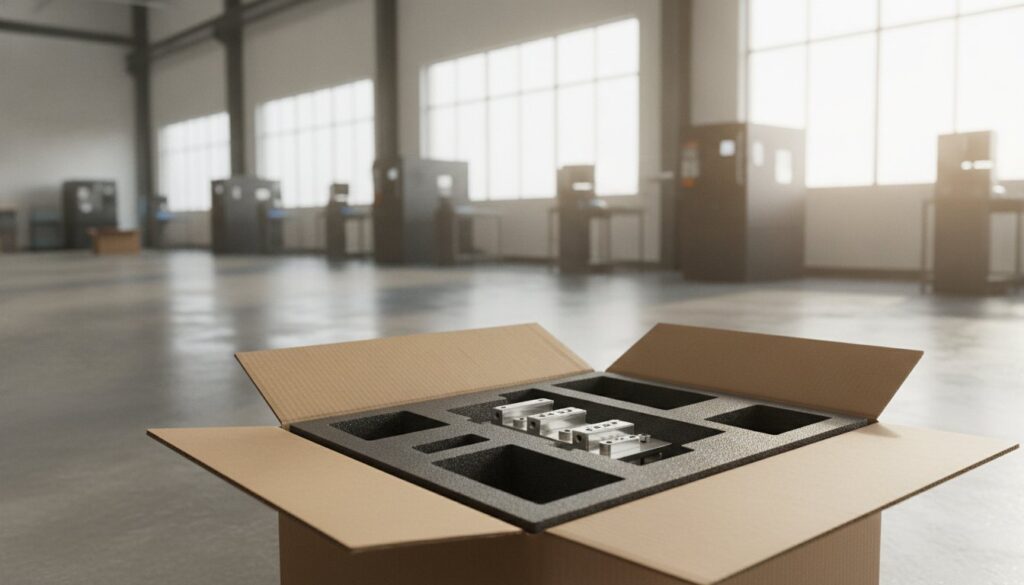
Shipping damage is not merely a logistical headache; it is a direct drain on your bottom line and a threat to your customer relationships. For procurement managers in the Inland Empire, even a minor increase in transit failure rates for sensitive aerospace or medical components can quickly erase the cost savings of a cheaper packaging vendor. You likely agree that consistent protection is non-negotiable, yet balancing those requirements with rising material costs and strict California regulations remains a constant challenge for local manufacturers.
This guide delivers the technical criteria and local sourcing advantages you need to optimize your die cut foam packaging in Riverside for maximum protection and efficiency. We will provide the data necessary to select between closed cell polyethylene and open cell polyurethane densities while addressing how local production significantly reduces lead times compared to out-of-state suppliers. You will learn how engineered inserts streamline assembly lines through kitting and how to ensure your packaging strategy aligns with the mandatory plastic reduction targets and recycling reporting requirements set by California SB 54.
Key Takeaways
- Compare the technical properties of polyethylene and polyurethane to select the optimal foam density for your specific industrial application.
- Optimize your supply chain by sourcing die cut foam packaging riverside to lower transportation expenses and maintain reliable just-in-time delivery schedules.
- Learn how precise CAD design and custom cavities prevent product damage by eliminating migration and surface abrasion during the shipping cycle.
- Streamline your assembly process by integrating custom foam inserts with corrugated boxes for a complete, pre-fitted packaging solution.
- Identify the essential technical data and volume requirements needed to secure an accurate quote for custom die cut tooling and production.
The Role of Die Cut Foam Packaging in Industrial Protection
The Die cutting process uses specialized tooling to shear foam materials into specific, repeatable shapes with high accuracy. For industrial manufacturers, this isn’t just about aesthetics; it’s about engineering a physical barrier that absorbs kinetic energy. Custom cavities ensure that components remain stationary. When a product shifts during transit, it creates friction that leads to surface abrasion or internal mechanical failure. By utilizing die cut foam packaging riverside, local facilities replace unpredictable loose-fill materials with engineered inserts that offer consistent, measurable protection. This transition from commodity void-fill to engineered inserts reduces the overall cube size of the shipment, which often results in lower freight costs over high-volume runs.
Precision Tolerances for Sensitive Components
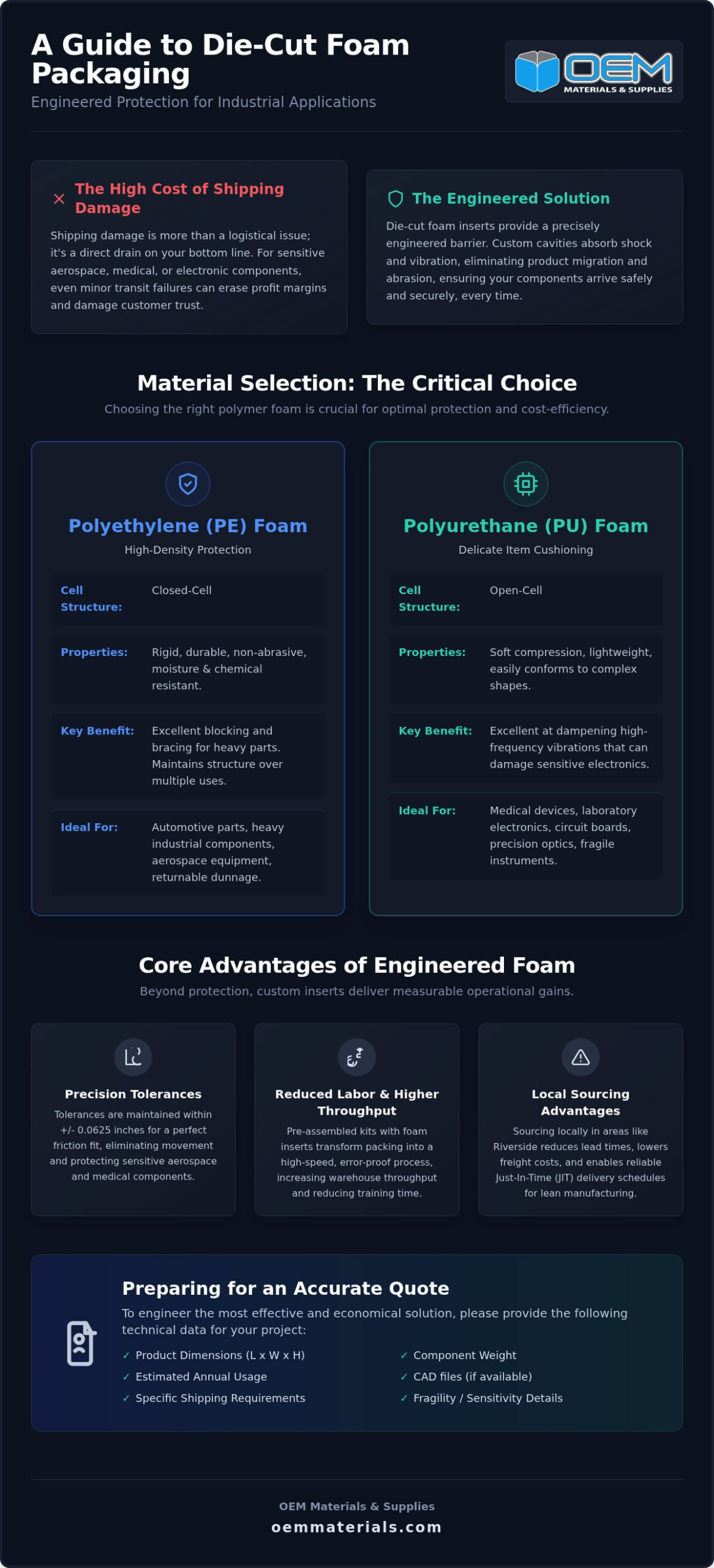
Aerospace and medical device manufacturing require exact friction fits to secure delicate instrumentation. A loose component is a failing component. In these sectors, industrial foam tolerances are typically maintained within a range of +/- 0.0625 inches, though the specific material density and tool design will influence the final dimensions. This level of precision eliminates the rattle factor. It ensures that even under the high-G forces of air freight or the vibrations of long-haul trucking, the product remains in its designed safety zone. When sourcing die cut foam packaging riverside, engineers can verify these tolerances through rapid prototyping before moving to full-scale production. Precision-cut foam also allows for multi-part kitting, where multiple components are housed in a single tray without touching each other, preventing metal-on-metal contact.
Reducing Labor Costs with Pre-Assembled Kits
Manual packing is a significant labor bottleneck. Wrapping items in bubble or stuffing boxes with paper takes time and produces inconsistent results. Integrating foam inserts into custom corrugated boxes transforms the packing station into a high-speed assembly point. We often recommend packaging kitting and assembly services to further optimize this workflow. By receiving pre-assembled kits, your warehouse team simply drops the product into the pre-cut cavity and seals the carton. This standardization increases warehouse throughput and reduces the training time required for new personnel. It turns a complex logistical task into a repeatable, error-proof process that minimizes the risk of human error during the packing stage.
Material Selection: Polyethylene vs Polyurethane Foam
Selecting the right polymer is the most critical decision in the engineering phase. It isn’t just about the softness of the material; it’s about the G-force rating and the load bearing capacity required for your specific product. For local manufacturers seeking die cut foam packaging riverside, the choice usually settles between Polyethylene and Polyurethane. Each material reacts differently to static loading and dynamic shock, meaning the wrong choice can lead to either product damage or unnecessary material costs.
Polyethylene Foam for High-Density Protection
Polyethylene (PE) is a closed cell foam known for its rigidity and durability. It provides excellent blocking and bracing for heavy industrial parts that require a firm support structure. Because it is non-abrasive and resistant to moisture and chemicals, it is the standard for custom foam packaging in the automotive and aerospace sectors. PE foam maintains its structural integrity over multiple trips, making it an ideal candidate for returnable dunnage programs. According to a Protective Packaging Design Guide, material density must be matched to the product’s fragility to avoid bottoming out during a drop. This is especially important as North American polyethylene suppliers proposed price increases in August 2026, making material efficiency a priority for procurement teams.
Polyurethane Foam for Delicate Instrumentation
Polyurethane (PU) is an open cell foam that offers a much softer compression set. It’s designed to cradle fragile items like medical devices, laboratory electronics, and precision optics. PU foam excels at dampening high frequency vibrations that can rattle internal components loose during long haul transit. For products with complex geometries or lightweight profiles, PU is easier to compress into tight spaces. If you’re handling sensitive circuit boards or microchips, we also provide anti-static (ESD) versions of these foams to prevent electrostatic discharge damage. Choosing the right density ensures the item remains suspended in the center of the carton, away from the impact zones.
California’s regulatory landscape is shifting rapidly. With the implementation of SB 54, producers must plan for a 10% reduction in plastic packaging weight by January 1, 2027. This mandate makes efficient material selection even more vital for Riverside facilities. By optimizing foam density and cavity design, you can reduce total plastic volume while maintaining or improving protection levels. If you need help determining the correct material for your specific transit stresses, you can consult with our engineering team to review your product specifications and annual usage goals.
Engineering and Design Considerations for Custom Inserts
Effective protective packaging is rarely the result of guesswork. It requires a systematic engineering approach where the foam insert is treated as a high precision component. When developing die cut foam packaging riverside, our engineering team utilizes CAD (Computer-Aided Design) software to map out the exact geometry of your product. This digital blueprinting ensures that every cavity provides the necessary friction fit while accounting for the static load of the item. Without this level of precision, you risk bottoming out, where the foam compresses fully under impact and transfers the shock directly to the product.
Testing for G-force protection and drop-test compliance is a standard part of the industrial design cycle. We evaluate how the foam density reacts to specific drop heights based on the weight and fragility of the equipment. This data-driven approach prevents over-engineering, which leads to excessive material costs, and under-engineering, which results in damage claims. Prototyping serves as the final validation step. It allows your operations team to handle a physical sample, verifying that the fit is accurate and that the inserts are easy to load on the production floor before committing to high-volume tooling.
Total Packaging System Integration
A foam insert is only one part of a larger protective ecosystem. For maximum reliability, we design foam in tandem with custom corrugated boxes to create a total solution. This integrated approach ensures that the outer container provides the necessary stacking strength while the internal foam manages the shock absorption. In cases where heavy items are palletized, we often incorporate edge and corner protectors to reinforce the external structural integrity of the shipment. This prevents the corrugated walls from buckling under the weight of stacked units, ensuring that your products arrive at their Riverside or Inland Empire destination without compromise.
Custom Packaging Design Services
Utilizing professional custom packaging design services is the most effective way to eliminate material waste and reduce your carbon footprint. By refining the layout of the die-cut sheet, we maximize the yield per square foot of foam, which directly impacts your unit cost. During the design phase, we also consider how these inserts will interact with your automated assembly lines. A well-designed prototype ensures that the foam doesn’t snag or tear during high-speed kitting processes. The transition from a CAD drawing to a physical prototype allows for real-world testing of these variables, providing a tangible proof of concept that builds confidence in the final production run.
Riverside Logistics: Sourcing Die Cut Foam Locally
Sourcing die cut foam packaging riverside is a strategic decision that directly impacts operational overhead. Foam inserts are inherently bulky; their low density means you are effectively paying to ship air when your supplier is located out of state. By partnering with a manufacturer within the Inland Empire, you eliminate the high freight surcharges associated with long distance transport. This local proximity also allows for rapid response during the design phase. If a complex medical device or automotive component requires a packaging audit, a Southern California partner can conduct on-site evaluations. This hands-on approach ensures that engineered cavities match the physical product without the delays of shipping prototypes back and forth across the country.
Supply chain resilience is built on local partnerships. When you source within the Riverside and Corona area, you are less vulnerable to the national logistics bottlenecks that often disrupt transcontinental shipping. A local partner understands the specific transit stresses of Southern California’s infrastructure, from the heat of the Inland Empire to the vibrations of the regional trucking corridors. This specialized knowledge allows for more accurate material selection and engineering, ensuring your protective packaging is optimized for the actual environment it will encounter.
JIT Delivery for Inland Empire Manufacturers
Manufacturing facilities in Riverside often operate under tight space constraints. Storing weeks of bulky foam inventory is an inefficient use of expensive floor space. By utilizing JIT packaging services, you can coordinate deliveries to arrive exactly when they are needed on the assembly line. This approach frees up warehouse space for raw materials or finished goods, effectively increasing your facility’s operational capacity. Local sourcing also mitigates the risk of inventory shortages caused by national supply chain disruptions, providing a more reliable cushion for your daily production requirements.
Vendor Managed Inventory (VMI) Benefits
For high volume operations, manual procurement processes often become an administrative burden. Implementing packaging VMI allows us to manage your stock levels of custom die cut foam automatically. We monitor your usage rates and trigger replenishment orders before you reach a critical low point. This system reduces the need for constant purchase order generation and follow up, allowing your purchasing department to focus on strategic sourcing. Maintaining optimal stock levels locally ensures that your kitting and assembly lines never stall due to a lack of protective inserts.
If you are ready to optimize your local supply chain and reduce transit costs, contact our team for a logistics consultation to discuss your specific volume and delivery requirements.
Requesting a Quote for Die Cut Foam Packaging
Securing an accurate quote for die cut foam packaging riverside requires more than a simple product description. To provide a functional and cost-effective estimate, our engineering team must understand the physical stresses your product will encounter. We look beyond basic dimensions to evaluate the total packaging environment. This includes the weight of the component, its fragility rating, and the anticipated transit method. Providing this data upfront allows us to recommend a foam density that prevents damage without over-specifying material; this keeps your unit costs under control and ensures your strategy remains competitive.
Your estimated annual usage is a primary driver in determining the most economical tooling option. For low-volume runs or initial prototypes, we utilize methods that require minimal upfront investment. However, for high-volume industrial production, investing in more robust die-cut tooling can significantly reduce the per-piece price over the life of the project. As a strategic partner, we help you calculate the break-even point where tooling costs are offset by labor savings and material efficiency. This financial transparency is essential for procurement managers who need to justify packaging spend against long-term operational gains.
Information Required for Accurate Pricing
To expedite the quoting process, please prepare the following technical data points for our engineering team. We require the exact length, width, and height of the product, along with its total weight. If your product has a known fragility rating, often measured in G-force limits, please include that information. You should also specify your preferred material, such as polyethylene for heavy-duty bracing or polyurethane for delicate cushioning. Finally, providing your projected annual order frequency helps us optimize the production schedule and material procurement to secure the best possible rates for your Riverside facility.
Moving from Quote to Production
The transition from an initial inquiry to a final production run follows a structured path designed to eliminate risk. Once the technical data is submitted and the quote is accepted, we move into the CAD design phase. Following design approval, we produce a physical prototype for your team to test in-house. Only after you have verified the fit and protection level do we proceed with tooling fabrication and high-volume manufacturing. This methodical approach ensures that the final inserts meet the rigorous standards required for aerospace, medical, and automotive sectors. Standard lead times for tooling and first-article production typically range from one to two weeks, depending on the complexity of the design.
Finalizing your packaging strategy with a local Riverside partner ensures that your supply chain remains agile and responsive to market changes. By integrating custom foam with your existing stock of corrugated boxes or crates, you create a unified protection system that reduces both damage and labor. If you are ready to begin the engineering process, request a custom foam quote for your Riverside facility today. Please include your product dimensions, weight, and annual usage volume to help our team provide the most accurate technical recommendation.
Optimizing Your Inland Empire Supply Chain
Transitioning from generic cushioning to engineered inserts is a technical requirement for high stakes industries. By selecting the correct density of polyethylene or polyurethane and utilizing local CAD design services, you eliminate the variables that lead to transit damage. Sourcing your die cut foam packaging riverside also addresses the logistical burdens of high freight costs and excessive warehouse inventory through established JIT and VMI programs. These local advantages ensure your facility remains agile while meeting strict California packaging mandates.
Our team specializes in the rigorous standards of aerospace and medical packaging. We provide the precision tolerances and rapid prototyping necessary for sensitive components. It’s our goal to act as a strategic partner to ensure your assembly lines remain efficient and your shipping costs remain predictable. We focus on solving the real world problems of product migration and surface abrasion before they impact your bottom line.
To start your technical evaluation, Request a custom die cut foam quote today. Please provide your product dimensions, weight, and annual usage so we can deliver an accurate recommendation for your specific application. We look forward to securing your next shipment.
Frequently Asked Questions
What is the typical lead time for custom die cut foam inserts in Riverside?
Standard lead times for die-cut tooling and first-article production typically range from one to two weeks. This timeframe includes the initial CAD design phase and physical prototyping. Because we are local to the Inland Empire, we can often expedite final delivery once the design is approved, helping you maintain your production schedule without the delays associated with out-of-state shipping or long-distance logistics.
Do I need to pay for tooling for every foam packaging order?
No, tooling is typically a one-time investment for your specific die cut foam packaging riverside project. Once the steel-rule die is fabricated, it is stored for all subsequent production runs. You’ll only face new tooling charges if you change the dimensions of your product or require a different cavity layout. This makes repeat orders more cost-effective over the life of your project.
Which is better for heavy industrial parts: polyethylene or polyurethane foam?
Polyethylene (PE) is the superior choice for heavy industrial parts because its closed-cell structure offers higher load-bearing capacity and rigidity. It excels at blocking and bracing heavy components during transit. Polyurethane is an open-cell foam that is far too soft for heavy loads; it is better suited for cushioning light, fragile instrumentation. Choosing the wrong density for heavy parts can lead to product bottoming out.
Can you provide ESD foam for sensitive electronic components?
Yes, we provide anti-static (ESD) foam in both polyethylene and polyurethane varieties to protect sensitive electronic components from static discharge. These specialty foams are treated with antistatic agents to safely dissipate charges that could damage microchips or circuit boards. We frequently supply these materials to medical and aerospace clients in the Riverside area who require high-precision protection for their sensitive electronic hardware and instrumentation.
How does sourcing foam locally in Riverside reduce my total packaging costs?
Local sourcing lowers your total costs by eliminating the freight penalties of shipping high-volume, low-density foam across long distances. It also reduces administrative overhead through integrated VMI programs that automate replenishment. By working with a Southern California partner, you can conduct on-site packaging audits to identify material waste, ensuring you only pay for the foam density required to protect your specific components and inventory.
What information do I need to provide to get a quote for die cut foam?
To provide an accurate quote, you need to supply the product’s length, width, height, and weight, along with its fragility rating. We also require your estimated annual usage and preferred foam material. This technical data allows our engineering team to determine the most cost-effective foam density and tooling option for your specific volume. Including your shipping destination helps us calculate the total logistical savings.
Can custom foam inserts be integrated into existing shipping boxes?
Yes, custom foam inserts are frequently designed to fit within your existing corrugated boxes, wood crates, or plastic pallets. We engineer the outer dimensions of the foam to match your current shipping containers, providing a seamless transition to a more protective system. This integration eliminates the need for manual wrapping or loose-fill materials, which streamlines your packing line and ensures a consistent, professional fit.
Do you offer prototyping services for custom foam designs?
Yes, we offer rapid prototyping as a standard part of our custom packaging design process. Before you commit to a full production run, we provide a physical sample for you to test with your actual product. This validation step allows you to verify the friction fit and shock absorption levels in a real-world environment, ensuring the final design meets all your technical requirements and safety standards.