
Your in-house assembly line is likely a hidden drain on your bottom line. For medical OEMs across Southern California, the cost of manual packaging isn’t just the hourly rate; it’s the cumulative inefficiency of managing dozens of individual SKUs. You’re probably dealing with the constant risk of damage to sensitive instrumentation and the logistical headache of coordinating multiple material vendors. It’s a complex, high-stakes process that often results in wasted floor space and unnecessary overhead.
We understand that precision and protection are non-negotiable in the medical sector. This article demonstrates how custom medical device packaging kits solve these specific operational pains by consolidating components into a single, engineered solution. You’ll learn how tailored kitting reduces packing time, eliminates shipping damage, and simplifies procurement through Vendor Managed Inventory (VMI) programs. We’ll examine how manufacturers in Orange County and Los Angeles are transforming their shipping departments from cost centers into streamlined logistical assets.
Key Takeaways
- Discover why custom medical device packaging kits outperform standard containers by providing precision protection for sensitive electronics and instrumentation.
- Learn how engineered foam inserts eliminate vibration damage during transit, ensuring your products arrive in perfect condition.
- Understand how Vendor Managed Inventory (VMI) reduces your warehouse footprint and streamlines procurement for Southern California manufacturing facilities.
- Identify the specific performance metrics used to quantify labor savings and reduced packing times across your assembly line.
- Gain insights into the collaborative prototyping process that ensures your packaging solution meets rigorous industry standards and operational requirements.
The Role of Custom Medical Device Packaging Kits in Modern Manufacturing
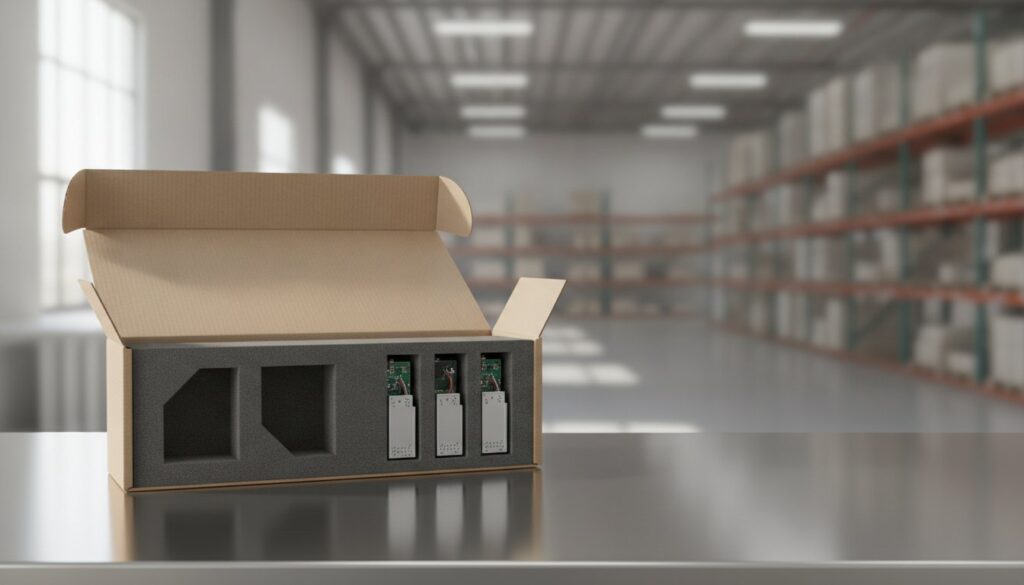
In the high-precision world of medical manufacturing, a packaging kit is more than just a box. It’s a pre-assembled, engineered set containing every component required to secure a specific device for transport. For Southern California OEMs, implementing custom medical device packaging kits transforms a fragmented packing process into a repeatable, high-speed operation. Standard shipping containers often fail because they lack the specific tolerances required for sensitive electronics and fragile instrumentation. These generic solutions don’t account for the unique vibration frequencies or G-force limits of a medical laser or diagnostic monitor.
Adhering to Medical device packaging standards requires a level of precision that off-the-shelf materials can’t provide. Custom kits ensure that every piece of foam packaging and every divider fits the device’s geometry exactly. This eliminates movement within the container, which is the primary cause of damage during transit. By bridging the gap between protective integrity and operational throughput, manufacturers can scale production without increasing their damage rates or labor overhead.
Defining the Component Mix
A medical packaging kit typically addresses secondary packaging needs. While primary packaging maintains the sterile barrier, the kit focuses on structural protection and logistics. Key elements often include heavy-duty corrugated boxes, custom-cut foam inserts, and precise labeling. Consistency is vital. Every component must meet strict material specifications to ensure regulatory compliance and repeatable performance across thousands of shipments. Using a single-source kit ensures that the interaction between the foam and the outer carton is optimized for the specific weight and fragility of the device.
Identifying Logistical Friction
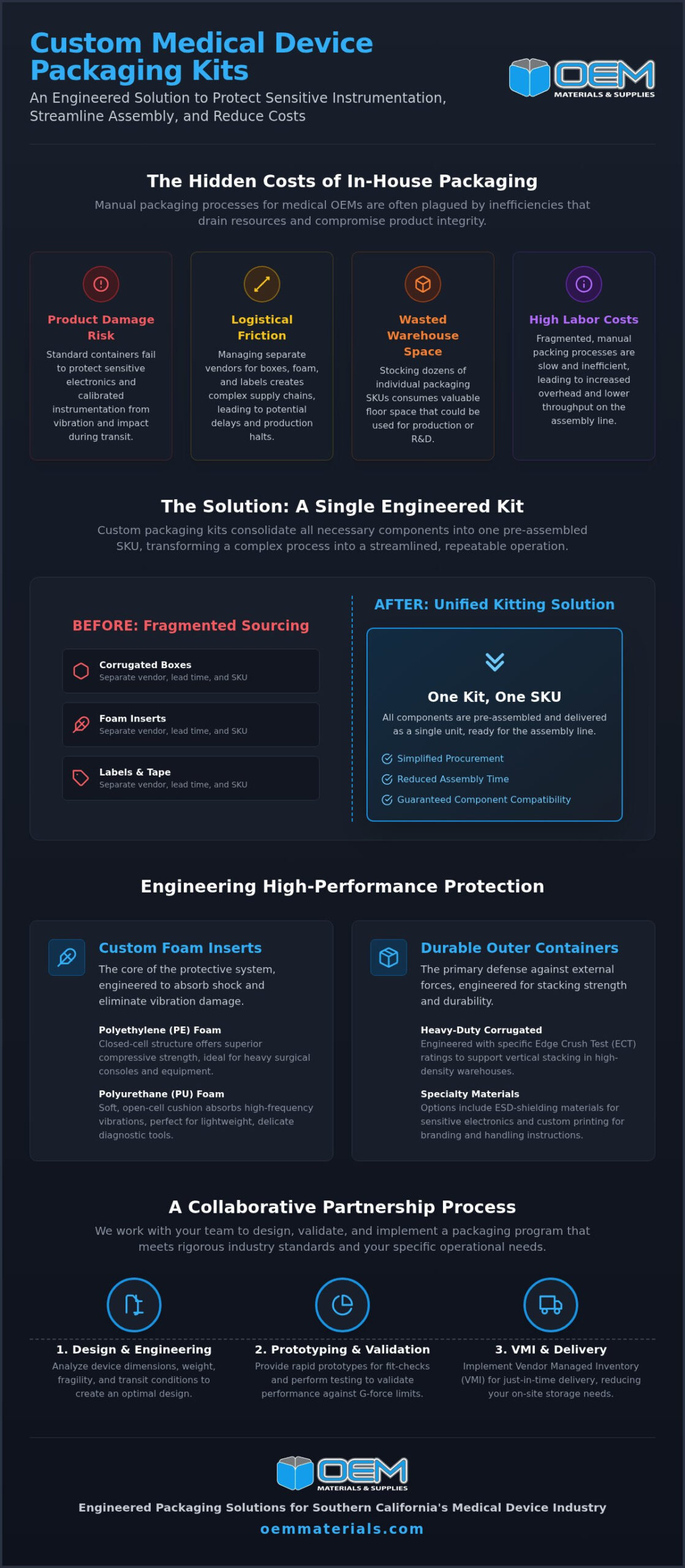
Fragmented sourcing is a silent killer of production efficiency. When an OEM manages separate vendors for boxes, foam, and labels, the assembly line depends on three different lead times. If one vendor is late, the entire shipment stops. Managing dozens of individual packaging SKUs also creates inventory headaches and consumes valuable warehouse space. Consolidating these into a single custom medical device packaging kit SKU simplifies procurement and clears floor space. For labs in San Diego or Los Angeles, having a local partner for rapid prototyping is essential. It allows for immediate design adjustments during the critical R&D phases of a new product launch, ensuring that the packaging is ready the moment the device clears clinical trials.
Engineering High Performance Medical Kit Components
Engineering custom medical device packaging kits requires a rigorous focus on material science and mechanical protection. It’s not a matter of simply filling a box. It’s a calculated effort to manage deceleration and energy absorption. When designing for the medical sector, packaging must account for the extreme sensitivity of calibrated optics and internal sensors. Engineers often look to the rigorous criteria established by various medical packaging standards organizations to validate that their designs will withstand the specific stresses of air and ground freight. Selecting the right medical device packaging solutions requires balancing regulatory compliance with the physical durability demands of industrial containers and cushioning materials.
Foam Insert Selection Criteria
The selection of foam packaging determines the kit’s ability to mitigate vibration. Polyethylene foam is typically the preferred choice for heavy surgical consoles because its closed-cell structure offers superior compressive strength. For lightweight, highly delicate diagnostic tools, polyurethane provides a softer, open-cell cushion that absorbs high-frequency vibrations. Precision die-cutting allows for snug fitment, ensuring that components don’t shift and cause internal friction damage. For medical instruments, the foam density must be precisely calibrated to the device’s static load to prevent the product from bottoming out during impact.
Outer Container Durability
The outer shell provides the primary defense against external forces. Custom corrugated boxes are engineered with specific Edge Crush Test (ECT) ratings to support vertical stacking in high-density warehouses. This is particularly critical for Southern California manufacturers who must maximize limited storage space. When shipping electronic devices, incorporating ESD-shielding materials is essential to prevent latent circuit failure. For large-scale shipments, integrating edge and corner protectors ensures the structural integrity of the pallet remains intact during high-speed transit.
Branding and safety go hand-in-hand. Custom printing on the exterior allows for clear, high-contrast handling instructions that alert logistics personnel to the fragile nature of the contents. If your current shipping solutions are resulting in unacceptable damage rates, you can request a quote for an engineered assessment of your current packaging architecture. This technical approach ensures that every component in the custom medical device packaging kits serves a functional purpose in protecting your investment.
Optimizing Assembly with Professional Kitting and VMI
Managing a high-volume medical manufacturing line requires more than just high-quality materials; it requires logistical precision. Traditional models often rely on bulk material storage, where pallets of flat corrugated boxes and loose foam inserts consume hundreds of square feet of expensive floor space. For manufacturers in San Diego and Orange County, this overhead is unsustainable. Transitioning to custom medical device packaging kits allows OEMs to move toward a just-in-time (JIT) model. Instead of storing raw materials, you receive fully assembled kits ready for immediate use on the production floor.
A packaging VMI (Vendor Managed Inventory) program further optimizes this by shifting the burden of inventory management to your packaging partner. We monitor your stock levels and trigger production or delivery before you run low. This ensures that the assembly line never stops due to a lack of packaging while simultaneously reducing your on-site warehouse footprint. It’s a proactive approach that eliminates the “hidden” labor costs of tracking SKUs and managing multiple material vendors.
The Kitting Process Workflow
Efficiency starts off-site. The process begins with component sourcing and rigorous quality verification of all raw materials, including corrugated shells and cushioning. Professional assembly involves the precision placement of foam inserts into containers, often utilizing specialized adhesives or friction-fit designs to ensure structural stability. Every kit undergoes a final quality inspection to verify that all elements are present and correctly oriented. These completed units are then delivered directly to the cleanroom or the final assembly line. By delivering a “ready-to-pack” solution, you reduce the number of touches on the production floor, which minimizes the risk of component contamination or human error during the final pack-out.
Benefits of Just-In-Time Delivery
In high-cost regions like Orange County, every square foot of manufacturing space must generate value. Storing empty packaging is a low-value use of that space. Just-in-time delivery frees up this floor space for additional production lines or R&D labs. It also improves cash flow. You’re no longer tying up capital in months of on-hand inventory; instead, you pay for what you use as you use it. Linking these kitting services to broader medical supply packaging strategies creates a cohesive, responsive supply chain. This approach ensures that your secondary packaging is as sophisticated and reliable as the medical technology it protects.
Performance Metrics: Measuring Labor Savings and Damage Reduction
Measuring the success of a packaging program requires looking beyond the unit price of individual components. For a medical OEM, the true metric of success is the total operational impact on the assembly line. Custom medical device packaging kits provide a quantifiable reduction in labor hours by eliminating the manual assembly steps required with generic materials. When your team doesn’t have to fold corrugated shells or hunt for disparate foam inserts, the speed of your pack-out line increases. This efficiency allows you to reallocate labor to higher-value manufacturing tasks while maintaining a consistent output rate.
Analyzing the total cost of ownership (TCO) reveals the hidden expenses of stock packaging. Generic solutions often necessitate excessive tape, secondary cushioning, and multiple manual touches to secure the product. Each extra step is a potential point of failure and a drain on your labor budget. An engineered kit arrives as a single, ready-to-use unit. This enables a drop-in packing method that ensures consistency across every shift, regardless of the operator’s experience level. It’s a technical solution that removes the variability of human error from the final stages of production.
The impact on fragile diagnostic equipment is particularly significant. A manufacturer shipping sensitive imaging components might face high replacement costs if transit damage occurs. By implementing a kit with precisely engineered foam, the device is isolated from shock and vibration. This results in a drastic reduction in return-and-repair cycles. Reducing these failures directly protects your bottom line and maintains your reputation for technical reliability in the field. OEM Materials & Supplies focuses on these outcomes to ensure your packaging is a logistical asset rather than a liability.
Calculating Packaging ROI
To determine your return on investment, you must aggregate labor, material, and freight costs. Utilizing professional custom packaging design frameworks helps identify where manual processes are inflating your overhead. Engineering the kit to the exact dimensions of the device also optimizes your logistics spend. Custom kits reduce dimensional weight charges by eliminating the unnecessary bulk associated with oversized stock boxes. If you want to identify specific savings in your current workflow, you can request a packaging audit and quote from our engineering team.
Long-Term Supply Chain Stability
Operational efficiency also depends on reliability. Stockouts of critical packaging materials can halt a production run during peak demand. A professional kitting program mitigates this risk by consolidating multiple components into a single SKU managed through a VMI program. This ensures you always have the necessary materials for high-volume production runs. Having a local Southern California support team in Orange County or San Diego allows for rapid adjustments. If a device design changes, your packaging partner can prototype and implement a new kit design quickly, ensuring your supply chain remains agile and stable.
Implementing a Custom Medical Device Packaging Program
Transitioning from a manual pack-out process to a managed system requires a methodical engineering approach. Implementation isn’t a simple transaction; it’s a structured integration into your existing manufacturing workflow. Successful adoption of custom medical device packaging kits depends on early collaboration between your product engineers and our packaging specialists. This ensures that the structural design of the kit accounts for every sensitive component, from delicate fiber optics to high-precision sensors, before the first production run begins.
Scaling these solutions requires a shift from reactive ordering to proactive supply chain management. The process moves from initial design concepts to short-run validation, and finally to high-volume production. This progression allows you to identify and resolve potential assembly bottlenecks in a controlled environment. By the time you reach full-scale manufacturing, the packaging process is a repeatable, optimized step that supports rather than hinders your production throughput.
The Prototype to Production Path
The engineering phase begins with a detailed analysis of your product’s physical characteristics. We require precise dimensions, weight, and center-of-gravity data to engineer the initial foam cushioning. This data-driven approach ensures that the energy absorption properties of the material match the fragility of your device. The implementation path typically follows these steps:
- Data Submission: Providing CAD files or physical samples for exact cavity mapping.
- Prototype Testing: Evaluating samples for fitment and structural integrity under simulated transit conditions.
- Usage Forecasting: Finalizing annual volume estimates to capture maximum economies of scale and optimize unit pricing.
- Validation: Conducting pilot runs to ensure the kit integrates seamlessly with cleanroom protocols or assembly line stations.
Partnering with a Southern California Specialist
Proximity is a critical factor in the success of a medical packaging program. For manufacturers in Los Angeles, Orange County, and the Inland Empire, working with a local partner enables rapid on-site audits and immediate design iterations. You don’t have to wait days for prototype shipments or deal with the logistical delays of out-of-state vendors. If a device design changes during the final stages of R&D, a local team can adjust the kit architecture and deliver new samples within a 24 to 48-hour window.
Leveraging local expertise ensures that your packaging strategy remains agile. The team at OEM Materials & Supplies understands the specific logistical challenges of the Southern California manufacturing sector, from high warehouse costs to the need for rapid turnaround. When you’re ready to modernize your shipping operations and reduce your total cost of ownership, you can contact OEM Materials & Supplies for a professional consultation on custom medical device packaging kits. This partnership provides the technical depth and logistical support necessary to maintain a stable, efficient, and damage-free supply chain.
Optimizing Your Medical Logistics Strategy
Transitioning to a managed packaging model is a strategic investment in your supply chain’s resilience. By integrating custom medical device packaging kits, you eliminate the logistical friction of managing multiple SKUs and reduce the labor-intensive process of manual assembly. These engineered solutions provide the exact vibration and shock protection required for sensitive instrumentation while freeing up valuable floor space in your facility. It’s a proven method for transforming your shipping department into a streamlined asset.
Success in the medical sector depends on precision and reliability. Our local Southern California support team provides the technical expertise needed to design, prototype, and scale your packaging operations across Los Angeles, Orange County, and San Diego. With VMI and JIT services available, you can maintain a lean inventory without the risk of production delays. We provide custom engineered foam and corrugated solutions that meet the rigorous standards of your industry.
Take the first step toward a more efficient assembly line. Request a quote for custom medical packaging kits today to see how our expertise can protect your products and your bottom line. We’re ready to help you optimize your logistics.
Frequently Asked Questions
What components are typically included in a custom medical device packaging kit?
A custom medical device packaging kit typically includes a high-ECT corrugated box, precision-engineered foam inserts, and specific identification labels. Depending on the device’s fragility, it may also incorporate ESD-shielding or edge protectors to maintain structural integrity. These components are delivered as a single, pre-assembled unit to simplify your assembly line.
How do custom kits help reduce labor costs for medical OEMs?
Custom kits reduce labor costs by eliminating the manual assembly of packaging materials on your production floor. Your staff doesn’t have to fold boxes or fit disparate foam pieces during the pack-out process. By providing a consolidated solution, you reduce the total number of touches required for each unit, which directly lowers your per-unit labor expenditure.
Can custom packaging kits be used for sterile cleanroom environments?
These kits function as secondary packaging and are compatible with cleanroom environments. We select materials like low-lint foam to prevent contamination and ensure the kits meet the hygiene standards of medical facilities. Using custom medical device packaging kits in this context allows you to maintain a sterile workflow while significantly improving your operational throughput.
What is the typical lead time for a custom foam and corrugated kit prototype?
For Southern California manufacturers, the typical lead time for an engineered prototype is 24 to 48 hours. Our local service in Los Angeles and San Diego enables rapid design cycles and immediate physical validation. This accelerated timeline ensures that your packaging is ready for production as soon as your device design is finalized.
How does Vendor Managed Inventory (VMI) work with medical packaging?
Vendor Managed Inventory (VMI) shifts the responsibility of stock monitoring to your packaging partner. We track your inventory levels and deliver pre-assembled kits just-in-time for production. This model eliminates the risk of stockouts during peak production and frees up valuable warehouse space by reducing the amount of on-hand material you need to store.
Do custom medical kits help reduce shipping damage for fragile instruments?
Engineered kits drastically reduce shipping damage by providing a precision fit for fragile instrumentation. The custom foam inserts are calibrated to absorb shock and mitigate vibration frequencies that could decalibrate sensitive optics or electronics. This level of protection prevents internal movement within the box, which is the leading cause of transit-related product failure.
What information is needed to get an accurate quote for a custom kit?
To generate an accurate quote, we need the device’s dimensions, weight, and center of gravity. It’s also helpful to provide G-force limits and details about your expected annual production volume. Sharing a CAD file or a physical sample allows our engineering team to design a kit that maximizes protection while minimizing material waste and shipping costs.
Are these packaging solutions compliant with medical industry standards?
Our packaging solutions are designed to align with essential medical industry standards, including ISO and ASTM protocols for transport testing. We emphasize material consistency and structural durability to ensure your products remain protected throughout the supply chain. Reviewing a medical packaging compliance checklist can help manufacturers systematically verify that their materials and processes meet these regulatory requirements. This focus on technical compliance helps manufacturers meet regulatory requirements while maintaining a high level of operational efficiency.