
With industrial real estate in Orange County averaging $17.09 per square foot, every pallet of overstocked corrugated boxes is an expensive drain on your bottom line. Choosing a wholesale industrial packaging supplier in Southern California has moved beyond a simple price per unit calculation; it’s now a high-stakes decision involving technical compliance and logistics efficiency. You’ve likely dealt with the frustration of production delays caused by packaging shortages or the hidden costs of product damage from poorly engineered foam. It’s clear that a vendor who just takes orders isn’t enough when containerboard prices have jumped $100 per ton in the first half of 2026 and new SB 54 regulations are adding layers of reporting requirements.
This article provides a framework to evaluate a packaging partner based on technical engineering, logistics efficiency, and total cost of ownership. We’ll explore how manufacturers in Los Angeles, San Diego, and the Inland Empire can optimize their supply chains through custom design and vendor-managed inventory. By moving from a commodity-based approach to a strategic partnership, you can reduce labor costs in kitting and reclaim valuable warehouse space for production instead of storage.
Key Takeaways
- Calculate the total cost of ownership by identifying hidden expenses like excessive labor and shipping damage that aren’t reflected in the initial unit price.
- Evaluate a wholesale industrial packaging supplier based on their ability to provide custom die-cut corrugated solutions and engineered foam inserts designed for sensitive components.
- Learn how Vendor-Managed Inventory (VMI) and Just-in-Time (JIT) delivery models can reduce your warehouse footprint and eliminate production delays caused by material shortages.
- Understand the specialized packaging requirements for high-stakes sectors like aerospace and medical devices, where physical protection and sterile integrity are critical.
- Identify the strategic benefits of partnering with a local Southern California specialist for rapid prototyping and on-site consultations in Orange County, Los Angeles, and San Diego.
Evaluating the Total Cost of Industrial Packaging Procurement
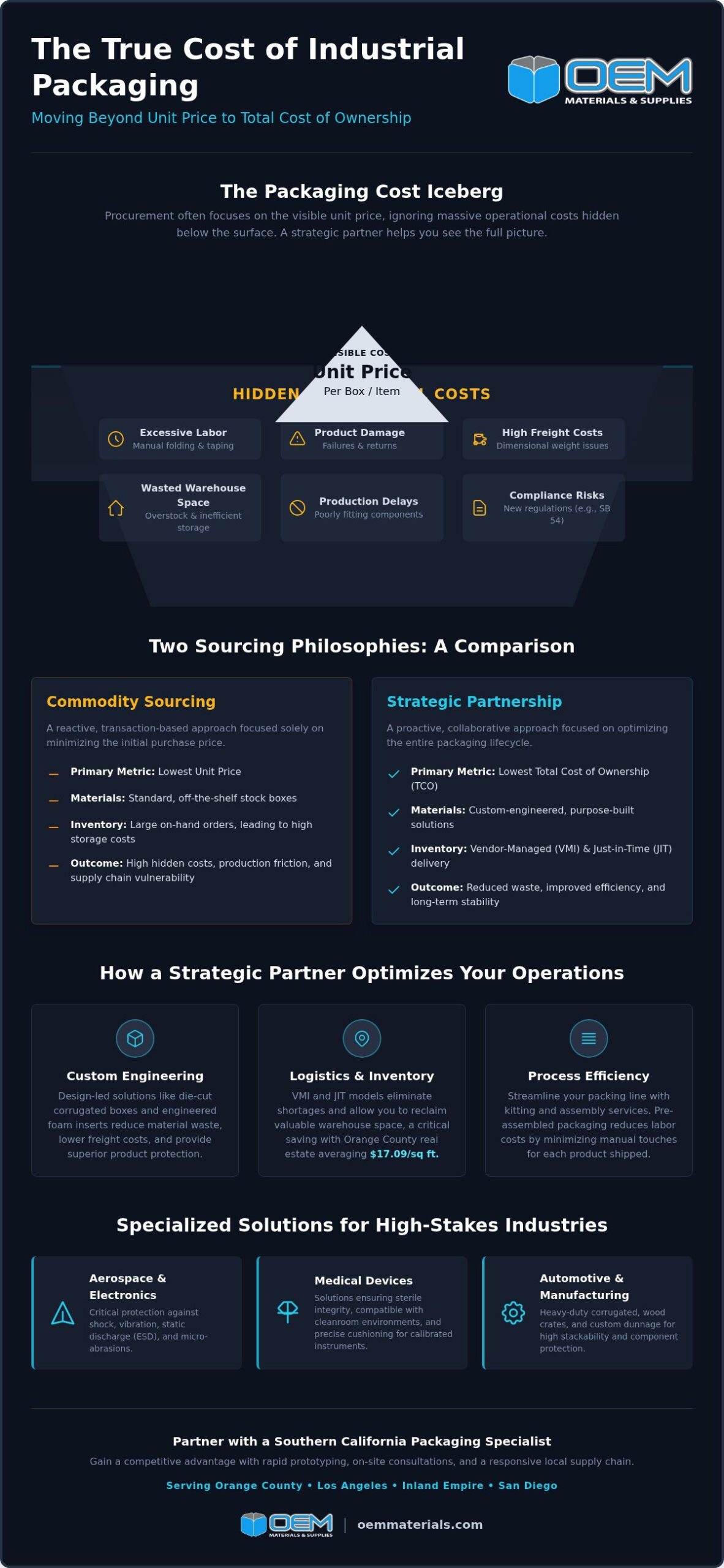
Procurement teams often focus strictly on the invoice price of a single corrugated box. This narrow view ignores the reality that packaging is a coordinated system of preparing goods for transport, warehousing, and sale. A reliable wholesale industrial packaging supplier helps you look beyond the line item to see how material choices impact your entire operation. High-value industrial components in the aerospace or medical sectors require superior material quality to prevent micro-abrasions or structural fatigue during transit. If a cheaper material fails, the cost of a single rejected part far outweighs any pennies saved on the initial purchase. Building a strategic relationship with a supplier ensures your supply chain remains predictable, even when market conditions shift.
In the first half of 2026, North American containerboard prices rose by $100 per ton. This volatility makes it even more critical to work with a partner that understands how to offset material price hikes through better engineering. By focusing on design-led efficiencies rather than just material thickness, manufacturers can maintain their margins without compromising product safety. This approach prioritizes long-term stability over short-term savings that often evaporate when logistical challenges arise.
The Unit Price vs. Operational Efficiency Trade-off
Packaging-related production line stoppages are an invisible drain on profitability. If a box does not fold correctly or a foam insert is off by a fraction of an inch, the entire assembly process grinds to a halt. These delays cost far more than the difference between a premium and a budget supplier. Additionally, poorly fitted boxes increase dimensional weight shipping costs. When you ship “air” because a standard stock box is too large for your component, you are essentially paying a premium for every cubic inch of wasted space. Investing in custom designs often reduces overall material usage by eliminating the need for excessive void fill.
Labor Costs in the Packing and Assembly Process
Manual tape application and box folding consume significant man-hours. In high-volume Southern California manufacturing facilities, these seconds add up to thousands of dollars in annual labor. Utilizing pre-assembled packaging kits or custom-engineered inserts can streamline warehouse operations by reducing the number of touches required to secure a product. When a wholesale industrial packaging supplier provides kitting services, your team can focus on core manufacturing rather than folding cardboard. Total cost of ownership in industrial packaging is the comprehensive sum of material acquisition costs combined with every operational expense tied to labor, storage, freight, and potential product damage.
Technical Capabilities: Beyond the Standard Corrugated Box
Many manufacturers mistakenly view packaging as a static commodity. A technical wholesale industrial packaging supplier treats it as an engineered component designed to interface with your product and your logistics chain. For specialized sectors like aerospace, medical devices, or automotive manufacturing, standard boxes often fail to provide the necessary structural support. You need a partner capable of integrating diverse materials, such as heavy-duty wood crates for machinery or heavy duty plastic pallets for sterile cleanroom environments. Rapid prototyping is another critical differentiator; obtaining a physical sample before a full production run prevents costly dimensional errors during new product launches.
Custom Corrugated and Die-Cut Packaging
Die-cut boxes offer precision that standard stock boxes cannot match. They are engineered to follow the exact footprint of your product, which eliminates the need for excessive void fill and reduces dimensional weight shipping costs. When evaluating corrugated boxes, it’s essential to specify material grades like double-wall or triple-wall for heavy industrial applications. These strength ratings determine stackability and crush resistance in high-density Southern California warehouses. Custom geometries also facilitate faster assembly on the production line, allowing your team to secure products with fewer manual steps.
Engineered Foam and Protective Cushioning
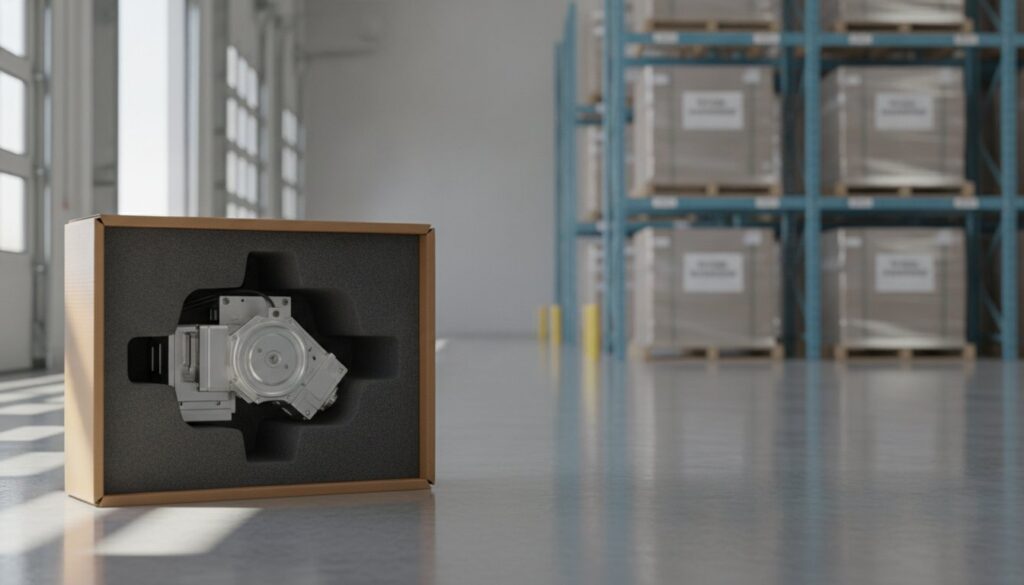
Protecting sensitive electronics or calibrated medical instruments requires more than basic cushioning. Engineered foam packaging provides calibrated shock absorption based on the specific fragility of your component. Polyethylene (PE) foam is typically selected for its durability and moisture resistance in heavy-duty applications, while polyurethane (PU) offers a softer, non-abrasive cushion for lighter, highly sensitive items. Custom-contoured foam inserts ensure zero movement within the shipping container, serving as the primary defense against vibration damage during transit. If you are unsure which material density fits your product’s G-force rating, you can request a technical consultation for a recommendation.
For manufacturers moving heavy equipment or bulky parts, the strategy must account for both static and dynamic loads. Integrating structural wood crates with internal foam blocking or heavy-duty plastic pallets provides the necessary rigidity for ocean or air freight. A sophisticated wholesale industrial packaging supplier will analyze the entire transit cycle to determine where edge protectors or specialized stretch film reinforcements are needed to maintain pallet integrity. This holistic approach ensures that your high-value shipments arrive intact, regardless of the handling conditions they encounter.
Logistics and Inventory Management: VMI vs. Traditional Sourcing
Traditional procurement methods often force manufacturers to choose between high unit prices or excessive inventory. Bulk buying might lower the cost per box, but it ties up working capital and consumes valuable warehouse floor space. A strategic wholesale industrial packaging supplier offers a more efficient alternative through advanced inventory management. By localizing the supply chain within Southern California, manufacturers in Orange County and Los Angeles can eliminate the risk of stockouts while maintaining leaner operations. Automated replenishment programs ensure that packaging materials are always available without requiring manual oversight from your procurement team.
Streamlining the Supply Chain with VMI
Vendor-Managed Inventory (VMI) fundamentally changes how you handle packaging supplies. Instead of your team tracking every pallet of stretch film or corrugated boxes, the supplier assumes responsibility for monitoring stock levels and triggering replenishment. This shift reduces the administrative burden on your warehouse managers and ensures accuracy in high-volume environments. One of the most significant advantages is the financial structure; many packaging VMI services allow you to pay for materials only as they are consumed or moved into production. This model improves cash flow and eliminates the cycle of traditional bulk ordering that often leads to warehouse congestion.
Just-In-Time Delivery for SoCal Facilities
With industrial real estate costs in Orange County averaging $17.09 per square foot, using warehouse space to store empty boxes is an operational inefficiency. Just-In-Time (JIT) delivery allows you to reclaim that floor space for revenue-generating production equipment. By scheduling smaller, frequent deliveries that sync with your daily production schedule, you minimize the footprint required for packaging storage. These JIT packaging solutions also mitigate the risk of inventory obsolescence. If a product design changes or a new regulation like SB 54 requires different material specifications, you aren’t stuck with thousands of outdated units. Localized service across the Inland Empire and San Diego County ensures that lead times remain short, providing the agility needed to respond to sudden spikes in demand.
Eliminating the gap between packaging delivery and product assembly requires a partner that understands the geography of Southern California. A supplier with its own fleet can bypass the delays often associated with third-party carriers, ensuring that your line never stops because a shipment of custom foam is stuck in transit. This level of logistical control is what separates a mere vendor from a true operational partner.
Selection Criteria for High-Stakes Industries
In high-stakes manufacturing, a packaging failure is more than a logistical inconvenience; it is a regulatory and safety risk. A standard wholesale industrial packaging supplier often lacks the technical depth required to meet the specific compliance standards of the aerospace, medical, and electronics sectors. In Southern California, where these industries form the backbone of the regional economy, your packaging partner must understand the difference between basic containment and engineered protection. Whether you are shipping calibrated sensors from San Diego or heavy automotive assemblies from the Inland Empire, the material choice must reflect the fragility, value, and regulatory sensitivity of the cargo.
Aerospace and Defense Standards
Aerospace components are frequently oversized, heavy, or possess irregular geometries that demand structural support far beyond corrugated cardboard. Custom crates are the industry standard for these applications, providing the rigidity necessary for air and ocean export. These wood structures often incorporate internal blocking, bracing, and specialized vapor-barrier materials to prevent oxidation during long-term storage or transit through high-humidity environments. Defense contractors also require strict adherence to MIL-SPEC standards, ensuring that every layer of packaging provides a predictable level of protection against mechanical shock and environmental degradation. Choosing a wholesale industrial packaging supplier that specializes in these high-stakes sectors ensures your products arrive in factory-condition, regardless of the transit duration.
Medical and Electronics Precision
Precision is the primary requirement for medical and electronic manufacturing. Medical device packaging must prioritize sterile barrier integrity and cleanliness, often requiring materials that are compatible with cleanroom environments. This involves utilizing low-particulate cushioning materials that meet strict standards for particulate counts and won’t contaminate sensitive instruments. For electronics, the threat is invisible but equally damaging. Electrostatic discharge (ESD) can destroy a circuit board before it even reaches the assembly line. Utilizing specialized ESD-safe foams, anti-static films, and shielding bags is non-negotiable for manufacturers in Los Angeles and Orange County.
Automotive logistics focus on high-density storage and pallet stabilization for heavy-duty components. Heavy duty plastic pallets and custom-sized edge protectors are essential for maintaining the integrity of bulk shipments during frequent forklift handling. When shipping heavy metal parts, the friction between the product and the container can cause surface wear or abrasions; engineered foam inserts solve this by isolating the product and dampening vibration. To ensure your specific industry standards are met, you can request a technical packaging assessment for your high-value components.
Partnering with a Southern California Packaging Specialist
While national resellers offer broad catalogs, they often lack the regional infrastructure to support the day-to-day operational needs of a high-volume manufacturing facility. A local wholesale industrial packaging supplier provides a level of responsiveness that is impossible to replicate from a distance. Proximity allows for on-site consultations where engineers can walk your production floor, identify bottlenecks in your packing process, and suggest immediate remedies. This hands-on approach is particularly valuable in Southern California, where traffic patterns and logistical hurdles in Los Angeles and Orange County require a partner who understands the local terrain. When your supplier is just a short drive away, the transition from a technical concept to a physical prototype happens in days rather than weeks.
Local Expertise and Nationwide Reach
Manufacturers often operate multiple facilities across the Inland Empire, San Diego County, and beyond. A specialist with deep roots in the region can coordinate packaging requirements across these different sites, ensuring consistency in material quality and branding. This local expertise is balanced by the ability to scale production as your business grows. Whether you are moving from a short-run prototype to high-volume production, a local partner manages the transition without the lead-time spikes associated with overseas or out-of-state sourcing. Local design support ensures that your custom packaging is engineered and tested in the same environmental conditions your supply chain encounters daily.
Next Steps: Requesting a Custom Quote
Initiating a partnership begins with a clear understanding of your product’s physical requirements and your facility’s operational goals. To provide an accurate recommendation, our team typically requires specific data points including product dimensions, total weight, and estimated annual usage. We also consider the fragility of the item to determine if specialized foam cushioning or heavy-duty corrugated materials are necessary. This data allows our engineers to move from a CAD design to a physical prototype that you can test in your actual shipping environment. This rigorous testing phase prevents the hidden costs of product damage and ensures that the final solution is optimized for both protection and labor efficiency.
If you are struggling with warehouse congestion, frequent shipping damage, or rising material costs, it’s time to move beyond a commodity vendor. A strategic partnership focuses on reducing your total cost of ownership through better engineering and smarter logistics. To begin the process of optimizing your supply chain, you can request a professional consultation and get a custom quote here for your specific industrial packaging needs. Our team will review your requirements and provide a technical solution designed to improve your operational efficiency and protect your bottom line.
Optimizing Your Southern California Supply Chain
Industrial packaging is a strategic investment that dictates the efficiency of your production line and the safety of your high-value components. It’s no longer just about buying boxes; it’s about engineering a system that protects your bottom line. Choosing a wholesale industrial packaging supplier with technical expertise in the aerospace, medical, and automotive sectors ensures your materials meet rigorous industry standards while minimizing product damage. By prioritizing total cost of ownership over unit price, you can reclaim valuable warehouse space through VMI programs and reduce labor costs with custom-engineered kits. Localized service across Orange County, Los Angeles, San Diego, and Riverside provides the agility needed for rapid prototyping and just-in-time delivery.
To receive a technical assessment and accurate recommendation, please provide your product’s dimensions, weight, and annual usage. Request a custom industrial packaging quote today to begin a partnership focused on operational excellence. We look forward to engineering a solution that supports your manufacturing growth and streamlines your logistical requirements.
Frequently Asked Questions
What is the difference between a packaging distributor and an industrial packaging supplier?
A standard distributor typically functions as a reseller of stock items with limited technical support. In contrast, a wholesale industrial packaging supplier acts as a technical partner that provides engineered solutions, custom design, and logistics management. We focus on the total cost of ownership rather than just the unit price. This includes providing specialized services like vendor-managed inventory and just-in-time delivery to help Southern California manufacturers streamline their operations.
How can a wholesale industrial packaging supplier help reduce my labor costs?
Labor costs are reduced through the use of pre-assembled packaging kits and custom-engineered designs that minimize packing steps. By delivering kits that are already kitted and ready for the production line, your team spends less time on manual folding and tape application. A strategic wholesale industrial packaging supplier analyzes your packing process to identify bottlenecks. Implementing these efficiencies allows your warehouse staff to focus on core manufacturing tasks instead of secondary assembly.
What industries do you typically serve in Southern California?
We provide specialized packaging solutions for high-stakes industries including aerospace, medical device manufacturing, automotive, and electronics. Our service area covers the major industrial hubs of Orange County, Los Angeles County, the Inland Empire, and San Diego County. Each sector has unique requirements, such as MIL-SPEC standards for defense or cleanroom-compatible materials for medical instruments. We understand the regional regulatory landscape and the specific logistical challenges faced by manufacturers in these sectors.
Do you offer custom printing for industrial corrugated boxes?
Yes, we provide custom printing options for corrugated boxes to help with branding, instructional clarity, and regulatory compliance. Custom printing allows you to include essential handling instructions, part numbers, or safety warnings directly on the container. This reduces the need for additional labeling and helps prevent errors during the shipping and receiving process. We can incorporate these printing requirements into your custom die-cut designs for a seamless, professional appearance.
What is the minimum order quantity for custom die-cut foam inserts?
Minimum order quantities for custom foam packaging depend on the specific material type, dimensions, and complexity of the design. We support manufacturers through the entire product lifecycle, from rapid prototyping and short runs to high-volume production. Because every project is unique, we recommend providing your specific product dimensions and annual usage for an accurate estimate. Our goal is to provide a scalable solution that fits your current production requirements without causing warehouse congestion.
How does a vendor-managed inventory (VMI) program work for packaging?
In a VMI program, the supplier takes full responsibility for monitoring your packaging stock levels and triggering replenishment. We track your usage patterns and ensure that materials like stretch film and corrugated boxes are always available before a stockout occurs. This shifts the administrative burden away from your procurement team and improves cash flow. Many of our partners in Los Angeles and Orange County utilize this model to reduce their warehouse footprint and eliminate production delays.
Can you provide prototypes for new industrial product packaging?
Yes, we offer rapid prototyping services to ensure your packaging performs correctly before you commit to a full production run. Our engineers move from CAD designs to physical samples that you can test in your actual shipping environment. This process is critical for identifying potential failure points and optimizing material usage. Testing a prototype helps verify that custom foam inserts or corrugated structures provide the exact level of protection your product requires during transit.
Do you supply specialized materials like ESD or cleanroom packaging?
We supply a comprehensive range of specialized materials, including electrostatic discharge (ESD) foams and cleanroom-compatible cushioning. For electronics manufacturers, ESD protection is essential to prevent invisible damage to sensitive circuit boards. For the medical sector, we provide low-particulate materials that maintain the integrity of sterile environments. These specialized products, including anti-static films and shielding bags, are designed to meet the rigorous technical standards of high-precision manufacturing facilities across Southern California.