
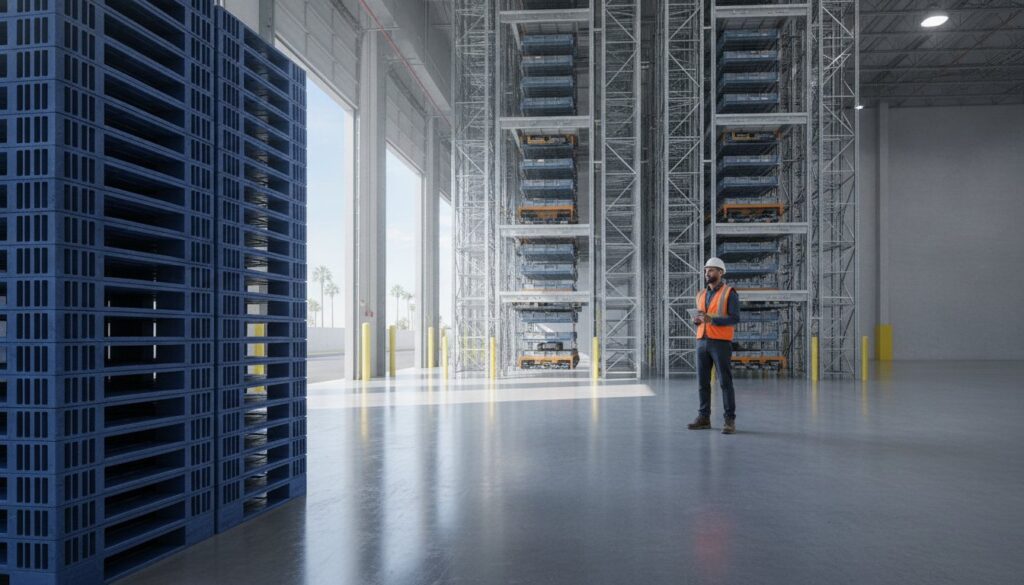
A pallet is often treated as a commodity, but in a high-capacity warehouse, it is actually a critical piece of precision engineering. If you manage high-density loads or automated storage and retrieval systems (ASRS), you already know that a single structural failure can halt an entire production line. Wooden pallets often introduce risks like splinters, loose nails, and inconsistent dimensions that jeopardize both product safety and operational uptime. For manufacturers across Southern California, maintaining a clean and efficient facility requires equipment that can withstand rigorous, repetitive use without degrading.
This guide explains how transitioning to heavy duty plastic pallets can solve these persistent logistical headaches while lowering your total cost of ownership. You will learn how these durable platforms optimize load stability and ensure compliance with strict hygiene standards for the medical, aerospace, and electronics sectors. We will also examine how standardized dimensions facilitate seamless integration into automated environments, ultimately improving safety for your warehouse staff. By the end of this article, you’ll understand the specific variables that justify the investment in plastic over traditional wood alternatives and how to select the right specifications for your application.
Key Takeaways
- Learn why high-density polyethylene (HDPE) construction makes heavy duty plastic pallets the preferred choice for high-capacity, closed-loop industrial shipping.
- Understand the critical differences between static, dynamic, and racking load capacities to prevent pallet failure and ensure warehouse staff safety.
- Discover how a total cost of ownership analysis reveals the long-term financial advantages of plastic over wood in repetitive shipping cycles.
- Identify specific pallet specifications required for cleanroom compliance and aerospace manufacturing standards in Southern California.
- Explore how vendor-managed inventory and strategic packaging design can eliminate pallet shortages and streamline your local supply chain operations.
What Defines a Heavy Duty Plastic Pallet in Industrial Logistics?
Heavy duty plastic pallets are engineered platforms constructed from high-density polyethylene (HDPE) or polypropylene (PP). Unlike lightweight export versions designed for single use, these industrial tools are built for closed-loop returnable systems where durability and longevity are paramount. This shift from disposable to reusable logistics is a primary driver for many facilities in San Diego and Los Angeles looking to reduce their long-term environmental footprint and per-trip costs. A truly heavy duty pallet is defined by its ability to maintain structural integrity through hundreds of cycles in demanding environments.
Strength in these platforms isn’t just about the volume of plastic used; it’s about the molding technology. High-pressure injection molding produces a pallet with high dimensional accuracy, which is critical for integration with automated storage and retrieval systems (ASRS). Alternatively, structural foam molding involves injecting nitrogen gas into the melt, creating a pallet with a solid outer skin and a cellular core. This process increases the moment of inertia, providing exceptional rigidity for heavy loads without the excessive weight of a completely solid block. These manufacturing methods ensure that heavy duty plastic pallets can withstand the rigors of industrial handling that would quickly destroy lighter alternatives.
Material Composition: HDPE vs. Polypropylene
HDPE is the most common choice for heavy duty applications because of its superior impact resistance. It remains flexible at low temperatures, making it a reliable option for cold storage facilities throughout the Inland Empire. Polypropylene (PP) offers higher stiffness and can withstand higher temperatures, which prevents the pallet from sagging when under constant pressure. While recycled resins are available, virgin materials are often required for medical or food-grade applications to ensure chemical purity and structural consistency. The choice of material impacts how Plastic Pallets respond to chemical exposure and environmental stressors over time.
Structural Design Features
The physical architecture of heavy duty plastic pallets determines their suitability for specific cargo. Solid decks prevent debris from falling through and are significantly easier to sanitize in cleanroom environments. Vented decks reduce the overall weight of the pallet while maintaining structural integrity and allowing for airflow. For high-bay racking systems, internal steel reinforcements are often added to reduce deflection and increase safety. Most industrial designs prioritize 4-way entry for forklift access, ensuring that warehouse teams in Orange County can move high-density loads with maximum speed and safety.
Understanding Load Capacities: Static vs. Dynamic vs. Racking
Selecting the right equipment requires more than checking a single weight rating. Engineers must evaluate how a load is distributed across the surface and how the material responds to movement. Most manufacturers test their products using a Uniform Distributed Load (UDL). This assumes the weight is spread evenly across the entire deck of the pallet. If your cargo has concentrated footprints or uneven weight distribution, the effective capacity of your heavy duty plastic pallets will be significantly lower than the nominal rating. Adhering to industry standards for plastic pallets ensures that these ratings are calculated using consistent, repeatable testing methodologies.
Heavy duty plastic pallets are designed to handle rigorous cycles, but their performance depends entirely on respecting these engineering limits. Environmental conditions also play a vital role in load bearing. High temperatures can soften the resin, increasing the rate of creep and lowering the racking limit. Conversely, extreme cold can make some materials more brittle, reducing impact resistance during dynamic handling. Always verify that your chosen material, whether HDPE or PP, is rated for the specific temperature range of your facility.
Static and Dynamic Load Limits
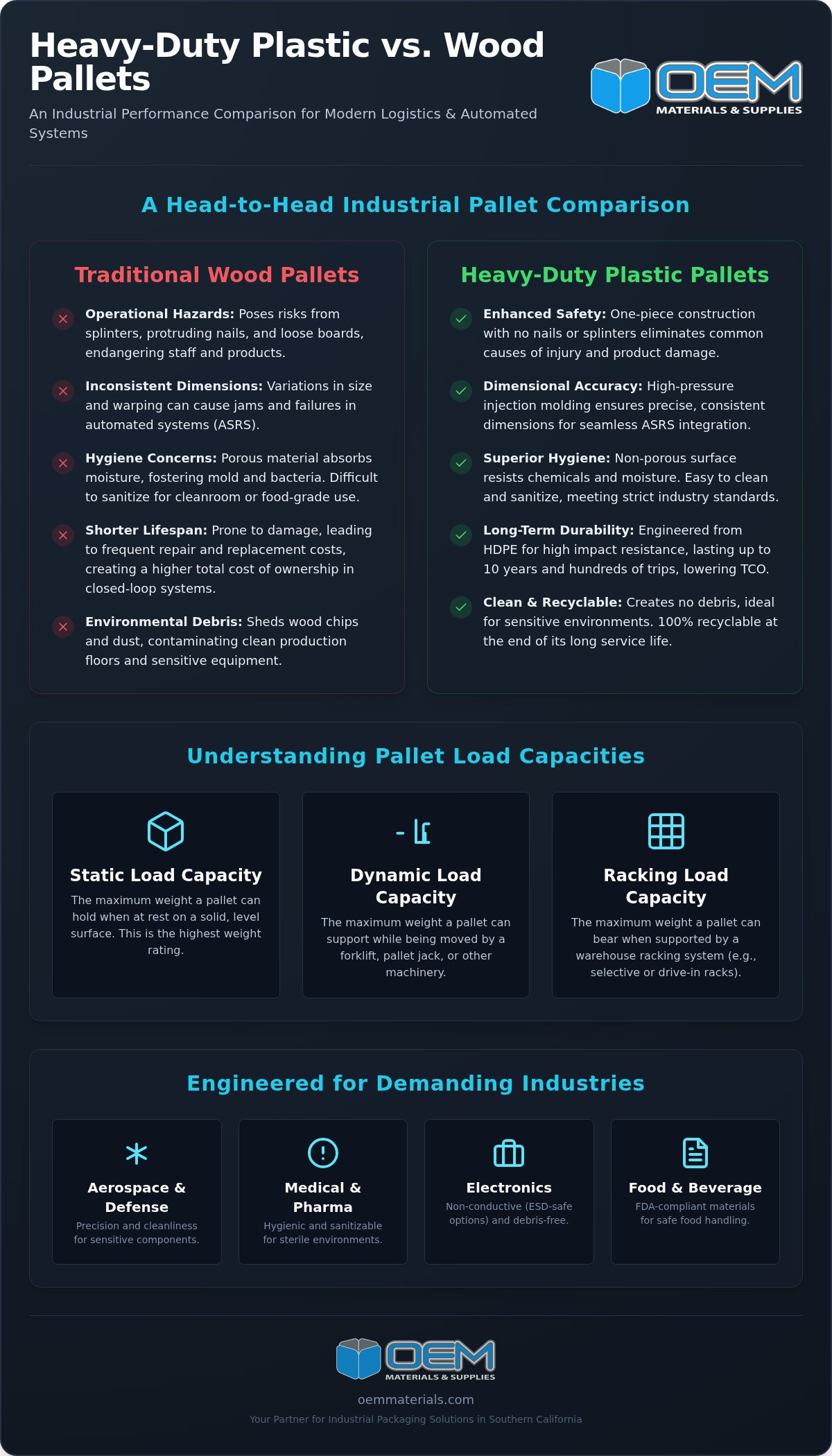
Static load capacity refers to the maximum weight a pallet can support when resting on a flat, level floor. This is typically the highest rating because the floor provides continuous support across the entire base. Dynamic load capacity is a more practical measurement for daily operations. It defines the weight limit while the pallet is in motion, such as during forklift transit or on a conveyor system. Safety margins are essential in high-volume environments. We recommend never exceeding 80% of the rated dynamic capacity to account for sudden shifts in momentum or floor irregularities that increase stress on the plastic structure.
Racking Capacity and Deflection
Racking capacity measures the maximum weight a pallet can hold when supported only by two edges in a warehouse rack. This configuration places the greatest amount of stress on the center of the platform. Under heavy loads, plastic can experience ‘creep,’ which is a slow, permanent deformation that occurs over time. This structural sagging, known as deflection, can interfere with automated sensors or cause the pallet to slip from the racking beams if not properly managed. Racking capacity is the most critical safety metric for warehouse managers. To ensure your facility remains compliant and safe, it’s helpful to consult with a packaging professional who can analyze your specific rack spacing and load profiles.
Plastic vs. Wood Pallets: An Industrial Performance Comparison
While wood pallets have a lower initial purchase price, they often carry hidden costs that inflate the total cost of ownership (TCO). In a 5-year lifecycle analysis, heavy duty plastic pallets frequently prove to be the more economical choice for closed-loop industrial systems. Wood platforms are prone to moisture absorption, warping, and structural failure, which requires frequent repair or replacement. High-quality plastic units can withstand hundreds of trips with minimal degradation, providing a more stable return on investment for high-volume operations. For a comprehensive breakdown of how different pallets compare across materials, standards, and logistics requirements, our industrial guide provides an authoritative analysis to support your procurement decisions.
Modern warehouses in San Diego and Orange County increasingly rely on ASRS and sensor-driven conveyor belts. These systems demand strict dimensional precision to function correctly. A single warped board or loose nail on a wooden pallet can trigger a system-wide shutdown or damage expensive automated equipment. Plastic pallets offer the consistency required for these high-tech environments, ensuring seamless movement through the supply chain without the risk of mechanical interference. Additionally, plastic is 100% recyclable at the end of its service life, allowing companies to meet sustainability goals while maintaining operational efficiency.
Maintenance and Longevity
One of the most immediate benefits is the elimination of product damage caused by wood splinters and rusty nails. These common wood defects are notorious for puncturing packaging and compromising high-value goods. By using heavy duty plastic pallets, manufacturers can maintain a cleaner facility and protect their inventory from avoidable physical hazards. Consistent tare weights also allow for more predictable shipping costs, as plastic does not gain weight from water absorption like wood does. For a deeper look at common misconceptions in international shipping, see our Export Pallet Myths vs. Reality: Shipping Guide.
Regulatory Compliance and ISPM 15
International shipping often requires wood packaging to undergo heat treatment or fumigation to comply with ISPM 15 regulations. Plastic pallets are naturally exempt from these requirements, simplifying the export process for manufacturers in Los Angeles and the Inland Empire. This exemption is particularly vital for cleanroom environments in medical device and aerospace manufacturing, where organic contaminants found in wood are strictly prohibited. For larger equipment that requires more than a platform, custom Crates provide a similar level of protection and regulatory compliance for heavy machinery shipping.
Selecting the Right Pallet for Southern California Industries
Southern California’s industrial landscape is diverse, ranging from the high-tech medical labs of San Diego to the massive aerospace hangars in Los Angeles and Orange County. A standard pallet might suffice for general warehousing, but specialized manufacturing requires equipment tailored to specific environmental and mechanical stressors. Selecting the right heavy duty plastic pallets involves analyzing your facility’s cleanliness requirements, the weight of your densest components, and the sensitivity of your electronics. In Riverside and the Inland Empire, where automotive parts distribution dominates, the focus shifts toward extreme durability and impact resistance for high-volume throughput.
Integrating these platforms with custom protective systems ensures that high-value cargo remains stable during transit. For instance, combining a precision-molded pallet with custom-engineered inserts prevents shifting that leads to surface abrasion or structural damage. This holistic approach to packaging design reduces waste and ensures that your logistics chain remains a predictable part of your operation rather than a source of unexpected costs.
Medical and Life Science Applications
San Diego County is a global hub for medical device and life science research. These facilities operate under strict regulatory oversight where organic contaminants are a primary concern. Heavy duty plastic pallets used in these environments feature non-porous surfaces that prevent microbial growth and the absorption of liquids. Unlike wood, which can harbor pathogens in its grain, plastic can be aggressively sanitized using industrial cleaning agents without degrading the material’s structural integrity. To see how these solutions fit into a broader operational strategy, explore our Manufacturing Packaging Solutions guide.
Aerospace and Heavy Electronics
The aerospace sector in Los Angeles and Orange County deals with some of the most sensitive and heavy components in manufacturing. Large engine parts require pallets with exceptional racking capacities to ensure safety in high-bay storage. For electronic assemblies, ESD (Electrostatic Discharge) pallets are often required to dissipate static charges that could permanently damage microchips. These specialized heavy duty plastic pallets are often paired with Foam Packaging to provide vibration dampening and precision fitment for delicate flight hardware. This combination of a rigid base and soft cushioning creates a comprehensive protection system for mission-critical parts.
Every industry has unique variables that dictate the ideal pallet specification. To ensure your selection meets your specific load profiles and compliance needs, contact us for a technical consultation today.
Optimizing Your Supply Chain with OEM Materials & Supplies
Industrial logistics requires more than just a reliable product; it requires a reliable partner who understands the nuances of local manufacturing. Moving beyond simple procurement allows companies to treat heavy duty plastic pallets as part of a comprehensive supply chain strategy rather than a recurring expense. At OEM Materials & Supplies, we function as a strategic partner for manufacturers across Southern California, providing the technical expertise needed to align pallet specifications with specific operational goals. Whether you are managing a high-throughput distribution center in Riverside or a sensitive electronics lab in San Diego, our focus is on eliminating logistical friction.
Our approach integrates physical products with value-added services to solve real-world problems like floor space constraints and inventory shortages. By analyzing your entire packaging workflow, we can identify opportunities to reduce labor costs and material waste. This results in a more resilient supply chain that can adapt to the rigorous demands of the aerospace, medical, and automotive sectors.
VMI and JIT Services
Maintaining a consistent supply of shipping platforms is essential for operational continuity. Through our Packaging VMI (Vendor-Managed Inventory) programs, we take responsibility for monitoring your stock levels and managing replenishment. This proactive approach eliminates the risk of pallet shortages during peak production cycles, ensuring that your outbound shipments are never delayed by a lack of equipment. By leveraging our local logistics network, we provide just-in-time (JIT) delivery to facilities throughout Orange County and Los Angeles County. JIT delivery improves cash flow for manufacturers by reducing the amount of capital locked in stagnant warehouse stock.
Custom Design and Prototyping
Standardized pallets are efficient for many, but unique product footprints often require a more tailored approach. We provide Custom Packaging Design services to develop integrated systems where the pallet and protective materials work in unison. This might include pairing heavy duty plastic pallets with custom foam inserts or specialized corrugated boxes to create a secure, vibration-dampened environment for high-value components. We also evaluate how high-performance Stretch Film and edge protectors can further stabilize loads, reducing the likelihood of product damage during transit.
If you are ready to optimize your logistics and reduce your total cost of ownership, we invite you to Request a Quote for Heavy Duty Pallets today. Providing specific data such as your typical load weight, product dimensions, and annual usage will help us develop the most accurate and effective recommendation for your facility.
Advancing Your Industrial Logistics Strategy
Transitioning to heavy duty plastic pallets is a strategic move that addresses the core challenges of modern manufacturing. By prioritizing high-density materials and precise load capacities, you eliminate the risks of product damage and mechanical failure associated with traditional wood platforms. These systems ensure strict compliance with medical and aerospace hygiene standards while providing the dimensional accuracy required for automated warehouses.
OEM Materials & Supplies supports Southern California manufacturers through local distribution hubs in Orange County and San Diego, offering custom engineering to align packaging with your specific product footprints. Our vendor-managed inventory and just-in-time delivery services are designed to keep your production lines moving without the burden of excessive overhead. We focus on providing stability and reliability for the most demanding supply chains.
To receive a tailored recommendation based on your load dimensions, weight requirements, and annual volume, Request a Quote for Industrial Heavy Duty Pallets today. We look forward to helping you build a more resilient and cost-effective supply chain.
Frequently Asked Questions
What is the average lifespan of a heavy duty plastic pallet compared to wood?
Heavy duty plastic pallets typically last 10 years or more in a closed-loop system, which is significantly longer than the 5 to 10 trips expected from a standard wood pallet. This extended lifespan reduces the frequency of procurement and disposal. It’s a reliable way to lower the total cost of ownership for high-volume distribution centers that prioritize long-term durability over low initial purchase prices.
Can heavy duty plastic pallets be used in high-bay racking systems?
Yes, many models are specifically engineered for high-bay racking. These pallets often feature internal steel reinforcements or are molded from high-rigidity resins like polypropylene to minimize deflection. It’s critical to verify the racking load rating for your specific rack configuration, as the pallet must remain structurally sound while supported only by its edges under a full load.
Are plastic pallets truly more environmentally friendly than wood?
Plastic pallets are 100% recyclable at the end of their service life, which prevents them from entering landfills. While wood is biodegradable, the frequent repair and replacement cycles of wooden pallets generate significant waste. The long-term use of a single plastic unit replaces dozens of wooden ones, reducing the overall carbon footprint associated with manufacturing and transporting shipping platforms.
What are the weight capacity limits for a standard 48×40 plastic pallet?
A standard 48×40 heavy duty plastic pallet generally supports a static capacity of 30,000 lbs and a dynamic capacity of 5,000 lbs. Racking limits typically range between 2,000 and 2,500 lbs. These figures assume a uniform distributed load (UDL). If your cargo has an uneven weight distribution or concentrated footprints, the effective capacity will be lower than the nominal rating.
How do I know if my plastic pallet is cleanroom compatible?
Cleanroom-compatible pallets feature a solid, smooth top deck with no open cavities or ribs where dust and bacteria can accumulate. They are manufactured from virgin resins that don’t outgas and are capable of withstanding aggressive chemical sanitization. If your application involves ISO-rated environments, ensure the pallet is specifically marketed for hygienic or medical use to maintain facility compliance.
Do plastic pallets require ISPM 15 certification for international shipping?
No, plastic pallets are naturally exempt from ISPM 15 regulations because they don’t harbor wood-boring pests. This exemption allows you to ship goods internationally without the need for heat treatment or fumigation. Using plastic eliminates the risk of your shipment being delayed or quarantined at customs due to documentation errors or pest infestations commonly associated with wooden packaging.
What is the difference between virgin and recycled HDPE in pallet manufacturing?
Virgin HDPE offers the highest structural consistency and impact resistance, making it the standard for medical and food-grade applications. Recycled HDPE is a more cost-effective and sustainable option for general industrial use. While recycled material is durable, it may have slightly lower tensile strength and inconsistent chemical properties, which can affect its performance in extreme temperature environments.
Can I get custom-sized heavy duty plastic pallets for non-standard loads?
Custom sizes are available, though they often require specialized fabrication methods like CNC machining and plastic welding for lower volumes. For high-volume requirements, a custom injection mold can be created to match your exact product dimensions. Custom-engineered platforms are ideal for aerospace and automotive components that require precise stabilization and integration with existing automated storage systems.