

With the average price of imported aircraft parts rising by 13.1% over the past year, can your operations afford a single instance of transit damage caused by substandard crating or inadequate cushioning? For manufacturers across Southern California, securing a reliable aerospace parts packaging supplier los angeles is no longer just a procurement task; it’s a critical strategy for protecting high-value avionics and navigating the complex 2026 regulatory environment. Every component, from a delicate sensor to a heavy engine housing, requires a precision-engineered solution to survive the logistics chain.
You understand that meeting the rigorous standards of the 2026 National Defense Authorization Act and California’s SB 54 packaging laws requires more than basic corrugated containers. This guide will identify the essential technical requirements for aerospace packaging and explain how to select a local partner that ensures zero-damage transit while reducing assembly labor through efficient kitting. We’ll examine engineered foam inserts for sensitive electronics, the impact of new EPR fees on material selection, and how vendor-managed inventory programs can prevent costly production delays in your facility.
Key Takeaways
- Identify the technical requirements for protecting flight-critical components from electrostatic discharge and physical shock during transit.
- Compare the performance of polyethylene and polyurethane foam inserts to ensure your sensitive avionics receive optimal vibration dampening.
- Learn how to evaluate an aerospace parts packaging supplier los angeles based on their in-house design capabilities and rapid prototyping services.
- Reduce assembly line labor and warehouse overhead by implementing pre-assembled packaging kits and vendor-managed inventory programs.
- Shift your procurement strategy from a commodity vendor model to a technical partnership that emphasizes precision and operational efficiency.
Requirements for an Aerospace Parts Packaging Supplier in Los Angeles
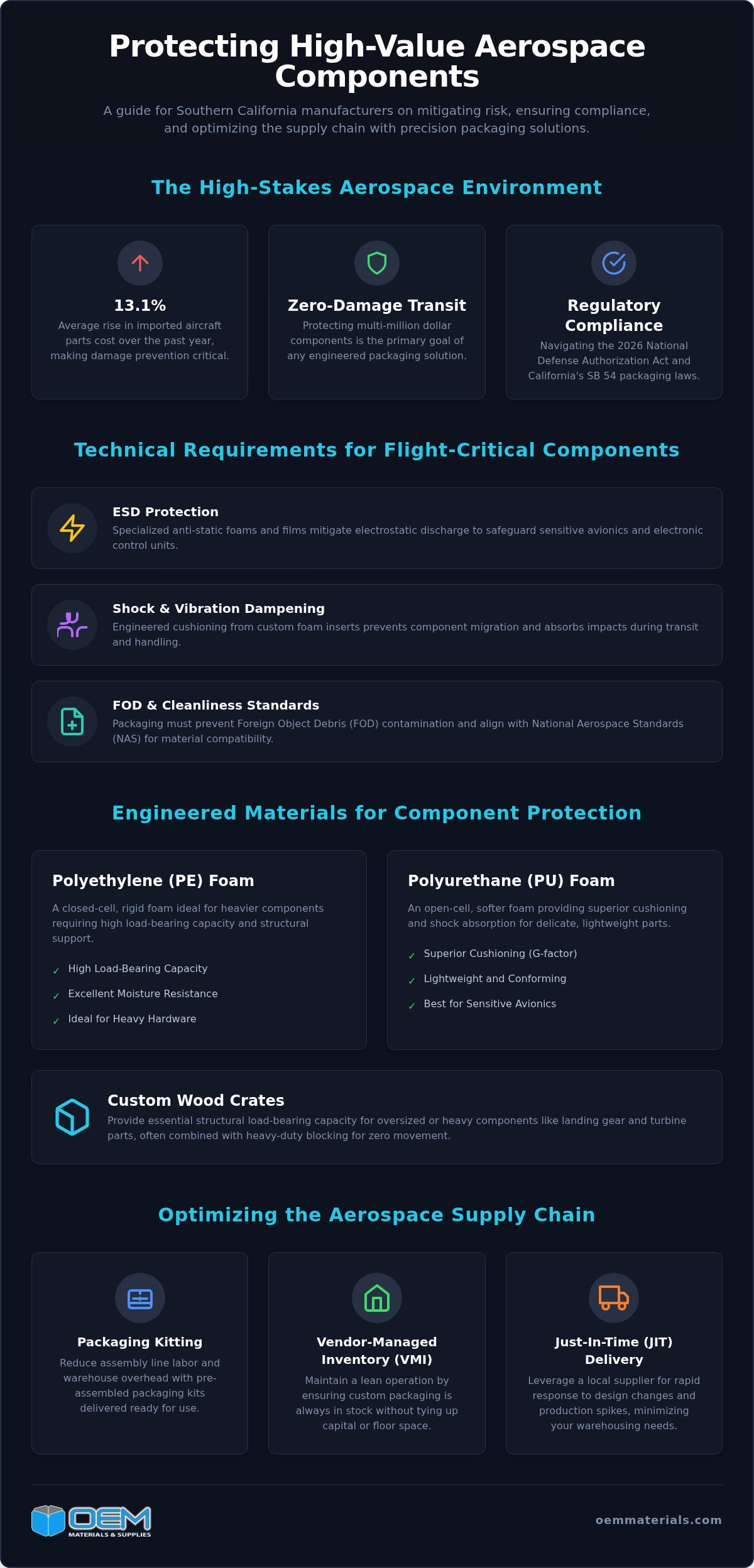
The Southern California aerospace corridor, stretching through El Segundo, Long Beach, and Torrance, represents one of the highest concentrations of aerospace manufacturing in the world. Operating within this hub requires more than just a vendor; it demands an aerospace parts packaging supplier los angeles that understands the technical rigors of flight-critical hardware. Protection goes beyond simple transit. It involves mitigating risks like electrostatic discharge (ESD), physical shock, and Foreign Object Debris (FOD), which can compromise a multi-million dollar component before it ever reaches the assembly line. Every packaging solution must be engineered to withstand the specific stresses of the aerospace supply chain while maintaining strict cleanliness standards.
Precision Engineering for High-Value Avionics
Standard shipping containers often fail to provide the static dissipation or vibration dampening required for sensitive flight electronics. High-value avionics require engineered interiors, often utilizing custom foam packaging to prevent component migration during handling. These designs must often align with National Aerospace Standards (NAS) to ensure every material used is compatible with the sensitive nature of the hardware. For air freight, the challenge is balancing structural integrity with weight. Excessive packaging increases fuel costs, while insufficient protection leads to catastrophic product loss. Precision design ensures the smallest possible footprint without sacrificing the durability needed for global distribution.
Local Logistics and Just-In-Time Requirements
Proximity to LAX and the ports of Long Beach and Los Angeles is a strategic necessity for local manufacturers. A local aerospace parts packaging supplier los angeles can offer just-in-time (JIT) packaging delivery, which is essential when warehouse space is at a premium. Local warehousing allows for rapid response to design changes or urgent production spikes that a national vendor simply cannot match. Lead times are shortened when your partner is minutes away rather than states away.
Onsite consultations in cities like Torrance or El Segundo allow packaging engineers to evaluate complex assemblies in person. This hands-on approach identifies potential FOD risks or kitting opportunities that might be missed in a digital CAD file. By integrating vendor-managed inventory (VMI), aerospace firms can maintain a lean operation. This ensures that custom crates or ESD-safe materials are always available without tying up excessive capital in floor stock. This local responsiveness is what differentiates a technical partner from a commodity reseller.
Engineered Materials for Aerospace Component Protection
Aerospace engineering relies on precision, and the materials used to transport these components must meet the same standard of accuracy. As a specialized aerospace parts packaging supplier los angeles, we focus on material science to mitigate the risks of transit. This involves selecting materials based on the specific fragility and weight of the hardware, ensuring compliance with the MIL-STD-2073-1 military packaging standard for preservation and packing. Every material choice is a calculated decision to prevent damage before it occurs.
Electronic control units (ECUs) and sensitive avionics require more than just physical cushioning. They need a controlled environment to prevent electrostatic discharge. We utilize specialized ESD-safe materials, such as anti-static foams and films, that prevent the buildup of static electricity during handling. For oversized or exceptionally heavy items, like landing gear or turbine components, custom wood crates provide the necessary structural load-bearing capacity that standard packaging cannot offer. These crates are often combined with heavy-duty blocking and bracing to ensure zero movement during transit.
Custom Foam Inserts and Cushioning
The choice between polyethylene (PE) and polyurethane (PU) foam depends on the G-factor or fragility rating of your part. Polyethylene is a closed-cell foam, offering higher load-bearing capacity for heavy hardware and excellent moisture resistance. Polyurethane is an open-cell, softer foam ideal for dampening high-frequency vibrations that can damage delicate circuit boards. We often design multi-layer foam configurations to accommodate complex geometries, ensuring every surface of the component is supported. You can view our technical material specifications for foam packaging to determine which density fits your application.
Heavy-Duty Corrugated and Protective Solutions
For industrial durability, we provide double-wall and triple-wall corrugated boxes designed to resist puncturing and crushing. These aren’t standard shipping containers; they’re engineered to carry significant weight while maintaining stackability. To reinforce these large containers during long-haul transport, we integrate edge and corner protectors. These components distribute the tension from stretch film and prevent the edges of the box from collapsing under pressure.
Even in a high-stakes industry like aerospace, sustainability is becoming a requirement due to California’s SB 54 regulations. We help manufacturers transition to recyclable corrugated materials without compromising the safety of the part. If you’re designing a new assembly and need material recommendations, you can request a quote for a custom prototype to test your specific requirements.
Optimizing the Aerospace Supply Chain with Kitting and VMI
Efficiency in the aerospace sector isn’t just about the flight performance of a part; it’s about the speed and reliability of the supply chain that supports it. A specialized aerospace parts packaging supplier los angeles provides more than just raw materials. They provide operational remedies. By moving beyond the procurement of individual boxes and foam inserts, manufacturers can address the two biggest bottlenecks in the packing department: excessive labor and inventory stockouts.
Labor Savings through Custom Packaging Kits
Packing an aerospace sub-assembly often involves multiple steps, such as lining a box, positioning foam, and applying anti-static wraps. This manual process is slow and prone to error. Custom packaging kits consolidate these components into a single SKU. Instead of pulling five different items from five different warehouse locations, your team receives a ready-to-use kit. This significantly reduces the touch-time per unit. For non-hazardous shipments, these kits can be designed to meet ASTM D3951 commercial packaging requirements, ensuring compliance while maximizing throughput.
By standardizing the packing process, you minimize the risk of inconsistent protection. Kitting also streamlines the procurement of secondary materials like labels, packaging tape, and stretch film. When these items are part of a pre-configured kit, the complexity of managing multiple vendors and purchase orders disappears. This level of organization is essential for maintaining the high-volume production runs common in the Southern California aerospace corridor.
Vendor Managed Inventory for Los Angeles Facilities
Running out of custom-sized corrugated boxes or high-performance stretch film can halt an entire production line. This is where packaging VMI becomes a strategic asset for Los Angeles facilities. Under a VMI program, your aerospace parts packaging supplier los angeles monitors your usage levels and replenishes stock automatically. You don’t have to manage purchase orders for every roll of tape or pallet of boxes.
This model improves cash flow because you only pay for materials as they are consumed. It also frees up valuable floor space in high-rent Southern California industrial zones. When integrated with JIT packaging, you achieve a lean supply chain that responds to real-time demand. Local warehousing ensures that your critical shipping supplies are always accessible, preventing stockouts and reducing the overhead associated with inventory management. This proactive approach allows your operations team to focus on manufacturing rather than monitoring box counts.
Evaluating an Aerospace Packaging Supplier in Los Angeles
Selecting an aerospace parts packaging supplier los angeles requires looking beyond basic certifications. While industry standards are a baseline, the true value of a partner lies in their ability to solve complex engineering challenges under tight deadlines. You need a supplier that can scale seamlessly, moving from a single prototype for an R&D project in El Segundo to high-volume production runs for a facility in Long Beach. This scalability ensures that your packaging remains consistent as your project moves through its lifecycle.
Reliability in this sector is defined by technical depth. A supplier should demonstrate a mastery of aerospace-specific materials, particularly in the application of ESD protection and high-density cushioning. They should act as a technical consultant, identifying potential failures in the packaging design before they result in damaged hardware or assembly line delays. This proactive approach is what separates a strategic partner from a simple commodity vendor.
Prototyping and Design Capabilities
Technical expertise begins with CAD-driven custom packaging design. By using precise digital models, engineers can create foam cavities and corrugated structures that match the exact geometry of your components. This precision is critical for preventing part migration during transit. Prototyping allows you to test these designs in real-world conditions, simulating the vibrations and impacts common in air and sea freight. This iterative process doesn’t just improve safety; it optimizes material usage. Reducing excess packaging helps you manage costs and stay compliant with California’s evolving environmental regulations without sacrificing part integrity.
Supplier Reliability and Regional Expertise
Regional knowledge is a strategic advantage in Southern California logistics. A supplier with a deep understanding of local shipping lanes knows how to navigate the specific requirements of LAX and the regional ports. When you are choosing a wholesale industrial packaging supplier, evaluate their track record with other local manufacturers. Regional expertise means they can provide onsite consultations in Torrance or the Inland Empire to troubleshoot packing line inefficiencies in person. Dedicated account management ensures that your specific quality requirements are understood and met during every production cycle.
Consistency is the foundation of a successful aerospace supply chain. If your current vendor lacks the technical depth or local responsiveness your projects require, it’s time to consult with an expert who understands the rigors of the industry. To get started on a custom design for your flight-critical components, request a quote with your specific dimensions, weight, and annual usage data.
Partnering with a Los Angeles Aerospace Packaging Expert
Transitioning from a transactional vendor model to a technical partnership is essential for maintaining a resilient aerospace supply chain. In an industry where a single packaging failure can lead to catastrophic financial loss, you need more than a box supplier. You need a partner that integrates with your engineering and operations teams to solve logistical challenges before they impact your delivery schedule. This shift ensures long-term stability and allows for a more sophisticated approach to material selection and inventory management.
The Quote Request Process
To develop a precise solution, our engineers require specific technical data. Providing accurate information during the initial consultation prevents over-engineering, which adds unnecessary cost, or under-engineering, which risks product damage. When you Request a Quote, please include the following data points for your components:
- Part dimensions (Length x Width x Height)
- Total weight per unit
- Fragility rating or G-factor if known
- Annual usage and typical order quantities
Specifying your annual usage is particularly important. This data allows your aerospace parts packaging supplier los angeles to provide tiered volume pricing and plan for raw material procurement, protecting you from price volatility. While volume pricing and material optimization offer significant advantages, actual cost-reduction results depend on specific variables such as product dimensions, material selection, and shipping requirements. By sharing your production forecasts, you enable your partner to reserve inventory specifically for your facility, ensuring that custom-engineered materials are available exactly when you need them.
Building a Solution-Oriented Partnership
A strategic partnership involves ongoing material optimization to find cost-reduction opportunities without compromising part safety. This isn’t a one-time setup; it’s a continuous process of reviewing packaging performance and transit damage rates. We recommend regular site audits to evaluate your current packing floor workflows. These audits often reveal hidden costs, such as excessive labor from inefficient manual kitting or material waste from oversized containers. By analyzing these variables, we can refine your packaging designs to improve both protection and operational speed.
Contact OEM Materials & Supplies to schedule a comprehensive audit of your Southern California facility. This allows us to assess your current inventory levels and identify where high-performance stretch film or custom-fit foam inserts can improve your throughput. By leveraging technical data and regional logistics expertise, we help you build a more stable and cost-effective supply chain for your flight-critical hardware.
Securing Your Aerospace Supply Chain for 2026
Protecting flight-critical hardware requires a shift from basic procurement to technical engineering. By prioritizing specialized foam engineering for sensitive avionics and implementing custom kitting, your operation can reduce labor costs and virtually eliminate the risk of transit damage. These strategies ensure that high-value components arrive at the assembly line in pristine condition, regardless of the shipping distance or handling rigors. Precision in the packing department is just as vital as precision in manufacturing.
Maintaining a lean operation in Southern California requires more than just high-quality materials; it demands a partner with local Los Angeles inventory and JIT delivery capabilities. Choosing a reliable aerospace parts packaging supplier los angeles allows you to navigate evolving regulatory requirements while keeping your production lines moving without interruption. This local responsiveness is the foundation of a resilient and cost-effective supply chain, providing the stability needed to manage complex manufacturing cycles.
Take the next step in optimizing your logistics. Request a custom aerospace packaging quote today to receive a tailored solution based on your specific part dimensions, weight, and annual usage. We look forward to helping you build a more secure and efficient manufacturing process.
Frequently Asked Questions
What are the common packaging materials used for aerospace parts?
High-density polyethylene (PE) and polyurethane (PU) foam, double-wall or triple-wall corrugated boxes, and custom wood crates are the industry standards. For sensitive electronics, we utilize anti-static (ESD) films and foams. These materials are selected based on the part’s weight and fragility. By matching the material properties to the component’s requirements, we ensure that every assembly remains protected from physical shock and environmental factors during long-haul transit.
How does a Los Angeles supplier help reduce shipping damage for avionics?
A local aerospace parts packaging supplier los angeles provides engineered cushioning specifically designed for the G-factor of your avionics. By conducting onsite consultations in facilities across Torrance or El Segundo, we evaluate the handling environment and transit lanes. This hands-on approach ensures that custom foam inserts provide exact fitment. This prevents component migration and physical shock during transport, which is a common cause of failure for delicate flight-critical hardware.
Can you provide custom foam inserts for small production runs?
Yes, we specialize in both rapid prototyping and small-batch production runs for R&D projects. Our CAD-driven design process allows us to create custom foam cavities without the need for expensive tooling in many cases. This flexibility supports aerospace engineers during the iterative design phase. It allows for precision protection even when annual usage volumes are low, ensuring that every prototype reaches its destination without damage from substandard or generic packaging.
Do you offer ESD-safe packaging for aerospace electronics?
We provide a full range of ESD-safe materials, including pink anti-static foam and conductive films. These materials prevent electrostatic discharge from damaging sensitive electronic control units (ECUs) and circuit boards. Our designs often integrate these materials into custom corrugated containers to provide both electrical protection and structural integrity. This combination is critical for protecting high-value aerospace assemblies from the invisible risks of static during the handling and shipping process.
What information is needed to get a custom aerospace packaging quote?
To provide an accurate quote, we require the part’s dimensions (L x W x H), total weight, and fragility rating. Additionally, specifying your annual usage and typical order quantities helps us determine tiered volume pricing. This technical data ensures we recommend the most cost-effective materials, such as specific corrugated strengths or foam densities, tailored to your application. Precise information at the start of the process prevents over-engineering and keeps your material costs predictable.
How does vendor-managed inventory work for aerospace manufacturers?
Under a VMI program, your aerospace parts packaging supplier los angeles monitors your stock levels and replenishes materials automatically. This eliminates the risk of stockouts for critical items like stretch film or custom crates. You don’t have to manage purchase orders for every roll of tape. You only pay for the packaging as it is consumed. This model significantly improves cash flow and reduces the warehouse floor space dedicated to inventory storage.
Do you serve aerospace companies in Orange County and San Diego as well?
Yes, we provide local service to aerospace and defense manufacturers throughout Southern California, including Orange County, San Diego County, and the Inland Empire. Our logistics network is designed for rapid response and just-in-time delivery to these regions. This regional presence allows our team to conduct onsite audits and consultations to troubleshoot packaging inefficiencies across the entire SoCal aerospace corridor, ensuring that high-value hardware is always protected during short-haul and long-haul transport.
What is the typical lead time for custom aerospace packaging prototypes?
Lead times for prototypes typically range from a few days to a week, depending on the complexity of the design. Our rapid prototyping capabilities allow us to quickly move from a CAD file to a physical sample for testing. This speed is essential for aerospace manufacturers meeting tight production deadlines or responding to urgent engineering changes. We prioritize efficiency to ensure that your packaging design keeps pace with your manufacturing schedule and project milestones.