
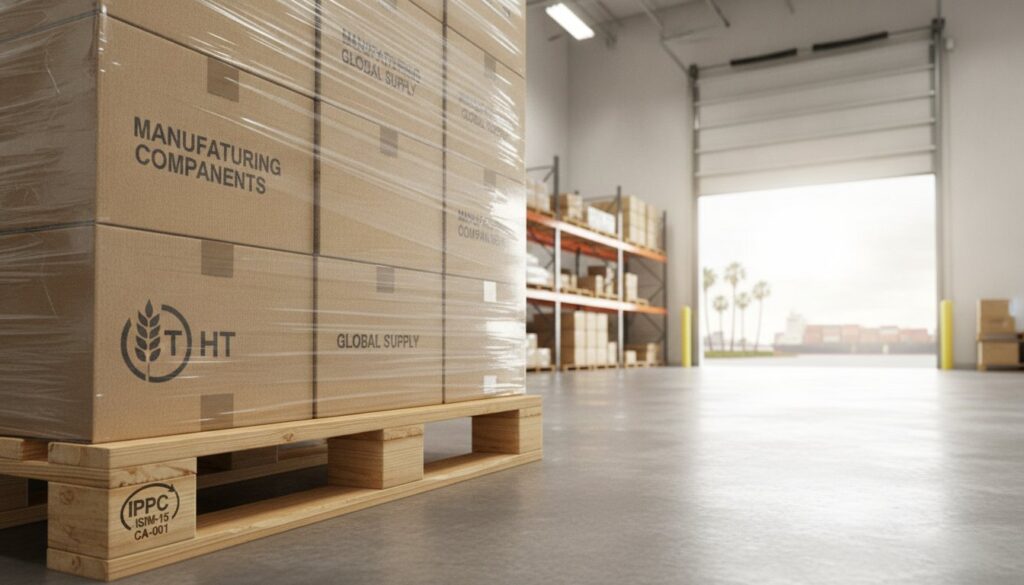
A single ink-stamped logo on your export pallets can now trigger a total shipment rejection and thousands of dollars in port fees. As of 2026, international standards require IPPC marks to be permanently branded into the wood; the days of using simple ink stamps are over. You likely understand that keeping your supply chain moving requires more than just a sturdy platform. It requires strict adherence to shifting global mandates. Even a small amount of bark or an incorrectly formatted facility code can lead to a quarantine that your budget won’t survive.
This guide identifies common misconceptions about international shipping regulations and explains how to select the right export pallets to avoid costly port rejections. You’ll learn the specifics of the latest ISPM 15 zero tolerance bark policy and the hyphenation requirements mandated by US Customs and Border Protection. We also provide a clear comparison between plastic and heat-treated wood. This helps manufacturers in Orange County, Los Angeles, and San Diego determine which material best reduces shipping weight and ensures compliance with the new EU Packaging and Packaging Waste Regulation (PPWR).
Key Takeaways
- Identify why standard wood pallets require specific heat treatment certifications to meet ISPM 15 standards and avoid costly port rejections.
- Evaluate the benefits of plastic export pallets for air freight to achieve consistent shipping weights and bypass complex phytosanitary inspections.
- Master the 2026 IPPC marking updates, including mandatory hyphenation and permanent branding requirements that have replaced traditional ink stamps.
- Select the appropriate pallet dimensions for your destination country to ensure compatibility with global transport networks and automated warehouse systems.
- Implement a localized vendor-managed inventory program to maintain a reliable supply of compliant packaging for just-in-time delivery in Southern California.
Understanding Export Pallets and International Shipping Requirements
An export pallet is a specialized shipping platform engineered to meet international phytosanitary standards. Its primary function is to facilitate the safe, legal movement of goods across borders while protecting local ecosystems from invasive species. In industrial manufacturing, selecting the right export pallets is a critical step in the logistics chain. It is not just about the weight capacity; it is about verified compliance that keeps your cargo moving through customs without intervention.
The primary regulatory driver for these platforms is the ISPM 15 Standard. This global mandate prevents the international spread of wood-boring pests, such as the emerald ash borer, which can devastate native timber industries. Failure to use compliant pallets can result in entire shipments being quarantined, destroyed at the port, or returned to the origin at the exporter’s expense. For high-value sectors like aerospace and medical device manufacturing, these delays can cause catastrophic disruptions to production schedules.
The Role of ISPM 15 in Global Trade
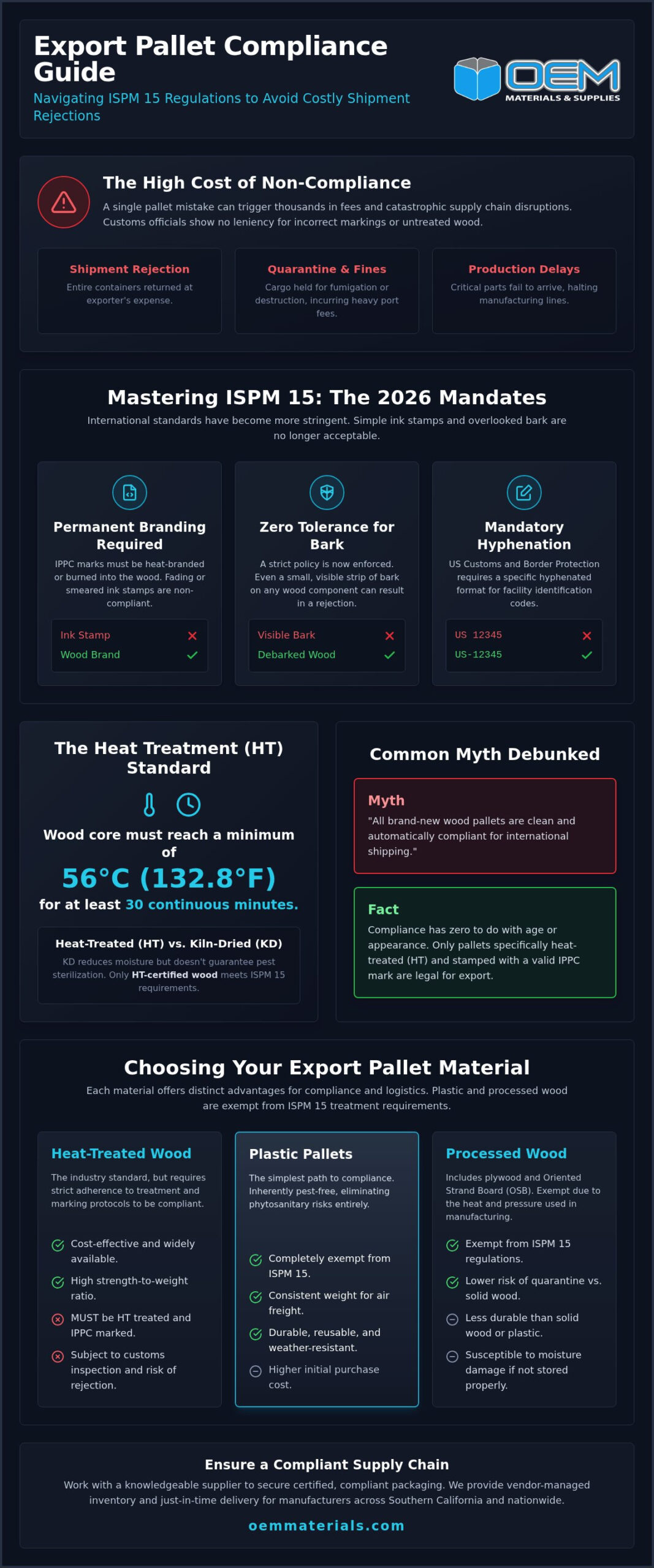
Customs officials in the European Union, China, and Australia are notoriously strict about pallet inspections. As of 2026, regulations have become even more stringent. IPPC markings must now be permanent brands burned into the wood; traditional ink stamps are no longer considered compliant. A zero-tolerance policy for bark is now enforced. Even a small strip of visible bark can lead to a port rejection. US Customs and Border Protection also requires a specific hyphenated format (e.g., “US-1234”) for facility codes. Non-compliance leads to immediate fines and the potential blacklisting of a shipper’s documentation.
Regulatory Differences Between Materials
Regulatory requirements vary significantly based on the material you choose. Plastic, paper, and metal pallets are generally exempt from ISPM 15 regulations because they don’t harbor biological pests. This makes plastic an excellent choice for manufacturers looking to eliminate the risk of quarantine entirely. Processed wood products, including plywood and OSB, are also exempt. These materials undergo high heat and pressure during manufacturing, which naturally kills larvae and fungi.
For Southern California exporters in Orange County, Los Angeles, and San Diego, verifying destination requirements is a vital part of the procurement process. While most countries follow the global ISPM 15 standard, some regions have specific documentation needs for different cargo types. Using heat-treated wood requires heating the core of the lumber to a minimum of 56°C (132.8°F) for at least 30 continuous minutes. Working with a knowledgeable partner helps ensure that your wood crates and pallets meet these precise technical benchmarks before they reach the dock.
Myth: All Wood Pallets are International Shipping Compliant
A common misconception among procurement teams is that brand-new wood pallets are inherently ready for global transit. This assumption is false and potentially expensive. Raw wood, regardless of how clean or new it appears, is a biological medium that can harbor invasive pests. Unless that timber has undergone specific, documented sterilization, it doesn’t qualify as an export pallet. Shipping on non-compliant wood often leads to immediate port rejections, even if the pallet was manufactured just days before the shipment date.
Customs inspectors don’t look at the age of the wood; they look for the certification. A pallet without a visible, legible IPPC mark is treated as a high-risk material. In many jurisdictions, including the EU and China, there is no “cure” at the port. If the markings are missing or illegible, the authorities may order the cargo to be returned or destroyed. To protect your supply chain, you must ensure your export pallets are sourced from a supplier that strictly adheres to ISPM 15 regulations.
The Heat Treatment Process Explained
Heat treatment (HT) is the most reliable method for neutralizing biological threats in solid wood. The process requires heating the core of the lumber to a minimum of 56 degrees Celsius (132.8 degrees Fahrenheit) for at least 30 continuous minutes. It’s vital to distinguish between kiln-dried (KD) and heat-treated (HT) wood. While kiln-drying reduces moisture content for dimensional stability, it doesn’t always meet the specific temperature and duration requirements of the ISPM 15 standard. Only wood marked with the “HT” designation is compliant for international trade. Additionally, chemical fumigation using Methyl Bromide is being phased out globally due to environmental concerns, making heat treatment the primary industrial standard for wood crates and pallets.
Identifying the IPPC Stamp
The IPPC mark serves as the passport for your packaging. It must contain the IPPC “wheat” symbol, the ISO two-letter country code, a unique producer/treatment facility code, and the treatment abbreviation (usually HT). As of 2026, customs authorities have increased their scrutiny of these markings. Ink stamps are frequently rejected if they are faded, smeared, or placed on a porous surface where they become unreadable. Many officials now require permanent brands burned directly into the wood to prevent fraud. When inspecting your inventory, you should verify that:
- The mark is placed on at least two opposite sides of the pallet.
- The facility code includes the mandatory hyphen (e.g., US-12345).
- There is zero visible bark remaining on any component of the pallet.
If you are unsure whether your current inventory meets these rigorous standards, our team can help you assess your export pallet needs to ensure total compliance before your next international shipment.
Plastic vs. Heat-Treated Wood: Evaluating Durability and Cost
Choosing the right material for your export pallets is a decision that impacts both your freight budget and your compliance risk. While heat-treated wood must strictly adhere to international shipping standards for wood packaging, plastic platforms bypass these requirements entirely. Plastic offers precise weight and dimension consistency; wood provides the structural flexibility required for heavy industrial equipment. Understanding these technical differences prevents overspending on materials that don’t match your specific load requirements. For a comprehensive breakdown of how these materials compare across structural ratings and global compliance frameworks, our industrial guide to pallets comparing materials, standards, and logistics provides an authoritative reference for procurement teams.
When to Choose Plastic Pallets
Industries with strict hygiene requirements, such as medical device manufacturing and pharmaceuticals, typically prefer plastic pallets. These platforms don’t produce wood dust or debris, which is essential for maintaining cleanroom integrity. For exporters using San Diego or Los Angeles airports, plastic is often the superior choice for air freight. The uniform weight allows for exact fuel surcharge calculations, often saving money on total landed costs. Many plastic export pallets are also nestable. This feature significantly reduces the footprint of empty units in your warehouse, which is a major advantage for facilities in high-rent areas throughout Orange County and the Inland Empire. Manufacturers managing high-density loads or automated storage systems should also review the full technical specifications covered in our industrial guide to heavy duty plastic pallets to determine the right platform for their operational requirements.
When Heat-Treated Wood is the Better Option
Heat-treated wood remains the industrial standard for one-way shipments and oversized machinery. When your product dimensions don’t fit a standard footprint, custom wood solutions are necessary. For high-value machinery exports that require total enclosure and superior structural support, custom wood crates are often the most reliable option. Wood typically handles extreme static loads better than lightweight plastic alternatives, making it the preferred choice for the automotive and aerospace sectors in Southern California. From a cost perspective, wood is generally more economical for one-way international shipments where pallet recovery is impossible.
Durability considerations also depend on the transit environment. Plastic is impervious to moisture, acids, and chemicals. This prevents the pallet from gaining weight or warping during long sea voyages. Conversely, wood offers higher surface friction, which helps keep cargo from shifting during truck or rail movement. If your priority is a low-cost, high-strength solution for a single trip, heat-treated wood is the practical remedy. If you require a sterile, lightweight, and reusable platform, plastic is the better investment for your supply chain.
How to Select the Right Export Pallet for Your Specific Load
Selecting export pallets requires a detailed analysis of your cargo’s physical characteristics and the logistical path it will take. You must first define the difference between static and dynamic load requirements. A static load refers to the weight the pallet supports while resting on a flat warehouse floor; the dynamic load is the weight it bears while being moved by a forklift, crane, or conveyor. For international shipping, the dynamic rating is the more critical metric due to the constant vibration and shifting inherent in ocean and air transit. Overloading a pallet beyond its dynamic capacity is a primary cause of product damage and safety incidents at destination ports.
International Size Standards
While the 48×40 inch pallet is the standard in North America, using this size for shipments to Europe or Asia often results in logistical friction. The standard Euro Pallet measures 1200x800mm; Asian markets frequently utilize 1100x1100mm footprints. If your pallet dimensions don’t align with the destination’s racking systems or automated warehouses, your shipment may require manual offloading and restacking at the port of entry. This adds significant labor costs and increases the risk of product damage. For manufacturers with unique equipment footprints, utilizing custom packaging design ensures that your pallet maximizes container cube utilization while meeting regional size expectations.
Environmental and Handling Factors
The transit environment is another variable that dictates material choice. If your goods will spend 30 days in a humid shipping container crossing the Pacific, raw wood may absorb moisture. This increases the total shipment weight and potentially leads to mold growth, which is a common reason for rejection in medical and food-grade sectors. Plastic export pallets remain unaffected by humidity and maintain a constant weight, which is vital for maintaining accurate freight billing. For operations that demand consistent performance across repetitive cycles, heavy duty plastic pallets offer the structural durability and dimensional uniformity needed to integrate seamlessly with automated warehouse environments. Handling efficiency also depends on the entry style. 4-way entry pallets allow forklifts to access the load from any side, providing the flexibility needed to pack containers tightly and navigate congested destination ports in places like Rotterdam or Shanghai.
To ensure the integrity of the load during these long journeys, specialized stabilization materials are required. High-performance stretch film provides the necessary containment force to prevent shifting, while edge protectors prevent strapping from crushing corrugated boxes or damaging high-value components. If you are shipping from the Inland Empire or Orange County, matching your pallet selection to these environmental realities is the best way to prevent insurance claims. You can request a quote for compliant export pallets tailored to your specific destination and load weight.
Streamlining Your Export Logistics with OEM Materials
Managing a global supply chain requires more than just purchasing compliant materials. It requires a strategic partner who understands the technical nuances of international shipping. OEM Materials & Supplies provides the localized support necessary for manufacturers to maintain a consistent flow of goods through Southern California’s complex logistics network. Whether you are shipping from the Port of Los Angeles or air freighting components from San Diego, our team ensures your export pallets meet every regulatory benchmark before they leave your facility. We move beyond the role of a vendor, acting as a technical consultant for your entire packaging operation.
Local Expertise for Southern California Manufacturers
Our proximity to major ports and airports in Orange County, Los Angeles, and the Inland Empire allows for just-in-time delivery that keeps your warehouse footprint lean. We understand the specific requirements of the aerospace and medical device sectors. These industries cannot afford the delays associated with pallet non-compliance or inferior packaging strength. For additional insights into optimizing your facility’s output, our manufacturing packaging solutions guide offers practical strategies for industrial packaging efficiency. By aligning your pallet procurement with local logistical realities, you eliminate the lead-time risks associated with out-of-state vendors.
Ensuring Compliance and Reducing Labor
The administrative burden of tracking ISPM 15 compliance and inventory levels often drains internal resources. Our Vendor Managed Inventory (VMI) program solves this by placing the responsibility of stock management and compliance verification on our experts. You never have to worry about a sudden shortage of heat-treated pallets or plastic units during a peak production cycle. This proactive approach reduces the labor costs associated with manual inventory counts and emergency ordering. We ensure every unit in your facility is ready for immediate export.
Consolidating your wholesale industrial packaging needs also allows for significant procurement efficiencies. When we manage your export pallets alongside your corrugated boxes, custom foam, and stretch film, we can optimize the entire shipping unit for maximum protection and minimum weight. This holistic view of the supply chain is where real cost savings are found. Total expenses depend on variables like product dimensions and annual usage, so a tailored approach is always necessary.
We invite you to contact us for a comprehensive pallet audit or a custom quote. To provide the most accurate recommendation, please share your product dimensions, load weight, and annual usage. Our team is ready to help you eliminate port rejections and streamline your international distribution with reliable, compliant export pallets and custom wood crates.
Securing Your Global Supply Chain
Compliance with international shipping standards is no longer a matter of checking a box; it’s a technical requirement that dictates the success of your distribution. You’ve seen how the 2026 IPPC marking updates and the zero-tolerance bark policy have increased the risks of port rejections. Selecting the correct export pallets requires balancing these regulatory mandates with the physical demands of your specific load and destination. Failing to account for these variables can lead to costly delays and product damage that impact your bottom line.
Whether you need the sterile consistency of plastic for air freight or the heavy-duty structural integrity of custom-engineered wood crates, OEM Materials & Supplies provides the technical expertise to keep your shipments moving. We serve manufacturers across Orange County, Los Angeles, and San Diego with ISPM 15 compliant solutions and localized VMI programs designed to eliminate supply chain bottlenecks. Our team acts as a dependable guide to help you navigate shifting global mandates and optimize your industrial packaging.
Contact OEM Materials for an Export Pallet Quote. Please include your product dimensions, weight, and annual usage to receive a tailored recommendation from our engineering team. We look forward to securing your next international shipment.
Frequently Asked Questions
Do plastic pallets need an IPPC stamp for international shipping?
Plastic pallets don’t require an IPPC stamp for international transit. These platforms are manufactured from synthetic materials that don’t harbor wood-boring pests, which places them outside the scope of ISPM 15 regulations. This exemption makes plastic a reliable choice for manufacturers who want to eliminate the risk of documentation errors or stamp legibility issues at the port.
What is the difference between heat-treated and kiln-dried pallets?
The difference lies in the specific temperature and duration requirements for sterilization. Heat-treated (HT) wood must reach a core temperature of 56 degrees Celsius for at least 30 continuous minutes to meet the global ISPM 15 standard. Kiln-dried (KD) wood is processed to reduce moisture content for structural stability, but it doesn’t always reach the necessary core temperature to kill biological pests. Only pallets with the “HT” mark are compliant for export.
Can I reuse an export pallet for multiple international shipments?
You can reuse an export pallet as long as the IPPC mark remains legible and the structural integrity is intact. If you repair the pallet using new, untreated wood, the entire unit must be re-treated and re-stamped to maintain compliance. It’s also vital to ensure the wood remains free of bark and pests during storage between shipments to avoid a port rejection on the second trip.
Are plywood pallets exempt from ISPM 15 regulations?
Plywood pallets are exempt from ISPM 15 regulations. Because plywood is a processed wood product manufactured using high heat and pressure, any potential pests are destroyed during the production process. Other exempt materials include oriented strand board (OSB), particle board, and wood wool. These materials are excellent alternatives for lightweight export pallets when solid wood isn’t required.
How do I know if a wood pallet has been properly heat treated?
You can verify treatment by inspecting the pallet for a permanent IPPC brand that includes the “HT” abbreviation. As of 2026, many customs authorities no longer accept ink stamps if they are faded or smeared. A properly treated pallet will have a clear facility code and the wheat symbol branded onto at least two opposite sides of the platform. Reputable suppliers can also provide treatment certificates upon request.
What happens if my export pallet is rejected at a foreign port?
If a pallet is rejected, the entire shipment is typically quarantined and either returned to the origin or destroyed at the exporter’s expense. This results in significant storage fees, lost time, and potential fines from customs authorities. In many regions, there is no option to treat the pallet at the port; the cargo must be removed from the non-compliant platform before entry is permitted.
Are there specific pallet sizes required for shipping to Europe or Asia?
Standard sizes vary by region to match local warehouse racking and transport systems. Europe primarily uses the 1200x800mm Euro pallet, while many Asian markets prefer the 1100x1100mm format. Shipping on a standard US 48×40 inch pallet to these regions can lead to inefficient container loading and increased handling labor at the destination. Matching your pallet size to the destination is a key step in logistics optimization.
Can OEM Materials provide custom sized export pallets for heavy machinery?
OEM Materials specializes in custom-engineered export pallets and wood crates for heavy machinery and oversized industrial loads. We design solutions based on your specific dynamic load requirements and product dimensions to ensure safe transit. Our team provides local support for manufacturers in Orange County and Los Angeles to ensure every custom platform meets international compliance standards and protects high-value cargo.