
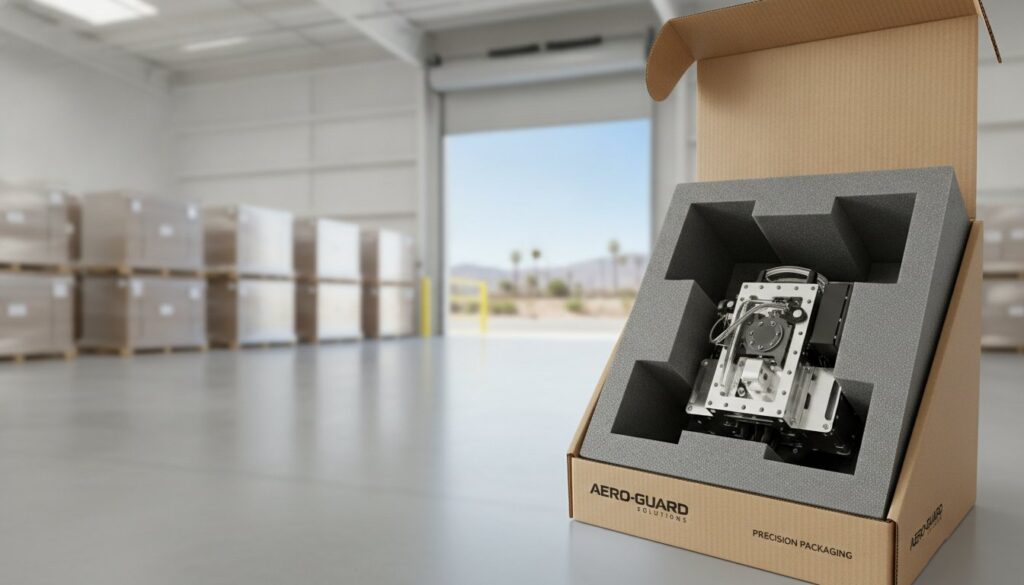
With industrial real estate costs in Orange County reaching $17.09 per square foot, every pallet of empty boxes sitting in your warehouse represents significant wasted capital. Most manufacturers throughout Los Angeles, San Diego, and the Inland Empire struggle with the rising costs of in-house kitting and the persistent frustration of product damage during transit. It’s difficult to maintain inventory accuracy when your team is already stretched thin by primary production demands.
Selecting the right packaging logistics provider in southern california allows you to reclaim your floor space and lower your total cost of ownership. You need a partner that understands the technical requirements of industries like aerospace and medical device manufacturing. This guide, developed by the experts at OEM Materials & Supplies, outlines the essential criteria for evaluating a logistics partner, from custom foam engineering to vendor-managed inventory (VMI) programs. We will examine how integrated kitting and just-in-time delivery can transform your packaging operations from a logistical burden into a streamlined strategic advantage.
Key Takeaways
- Identify a packaging logistics provider in Southern California that offers technical expertise and proximity to major industrial hubs like Orange County and Los Angeles.
- Learn why custom engineered foam inserts provide superior protection compared to stock cushioning materials for high value components.
- Discover how Vendor Managed Inventory (VMI) and Just In Time delivery programs reclaim warehouse floor space and reduce operational overhead.
- Understand the specific compliance requirements for sensitive sectors, including ESD protection for electronics and cleanroom compatible materials for medical devices.
- Determine how a comprehensive packaging audit identifies hidden inefficiencies in your current assembly and shipping workflows.
Evaluating a Packaging Logistics Provider in Southern California: Key Criteria
Selecting a packaging logistics provider in southern california requires more than comparing warehouse square footage or labor rates. It demands a technical assessment of how a partner integrates material engineering with distribution. A qualified provider must demonstrate proficiency in high-compliance sectors like aerospace and medical devices, where a failure in protection leads to catastrophic costs. A foundational step in this process involves understanding packaging and labeling standards that govern industrial transit. Reliability stems from a partner’s ability to execute rapid prototyping and custom design while maintaining proximity to manufacturing hubs in Orange County and Los Angeles.
The Difference Between a 3PL and a Packaging Specialist
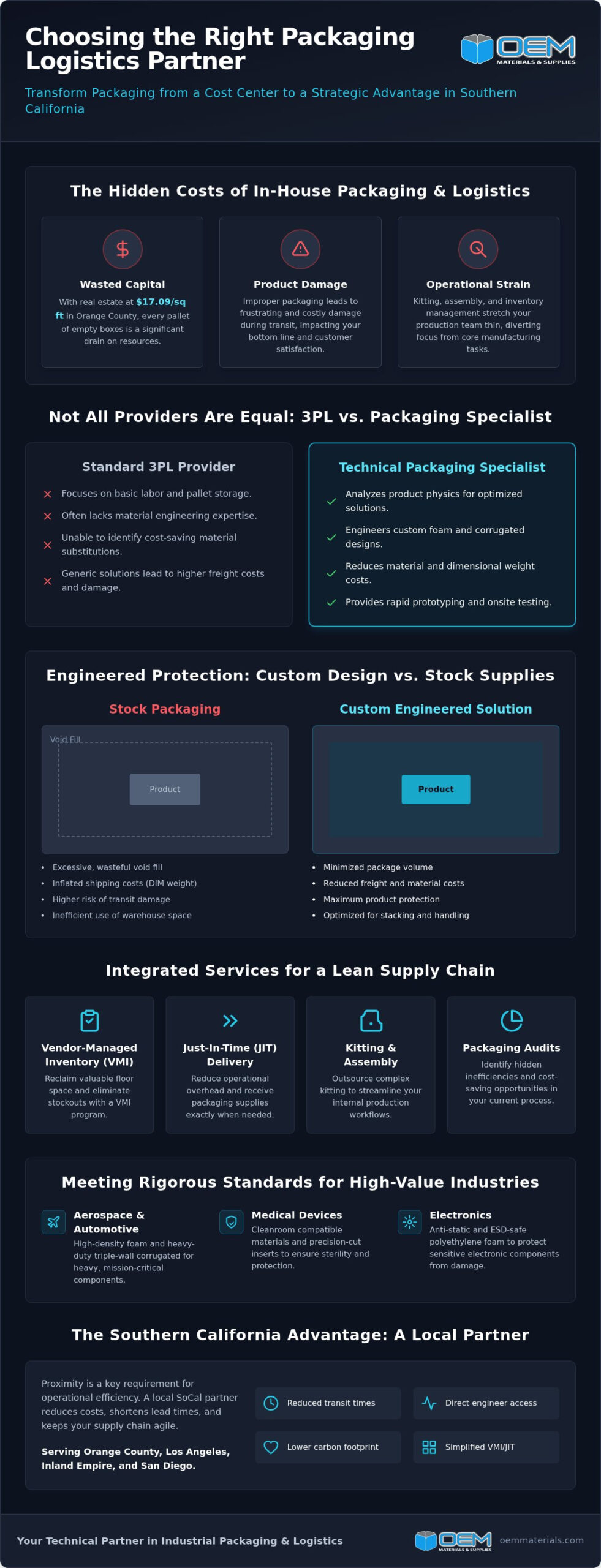
Standard third-party logistics (3PL) firms focus on labor flexibility and pallet storage. They often lack the engineering expertise to identify cost-saving material substitutions. In contrast, a packaging specialist analyzes the physical properties of your product to design optimized solutions. This includes selecting the right density for foam packaging or the appropriate burst strength for corrugated boxes. Onsite testing and custom packaging-design ensure that industrial loads are stabilized for the specific rigors of the Southern California supply chain. Specialists identify where a lighter material can provide equal protection, reducing both material costs and dimensional weight fees.
Local Service Advantages in the SoCal Corridor
Proximity is a functional requirement for operational efficiency. Manufacturers in San Diego and Riverside face high transportation costs and variable lead times when sourcing from distant vendors. Localized distribution centers reduce these overheads significantly. Responsive local support allows for high-volume programs to pivot quickly when production schedules change. By utilizing just-in-time (JIT) packaging, you eliminate the need for excessive onsite inventory. This frees up valuable floor space for core manufacturing activities. A regional focus ensures that your supply chain remains agile and cost-effective. Key advantages of local partnerships include:
- Reduced transit times for emergency replenishments
- Lower carbon footprint through shorter freight lanes
- Direct access to design engineers for rapid prototyping
- Simplified coordination for vendor-managed inventory programs
Effective logistics partners don’t just store materials; they optimize how those materials move through your facility. They act as a technical consultant that understands the intricacies of local manufacturing requirements and the volatility of freight markets.
Engineering Protection: Why Custom Design Beats Stock Supplies
Industrial components rarely fit standard box sizes. Relying on stock supplies often results in excessive void fill and inflated shipping costs. A technical packaging logistics provider in southern california focuses on precision engineering to eliminate these inefficiencies. By analyzing the exact dimensions and weight of a product, engineers can develop custom corrugated solutions that minimize external volume while maximizing internal safety. This approach is fundamental to Optimizing Supply Chains because it directly impacts dimensional weight (DIM) charges. When you reduce the footprint of a package, you lower the freight costs associated with shipping air.
Material Selection for Industrial Durability
Selecting the right protective material depends on the fragility and surface sensitivity of the item. For sensitive electronics, anti-static polyethylene foam provides rigid support and ESD protection. Heavier machinery requires high-density polyurethane or heavy-duty triple-wall corrugated to prevent structural failure during stacking. Learn more about custom foam packaging and how specific densities affect energy absorption. Unlike generic cushioning materials, custom inserts are cut to the exact profile of the product. This prevents shifting during transit, which is the primary cause of abrasions and mechanical damage. High-strength corrugated ratings also allow for higher stacking heights in the warehouse, effectively increasing your storage capacity without expanding your square footage.
Prototyping and Performance Testing
Rapid prototyping serves as a critical bridge between design and production. It allows engineers to verify that a custom solution meets rigorous standards before a full production run begins. Testing for drop protection and vibration resistance ensures that the packaging survives the specific rigors of your shipping methods, whether it’s LTL freight or small parcel delivery. This phase identifies potential failure points, such as weak box joints or insufficient foam thickness, preventing costly damage claims later. If you’re experiencing high damage rates or excessive material waste, you can request a technical consultation to evaluate your current design performance.
Optimizing Supply Chains with VMI and JIT Packaging Programs
Managing packaging inventory is a significant overhead for manufacturers in Orange County and Los Angeles. A specialized packaging logistics provider in southern california offers Vendor-Managed Inventory (VMI) to eliminate the risk of production shutdowns caused by stockouts. By outsourcing the monitoring of stock levels, you ensure that essential materials like stretch film or corrugated boxes are always available. This shift improves cash flow because you only pay for packaging as it’s consumed, rather than tying up capital in bulk orders that sit on shelves for months.
The Mechanics of a Successful VMI Program
VMI is a system where the supplier monitors and replenishes inventory at the customer site. Successful implementation relies on establishing precise minimum and maximum inventory levels based on your actual monthly usage and production forecasts. This data-driven approach prevents the bullwhip effect in the supply chain, where small fluctuations in demand lead to massive inventory imbalances. Explore our packaging VMI services to see how this technical coordination stabilizes material availability and reduces the administrative burden on your purchasing department.
Kitting and Assembly for Operational Efficiency
Internal labor costs for assembly are often higher than manufacturers realize. Integrating kitting and assembly services into your logistics strategy allows your team to focus on core production. Instead of managing multiple vendors for foam, boxes, and labels, you can receive a single, ready-to-use SKU. For example, an electronics manufacturer can combine a custom-cut foam insert, a printed corrugated box, and protective edge protectors into one pre-assembled kit. This reduces the number of vendors and streamlines the final packing line.
When combined with just-in-time (JIT) delivery, you reclaim valuable floor space by receiving these kits only when they’re needed for a specific production run. This is particularly effective for manufacturers in San Diego and the Inland Empire who need to maximize their existing square footage. By consolidating components into a single SKU, you improve inventory accuracy and simplify your internal receiving process. This integrated approach ensures that every component required for shipping is present and accounted for before it ever hits your assembly floor.
Meeting Rigorous Standards for Aerospace and Medical Manufacturing
Compliance in high-stakes industries like aerospace and medical manufacturing is non-negotiable. A qualified packaging logistics provider in southern california must go beyond basic distribution to ensure every material meets specific industrial or military benchmarks. For defense contractors in the Inland Empire or Los Angeles, this often involves adhering to MIL-STD-2073-1 for preservation and packaging. Traceability must be maintained throughout the supply chain to prevent the introduction of compromised components. Documentation accuracy is as critical as the physical protection provided by the packaging itself.
Packaging for Sensitive Electronics and Aerospace
Sensitive avionics and electronic assemblies require advanced protection against electrostatic discharge (ESD). Static discharge causes latent defects that lead to component failure long after a product has left your facility. We utilize specialized ESD-safe materials, including conductive and anti-static foams, to neutralize these risks. For large-scale aerospace components, custom heavy-duty wood crates built to ASTM D6251 standards provide the necessary structural integrity for transit. You can also view our corrugated box solutions for secondary packaging needs that require high burst strength and stacking durability. Precision engineering ensures that high-value assets remain secure during every phase of the logistics cycle.
Logistics for Medical and Life Science Facilities
Medical device manufacturers in San Diego and Orange County operate under strict regulations that extend to packaging materials. Logistics for these facilities require cleanroom-compatible materials that are non-shedding and resistant to microbial growth. Engineered foam inserts provide precise cushioning for fragile surgical instruments, preventing shifting that could compromise sterilization barriers. Labeling accuracy is another critical factor; standardized quality and safety dates must be clear and compliant with California AB 660 requirements for packaged goods. Every SKU must be clearly identified to ensure rapid and accurate retrieval in laboratory environments.
Maintaining these standards requires a partner that acts as a technical consultant rather than a commodity vendor. If your current supply chain lacks the necessary compliance documentation or material certifications, you should request a technical quote to align your packaging with industry requirements. We provide the expertise needed to navigate complex specifications for the most demanding industrial applications.
Implementing a Scalable Packaging Logistics Strategy
Scalability in industrial manufacturing requires a packaging strategy that evolves alongside production volumes. Efficiency is often lost during the transition from initial design to high-volume distribution. A technical packaging logistics provider in southern california identifies these friction points through a comprehensive packaging audit. This assessment evaluates your entire workflow, from the moment a product leaves the assembly line to its arrival at the end user. By analyzing where stock materials fail or where excessive labor is consumed, you can implement changes that protect margins as you grow. Moving from rapid prototypes to full-scale production requires a partner that maintains local agility while providing the infrastructure for nationwide support.
Transitioning to an Integrated Provider
Onboarding a new packaging logistics partner should be a structured, technical process rather than a simple vendor swap. It begins with aligning custom designs with your existing automated packing lines to ensure minimal friction on the warehouse floor. If a custom foam insert or corrugated box isn’t optimized for your equipment, the resulting downtime will quickly erode any material cost savings. Measuring the success of a new logistics program involves tracking key performance indicators such as reduced shipping damage rates, lower labor hours per kit, and improved inventory accuracy. A successful transition results in a streamlined operation where packaging is a functional extension of the manufacturing process.
Requesting a Quote for Industrial Packaging
Accuracy in logistics pricing depends entirely on the quality of data provided during the quoting phase. To receive a precise recommendation and avoid hidden costs, you must provide specific details including product dimensions, weight, and estimated annual usage. This data allows engineers to calculate the most cost-effective material densities and shipping configurations. Prototypes play a critical role in this process, allowing your team to verify fit and function before committing to high-volume production runs. Testing a physical sample ensures that the proposed solution meets your protection standards and fits within your logistical constraints. When you are ready to optimize your supply chain, you can request a quote for your custom packaging project to begin the technical evaluation of your current requirements.
Modernizing Your Packaging Operations for Scale
A strategic partnership with a packaging logistics provider in southern california transforms your supply chain from a cost center into a competitive advantage. By moving away from stock supplies and embracing custom engineered solutions, you eliminate the overhead associated with product damage and excessive warehouse footprints. Integrating vendor managed inventory and just-in-time delivery ensures that your production lines in Orange County, Los Angeles, or San Diego never face a stockout. These technical optimizations allow your team to focus on core manufacturing while maintaining the rigorous standards required by the aerospace and medical sectors.
Reliability in the industrial sector is built on precision and data. When you’re ready to evaluate your current packaging workflow, we recommend starting with a technical audit to identify hidden inefficiencies. To facilitate an accurate assessment of your needs, please have your product dimensions, weights, and annual usage data ready for our engineering team. We look forward to helping you streamline your operations and protect your high value assets during every stage of transit.
Take the next step in optimizing your supply chain: Request a custom packaging logistics quote today to begin your technical consultation.
Frequently Asked Questions
What is a packaging logistics provider?
A packaging logistics provider southern california is a strategic partner that integrates material engineering with supply chain management. Unlike a standard vendor that merely sells boxes, this type of partner designs custom protective solutions and manages the flow of materials to your facility. They help manufacturers reduce operational overhead by combining technical expertise in materials like custom foam and corrugated with value-added services like inventory management and assembly.
How does VMI help reduce packaging costs?
Vendor Managed Inventory (VMI) reduces costs by shifting the responsibility of stock monitoring and replenishment to the supplier. This system eliminates the need for large bulk orders that consume expensive warehouse floor space in areas like Orange County. By establishing minimum and maximum stock levels based on actual usage, you improve cash flow and eliminate the administrative labor associated with frequent purchase orders and manual inventory counts.
Can you provide custom packaging for aerospace components in Los Angeles?
Yes, we specialize in technical packaging for high-value aerospace components throughout Los Angeles County. We design and manufacture custom wood crates and heavy-duty corrugated solutions that meet rigorous industry standards like ASTM D6251. For sensitive avionics, we incorporate specialized ESD foam inserts to prevent electrostatic discharge. Our proximity to major aerospace hubs allows for rapid prototyping and responsive support for complex engineering requirements.
What industries do you serve in Southern California?
As a leading packaging logistics provider southern california, we primarily serve industrial manufacturers in the aerospace, medical device, electronics, and automotive sectors. Our operations support facilities across Orange County, Los Angeles, San Diego, and the Inland Empire. Because these industries require high levels of compliance and precision, we provide engineered solutions like cleanroom-compatible packaging for medical labs and specialized cushioning materials for fragile electronic assemblies.
What is the difference between JIT and VMI for packaging?
Just-In-Time (JIT) delivery focuses on the timing of shipments to coincide exactly with your production schedule, minimizing onsite storage. Vendor Managed Inventory (VMI) is a broader system where the provider takes ownership of monitoring and replenishing your stock levels based on agreed-upon thresholds. While JIT reduces your warehouse footprint, VMI reduces the administrative burden and risk of stockouts. Both strategies are often combined to create a highly efficient supply chain.
Do you provide on-site assembly and kitting?
We provide comprehensive kitting and assembly services that allow your team to focus on primary manufacturing. Instead of managing separate components like boxes, foam inserts, and tape, we deliver a single, ready-to-use SKU to your assembly line. This integrated approach significantly lowers your internal labor costs and improves packing speed. It also simplifies your receiving process by reducing the number of individual items your warehouse team must track and store.
How do custom foam inserts prevent shipping damage?
Custom foam inserts are engineered to the exact dimensions and weight of your product, providing superior energy absorption compared to generic cushioning. This precision fit prevents the product from shifting inside the box during transit, which is the leading cause of abrasions and mechanical failure. By selecting the correct foam density for your specific item, we ensure that the packaging can withstand vibrations and drops without compromising the integrity of the contents.
What information is needed for a custom packaging quote?
To provide an accurate technical quote, we require specific data including the product dimensions, weight, and fragility. We also need to understand your estimated annual usage and your primary shipping methods, such as small parcel or LTL freight. This information allows our engineers to recommend the most cost-effective materials and design configurations. Providing these details upfront ensures that the final quote reflects the true total cost of ownership for your packaging program.