
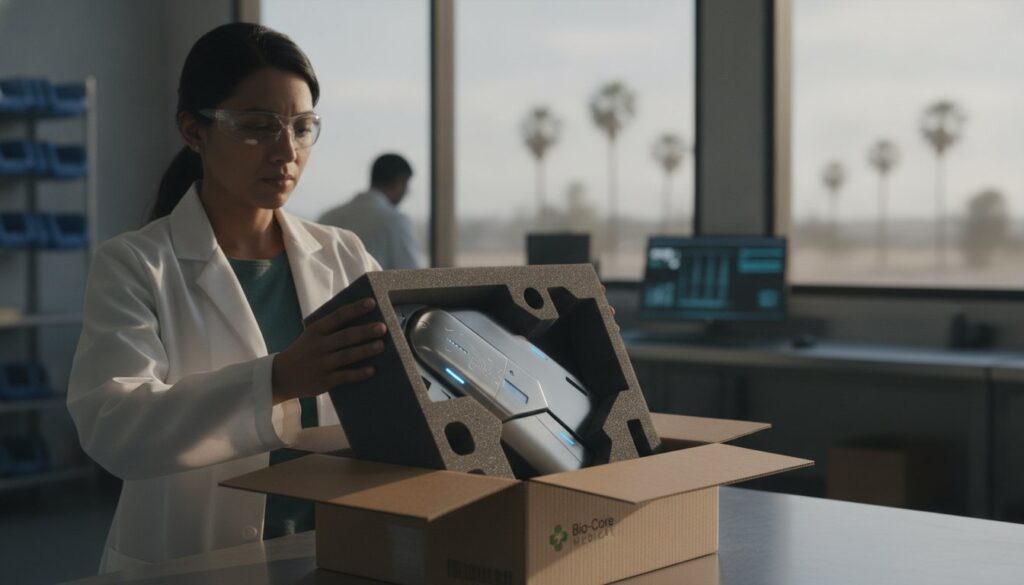
What if the most expensive component of your medical device isn’t the precision sensor or the surgical steel, but the thirty seconds it spends vibrating in an inadequate shipping container? For manufacturers in the Southern California life sciences hub, a single instance of transit damage can result in thousands of dollars in losses and critical delays for healthcare providers. You understand that standard off-the-shelf solutions rarely provide the security required for high-value diagnostic or surgical tools. Securing reliable custom packaging for medical instruments san diego is a technical necessity that directly impacts your bottom line and brand reputation.
We agree that your packaging must do more than just protect; it should streamline your operations and present a professional image to end-users. This guide will teach you how to engineer high-protection packaging systems that safeguard delicate instruments while optimizing your local supply chain. We will examine the integration of custom foam inserts with corrugated structures, strategies to reduce manual assembly labor through kitting, and how vendor-managed inventory can prevent costly stockouts in your warehouse. By the end of this article, you will have a clear roadmap for selecting packaging materials that meet rigorous industrial standards while improving your facility’s operational flow.
Key Takeaways
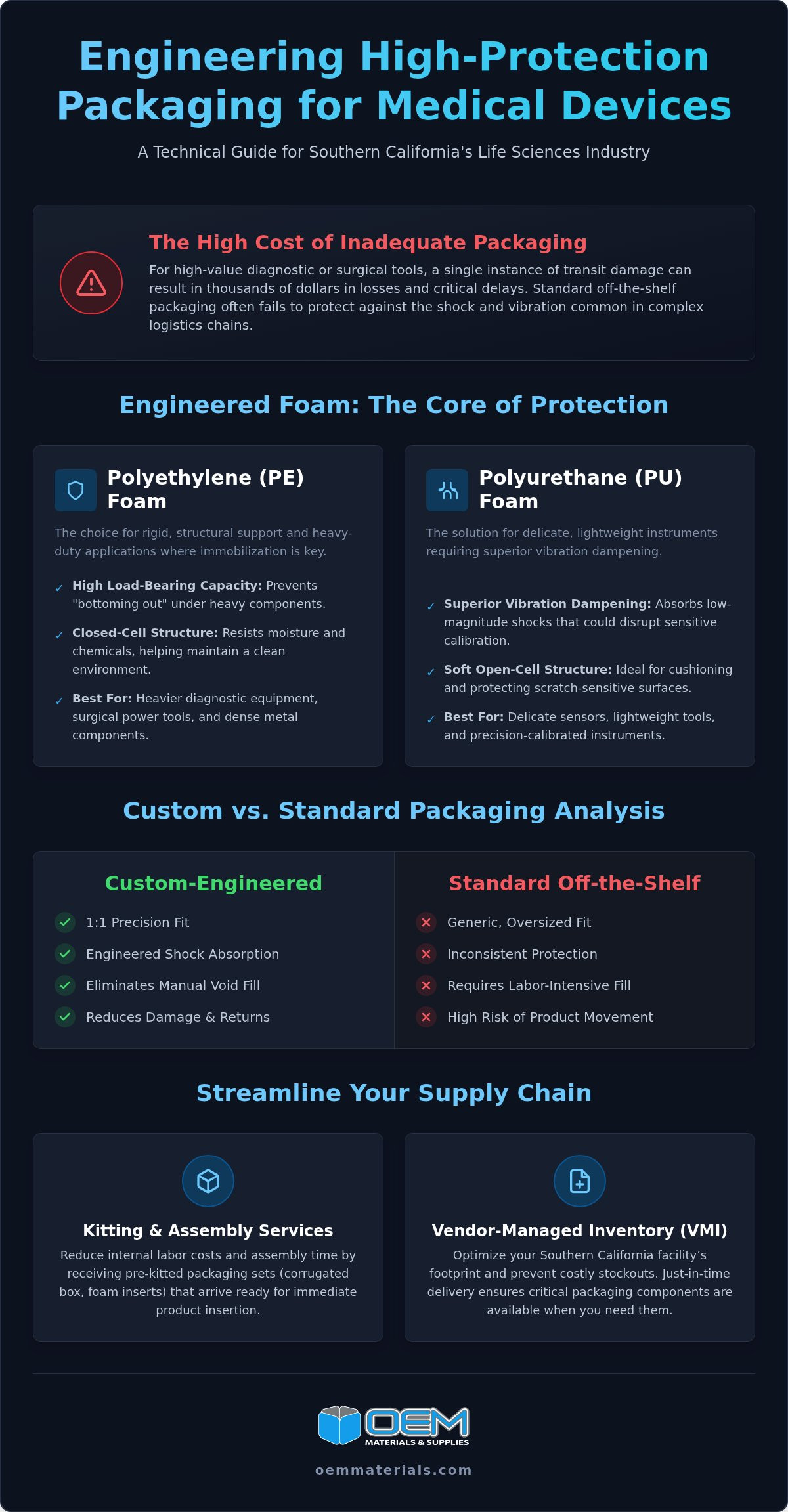
- Identify the correct engineered foam density, such as Polyethylene for rigid support or Polyurethane for delicate cushioning, to mitigate transit vibration and shock.
- Utilize custom packaging for medical instruments san diego to eliminate oversized shipping containers and the labor-intensive need for manual void fill.
- Reduce internal labor costs and assembly time by receiving pre-kitted packaging sets that arrive ready for immediate product insertion.
- Optimize your Southern California facility’s footprint through Vendor Managed Inventory (VMI) and just-in-time delivery of critical packaging components.
Evaluating Custom Packaging Requirements for Medical Instruments in San Diego
San Diego’s life sciences corridor demands technical precision at every stage of the manufacturing process. In this region, medical device manufacturers move products through complex local and international logistics chains that expose delicate equipment to significant physical stress. High-value diagnostic tools and surgical instruments face repetitive vibration and sudden impact shocks that can compromise their calibration. Utilizing custom packaging for medical instruments san diego ensures every component is immobilized and cushioned against these specific environmental variables.
Off-the-shelf corrugated boxes are built for general commodities and lack the structural integrity required for sensitive medical hardware. They rely on manual void fill, which often shifts or settles during long-haul transport. For a precision instrument, even a small amount of movement can cause misalignment or total failure. Custom solutions utilize engineered foam packaging inserts that provide a 1:1 fit. This eliminates the slop that leads to damage and ensures the product arrives in the same condition it left the assembly line.
The High Cost of Shipping Damage in Medical Devices
Receiving a damaged surgical tool is a significant operational failure that extends beyond the immediate hardware cost. OEMs face mounting expenses from expedited return shipping, technical reassessment, and reputational harm with healthcare providers. Investing in custom corrugated boxes and specialized custom packaging for medical instruments san diego acts as a necessary insurance policy for high-value equipment. Relying on generic cushioning often leads to inconsistent results that jeopardize expensive product launches. The total cost of an engineered packaging system is a small fraction of the capital required to replace a single precision-calibrated diagnostic unit.
Regulatory and Compliance Considerations
Compliance is a primary requirement that dictates how medical products are handled and shipped. Packaging must support Medical device packaging standards to ensure instruments remain clean and functional upon arrival at a clinical site. Custom designs allow for the integration of required labeling and tracking serial numbers directly into the kitted presentation, which helps facilities maintain strict inventory control. This level of organization ensures that the physical integrity of the device is never compromised by the materials used for transport. Proper material selection also prevents contamination and particulates, which is critical for tools destined for sterile hospital environments.
Engineering Protective Interiors: Foam Inserts and Cushioning Materials
Precision medical tools require more than just a soft layer of padding. The engineering behind the interior cushioning determines how well a device survives the rigors of the Southern California supply chain. Selecting the right density and cell structure is a technical decision that impacts both protection and long-term operational costs. When developing custom packaging for medical instruments san diego, the focus must be on immobilizing the product while absorbing the specific frequencies of vibration encountered during transit.
Polyethylene vs Polyurethane Foam for Medical Tools
Polyethylene (PE) is a closed-cell foam known for its high load-bearing capacity and rigidity. It’s an excellent choice for heavier diagnostic equipment or surgical power tools that need to stay firmly in place. Because it’s closed-cell, PE foam is naturally resistant to moisture and chemicals. This helps maintain a clean environment for the device, which is critical for maintaining instrument integrity. It doesn’t bottom out under the weight of dense metal components, making it a reliable choice for structural support.
In contrast, Polyurethane (PU) foam features a soft, open-cell structure. It’s designed for delicate, lightweight instruments that require superior vibration dampening. While PU foam doesn’t offer the same structural support as PE, it excels at absorbing low-magnitude shocks that could disrupt sensitive calibrations. When designing custom foam packaging, we often combine these materials to balance structural support with soft cushioning for complex assemblies.
Custom Die-Cut Inserts for Multi-Part Kits
Medical instrument kits often consist of multiple interconnected parts, such as scopes, cables, and handpieces. Custom die-cutting allows for the creation of precise cavities that mirror the exact geometry of each component. This level of precision prevents part-on-part contact, which is a major cause of surface abrasion and mechanical damage during shipping. It also creates a professional, kitted presentation that allows medical staff to quickly verify that all components are present.
Repeatability is the core benefit of die-cut solutions. Every kit you ship from your facility will have the exact same level of protection, regardless of who is packing it. For a deeper look at the technical specifications of these materials and how they are manufactured, see our Industrial Guide to Foam Inserts.
Polished stainless steel or glass surfaces on medical devices are highly susceptible to scratching from abrasive packaging materials. We utilize non-abrasive liners or specific foam grades to ensure that the finish remains pristine upon arrival. Adhering to FDA device packaging regulations is mandatory; these rules state that packaging must protect the device from alteration or damage throughout distribution. You can request a quote for a prototype to see how these engineered materials protect your specific instrument dimensions.
Custom vs. Standard Packaging: Cost-Benefit Analysis for Medical OEMs
Standard off-the-shelf boxes are often the first choice for startups or low-volume prototyping because of their low unit price. However, as production scales, the hidden costs of generic packaging begin to erode margins. For medical OEMs in Southern California, the decision to move to custom packaging for medical instruments san diego is usually driven by a need to eliminate manual labor and reduce shipping overhead. A stock box often requires significant amounts of bubble wrap or loose-fill peanuts to secure a surgical kit, whereas a custom engineered solution provides protection through design rather than volume.
When to Invest in Custom Corrugated Solutions
Determining when to transition from stock to custom depends on your annual usage and the fragility of the instrument. If your product requires more than two minutes of manual packing time, the labor savings from a custom box often offset the higher tooling costs within the first few hundred units. For heavier medical diagnostic units or benchtop laboratory equipment, we recommend double-wall corrugated boxes. This material provides the stacking strength necessary to survive palletized transport without the risk of sidewall compression or corner crushing.
Reducing Dimensional Weight and Material Waste
Shipping costs are increasingly calculated based on dimensional (DIM) weight rather than actual weight. Using an oversized stock box means you’re paying to ship air. Right-sized custom packaging for medical instruments san diego allows you to minimize the external footprint of each shipment, which can lead to measurable freight savings for high-volume distributors. Beyond the financial impact, these efficiencies help address broader medical device supply chain challenges by reducing the reliance on excess materials.
Reducing material waste also simplifies the end-user experience in clinical settings. Hospitals and surgical centers have limited floor space and strict waste management protocols. Smaller, right-sized boxes reduce the volume of recyclables they must process daily. Additionally, eliminating excess plastic void fill aligns with industry-wide initiatives to reduce the environmental footprint of medical distribution. Custom-printed packaging with clear labeling and professional branding reinforces your position as a top-tier medical device manufacturer, providing a kitted presentation that generic boxes simply can’t match.
While custom solutions require an initial investment in design and tooling, the long-term benefits include lower freight costs and reduced labor. Results always depend on specific variables like your product dimensions and shipping frequency, so a technical evaluation is the best way to determine your potential ROI.
Streamlining the Supply Chain with Kitting and Assembly Services
High-volume medical manufacturing requires a high-velocity approach to fulfillment. Kitting transforms individual packaging components into a single, synchronized unit that arrives ready for the production line. By implementing custom packaging for medical instruments san diego, OEMs can eliminate the logistical friction of managing multiple SKUs for boxes, inserts, and protective wraps. A kitted solution ensures that every necessary element is physically present and organized before it reaches the packer. Efficiency is the priority.
Manual assembly of packaging components is a significant bottleneck on the OEM floor. When workers have to fold corrugated boxes and manually position foam inserts, they aren’t focused on instrument calibration or quality control. Kitting solves this by providing a finished assembly that requires only the insertion of the medical tool. This methodical approach reduces the risk of missing critical items like instructions for use (IFU) or serialized labels; the kit provides a visual cue for every component that must be included.
Value-Added Assembly for Medical Manufacturers
Receiving pre-assembled packaging allows your team to treat the container as part of the instrument assembly process. We handle the labor-intensive tasks, such as bonding foam to corrugated or pre-assembling complex die-cut structures, before the materials ever enter your facility. For companies evaluating their current partners, Choosing a Wholesale Industrial Packaging Supplier involves looking beyond the price per unit to the total labor savings provided by these value-added services. This shift in operational strategy allows your staff to focus on high-value production tasks while we manage the secondary assembly requirements.
Just-In-Time (JIT) Delivery for San Diego Labs
Space-constrained San Diego labs and manufacturing sites cannot afford to store mountains of empty boxes. Real estate in the Southern California biotech hub is at a premium, making efficient warehouse management a necessity. Our JIT packaging services provide frequent, smaller deliveries of kitted units that match your production schedule. This strategy improves cash flow and frees up valuable floor space for actual manufacturing equipment. Integrating custom packaging for medical instruments san diego into a JIT workflow ensures you always have the right materials on hand without the burden of excessive inventory. It streamlines your footprint while maintaining peak operational readiness.
You can request a quote for a technical evaluation of your current assembly process to see how kitting can reduce your per-unit labor costs and improve your warehouse efficiency.
Partnering with a San Diego Packaging Expert for Medical Grade Results
Selecting a supplier for custom packaging for medical instruments san diego requires more than comparing unit prices. It’s about finding a technical partner who understands the specific regulatory and logistical pressures of the Southern California biotech corridor. We position ourselves as a consultant rather than a simple reseller. Our goal is to provide a comprehensive system that addresses the total cost of ownership, including material costs, assembly labor, shipping efficiency, and inventory management. Reliability is the foundation of a successful medical device supply chain.
Vendor Managed Inventory (VMI) for Medical Packaging
Inventory stockouts of critical packaging materials can halt a production line and delay life-saving medical tools from reaching clinical facilities. Our packaging VMI services eliminate this risk by placing the responsibility of inventory levels on us. We monitor your usage and maintain stock levels in our local Southern California warehouses, ensuring you always have boxes and foam inserts when you need them. This local presence is a distinct advantage for San Diego medical clusters, as it allows for rapid response times that nationwide suppliers can’t match. VMI also frees up your warehouse floor space, allowing you to use that square footage for high-value manufacturing or R&D instead of storing empty corrugated boxes.
From Prototype to Production
The development cycle for a new medical instrument is rigorous. It often begins with rapid prototyping where precision and speed are paramount. Our design team works alongside your engineers to create custom foam structures and corrugated exteriors that match your device’s exact dimensions. This local expertise in Southern California speeds up the development cycle, as we can quickly iterate on designs and provide physical prototypes for testing. We understand that a medical device launch has no room for error, so we focus on creating a repeatable, high-protection system from day one.
As you move from initial launch to high-volume manufacturing, our systems scale with you. We ensure that the technical precision of the prototype is maintained across thousands of units. This consultative approach ensures that your packaging is never an afterthought but a functional component of your product’s success. To begin a technical evaluation of your current requirements, you can request a custom packaging quote for your medical instruments. We typically request specific data such as product dimensions, weight, and annual usage to facilitate an accurate and effective recommendation for your facility.
Optimizing Your Southern California Medical Supply Chain
Effective instrument protection relies on a technical system where engineered foam and custom corrugated materials eliminate transit damage. Moving away from standard stock boxes reduces dimensional weight and labor costs simultaneously. Implementing specialized kitting and assembly services ensures your staff stays focused on high-value production while we handle the logistical details. Local Southern California support provides the JIT delivery and VMI programs necessary to maintain a lean, responsive facility.
Securing reliable custom packaging for medical instruments san diego is a strategic investment in your brand’s reputation and operational bottom line. Scaling from a successful prototype to high-volume global distribution requires a packaging partner who acts as a dependable guide. We invite you to Request a Quote for Custom Medical Packaging to begin your technical evaluation today. Please provide your product dimensions, weight, and annual usage so we can develop an accurate recommendation. We look forward to achieving zero-damage shipping and a more efficient warehouse operation for your facility.
Frequently Asked Questions
What are the best foam materials for shipping delicate medical instruments?
Polyethylene (PE) and Polyurethane (PU) are the primary choices for protecting medical instruments. PE foam provides rigid support and moisture resistance for heavier surgical tools and metal components. PU foam offers soft cushioning to dampen low-magnitude vibrations for sensitive diagnostic sensors. Selecting the right density prevents bottoming out and ensures the device remains immobilized during transit through the Southern California supply chain, maintaining critical calibration upon arrival.
Do you provide custom kitting and assembly for medical device manufacturers in San Diego?
We provide comprehensive kitting and assembly services for medical manufacturers throughout San Diego County. This process involves pre-inserting foam components into corrugated boxes and organizing multiple instrument parts into a single unit. By receiving pre-assembled kits, your facility reduces manual labor and minimizes errors on the production line. Our local presence allows us to synchronize deliveries with your specific manufacturing schedules to maintain peak operational efficiency.
How does custom packaging reduce shipping costs for medical OEMs?
Custom packaging for medical instruments san diego reduces costs by optimizing dimensional (DIM) weight. Standard boxes are often oversized; this forces you to pay for empty space. Right-sized custom solutions eliminate excess volume and the need for expensive manual void fill. This precision reduces freight charges and material waste, resulting in a lower total cost per unit shipped for high-volume OEMs in the Southern California region.
Can you help design packaging for medical instrument prototypes?
We offer technical design consultation for medical instrument prototypes to ensure protection is integrated early in the development cycle. Our team works with your engineers to create custom foam inserts that match your device’s exact geometry. This collaborative approach allows for rapid iterations and physical testing before you commit to high-volume production, ensuring the final packaging system meets all structural requirements while remaining cost-effective for assembly.
What is Vendor Managed Inventory (VMI) and how does it benefit medical manufacturers?
Vendor Managed Inventory (VMI) is a supply chain program where we monitor and maintain your packaging stock levels. We warehouse your custom boxes and foam inserts locally, delivering them as needed to your facility. This model eliminates the risk of stockouts and frees up valuable warehouse floor space in San Diego. It improves cash flow by reducing the amount of capital tied up in dormant inventory while ensuring production never stops.
Do you offer corrugated boxes that meet specific strength requirements for heavy diagnostic equipment?
We manufacture heavy-duty corrugated boxes, including double-wall and triple-wall configurations, specifically for large diagnostic units. These materials provide superior stacking strength and puncture resistance compared to standard single-wall boxes. For heavy laboratory equipment, we often combine these corrugated structures with high-density polyethylene foam bases to ensure the unit remains stable and protected against side-impact shocks during palletized transport across the Southern California supply chain.
What information is needed to get an accurate quote for custom medical packaging?
To provide an accurate quote, we require the physical dimensions and weight of the instrument along with your estimated annual usage. Information regarding the sensitivity of the device to vibration and any specific cleanliness requirements is also helpful. Providing these data points allows our technical team to recommend the most cost-effective materials and design structures for your specific application in the Southern California medical sector, ensuring a precision fit.