
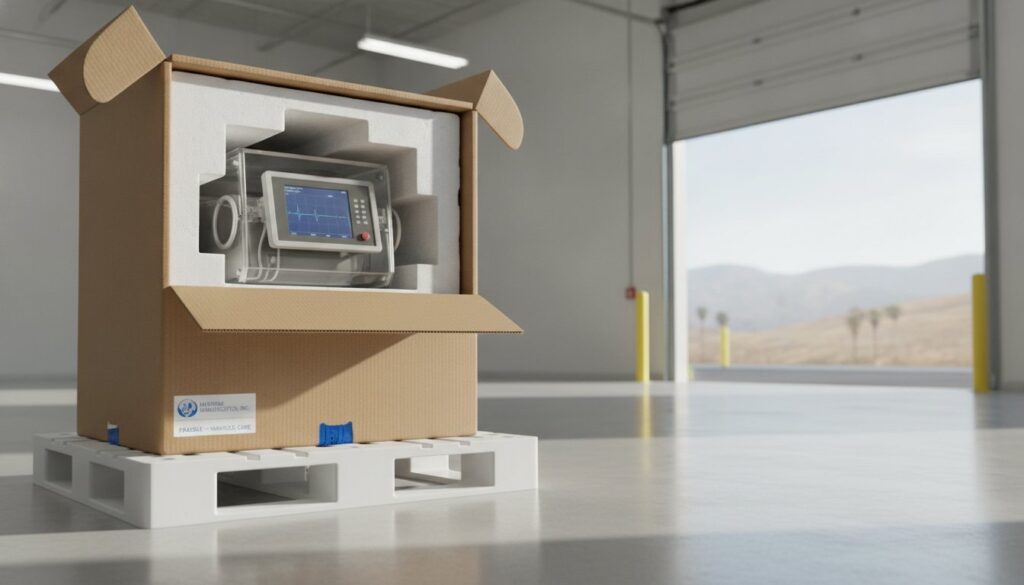
A single microscopic breach in a sterile barrier or a hairline fracture in a sensitive diagnostic tool can render an entire shipment of medical devices useless. For manufacturers in Southern California, the pressure to maintain compliant medical packaging while managing complex supply chains is constant. You understand that meeting ISO 11607 standards or FDA requirements is not just a regulatory hurdle; it is a fundamental part of patient safety. Balancing these rigid mandates with the practical realities of shipping and material costs often leads to operational friction and unnecessary waste.
This comprehensive checklist provides the technical roadmap you need to evaluate your current strategy. We will outline how to select high-performance materials, such as custom foam inserts and cleanroom-compatible plastic pallets, that protect your products from the vibration and shock of transit. By following this structured approach, you can reduce material waste through better engineering and establish a more reliable supply chain right here in Orange County and Los Angeles. You will learn how to bridge the gap between regulatory compliance and industrial efficiency to ensure every shipment arrives intact and ready for use.
Key Takeaways
- Differentiate between primary, secondary, and tertiary layers to ensure your medical packaging strategy addresses both sterile integrity and industrial durability.
- Match material selection to specific sterilization methods while integrating ESD protection for sensitive medical instrumentation.
- Maintain cleanroom integrity by utilizing non-porous plastic pallets and materials manufactured in controlled environments.
- Prevent transit damage to high-value supplies by using high-performance stretch film and edge protectors to secure palletized loads.
- Optimize supply chain reliability and reduce overhead through engineered kitting services and local Vendor Managed Inventory programs.
Defining Medical Packaging Standards for Industrial Applications
Medical packaging is a multi-component system designed to ensure that life-saving devices and pharmaceuticals reach their destination in the exact condition intended by the manufacturer. It acts as both a physical shield and a biological barrier. In the industrial sector, we define this packaging by its ability to withstand the rigors of the supply chain while adhering to strict regulatory protocols. From simple diagnostic kits to complex surgical instruments, the choice of materials directly impacts product safety and operational efficiency.
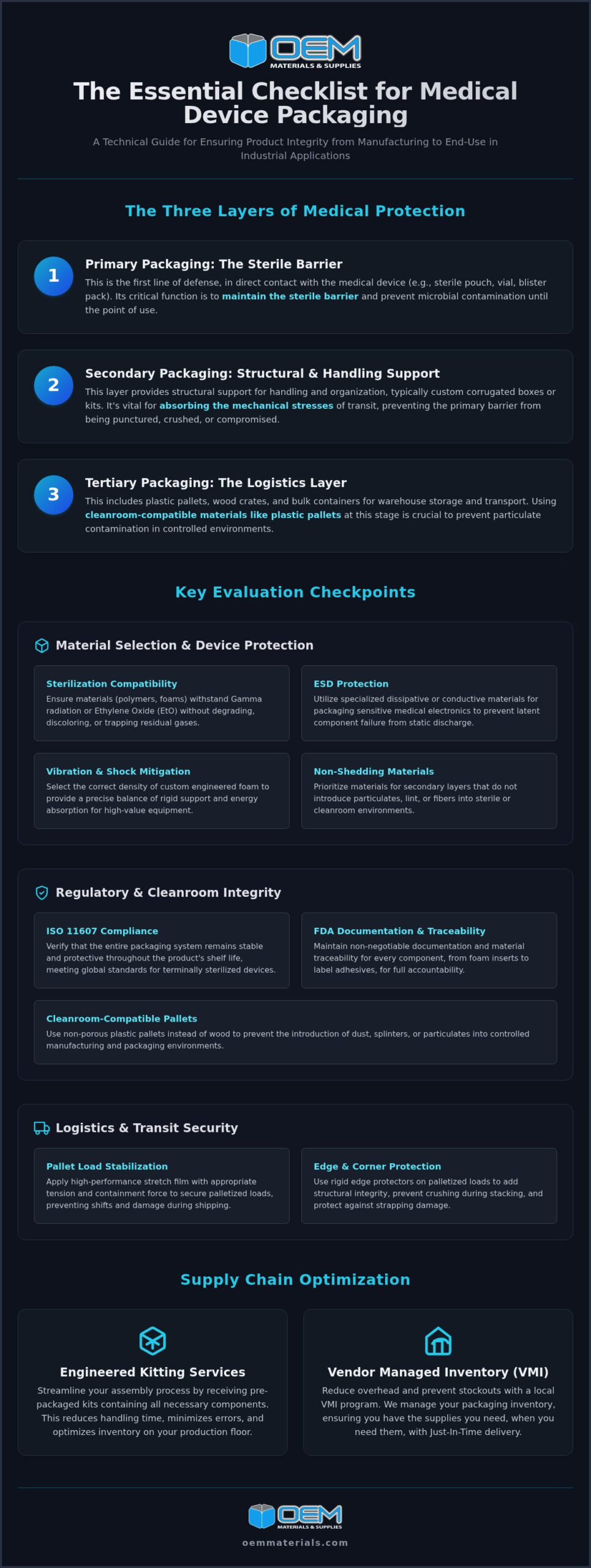
Effective medical packaging must address three distinct levels of protection. Each layer serves a specific functional purpose, and a failure in one can compromise the entire shipment. Manufacturers must view these layers as an integrated system rather than isolated components. If the secondary layer fails to provide enough cushioning, the primary sterile barrier often pays the price.
The Three Layers of Medical Protection
Primary packaging represents the first line of defense. This material, such as a sterile pouch, vial, or blister pack, stays in direct contact with the device or pharmaceutical. Its main job is to maintain the sterile barrier and prevent microbial contamination until the point of use.
Secondary packaging provides the structural support needed for handling and organization. This layer typically consists of custom corrugated boxes or specialized kits that house primary containers. Industrial-grade secondary packaging is vital because it absorbs the mechanical stresses of transit. It prevents the primary barrier from being punctured, crushed, or compromised by external pressure during stacking.
Tertiary packaging is the logistics layer. This includes plastic pallets, crates, and bulk containers used for warehouse storage and long-distance transport. For medical manufacturers in Los Angeles or Orange County, using cleanroom-compatible pallets at this stage is often a requirement to prevent the introduction of wood dust or particulates into controlled environments.
Regulatory Foundations for Medical Containers
The global standard for terminally sterilized medical devices is defined by ISO 11607. This international benchmark requires that packaging systems remain stable and protective throughout the product’s entire shelf life. It’s not enough to just box the item; you must prove that the material choices don’t react chemically with the device or degrade under various environmental conditions.
The FDA also maintains strict oversight regarding packaging material safety and chemical compatibility. Documentation and material traceability are non-negotiable requirements for any medical supply chain. Every component, from the engineered foam inserts to the adhesive on the labels, must be accounted for in the technical file. This level of precision ensures that if a failure occurs, the source can be identified and mitigated quickly. Reliability is the baseline in this industry, and rigorous documentation provides the necessary proof of that reliability.
Material Selection Checklist for Medical Device Protection
Material selection is a technical engineering challenge that dictates the success of your sterilization cycle and the safety of the end user. You must evaluate how your chosen substrates react to common sterilization methods like Gamma radiation or Ethylene Oxide (EtO). Some polymers become brittle or discolor when exposed to high-energy radiation, while others might trap residual gases. Beyond chemical compatibility, you need to assess the need for Electrostatic Discharge (ESD) protection. Sensitive medical electronics require specialized dissipative materials to prevent latent component failure. We prioritize non-shedding materials in our designs to ensure your secondary layers don’t introduce particulates into sterile environments. Implementing professional medical device packaging solutions requires a balance between regulatory compliance and physical durability that begins with precise material specification.
Selecting the right density for custom foam packaging is the most effective way to mitigate vibration damage during transit. High-value diagnostic equipment requires a precise balance between rigid support and energy absorption. You can request a technical consultation to determine the exact material specifications required for your specific device dimensions and weight.
Engineered Foam and Cushioning Requirements
Choosing between polyethylene and polyurethane foam depends entirely on the fragility and mass of your instrument. Polyethylene is a closed-cell material that offers superior structural support for heavier devices. It’s highly resistant to moisture and chemicals. Polyurethane is an open-cell foam, providing a softer ride for lightweight, delicate surgical tools. We use custom die-cut inserts to secure these items, ensuring they don’t shift or strike the container walls. For irregular shapes, integrating specific cushioning materials helps fill internal voids, which maintains the integrity of the medical packaging during rough handling.
Corrugated Grades for Medical Shipments
The structural integrity of your outer carton is measured by its Edge Crush Test (ECT) rating. For heavy medical machinery or bulk fluid shipments, a standard ECT 32 box is often insufficient. We recommend moving to ECT 44 or 51 to provide the necessary stacking strength for long-term warehouse storage. Double-wall corrugated is the industrial standard for international shipping, as it provides an extra layer of puncture resistance and insulation against temperature fluctuations. Integrating custom medical device packaging kits into your workflow can significantly reduce labor time. These kits arrive pre-organized, allowing your team to move from assembly to shipping without searching for individual components. This methodical approach ensures the efficiency of your medical packaging system while keeping material costs predictable.
Regulatory Compliance and Cleanroom Integrity Checklist
Maintaining cleanroom integrity requires looking beyond the immediate sterile pouch to the environment where your secondary materials are handled. You must verify that your medical packaging components are manufactured in controlled settings to prevent the introduction of foreign particulates. A rigorous quality control process for incoming inventory ensures that every box, insert, and pallet meets your facility’s cleanliness specifications before they cross the threshold of your production floor. This proactive approach prevents contamination events that could lead to costly batch rejections or regulatory audits.
Cleanroom-Compatible Pallets and Crates
In medical laboratories and sterile manufacturing hubs across Orange County and San Diego, heavy duty plastic pallets are the industrial standard. Wood pallets are porous, prone to shedding fibers, and can harbor biological contaminants or moisture. Plastic alternatives are non-porous and easy to sanitize, making them ideal for tertiary packaging in sensitive zones. When your operations move into international distribution, these plastic units simplify compliance by meeting ISPM-15 requirements without the need for additional heat treatment or fumigation documentation required for wood. Using treated materials or high-grade polymers for your crates and pallets eliminates a significant risk factor for particulate contamination in your supply chain.
Labeling and Traceability Essentials
Regulatory compliance is impossible without a robust traceability system. Your labels and printing supplies must meet specific medical durability standards to ensure they remain legible throughout the entire product lifecycle. This includes resistance to extreme temperatures during cold-chain storage and the chemical stresses of sterilization cycles. If a label fails to remain scannable, the integrity of the entire shipment is compromised.
Unique Device Identification (UDI) requirements mandate that every piece of medical packaging carries clear, scannable data. This is particularly relevant when applying labels to curved surfaces, such as mailing tubes and cores used for medical textiles or specialized surgical membranes. The adhesive must be engineered to bond permanently to the substrate without leaching chemicals into the product. We recommend testing label adhesion under simulated sterilization conditions to prevent field failures and ensure total supply chain visibility. Implementing a verification step for incoming label stock helps ensure that barcode density and contrast meet high-speed scanning requirements before they reach your assembly line.
Logistics Checklist: Protecting Medical Shipments in Transit
Transit represents the most volatile phase for any medical device. While engineered foam and high-grade corrugated provide the internal defense, the external load must be stabilized to survive the mechanical stresses of a modern supply chain. Failure often occurs not because the primary container was weak, but because the pallet load shifted during a sudden braking event or moved in a high-stacking warehouse. Testing your designs against ISTA (International Safe Transit Association) standards is the only way to verify that your medical packaging can withstand these real-world variables before they reach the field.
Temperature fluctuations also play a significant role in material performance. Adhesives can soften and certain polymers can become brittle when exposed to the thermal extremes found in cargo holds or desert transit routes. It is vital to evaluate how these environmental changes affect the integrity of your seals and structural components. If you are seeing inconsistent results at the point of delivery, you can request a logistics audit to identify the specific failure points in your current palletizing strategy.
Load Stabilization and Pallet Integrity
Securing a medical shipment requires more than just a few layers of plastic. You must use high-performance stretch film applied with the correct containment force. Calculating wrap tension is critical; too little tension leads to load shifting, while too much can crush the corners of your secondary boxes. We recommend following an industrial guide for pallet wrapping to ensure consistent results across every shift. To further protect against strap damage, apply edge and corner protectors. These components distribute the pressure of poly or steel strapping, preventing the outer cartons from buckling under the load and compromising the protection of the devices inside.
Mitigating Product Damage in Southern California
Manufacturers operating in Orange County and Los Angeles face unique regional transit challenges, including high-frequency vibrations from heavy traffic and intense coastal humidity. These factors can weaken corrugated fibers over time. For heavy laboratory equipment or sensitive diagnostic machines, standard corrugated is often insufficient. In these cases, we design custom crates that provide rigid protection and can be integrated with pre-assembled medical packaging kits to reduce labor costs and assembly errors. By utilizing locally sourced, pre-configured kits, SoCal manufacturers can streamline their operations while ensuring that every unit meets the same high standard of protection before it leaves the dock.
Optimizing Your Medical Supply Chain with Custom Solutions
Supply chain optimization in the life sciences sector requires more than just regulatory compliance. It demands a technical evaluation of inventory overhead and material waste. Analyzing your current packaging waste often reveals that over-engineered solutions or inefficient box sizes are driving up your total cost of ownership. By refining your material specs, you can reduce bulk and lower shipping expenses without compromising protection. Every inch of saved space translates to better pallet density and lower freight costs over the long term.
Implementing Vendor Managed Inventory (VMI) ensures that critical components are always available without tying up your working capital. In Southern California, where warehouse space is a significant expense, Just-In-Time (JIT) delivery is a logistical necessity. This approach allows manufacturers in the Inland Empire or Orange County to maintain lean operations while guaranteeing that their medical packaging supplies arrive exactly when the production line needs them. Partnering with a custom packaging design team also enables rapid prototyping. This process validates that your secondary protection matches the exact specifications of your primary sterile barrier before you commit to high-volume production runs.
Value-Added Services for Medical Manufacturers
Many medical OEMs struggle with high internal labor costs during the final assembly and packing stages. Kitting and assembly services solve this problem by delivering pre-configured sets that include the corrugated box, die-cut foam inserts, and required labeling in a single unit. This reduces the time your team spends searching for individual components. For facilities in San Diego and Riverside, local support means faster response times and significantly reduced freight lead times. You can explore our comprehensive guide to medical supply packaging for deeper insights into how these services integrate into a broader distribution strategy.
Finalizing Your Procurement Strategy
A successful procurement strategy relies on clear Key Performance Indicators (KPIs). You should track metrics such as damage-on-arrival rates and the time spent on the packing line to identify specific areas for improvement. Before finalizing any new design, always request physical prototypes to validate the fit and function of your custom foam or specialized corrugated structures. This testing phase is the best way to prevent field failures and ensure your medical packaging meets the rigorous demands of your end users. When you are ready to stabilize your supply chain and reduce operational friction, Request a Quote for Medical Packaging Solutions. Providing specific data such as product weight, dimensions, and estimated annual usage allows us to deliver a precise recommendation tailored to your manufacturing requirements.
Strengthening Your Medical Manufacturing Supply Chain
Maintaining compliance requires a methodical approach to every layer of protection. By selecting high-density foam inserts and cleanroom-compatible pallets, you protect both the physical device and the sterile barrier. Optimizing your logistics with high-performance stretch film and edge protectors ensures that your shipments survive the mechanical stresses of the Southern California supply chain. These technical choices prevent product damage and reduce the risk of regulatory friction while keeping your operations efficient.
OEM Materials & Supplies acts as a technical partner for manufacturers in Orange County, Los Angeles, and San Diego. We provide specialized foam inserts for diagnostic equipment and custom kitting services that streamline your assembly process. Our VMI and JIT programs are specifically designed to reduce warehouse overhead and ensure consistent material availability for high-growth medical hubs. We understand the precision required for terminally sterilized devices.
When you’re ready to refine your supply chain strategy and reduce operational risk, Request a Quote for Custom Medical Packaging Solutions. Please provide your product dimensions, weight, and annual usage so we can develop a recommendation tailored to your specific application. We look forward to helping you build a more resilient and compliant operation.
Frequently Asked Questions
What are the primary ISO standards for medical packaging?
ISO 11607 is the foundational standard for terminally sterilized medical devices. Part 1 focuses on the requirements for materials and sterile barrier systems, while Part 2 addresses validation requirements for forming, sealing, and assembly processes. Adhering to these standards ensures that the packaging system remains stable throughout the product’s shelf life. It provides the documented evidence required by regulatory bodies to prove that the device remains safe for the end user.
Can I use standard corrugated boxes for medical device shipping?
Standard corrugated boxes are frequently used as secondary packaging, but they must be specified for industrial durability. For medical packaging shipments, we often recommend higher Edge Crush Test (ECT) ratings or double-wall construction to withstand stacking pressures. Standard ECT 32 boxes may fail under the weight of heavy diagnostic equipment or during transit. Selecting the correct grade prevents the outer carton from buckling and compromising the sterile barrier inside.
Why is foam density important for medical instrument packaging?
Foam density dictates how much energy the packaging can absorb during a drop or vibration event. For sensitive medical instruments, using a density that is too low allows the product to bottom out, while a density that is too high transfers too much shock to the device. Precise engineering ensures that custom foam inserts provide the necessary deceleration to keep delicate components and calibrations intact throughout the entire distribution cycle.
Are plastic pallets required for all medical cleanroom environments?
While regulations vary by facility class, plastic pallets are the preferred choice for cleanrooms because they don’t shed particulates. Wood pallets are porous and can harbor mold, insects, or moisture, which poses a significant contamination risk. Plastic units are non-porous and easy to sanitize with standard cleaning agents. For manufacturers in San Diego or Orange County, using cleanroom-compatible plastic pallets is a practical step toward maintaining strict environmental controls.
How do I ensure my medical labels remain legible during sterilization?
You must select label stock and thermal transfer ribbons designed for chemical and thermal resistance. Medical labels often face harsh sterilization methods like Gamma radiation or Ethylene Oxide, which can degrade standard adhesives and inks. Testing your labels under simulated sterilization conditions ensures they remain legible and scannable. This durability is critical for maintaining Unique Device Identification (UDI) compliance and total traceability throughout the product’s lifecycle in the medical supply chain.
What is the benefit of a VMI program for medical manufacturers?
A VMI program allows your supplier to monitor and replenish your packaging stock automatically. This ensures you never face a production halt due to inventory shortages. For medical manufacturers in Southern California, VMI reduces the need for large on-site storage areas, which is vital given the high cost of local real estate. It shifts the burden of inventory management to your partner, allowing your team to focus on core manufacturing tasks.
How does secondary packaging impact the sterile barrier of a device?
Secondary packaging provides the structural integrity that protects the primary sterile barrier from mechanical damage. If the outer box or foam insert fails to absorb impact, the sterile pouch or blister pack can be punctured or crushed. This breach renders the device non-compliant and unsafe for use. High-quality medical packaging systems are designed so that each layer supports the next, ensuring the sterile barrier remains uncompromised until the point of care.
Can custom packaging kits help reduce medical manufacturing labor costs?
Custom packaging kits arrive as a single SKU containing all necessary components, including the box, foam, and labels. This pre-configured approach eliminates the labor time spent gathering individual materials from different warehouse locations. By streamlining the packing process, manufacturers can increase their throughput and reduce assembly errors. It’s an effective way to lower total operational costs while ensuring that every device is packed according to a standardized, compliant protocol.