

Latent component failure remains a silent profit killer in the electronics industry, often caused by improper handling that goes undetected until a product fails in the field. For manufacturers operating in the Inland Empire, sourcing high-performance ESD protective packaging riverside is a critical step in maintaining quality control and protecting expensive hardware. You already know that a single uncontrolled electrostatic discharge can ruin a sensitive circuit board, yet balancing technical protection with shipping costs and inventory reliability is a constant challenge for procurement teams.
This guide provides a roadmap for selecting the correct electrostatic discharge protection for your sensitive electronics while optimizing your local supply chain. We will examine how to apply the latest ANSI/ESD S541-2026 standards to your packaging strategy and how local vendor-managed inventory programs can eliminate the risk of stockouts. You will also learn how integrating custom foam and kitting services can reduce labor requirements and help your operation achieve zero-defect shipping benchmarks. By focusing on engineered solutions rather than commodity materials, your business can lower total landed costs and improve long-term reliability.
Key Takeaways
- Identify the technical differences between anti-static, dissipative, and conductive materials to ensure your components receive the exact level of surface resistivity required.
- Learn how to select the right combination of custom foam, corrugated containers, and static-shielding bags to protect against both physical shock and electrostatic discharge.
- Discover the logistical advantages of sourcing ESD protective packaging riverside to lower shipping expenses and improve response times for critical production runs.
- Verify your compliance with industrial standards such as ANSI/ESD S20.20 and MIL-STD-2073 by understanding material certification requirements.
- Implement value-added services like Vendor-Managed Inventory (VMI) and assembly kitting to streamline your warehouse operations and prevent costly inventory shortages.
ESD Protective Packaging for Riverside Electronics Manufacturers
Riverside and the broader Inland Empire have transformed into critical hubs for electronics manufacturing and aerospace engineering. As precision becomes the baseline for these sectors, the demand for high-performance ESD protective packaging riverside continues to rise. Electrostatic discharge is a constant threat to sensitive components, capable of destroying microchips with a voltage spike too small for a human to even feel. For procurement managers, selecting the right materials isn’t just a logistical checkbox; it’s a fundamental part of the quality assurance process.
The Cost of Improper ESD Protection
Improper handling during transit is a leading cause of latent defects. These failures are particularly damaging because the component survives initial factory testing but fails after it reaches the end user. This leads to high return rates, warranty claims, and damaged brand reputations. Standard corrugated boxes and generic cushioning lack the necessary surface resistivity to prevent static buildup during vibration. Without a dedicated antistatic bag or dissipative foam packaging, simple friction during shipping can generate thousands of volts of static electricity. When a single pallet of damaged circuit boards can represent thousands of dollars in lost revenue, the cost of high-quality shielding becomes a minor operational expense. A comprehensive static control plan must address every touchpoint in the supply chain to ensure zero-defect delivery.
Riverside Industrial Logistics and ESD Needs
The Inland Empire industrial landscape requires specialized solutions for aerospace and medical device sectors. Aerospace manufacturers often demand strict compliance with MIL-STD-2073, while medical device labs require cleanroom-compatible ESD materials that don’t outgas. Sourcing these materials locally provides a distinct advantage for Riverside operations. When production schedules shift or urgent orders arrive, relying on out-of-state vendors creates unacceptable lead times and high freight costs. Local partnerships allow for more agile operations. By utilizing custom packaging design and packaging VMI services in the Southern California area, firms can maintain leaner inventories without risking stockouts. This proximity allows for rapid prototyping and immediate adjustments to packaging specifications as product designs evolve. Reliable local supply chains ensure that sensitive electronics don’t sit exposed to damaging electrostatic events during long transit times.
Understanding ESD Material Categories: Anti-Static, Dissipative, and Conductive
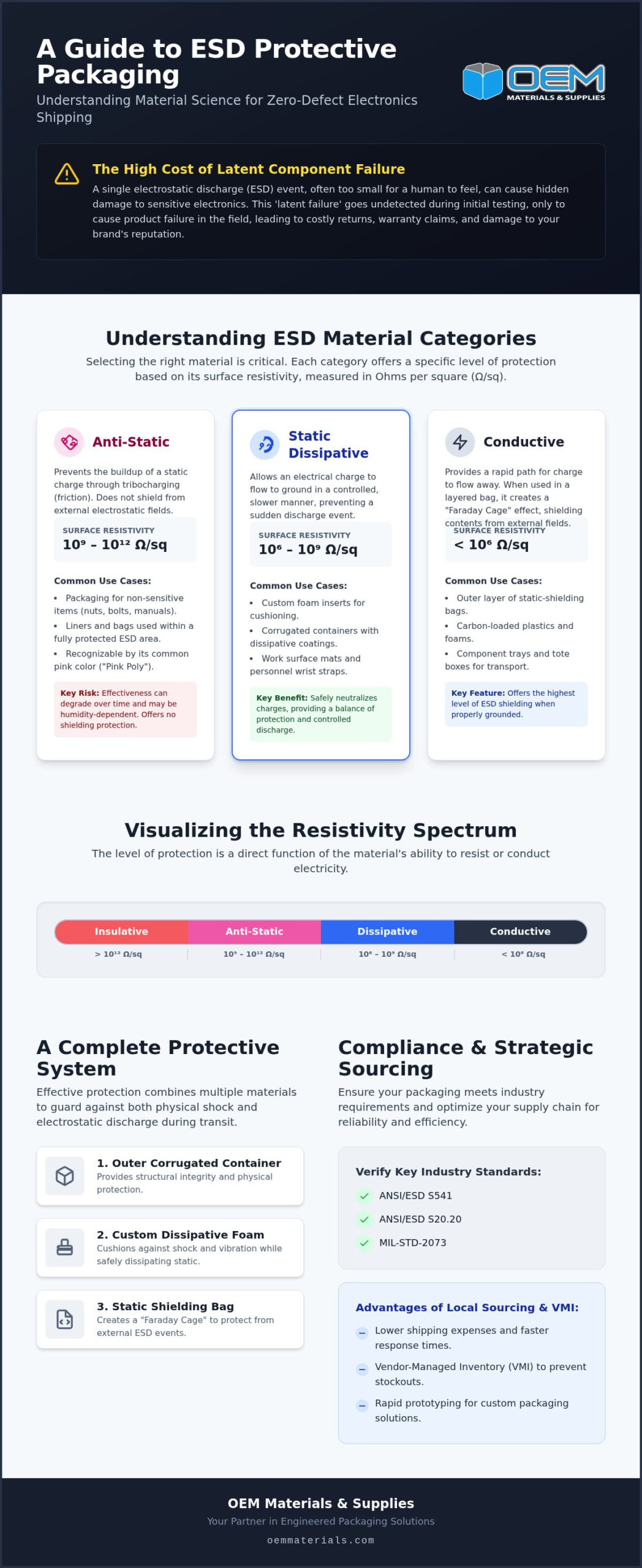
Selecting the right ESD protective packaging riverside requires a technical understanding of how materials interact with electrical charges. The industry categorizes these materials based on surface resistivity, measured in ohms per square. This measurement determines how quickly a charge moves across or through the material. In the arid climate of Riverside, where low humidity can exacerbate static buildup, choosing the wrong category can lead to catastrophic component failure.
Anti-Static Materials and Pink Poly
Anti-static materials, often recognized by their pink color, are treated with chemical agents to minimize tribocharging. This means they won’t generate a charge when rubbed against other materials. However, they do not provide a shield against external electrostatic fields. Pink polyethylene is a common choice for non-sensitive items like nuts, bolts, or instruction manuals used within an ESD-safe zone. It’s important to remember that these anti-static agents are often humidity-dependent and can migrate over time, losing their effectiveness. For long-term storage or high-sensitivity components, relying solely on pink poly is a technical risk.
Static Dissipative vs. Conductive Shielding
Static dissipative materials have a resistivity range between 10^6 and 10^9 ohms. They allow a charge to flow to the ground in a controlled, slower manner than conductive materials. This prevents the “spark” associated with rapid discharge. For the most sensitive devices, conductive shielding is mandatory. These materials, typically found in metalized cushioning materials or shielding bags, create a Faraday cage. This cage redirects external electrical charges around the exterior of the package rather than through the contents.
Compliance with Defense Logistics Agency packaging standards ensures that your selection meets the rigorous requirements for Human Body Model (HBM) sensitivity. When protecting Class 0 devices, the margin for error is non-existent. Engineers must evaluate whether foam packaging needs to be dissipative or if a full conductive shield is required. If you are unsure which material fits your specific HBM sensitivity rating, you can consult with our technical team for a material evaluation. This precision ensures you aren’t over-spending on shielding for low-risk items while providing maximum security for your most valuable electronics. Reliable ESD protective packaging riverside is about matching the material to the specific electrical vulnerability of the part.
Selecting Formats: ESD Bags, Foam Inserts, and Corrugated Containers
Effective ESD protective packaging riverside requires a hybrid approach that addresses both electrical shielding and physical shock protection. While a static-shielding bag might prevent a discharge, it offers zero protection against the mechanical vibrations common in Inland Empire logistics. For high-value assemblies, procurement teams must select a format that integrates into their existing shipping workflows without adding unnecessary labor or material waste. The goal is to create a secure environment that maintains the integrity of the component from the assembly line to the final destination.
Custom ESD Foam Inserts
Engineered foam is the primary defense against physical damage for sensitive electronics. When selecting materials, engineers generally choose between polyurethane (PU) and polyethylene (PE) based on the product’s weight and fragility. Polyurethane is open-cell and softer, making it ideal for lightweight components, while polyethylene is a closed-cell material that provides superior support for heavier aerospace hardware. These foams are treated with conductive or dissipative agents to ensure they meet EOS/ESD Association standards. Designing inserts for complex geometries ensures that components remain immobilized during transit. For a deeper dive into material properties and engineering specifications, see The Industrial Guide to Foam Inserts.
Conductive Corrugated and Kitting
Carbon-loaded corrugated containers offer a robust alternative to standard boxes paired with individual bags. These containers feature a conductive layer that creates a permanent Faraday cage, often eliminating the need for additional shielding wraps. This is particularly effective for high-volume Riverside manufacturing where speed on the assembly line is paramount. By utilizing corrugated packaging box manufacturers that specialize in ESD-safe materials, companies can implement kitting services. Kitting involves pre-assembling the box and foam inserts before they reach the workstation, allowing employees to simply place the component in and seal the package. This reduction in packaging labor often offsets the higher material cost of conductive corrugated. When evaluating ESD protective packaging riverside, consider a cost-benefit analysis of reusable vs. disposable options. Reusable conductive bins are ideal for closed-loop internal transfers within the Inland Empire, while disposable shielded corrugated remains the standard for outbound shipping to global customers.
Compliance and Quality Standards for Industrial ESD Packaging
Industrial standards provide the technical framework necessary to ensure that packaging materials perform as intended. For manufacturers in the Inland Empire, adhering to these protocols is not just about paperwork; it’s about mitigating the risk of component failure. Purchasing managers must look beyond marketing claims and verify that their ESD protective packaging riverside meets specific surface resistance and static decay thresholds. Testing protocols usually involve measuring surface resistivity using a megohmmeter and ensuring that static charges dissipate within the timeframes specified by the EOS/ESD Association. Without verified certifications, you’re essentially guessing about the safety of your hardware.
ANSI/ESD S20.20 for Electronics OEMs
The ANSI/ESD S20.20 standard is the primary benchmark for commercial electronics manufacturing. It requires that all packaging materials used for ESD-sensitive items be characterized for their electrical properties. To maintain compliance during a quality audit, your team must keep up-to-date material certifications from the supplier. This documentation serves as proof that the foam packaging or shielding bags in your facility meet the required dissipative or conductive ranges. Additionally, staff training is essential; even the best materials fail if warehouse personnel don’t understand how to properly seal a shielding bag or ground themselves before handling open containers. Proper documentation streamlines the audit process and builds trust with your own customers.
Military and Aerospace Specifications
Aerospace firms in the Riverside area often face more stringent requirements, such as MIL-STD-2073 or MIL-PRF-81705F. These military specifications dictate specific barrier materials that protect against not only static but also moisture and electromagnetic interference. Traceability is a critical component of these standards. Every batch of corrugated boxes or custom inserts must be traceable back to the raw material manufacturer to ensure consistent performance in high-reliability applications. Labeling plays a vital role here; using standardized ESD symbols and caution statements on all exterior packaging prevents accidental opening by ungrounded personnel in the field. Ensuring your ESD protective packaging riverside meets these specialized MIL-specs is non-negotiable for defense contracts.
If your current quality management system requires rigorous documentation for your static control program, you can request a quote and technical specifications to see how our materials align with your compliance needs.
Strategic Sourcing and VMI for Riverside Packaging Operations
Strategic sourcing for industrial packaging involves more than comparing unit prices. For facilities in the Inland Empire, the logistical efficiency of your supplier directly impacts your bottom line. Sourcing ESD protective packaging riverside locally reduces the total cost of ownership by eliminating the high freight costs associated with shipping bulky items like corrugated boxes and foam packaging over long distances. Proximity also enables JIT packaging strategies, allowing you to receive materials exactly when they are needed for a production run, which frees up valuable floor space in your warehouse.
Implementing VMI in Electronics Manufacturing
Implementing Packaging VMI Services is a proven method for streamlining the procurement of recurring ESD supplies. In this model, your supplier takes responsibility for monitoring and replenishing stock levels at your facility. This data-driven approach ensures that you never experience a stockout of critical shielding bags or conductive inserts. Beyond inventory management, organized kitting services can significantly reduce labor costs. By receiving pre-assembled packaging sets, your team spends less time on manual assembly and more time on high-value manufacturing tasks. This transition from transaction-based purchasing to an integrated inventory system provides the stability needed for high-volume production schedules.
Partnering with a Local Riverside Supplier
Partnering with a local Riverside supplier also facilitates rapid prototyping for new electronics launches. When an engineer needs to test a new custom foam insert for a sensitive aerospace component, a local partner can deliver a prototype for a site visit within hours. This level of collaboration is impossible with a commodity reseller located across the country. Localized sourcing also supports corporate sustainability goals by drastically reducing the carbon footprint of your Inland Empire supply chain. Moving materials across town rather than across state lines minimizes fuel consumption and transport emissions. If you are looking to optimize your current logistics, you can contact us for a custom ESD packaging quote. Be prepared to provide details such as product dimensions, weight, and annual usage to receive a technical recommendation that balances protection with operational efficiency.
Optimizing Your Inland Empire Static Control Program
Securing sensitive electronics requires a technical approach that balances material science with logistical efficiency. Selecting the correct ESD protective packaging riverside ensures your operation eliminates the high cost of latent failures while maintaining strict compliance with ANSI/ESD S20.20 and MIL-spec standards. Transitioning to a local supply model keeps your production lines active without the burden of excessive inventory or long lead times from distant vendors.
OEM Materials & Supplies delivers specialized ESD and cleanroom material expertise for demanding aerospace and medical electronics projects. Our local Inland Empire inventory and VMI support allow for custom engineering and rapid prototyping that aligns with your specific assembly workflows. We focus on reducing total landed costs through engineered foam inserts, conductive corrugated, and streamlined kitting services. To improve your shipping reliability and warehouse efficiency, Request an ESD Packaging Quote for Your Riverside Facility today. We’re ready to help you build a more resilient and cost-effective supply chain.
Frequently Asked Questions
What is the difference between anti-static and static dissipative packaging?
Anti-static packaging prevents the generation of static electricity caused by friction, a process known as tribocharging. It does not, however, protect against external electrical fields. Static dissipative materials have a specific resistance range, typically between 10^6 and 10^9 ohms, allowing them to bleed off existing charges to ground at a controlled rate. This controlled discharge is significantly safer for sensitive components than the rapid surge associated with conductive materials.
Does ESD packaging have an expiration date?
Many ESD materials have a functional shelf life, particularly those with topical anti-static coatings like pink polyethylene. These chemical agents can migrate or evaporate over 12 to 24 months, eventually leaving the plastic untreated. While metalized shielding bags and carbon-loaded corrugated last longer, they should be tested annually with a surface resistance meter. Regular testing ensures your stored materials still provide the protection levels required by your quality plan.
How do I know if my components require conductive shielding or just dissipative foam?
Conductive shielding is necessary for components with high sensitivity to external electrical fields, often rated as HBM Class 0. These materials create a Faraday cage that redirects charges around the exterior of the package. Dissipative foam is better suited for providing physical cushioning and controlled grounding within an already shielded environment. If your product is susceptible to low-voltage spikes, a hybrid approach using both formats offers the most reliable protection.
Can I reuse ESD bags and corrugated containers safely?
Reusing ESD bags and containers is possible if the materials remain physically and electrically intact. You must inspect shielding bags for creases, punctures, or tears, as these defects can break the Faraday cage and expose the contents to static. Corrugated containers should be checked for crushed corners or surface contamination. To maintain compliance, use a surface resistance meter to verify that reused items still fall within the specified dissipative or conductive ranges.
What are the specific ESD packaging requirements for aerospace manufacturers in Riverside?
Aerospace manufacturers in Southern California must typically adhere to MIL-PRF-81705F for flexible barrier materials. This standard ensures protection against electrostatic discharge, electromagnetic interference, and water vapor. Traceability is another core requirement, ensuring every component of the ESD protective packaging riverside can be tracked back to its original production batch. This level of documentation is essential for maintaining quality control in high-reliability defense and commercial aviation supply chains.
How does humidity in the Inland Empire affect ESD protective materials?
The Inland Empire’s dry climate directly impacts the performance of topical anti-static agents. These chemicals require ambient moisture to create a conductive path; therefore, they often fail when humidity drops below 20 percent. For reliable ESD protective packaging riverside, manufacturers should prioritize inherently dissipative or conductive materials. These options don’t rely on environmental factors to maintain their electrical properties, providing more consistent protection during Riverside’s peak summer heat.
Is pink anti-static foam safe for long-term storage of sensitive PCBs?
Pink anti-static foam is generally unsuitable for long-term PCB storage. The chemical additives used to create the anti-static property can leach out over time, potentially causing corrosion on solder joints or leaving ionic contamination on the board. Additionally, the material loses its effectiveness as the chemicals dissipate. For long-term protection, engineers should specify inherently dissipative foams that don’t rely on chemical coatings or use vacuum-sealed moisture barrier bags.
How can I verify that my packaging supplier meets ANSI/ESD S20.20 standards?
You can verify a supplier’s compliance by requesting technical data sheets and a Certificate of Compliance for every batch. These documents should clearly state the surface resistivity and static decay rates according to EOS/ESD Association test methods. A professional partner will also provide traceability data and participate in regular quality audits. This transparency ensures that the materials you receive meet the rigorous requirements of your ANSI/ESD S20.20 certified control program.