
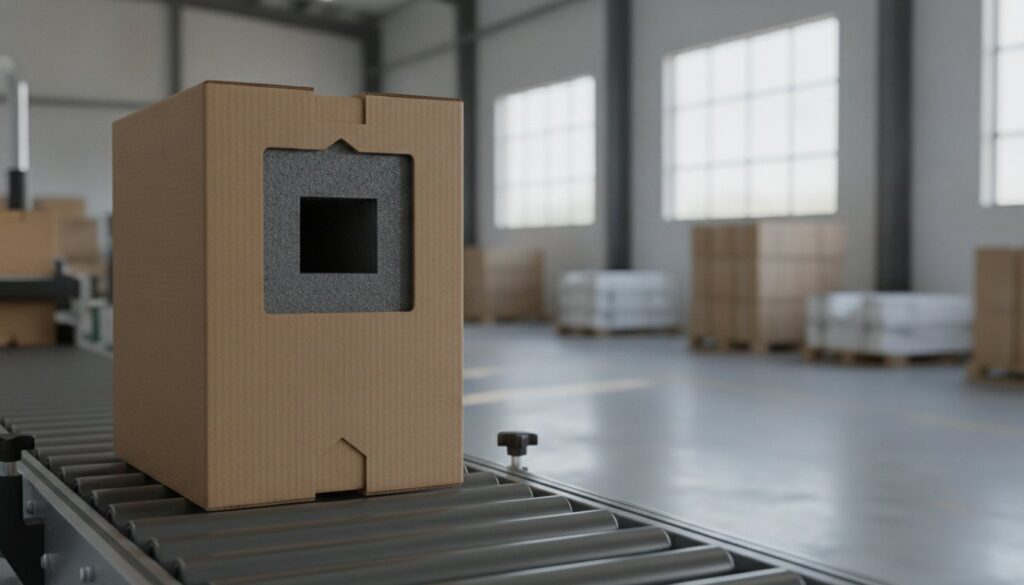
With the California statewide minimum wage reaching $16.90 per hour in 2026, the cost of every manual touch on your production line has never been higher. For many manufacturers in Southern California, labor now represents a disproportionate share of the total cost of ownership for every shipped unit. You’re likely struggling with high turnover in warehouse staff and bottlenecks at the kitting station that stall your entire operation. It’s frustrating to watch throughput drop because of complex box assembly or frequent errors in manual packing that require expensive rework.
This guide provides a technical strategy for reducing packaging labor costs by identifying hidden inefficiencies and implementing design-led solutions. You’ll learn how to move away from slow, manual processes toward a streamlined system that prioritizes speed and precision. We will analyze the impact of pre-assembled kitting services, custom-engineered foam inserts, and vendor-managed inventory programs on your bottom line. These strategies focus on eliminating unnecessary handling and reducing your reliance on temporary labor. By the end of this article, you’ll have a clear plan to achieve predictable packaging costs and faster throughput on your assembly line.
Key Takeaways
- Audit every manual touch from receipt to shipping to identify specific opportunities for reducing packaging labor costs.
- Transition to auto-bottom corrugated boxes and intuitive custom designs to eliminate secondary assembly steps like manual taping.
- Leverage pre-assembled kitting to eliminate the need for on-site sorting and complex component organization.
- Deploy a packaging VMI program to automate inventory counts and replenishment, reclaiming hours for your procurement team.
- Partner with a Southern California supplier that combines local JIT delivery with custom engineering to maintain high production speeds.
Identifying the Hidden Drivers of Packaging Labor Expenses
Reducing packaging labor costs requires a granular audit of every manual interaction a product undergoes from the moment it arrives at the warehouse to its final loading onto a delivery truck. In the industrial sector, labor often accounts for a significant portion of the total packaging budget, yet these costs are frequently buried within general overhead. Every manual touch represents a potential bottleneck and a direct expense. To uncover these hidden drivers, manufacturers must analyze the sequence of assembly and identify where time is lost to repetitive, non-value-added tasks.
Secondary operations like tape application and void filling are common culprits of inefficiency. While a few extra seconds per box may seem negligible, the cumulative impact across thousands of units is substantial. Additionally, complex packaging designs lead to frequent assembly errors. Reworking a single shipment because of a packing mistake effectively doubles the labor cost for that unit. Warehouse congestion also plays a role. When packing stations are disorganized or poorly designed, forklift and picker productivity drops as staff navigate around clutter and excess material.
The True Cost of Manual Assembly
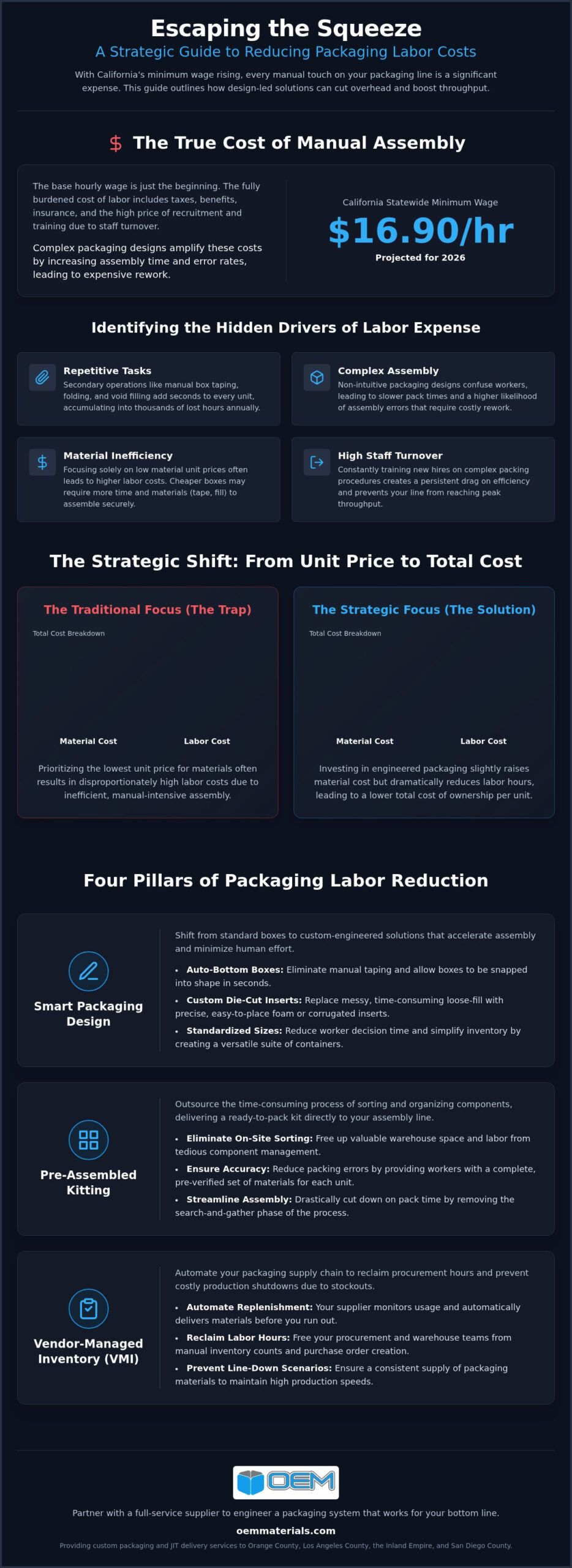
Calculating the real expense of manual labor involves more than just the base hourly wage. In California, where the minimum wage is $16.90 as of 2026, the fully burdened cost including taxes, benefits, and insurance is much higher. High turnover rates in the distribution sector further inflate these figures because of the constant need for recruitment and training. If your packaging specifications are overly complex, new hires take longer to reach peak efficiency. This creates a lag where packaging speed cannot keep pace with production output, often forcing the use of expensive temporary labor to clear backlogs.
Material Inefficiency vs. Labor Inefficiency
Procurement teams often prioritize the unit price of materials, but cheaper components frequently drive up total labor hours. For example, a standard corrugated box might be inexpensive to purchase but requires extensive manual taping and folding. In contrast, auto-locking designs or custom-engineered kits allow for rapid assembly without tools. Poorly sized packaging also forces workers to spend excessive time applying cushioning materials to fill voids. While packaging line automation can solve some of these issues, the first step is always optimizing the design to minimize human effort.
Optimizing Packaging Design to Accelerate Assembly Speed
Design choice is a primary lever for reducing packaging labor costs. It dictates how many seconds a worker spends on each unit. Many facilities rely on standard containers that require excessive manual preparation, which creates unnecessary friction. Switching to custom corrugated boxes with auto-bottom features can eliminate the need for manual taping at the bottom of every container. This single change allows workers to snap a box into shape in a fraction of a second. When you eliminate tape dispensers from the initial assembly stage, you remove a physical tool and a potential point of failure from the line.
Standardizing box sizes across your product catalog also pays dividends. It reduces the time spent by workers selecting the correct container from a vast inventory of SKUs. Fewer choices lead to faster decisions. By utilizing custom packaging design, you can create a versatile suite of containers that accommodate multiple product types while maintaining a consistent assembly workflow.
Engineering Out the Friction
Assembly-ready design refers to packaging that requires zero tools for setup. This approach prioritizes speed by making the packing process as intuitive as possible. Engineers can create one-way assembly paths that guide the worker naturally, which reduces the cognitive load and minimizes errors. Implementing die-cut inserts is another effective strategy. These inserts replace loose-fill peanuts or paper dunnage, which are messy and time-consuming to handle. For high-volume operations, designing multi-pack containers allows for the simultaneous insertion of multiple products. This effectively multiplies the throughput per man-hour without increasing the physical effort required from the staff.
Reducing Secondary Packaging Steps
Secondary operations like wrapping products in bubble wrap consume massive amounts of floor time. Integrating custom foam packaging secures items instantly without multiple wrapping steps. These custom-molded foam inserts provide superior protection while eliminating the need for separate cushioning materials. To further streamline the process, replace manual tape dispensers with pre-applied adhesive strips on custom boxes. This removes another tool from the station and speeds up the final sealing process. You might also consider incorporating tear-strips. While these improve the customer unboxing experience, they also allow for faster quality checks and opening at the facility if a package requires inspection. If your current assembly process feels sluggish, you can consult with a packaging engineer to evaluate your design efficiency.
Utilizing Kitting and Pre-Assembly to Lower On-Site Overhead
Manufacturers often overlook the significant labor hours spent on component sorting and preparation. This approach forces your internal team to handle the collection and organization of multiple packaging materials; it’s a drain on your most valuable resources. Outsourcing the assembly of these components is a direct path toward reducing packaging labor costs. By receiving pre-assembled kits, your staff focuses solely on product placement rather than hunting for boxes, inserts, or tape. This strategic shift is essential for maintaining high quality standards while accelerating the pace of your shipping department.
Managing 20 different packaging SKUs is a logistical burden that creates friction in your supply chain. You can consolidate these items into a single kit SKU, shifting the assembly burden to a specialized wholesale industrial packaging supplier. This simplification streamlines your procurement process and significantly reduces the square footage required for packing stations in your facility. When you eliminate the clutter of individual components, your warehouse flow becomes more logical and efficient.
When to Transition to Pre-Assembled Kits
Evaluate kitting for high-volume production runs where component counts remain consistent across every unit. If your internal labor costs exceed the service fee charged by your packaging partner, the transition is a financial necessity. You must also assess the value of reclaimed floor space. Every pallet position saved from raw packaging storage is a position available for actual manufacturing activities or finished goods. It’s about maximizing the revenue-generating potential of your facility. If you’re spending more time assembling boxes than building products, your priorities need to shift.
Streamlining the Final Pack-Out
The objective is to receive kits that are ready for immediate product insertion and shipping. This process eliminates the chance of missing components in complex industrial shipments, which is a common cause of expensive rework. It also improves consistency across different shifts. When every kit arrives pre-configured, the human element of assembly is minimized. This ensures that a unit packed on a Tuesday morning looks exactly like one packed on a Friday night. By removing the guesswork from the packing station, you achieve predictable throughput and more stable operational expenses.
Implementing Vendor-Managed Inventory to Reclaim Warehouse Labor
Managing packaging inventory is a silent labor drain that affects both procurement and warehouse operations. Procurement staff often spend hours every week performing manual inventory counts and placing individual purchase orders for various SKUs. Meanwhile, warehouse teams lose time moving, organizing, and searching through excess packaging stock that occupies valuable floor space. Implementing a packaging VMI program automates the replenishment process and is a powerful strategy for reducing packaging labor costs. This approach shifts the responsibility of inventory management to your supplier, allowing your team to focus on high-value production tasks.
Excessive inventory creates a cluttered environment that slows down every other warehouse activity. When your facility is overstocked with packaging materials, forklift operators and pickers must navigate around pallets of unused boxes and foam. By utilizing JIT packaging, you receive supplies only when they are required for current production runs. This precision reduces the physical labor involved in material handling and ensures that your loading docks remain clear for finished goods.
The Labor Efficiency of VMI
The primary benefit of a VMI program is the reclamation of man-hours. VMI technicians from your supplier handle the physical unloading and stocking of materials directly at your point of use. This eliminates the need for your internal staff to touch packaging materials until the moment they are needed on the assembly line. Administrative labor is also significantly reduced. Instead of processing dozens of individual purchase orders, your finance and procurement teams manage a single, streamlined billing cycle. This system also eliminates “emergency” labor expenses. You no longer have to pay staff to hunt for out-of-stock boxes or rush orders through the system because of a counting error.
Optimizing the Supply Chain for SoCal Manufacturers
For manufacturers in Southern California, local proximity is a critical component of labor efficiency. Utilizing local facilities allows for more frequent inventory audits and rapid delivery cycles. You can coordinate restocking schedules to align with your production peaks, which prevents dock congestion during your busiest hours. Maintaining a local supply chain also simplifies the oversight required from your management team. For those looking to optimize their local sourcing, our guide on corrugated packaging box manufacturers offers specific tips for identifying the right regional partners. If you’re ready to automate your inventory replenishment, you can request a VMI audit to see how much labor your team can reclaim.
Partnering with a Full-Service Southern California Packaging Supplier
Achieving long-term success in reducing packaging labor costs requires more than just better materials; it requires a strategic partnership with a full-service provider. You should select a partner that integrates custom engineering with robust logistics support. This dual capability ensures that your packaging is designed for speed and delivered exactly when your production line needs it. Prioritizing suppliers with local footprints in Orange County, Los Angeles, and San Diego is essential for Southern California manufacturers. Proximity allows for immediate troubleshooting and a deeper understanding of regional operational challenges, including the $16.90 per hour minimum wage standard that took effect in 2026.
Look for value-added services like rapid prototyping. This capability is critical for new product launches where packaging design must be finalized quickly to meet market deadlines without sacrificing assembly efficiency. A comprehensive audit of your current packaging line is also a vital tool. A professional assessment can identify labor leaks that your internal team might overlook, such as redundant movements at the kitting station or inefficient material handling workflows that stall your throughput.
The OEM Materials Advantage
OEM Materials & Supplies positions itself as a seasoned industry consultant rather than a mere vendor. Our team possesses deep expertise in the aerospace, medical, and electronics sectors, where precision and reliability are non-negotiable. We handle the entire lifecycle of your packaging requirements, from initial prototypes to high-volume production runs. This end-to-end support eliminates the friction of managing multiple vendors. It ensures that your strategies for reducing packaging labor costs are consistently applied across all product lines. We focus on the practical needs of your distribution sector to provide stability and technical competence at every stage.
Taking the Next Step Toward Efficiency
Taking the next step toward operational efficiency is a straightforward process. We recommend a site visit to observe your current packing process first-hand. This allows our engineers to see the physical challenges your staff faces and propose functional remedies. To begin the process, you can provide your product dimensions and annual usage figures for a custom analysis. This data-driven approach ensures that your strategy is based on actual production requirements rather than estimates. A site visit often reveals hidden bottlenecks that simple data cannot capture. Request a Quote for Custom Packaging Solutions to start reclaiming your warehouse labor today.
Securing Operational Stability in a High-Cost Labor Market
Optimizing your packaging operation is no longer just about material prices. It’s about reclaiming the hours lost to inefficient assembly and manual inventory management. By auditing manual touches and implementing assembly-ready designs, manufacturers can significantly lower their overhead. Transitioning to pre-assembled kits and vendor-managed inventory removes the logistical burden from your internal team. This allows your staff to focus on core production rather than folding boxes or counting SKUs. These strategies are essential for reducing packaging labor costs as regional wages continue to rise across California.
Success requires a partner that understands the technical requirements of industrial OEMs. OEM Materials & Supplies provides the expert engineering needed to develop custom foam inserts for rapid assembly. Our local Southern California VMI programs ensure your supply chain remains lean and responsive. We act as a seasoned consultant to help you navigate operational challenges with precision and reliability. Your facility can achieve faster throughput and predictable costs with the right design-led approach. Request a Quote for Labor-Saving Packaging Solutions to begin your transition toward a more efficient assembly line.
Frequently Asked Questions
What is the most effective way to reduce packaging labor without new machinery?
The most effective way to reduce labor without capital investment is through assembly-ready design. Switching to auto-bottom corrugated boxes and custom foam inserts eliminates the need for manual taping and complex folding. These design changes allow workers to set up a container in seconds rather than minutes. By removing physical tools and extra steps from the packing station, you increase throughput immediately without the expense of automated machinery.
How does custom packaging design actually save money on labor?
Custom packaging design reduces the number of manual touches required for every unit. When a box is engineered specifically for your product, it eliminates the need for generic void fill or multiple layers of bubble wrap. Intuitive, one-way assembly paths guide the worker through the process; this reduces the cognitive load and the likelihood of errors. These efficiencies lead to a lower total cost of ownership by decreasing the man-hours required per shipment.
What industries benefit most from outsourced kitting and assembly?
Industries that handle complex components or high-volume production runs benefit most from outsourced kitting. This includes the aerospace, medical device, and electronics sectors where precision is critical. By receiving pre-assembled packaging kits, these manufacturers can redeploy their internal labor to core production tasks. Outsourcing the organization of multiple SKUs into a single kit simplifies the final pack-out process and reduces the floor space required for material storage.
Can Vendor-Managed Inventory really reduce my warehouse headcount?
A VMI program reduces the administrative and physical labor required to manage packaging stock. While it may not always result in a direct reduction in headcount, it allows you to reclaim hours for higher-value activities. VMI technicians handle the counting, restocking, and point-of-use delivery, which removes these tasks from your internal team. This is a primary strategy for reducing packaging labor costs by automating the replenishment cycle and eliminating manual inventory audits.
Is pre-assembled packaging more expensive than standard boxes?
Pre-assembled packaging often has a higher unit price than standard flat-shipped boxes, but it significantly lowers the total cost of ownership. The initial material expense is offset by the reduction in on-site labor hours and the elimination of secondary supplies like tape or loose-fill peanuts. You must evaluate the fully burdened cost of labor to see the true savings. In high-wage regions like California, the assembly speed of pre-configured kits usually outweighs the material premium.
How do I calculate the labor cost per unit for my packaging process?
To calculate labor cost per unit, multiply the average time spent packing one unit by the fully burdened hourly rate of your staff. This rate should include base wages, benefits, taxes, and insurance. For an accurate measurement, audit the process from the moment a worker picks up the box until the unit is ready for the shipping dock. Factor in the cost of rework and training time to understand the complete impact on your operational budget.
What Southern California areas does OEM Materials & Supplies serve for VMI?
OEM Materials & Supplies provides VMI and JIT support across the primary manufacturing hubs of Southern California. We specifically serve industrial clients in Orange County, Los Angeles, and San Diego. Our local footprint allows for rapid delivery and on-site inventory audits that align with your production schedules. This regional focus ensures that we can provide the high-level technical support and reliability required by aerospace and medical manufacturers in the area.