
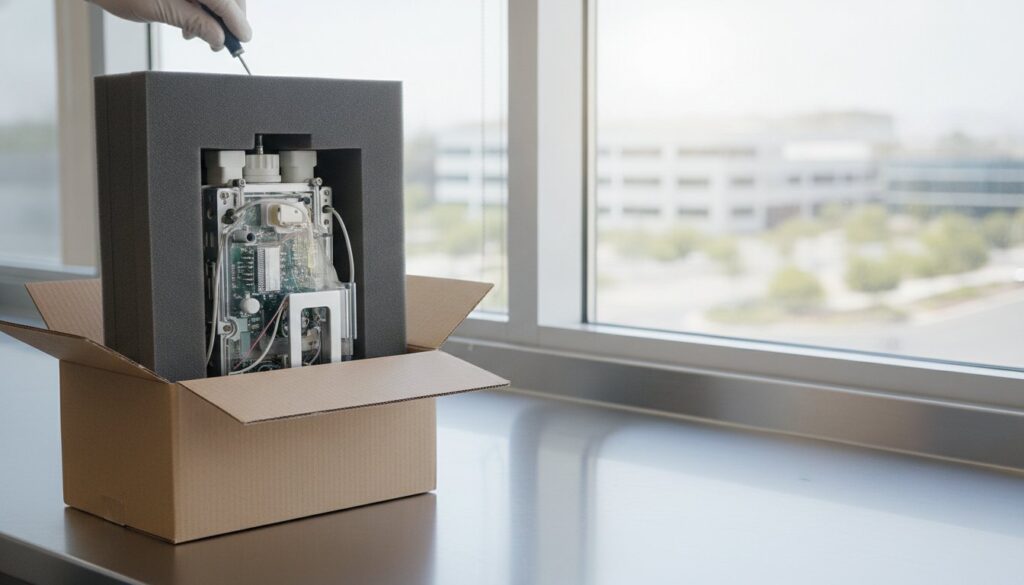
A single compromised seal or a crushed outer carton can invalidate months of research and jeopardize patient safety before a device even reaches the clinical environment. Maintaining the integrity of a sterile barrier while managing a complex supply chain is a significant logistical hurdle for any manufacturer. You recognize that standard shipping materials often lack the precision required for sensitive medical instrumentation.
Implementing professional medical device packaging solutions requires a balance between regulatory compliance and physical durability. This guide provides the technical context needed to select the right industrial containers and cushioning materials to prevent shipping damage. You will learn how to align your packaging strategy with the FDA Quality Management System Regulation (QMSR) that became effective on February 2, 2026, and the updated ISO 20417:2026 standards. We will also examine how custom foam inserts and local vendor-managed inventory programs in Orange County and Los Angeles can reduce transit risks and improve kitting efficiency. By the end of this article, you will have a clear framework for optimizing your secondary packaging to meet both international standards and your specific operational requirements.
Key Takeaways
- Understand how ISO 11607 and mandatory transit testing protect the sterile barrier system during the rigors of industrial distribution.
- Evaluate the performance of engineered foam inserts and custom corrugated boxes in mitigating vibration and shock for sensitive medical electronics.
- Discover how pre-assembled packaging kits reduce labor costs and eliminate packing errors during the kitting and assembly process.
- Optimize your supply chain by integrating medical device packaging solutions with local vendor-managed inventory programs to prevent critical material stockouts.
- Identify the logistical benefits of sourcing industrial containers from a local Southern California partner to ensure faster prototyping and reliable just-in-time delivery.
What are medical containers and why is specialized packaging required?
Industrial medical containers are more than just boxes. They are engineered components designed to safeguard the sterile integrity and functional precision of healthcare products throughout the supply chain. While the industry often focuses on the sterile pouch, the outer shell provides the necessary structural support during the rigors of transit. Understanding packaging and its role in protecting goods is essential for any manufacturer moving high-value diagnostic equipment or sensitive electronics. Without specialized medical device packaging solutions, even the most advanced medical technology is at risk of becoming scrap before it reaches the hospital.
The secondary container acts as the first line of defense for the sterile barrier system (SBS). It doesn’t just hold the product; it absorbs the kinetic energy of drops, prevents the compression of internal components, and shields the primary barrier from environmental contaminants. For high-value medical electronics, structural integrity is non-negotiable. A minor dent in a thin-walled box can lead to a misaligned sensor or a cracked screen, resulting in costly returns and potential delays in patient care.
The Hierarchy of Medical Device Packaging
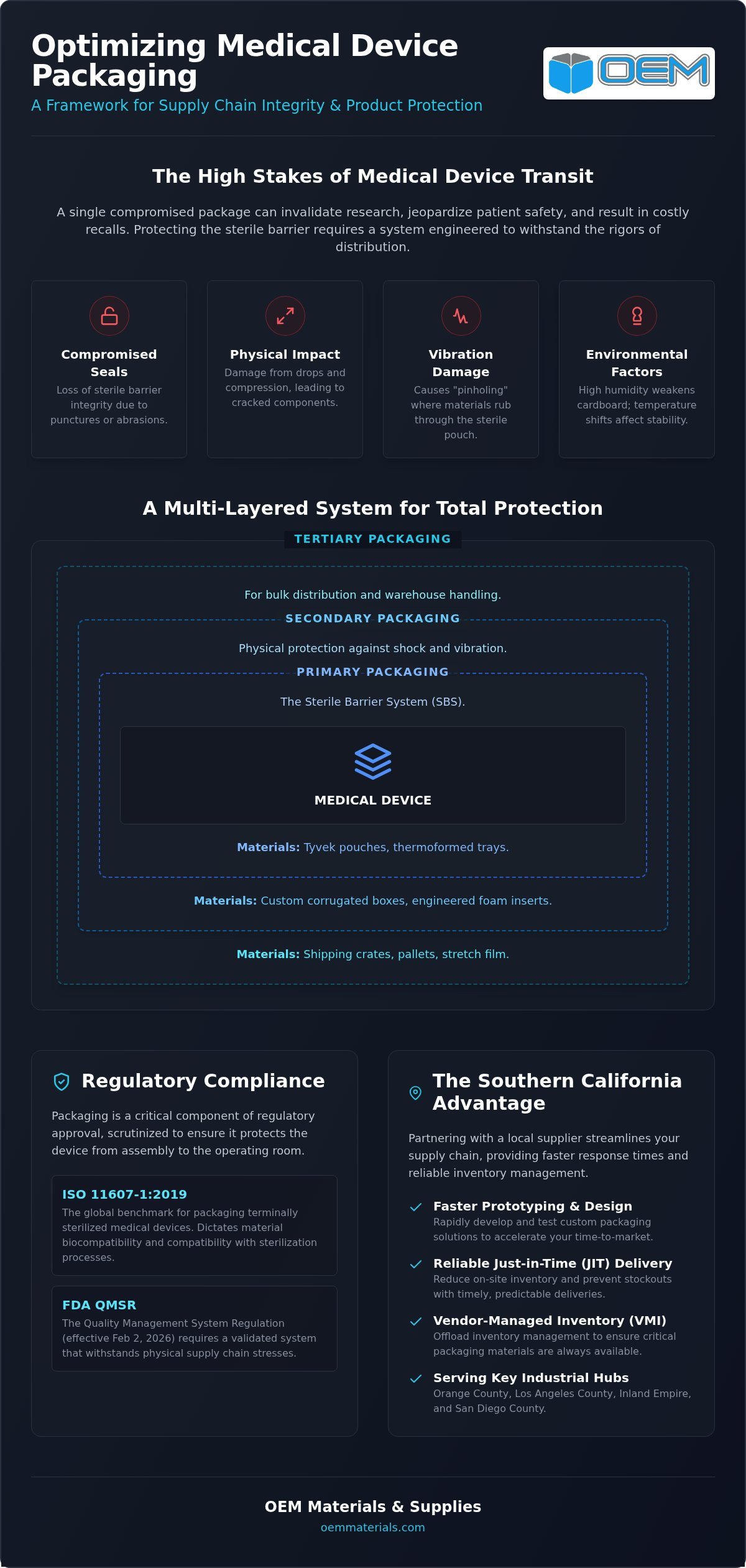
Effective protection requires a layered approach. We categorize these layers based on their proximity to the device and their specific protective function:
- Primary Packaging: This is the sterile barrier, such as Tyvek pouches or thermoformed trays, that comes into direct contact with the device.
- Secondary Packaging: These are the custom corrugated boxes and engineered foam inserts that organize and protect the primary barrier from physical impact.
- Tertiary Packaging: This includes shipping crates, plastic pallets, and stretch film used for bulk distribution and warehouse handling.
Common Challenges in Medical Logistics
Vibration is a silent killer in medical logistics. Constant movement during truck or air transport can cause “pinholing,” where the device or its primary tray rubs against the pouch until the sterile seal is breached. Manufacturers must also manage environmental factors. High humidity can weaken standard cardboard, while temperature fluctuations can affect the chemical stability of diagnostic kits. Finally, warehouse efficiency is a constant pressure. We help manufacturers reduce their packaging footprint to optimize storage space without sacrificing the safety of the device. By using custom packaging design, you can ensure each container is exactly as large as it needs to be, and no larger.
What regulatory standards apply to medical device packaging solutions?
Compliance in medical manufacturing requires more than just a sterile environment; it demands a validated system that protects the product from the point of assembly to the operating room. Regulatory bodies don’t just look at the pouch. They scrutinize the entire packaging system to ensure it can withstand the physical stresses of the supply chain without compromising the device. Adhering to these standards is essential for mitigating risk and avoiding costly product recalls.
ISO 11607 and the Sterile Barrier System
The ISO 11607-1:2019 standard serves as the definitive global benchmark for packaging sterile medical devices. This standard dictates that all materials must be non-toxic, biocompatible, and fully compatible with the chosen sterilization process. While some competitors focus exclusively on cleanroom classifications, we emphasize that the secondary container is what actually preserves the sterile seal. If your outer box fails, your sterile pouch is vulnerable to abrasion and puncture. You can review our Medical Packaging Compliance Checklist to see how your current materials align with these requirements.
Transit Testing and Validation
Validation is the cornerstone of regulatory approval. To prove that your medical device packaging solutions are effective, you must subject them to transit testing protocols such as ASTM D4169 or ISTA standards. These tests simulate the harsh realities of the distribution environment, including random vibration, high-altitude pressure changes, and repeated drops. They provide the empirical data required by the FDA and other global regulators to prove that a device will arrive in its intended state.
Engineered foam packaging is frequently the primary solution for passing these rigorous validations. Custom foam inserts provide the necessary deceleration and shock absorption to protect sensitive electronics from G-force impacts. Beyond physical protection, you must also ensure that all labels and barcodes remain legible and intact after testing. Documentation of these results is a mandatory part of any regulatory audit. If you are preparing for a new product launch, consider requesting a packaging consultation to ensure your designs are ready for the lab. Every data point regarding material durability must be recorded to provide a complete history of the packaging system’s safety and performance.
How do materials like corrugated and foam protect medical devices?
While the sterile barrier is vital, it cannot survive the physical demands of a warehouse or a delivery truck without structural support. Manufacturers often overlook the secondary layer, yet this is where the majority of transit damage occurs. Professional medical device packaging solutions rely on a combination of high-strength corrugated materials and precision-cut foam to neutralize the forces of impact and vibration. This multi-material approach ensures that the device arrives in the same calibrated state it left the factory.
Corrugated Solutions for Medical OEMs
Choosing between stock containers and custom corrugated boxes depends on the sensitivity and weight of the device. For heavy diagnostic machinery, we prioritize Mullen Burst Strength to ensure the walls don’t puncture under pressure. For lighter, high-volume disposables, Edge Crush Test (ECT) ratings provide a better metric for stacking strength in the warehouse. Custom die-cut designs allow for integrated handles and locking tabs, which streamline the unboxing process for medical staff while maintaining a rigid, protective outer shell.
Engineered Foam Inserts for Sensitive Equipment
Cushioning is a science of deceleration. Custom foam packaging utilizes different densities to manage the G-force of a drop. We select materials based on the specific fragility of the instrument:
- Polyethylene (PE) Foam: A closed-cell material that provides excellent support for heavier instruments and resists moisture.
- Polyurethane (PU) Foam: An open-cell, softer material ideal for delicate, lightweight components that require gentle cradling.
We design foam cavities to secure multiple components within a single kit, preventing them from colliding during transit. This is particularly effective for surgical sets that include both heavy handpieces and fragile optics. For devices with integrated circuitry, ESD (Electrostatic Discharge) packaging is mandatory to prevent invisible damage from static buildup during handling.
Additionally, palletized shipments in Southern California often face shifting loads during short-haul trucking between Orange County and Los Angeles. We use edge protectors to distribute the pressure of stretch film and prevent the corners of corrugated containers from collapsing under tension. This comprehensive material strategy protects your high-value assets from the moment they are kitted until they reach the end user.
What are the benefits of custom medical device packaging kits?
Medical kitting is the process of pre-assembling every individual component required to pack a specific device into a single, ready-to-use unit. Instead of warehouse staff pulling a box from one pallet, foam from another, and labels from a third, they receive a complete unit designed for immediate use. This approach is a cornerstone of modern medical device packaging solutions, transforming a disjointed assembly line into a streamlined operation. Sourcing a complete kit from a single industrial supplier ensures that every piece fits perfectly, eliminating the friction of mismatched components from different vendors.
Improving Operational Efficiency with Kitting
Operational efficiency is measured by the number of touches required to move a product from the manufacturing floor to the shipping dock. Kitting significantly reduces these touches. When all materials are pre-sized and organized, packing becomes a repeatable, error-proof task. This precision also minimizes material waste, as you aren’t over-packing with loose fill or oversized boxes. You can see these principles in action by reviewing our Custom Medical Device Packaging Kits Case Study, which details how organized assembly drives down overhead. While labor savings depend on specific variables like product dimensions and assembly complexity, the reduction in packing errors alone provides a stable foundation for scaling production.
Organization and User Experience
For medical professionals, the unboxing experience is a matter of safety and procedural speed. Custom inserts within a kit allow for the organization of complex surgical or diagnostic components in a logical, sequential order. This arrangement ensures that the most critical items are accessible exactly when needed, preventing confusion in high-pressure clinical environments. Integrating these organized medical device packaging solutions into your product design shows a commitment to the end-user’s needs.
Clear organization also serves as a safety control. By using printed instructions and precise labels within the kit, you provide secondary verification for the user. This reduces the risk of contamination in the field, as staff don’t have to fumble with multiple loose packages or search for missing components. A well-designed kit acts as a roadmap for the procedure. If you are looking to streamline your assembly line or improve the end-user experience, request a quote for a custom kitting prototype. Providing your product dimensions and annual usage will allow us to design a solution that maximizes both protection and packing speed.
How can Southern California manufacturers optimize their medical supply chain?
Southern California remains one of the world’s most concentrated hubs for medical device innovation. However, many OEMs struggle with the logistical burden of managing bulky packaging materials. Relying on long-distance or global suppliers for medical device packaging solutions often results in inflated shipping costs and unpredictable lead times. By transitioning to a local partner, you gain immediate control over your supply chain while reducing the overhead associated with long-haul transport. Localized sourcing isn’t just about proximity; it’s about the agility required to meet rigorous production schedules.
Local Support for Orange County and Los Angeles
Proximity allows for a level of collaboration that global vendors cannot match. Manufacturers in Orange County and Los Angeles benefit from rapid prototyping and same-week design revisions. If a device design changes, a local supplier can provide updated foam packaging samples in days rather than weeks. This speed is critical for supporting the manufacturing hubs in San Diego and Riverside, where time-to-market is a primary competitive advantage. On-site consultations also allow packaging engineers to see your assembly line firsthand, ensuring that medical device packaging solutions are optimized for your specific kitting and palletizing workflows.
Inventory Management Strategies
Warehouse floor space in Southern California is at a premium. Devoting thousands of square feet to empty corrugated boxes or bulky cushioning materials is an inefficient use of capital. Vendor Managed Inventory Services (VMI) solve this problem by shifting the responsibility of stock management to the supplier. We monitor your inventory levels and replenish your stock automatically, which prevents the critical stockouts that can halt a production line. This proactive approach allows your procurement team to focus on high-value components rather than packaging stock.
Using Just-In-Time (JIT) delivery further optimizes your facility. By receiving materials only when they are needed for the assembly of finished goods, you free up floor space for additional production equipment or sterile storage. This methodical approach to logistics ensures that your operation remains lean and responsive. To identify specific opportunities for cost savings and efficiency gains, we encourage manufacturers to request a technical consultation. Providing data such as your product dimensions, weight, and annual usage enables us to design a supply chain strategy tailored to your operational requirements.
Strengthening Your Medical Packaging Supply Chain
Securing a medical device for distribution requires a methodology that extends beyond the sterile pouch. You must ensure that every secondary container and foam insert is validated to withstand the physical stresses of the supply chain. By integrating custom kitting and rigorous transit testing, you protect both your high-value assets and your regulatory standing. A holistic approach to material selection and structural design is the only way to guarantee that sensitive instrumentation arrives in a clinical setting without damage or contamination.
Manufacturers in Orange County, Los Angeles, and San Diego can further refine their operations by utilizing local vendor-managed inventory (VMI) and just-in-time (JIT) programs. These services eliminate stockouts and free up valuable floor space, allowing you to focus on production rather than packaging logistics. OEM Materials & Supplies specializes in engineered foam and custom corrugated medical device packaging solutions designed for the specific needs of medical OEMs.
To begin optimizing your supply chain, Request a Quote for Custom Medical Packaging. Please include your product dimensions, weight, and annual usage so we can provide a precise technical recommendation for your next project. We look forward to helping you improve your operational efficiency.
Frequently Asked Questions
What is the difference between primary and secondary medical packaging?
Primary packaging is the sterile barrier, such as a Tyvek pouch or thermoformed tray, that comes into direct contact with the device. Secondary packaging refers to the industrial containers and engineered foam inserts that protect that sterile barrier. While the primary layer ensures sterility, the secondary layer provides the structural integrity required to prevent physical damage, such as pinholing or seal failure, during the rigors of transit and warehouse handling.
How do I choose the right foam density for a medical device?
Selection depends on the weight and fragility of the instrument. High-density polyethylene (PE) foam provides rigid support for heavy diagnostic machinery and resists moisture. Low-density polyurethane (PU) foam is better for lightweight, delicate components that require soft cushioning to absorb low-level vibrations. Engineering a custom cavity ensures the foam density matches the specific G-force requirements of your device validation to prevent internal component shifting during shipping.
What transit testing standards are required for medical containers?
Manufacturers must typically comply with ASTM D4169 or ISTA standards to validate their medical device packaging solutions. These protocols involve a series of lab-controlled tests, including random vibration, drop impacts, and compression cycles, to simulate the actual distribution environment. Passing these tests provides the empirical documentation required by the FDA and global regulators to prove the packaging system maintains product safety from the factory to the end user.
Can I use standard corrugated boxes for medical device shipping?
Standard stock boxes are often insufficient for high-value medical shipments because they lack the specific strength ratings required for transit validation. We recommend custom corrugated boxes with specific Mullen Burst or Edge Crush Test (ECT) ratings tailored to the device weight. Custom designs also allow for integrated dividers and locking tabs, which provide superior stability compared to generic containers that require excessive loose-fill cushioning materials to fill empty space.
What are the benefits of a vendor-managed inventory program for medical supplies?
A VMI program eliminates the risk of stockouts for critical industrial containers by shifting inventory oversight to the supplier. This is especially beneficial for Southern California OEMs with limited warehouse space in Orange County or Los Angeles. By automating replenishment, your operations team can focus on production schedules while ensuring that custom foam and corrugated materials are always available for the next kitting run without tying up capital in excess stock.
How does custom kitting reduce labor costs for medical OEMs?
Custom kitting reduces labor by consolidating all packaging components into a single, pre-assembled unit. This process eliminates the time warehouse staff spend searching for individual materials like edge protectors or stretch film. While exact savings depend on assembly complexity and product dimensions, reducing the number of touches required to pack a finished product lowers overhead and minimizes the potential for human error during the final packing and distribution phase.
What is ESD packaging and when is it needed for medical devices?
ESD (Electrostatic Discharge) packaging is specialized material designed to prevent static electricity buildup that can damage sensitive electronic components. It is mandatory for medical devices with integrated circuitry, sensors, or microprocessors. Using anti-static foam or shielded bags ensures that invisible electrical charges don’t compromise the functionality of the device during shipping or unboxing in a clinical environment. This protection is vital for maintaining the calibration of precision diagnostic tools.
How do I ensure my medical packaging is compliant with ISO 11607?
Compliance requires documenting that your medical device packaging solutions are non-toxic, compatible with sterilization, and capable of maintaining a sterile barrier until the point of use. You must perform formal validation studies, including stability testing and transit simulations. Partnering with an experienced industrial supplier ensures your secondary containers provide the necessary physical protection to keep the primary sterile barrier intact throughout the entire lifecycle of the product and during regulatory audits.