
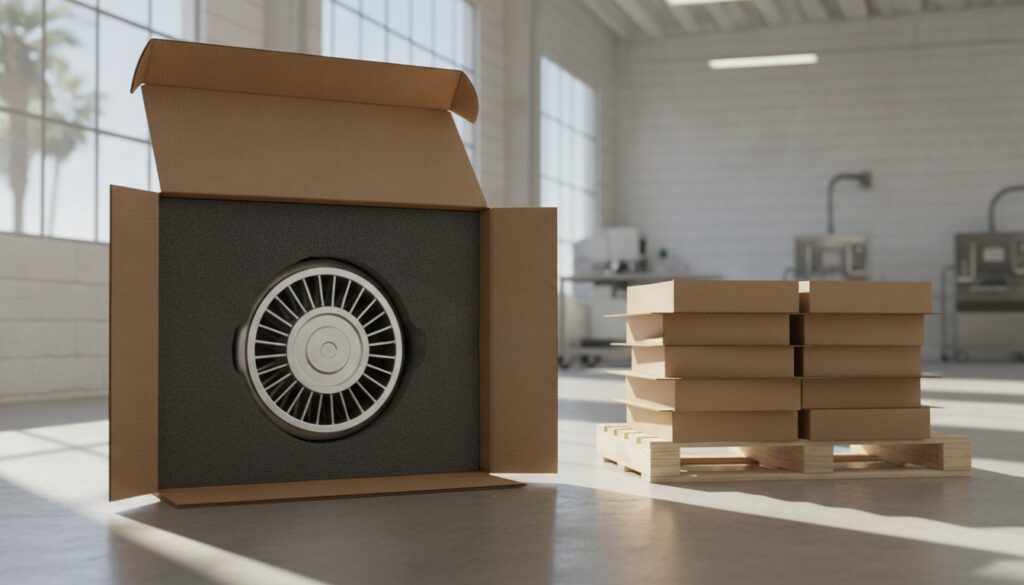
A shipping container is often the first physical touchpoint a customer has with your engineering, yet many firms treat it as a secondary concern. An improperly specified box does more than look unprofessional; it actively drains your bottom line through product damage and excessive dimensional weight charges. When you source custom branded boxes for manufacturers, you are not just buying cardboard. You are investing in a logistical asset that must protect high value components while reinforcing your position as a reliable industrial partner.
We understand the frustration of dealing with inconsistent print quality or structural failures that lead to costly returns and supply chain friction. This guide provides a technical roadmap for procurement and operations managers to specify packaging that balances rigorous protection with a professional brand identity. You will learn how to engineer your corrugated solutions to reduce shipping damage, optimize warehouse storage, and streamline your packing labor efficiency. We will cover the essential steps to move beyond generic containers and implement a branded packaging strategy that meets the exacting standards of the aerospace, medical, and electronics sectors.
Key Takeaways
- Learn to specify corrugated board grades and flute sizes that provide the structural integrity required for heavy or sensitive industrial components.
- Discover how to engineer custom branded boxes for manufacturers that optimize pallet density and reduce dimensional weight shipping costs.
- Identify why physical prototyping and local engineering support in Southern California are essential for verifying fit and protection before full production.
- Understand how integrating Vendor-Managed Inventory (VMI) and JIT delivery can streamline your supply chain and reduce on-site warehouse overhead.
Why Standard Shipping Containers Fail Modern Manufacturers
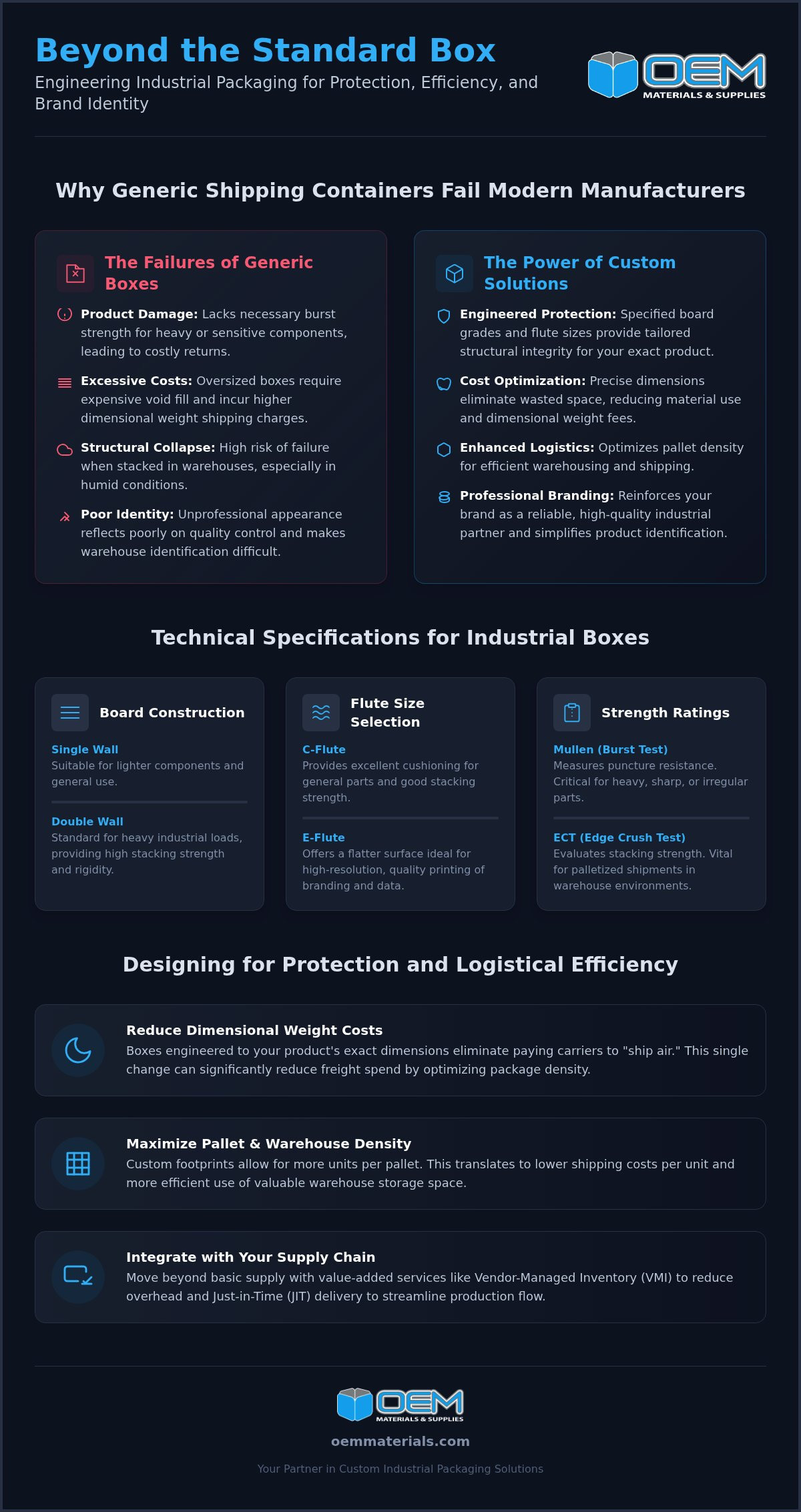
Standard shipping containers are designed for general commodities, not the specific requirements of heavy or sensitive industrial equipment. These stock boxes often lack the necessary burst strength to support dense metal parts or high value medical devices. When a box fails during transit, the manufacturer faces more than just the loss of the product. They deal with administrative overhead, replacement shipping costs, and damaged client relationships. Generic packaging increases the risk of structural collapse, especially when stacked in multi tier warehouse configurations. Relying on off the shelf solutions often means compromising on the safety of your cargo.
The Hidden Costs of Generic Industrial Packaging
Financial losses from shipping damage can quickly erase the thin margins common in competitive manufacturing sectors. Using oversized, generic boxes forces your team to rely on excessive cushioning materials to fill empty space. This is a double expense. You pay for more void fill than necessary, and you pay higher freight costs due to dimensional weight pricing. Carriers charge based on the space a package occupies, not just its weight. If your box is three inches larger than necessary in any dimension, you’re essentially paying to ship air. Proper custom branded boxes for manufacturers are engineered to the exact dimensions of the product, which optimizes shipping density and reduces material waste.
Adhering to international packaging and labeling standards is also difficult with stock containers. Generic boxes often lack the surface quality needed for clear, scannable barcodes or critical handling instructions. This leads to traceability gaps in the supply chain, which is unacceptable for industries like aerospace or automotive manufacturing where accountability is mandatory. Without clear identification, your shipments are more likely to be misplaced or mishandled during the various stages of transit.
Professional Identity in the B2B Supply Chain
Your packaging is a physical representation of your quality control standards. When a shipment arrives at a Tier 1 supplier or an OEM in an unmarked, battered box, it reflects poorly on your internal processes. Professional, branded presentation builds trust. It signals that the components inside have been handled with the same level of care used during the machining or assembly process. In a crowded warehouse in Orange County or Los Angeles, custom branded boxes for manufacturers allow for immediate visual identification. This reduces picking errors and speeds up the receiving process for your customers. A well designed box isn’t just a container; it’s a functional tool that improves logistics efficiency and reinforces your position as a top tier industrial partner.
Technical Specifications for Custom Branded Industrial Boxes
Specifying industrial packaging requires a deeper understanding than simple aesthetics. It involves the multidisciplinary field of packaging science to ensure structural integrity during transit. Single wall corrugated boxes are suitable for lighter components, but double wall construction is the standard for heavy industrial loads or items requiring high stacking strength. Flute size selection is equally critical. While C-flute provides excellent cushioning for general parts, E-flute offers a flatter surface for superior high resolution printing on custom branded boxes for manufacturers. Selecting the wrong flute can lead to crushed board or poor legibility of critical shipping data.
Corrugated Material Selection and Strength Ratings
Manufacturers must choose between Mullen Burst Test and Edge Crush Test (ECT) ratings based on their specific logistics cycle. Mullen ratings measure the force required to puncture the liner board, which is essential for heavy, sharp, or irregular parts that might shift during shipping. ECT evaluates the stacking strength of the box, a vital metric for palletized shipments in tiered warehouse environments. In Southern California, manufacturers in the Inland Empire or Orange County must consider warehouse humidity. High moisture levels can significantly degrade ECT ratings. Specifying moisture resistant liners or anti static coatings for sensitive electronics prevents these environmental failures and ensures consistent protection throughout the supply chain.
Industrial Printing Methods and Branding Durability
For high volume production, flexographic printing remains the most cost effective option for industrial branding. It uses flexible relief plates to apply ink directly to the board, providing durable results that withstand rugged handling. For rapid prototyping or short runs of corrugated boxes, digital printing eliminates plate costs and allows for immediate design adjustments. Regardless of the method, industrial ink must be durable enough to survive the friction of automated conveyor systems in San Diego or Los Angeles distribution centers. Smudged or faded branding isn’t just a marketing failure; it can lead to scannability issues and delivery delays.
Sensitive medical or electronic equipment often requires more than just an outer container. Integrating custom foam packaging within the branded box provides engineered vibration dampening and shock absorption. This synergy between the outer box and the internal insert ensures the product arrives within its functional specifications. If you are unsure which board grade or printing method fits your application, you can speak with an engineer for a technical consultation to review your specific requirements.
Designing for Protection and Logistical Efficiency
Effective industrial packaging design prioritizes the internal volume as much as the outer dimensions. When engineering custom branded boxes for manufacturers, every millimeter of space must be calculated to accommodate specific cushioning materials or custom inserts. A box that is too large requires excessive void fill, while one that is too small risks structural failure or product contact with the outer walls. Die-cut designs allow for precise nesting of complex components, which is essential for kitting operations in the aerospace and electronics sectors. This level of precision ensures that assembly teams can pack products faster and with greater consistency.
Integrating Engineered Protection
Industrial protection relies on a system of components working in unison. A custom box should be designed in tandem with engineered foam to provide specific shock absorption levels based on the product weight and fragility. For heavy machinery or large metal assemblies, integrating edge and corner protectors within the box prevents the product from puncturing the corrugated walls. Adhering to guidelines from the International Standards Organization (ISO) and testing against ISTA or ASTM standards provides the data necessary to verify that a container will survive the rigors of the global supply chain. This technical approach moves packaging from a commodity purchase to an engineered solution.
Palletization and Warehouse Optimization
Logistical efficiency is often won or lost on the pallet. Custom box dimensions should be optimized for standard pallet footprints to eliminate overhang, which is a primary cause of stack collapse and transit damage. Maximizing shipping density reduces the total number of pallets shipped, directly lowering freight costs and improving trailer utilization. In busy distribution centers across the Inland Empire and San Diego County, branded packaging serves as a visual cue for warehouse personnel. Clear, high contrast branding on the box exterior facilitates faster pick and pack operations and reduces the likelihood of shipping errors. Well designed packaging isn’t just a protective shell; it is a critical component of your warehouse management strategy.
Sourcing Strategy for Southern California Manufacturers
Local proximity is a strategic advantage for manufacturers in Southern California. When sourcing custom branded boxes for manufacturers, relying on a distant vendor often leads to communication gaps and shipping delays. A local partner in Orange County or Los Angeles provides on-site engineering support that national resellers cannot match. This proximity allows for rapid design iterations and face-to-face consultations, ensuring that the final custom branded boxes for manufacturers meet the technical requirements of your specific industry. Proximity also reduces the carbon footprint of your supply chain and allows for more frequent quality audits.
Evaluating Supplier Capabilities
Selecting the right partner requires more than comparing price sheets. You must evaluate their internal design and engineering resources. Ask potential vendors about their experience with high-precision sectors like aerospace or medical device manufacturing. A qualified wholesale industrial packaging supplier should demonstrate long-term scalability, handling everything from initial short-run prototypes to high-volume production programs. In industrial hubs like the Inland Empire and San Diego County, lead times for custom tooling can vary. Verify that your supplier has the infrastructure to support your just-in-time delivery requirements without compromising on print quality.
The Prototype and Testing Phase
Physical samples are mandatory for industrial applications. You shouldn’t move to mass production based on a digital rendering alone. Requesting a physical prototype allows your engineering team to verify the fit between the product, internal foam inserts, and the outer box. This phase is the time to perform rigorous drop tests and vibration tests using actual product samples to simulate the distribution cycle. Testing also confirms that your branding remains clear and legible on the final material. Reviewing a physical sample ensures that ink durability meets your standards and that barcode placement is optimized for automated scanning systems. If you are ready to begin the design process, you can request a custom prototype and quote to get started.
Optimizing the Supply Chain with Managed Packaging Solutions
Transitioning from a transactional vendor relationship to a managed packaging partnership is a vital step for high-volume operations. While the design and structural integrity of custom branded boxes for manufacturers are fundamental, the logistical framework supporting their delivery determines your operational uptime. Procurement teams often struggle with the balance of maintaining enough stock to prevent line stoppages without over-allocating capital to stagnant inventory. By integrating professional kitting and assembly services, you can offload labor-intensive tasks and receive ready-to-use packaging components directly at your production station. This comprehensive approach extends to all consumables, allowing you to source everything from custom corrugated solutions to industrial-grade stretch film from a single, reliable point of contact.
Vendor-Managed Inventory for Custom Packaging
Implementing Vendor-Managed Inventory (VMI) eliminates the administrative burden of tracking stock levels and issuing repetitive purchase orders. Under a VMI program, your supplier takes responsibility for monitoring your usage of custom branded boxes for manufacturers and replenishing stock automatically based on pre-set minimum and maximum levels. This ensures a consistent supply for high-speed production lines where a single stockout of a branded container could halt shipments. Consolidating your packaging procurement through a managed program also offers significant financial benefits by reducing procurement labor and allowing for more predictable budgeting. You gain the stability of a dedicated inventory buffer without the overhead of manual oversight.
Just-In-Time Delivery in Southern California
Industrial real estate in Orange County and Los Angeles is among the most expensive in the country. Devoting thousands of square feet to empty boxes is an inefficient use of warehouse space that could be better utilized for manufacturing or finished goods. Utilizing Just-In-Time (JIT) delivery allows you to receive your packaging in smaller, frequent increments that match your daily or weekly production schedule. Partnering with a corrugated packaging box manufacturer with local distribution hubs across the Inland Empire and San Diego County ensures a rapid response to sudden production changes. This local presence is the key to maintaining a lean supply chain. It provides the flexibility to adjust delivery volumes on short notice, ensuring your facility remains organized and efficient without the clutter of excessive safety stock.
Advancing Your Industrial Packaging Strategy
Engineering a custom packaging solution is a strategic investment in your operational reliability. By moving away from generic containers and specifying corrugated grades that match your product weight and fragility, you significantly reduce the risk of transit damage. Integrating these designs with managed inventory services like VMI or JIT delivery ensures that your production lines never experience a stockout while keeping your warehouse footprint lean in expensive Southern California markets.
Implementing custom branded boxes for manufacturers allows your firm to maintain a consistent professional identity throughout the B2B supply chain. Whether you’re shipping sensitive electronic components or heavy aerospace parts, the right container acts as a functional tool for protection and brand reinforcement. Since 1995, OEM Materials & Supplies has served as a technical partner for regional industries, providing local design and rapid prototyping from our Orange County facility. We specialize in the rigorous requirements of the medical and aerospace sectors, ensuring every box meets high industrial standards.
To optimize your current packaging system, contact us for a custom packaging consultation. We look forward to helping you engineer a more efficient and protective delivery system for your specific application.
Frequently Asked Questions
What is the minimum order quantity for custom branded boxes for manufacturers?
Minimum order quantities depend on the production method and box dimensions. Digital printing allows for shorter runs suitable for prototyping or specialized equipment. High volume flexographic printing typically requires larger quantities to justify the initial plate setup and machine calibration. We recommend reviewing your annual usage data to determine the most cost effective production volume for your specific inventory needs and logistical requirements.
How much does custom branding add to the cost of an industrial shipping box?
The cost of branding varies based on the number of colors, ink coverage, and the chosen printing technology. Initial setup for flexographic printing involves one time plate charges, while digital printing avoids these fees but may have a higher unit cost. Factors like the complexity of the graphics and the surface area of the box also influence the final price. We provide detailed cost breakdowns based on your specific artwork and volume requirements.
Which printing method is best for high volume industrial corrugated boxes?
Flexographic printing is the industry standard for high volume industrial corrugated boxes. It uses durable relief plates to apply ink quickly and consistently across thousands of units. This method provides the best balance of durability and unit cost for large production runs. For manufacturers in Southern California requiring rapid replenishment, flexographic printing offers the speed necessary to maintain high speed production lines without compromising on brand legibility.
Can custom branded boxes be designed to meet medical or aerospace regulations?
Yes, custom branded boxes for manufacturers can be engineered to meet the stringent requirements of the medical and aerospace sectors. This includes using specialized board liners for moisture resistance and ensuring the packaging supports full supply chain traceability. We design containers that comply with international standards, ensuring your high value components are protected and identifiable throughout the distribution cycle. Proper documentation and material certifications can be provided to meet your quality control standards.
How do I determine the correct corrugated strength for my heavy product?
Determining the correct strength involves evaluating the total weight of the product and the intended stacking height in the warehouse. We use the Edge Crush Test (ECT) to measure top to bottom compression strength for palletized loads. For products with irregular shapes or sharp edges, the Mullen Burst Test measures the force required to puncture the box wall. Our engineers analyze your product dimensions and shipping environment to recommend either single wall or double wall construction.
What information should I provide to get an accurate quote for custom packaging?
To provide an accurate quote, we require the internal dimensions of the box, the total weight of the contents, and your estimated annual usage. Information regarding internal cushioning materials, such as custom foam inserts, is also essential for structural engineering. Please include details on the shipping environment and any specific branding requirements. Providing high resolution artwork and vector files helps our design team estimate ink coverage and setup costs more precisely.
How long does it take to receive a prototype for a custom branded box?
Prototype lead times are significantly reduced through our local presence in Orange County and Los Angeles. We can often produce a physical sample of custom branded boxes for manufacturers quickly once the design specifications and artwork are finalized. This phase allows your team to verify the fit and structural integrity of the container before moving to mass production. Rapid prototyping is essential for identifying potential design flaws and ensuring the branding meets your professional standards.
Do custom branded boxes require special tape or stretch film for shipping?
While custom branded boxes provide the outer shell, the total packaging system often requires industrial grade tape and stretch film for secure transit. Heavy or high value shipments may need reinforced water activated tape to prevent tampering and ensure the box remains sealed under stress. We also recommend high performance stretch film to maintain pallet stability during transport through Southern California distribution centers. Choosing the right closure and containment materials is critical for maintaining the professional appearance of your branded packaging.