
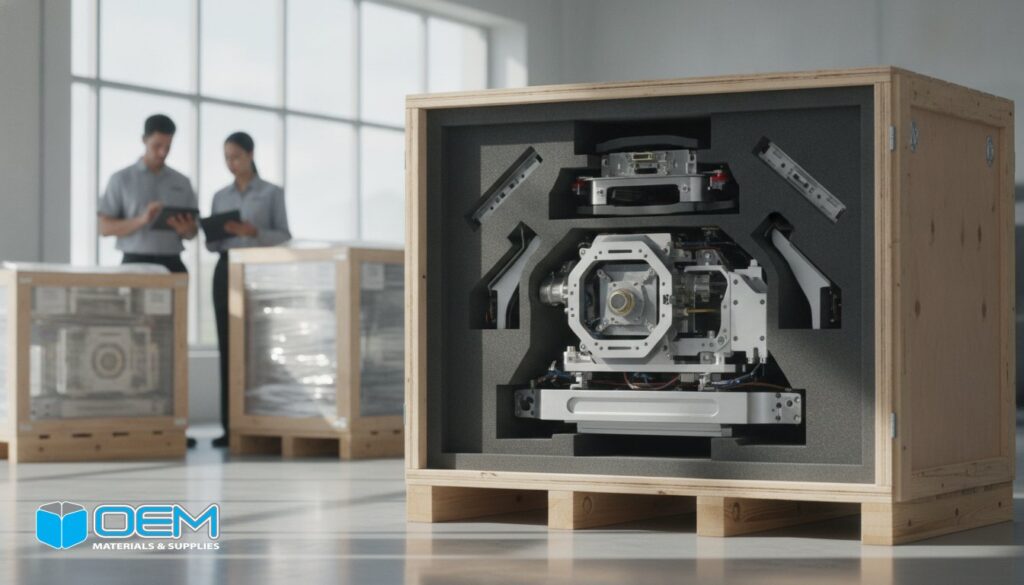
Why does a high-precision medical device arrive at a facility in San Diego out of calibration even when the outer crate shows no signs of impact? It’s a frustrating reality for many manufacturers in the aerospace and electronics sectors. You invest in robust wood crates and standard cushioning, yet the internal components still suffer from the silent effects of transit resonance. Understanding how to prevent vibration damage during shipping requires moving beyond generic protection and focusing on frequency-specific damping.
This guide provides a technical framework for selecting the correct foam density and engineering custom foam packaging that neutralizes vibration. We will look at current compliance standards, such as ASTM D4169-23e1 and the 2026 updates to ISTA 3E, to ensure your sensitive equipment remains operational upon arrival. By applying these principles, you can reduce the need for on-site technician recalibrations and protect your brand reputation from the high costs of hidden product failures. This methodology helps position your operations for greater reliability across the Southern California supply chain, ensuring that high-value components withstand the rigors of the road.
Key Takeaways
- Distinguish between high-intensity shock and low-intensity continuous vibration to identify the root cause of hidden product failures.
- Discover how to prevent vibration damage during shipping by engineering foam inserts that neutralize specific resonance frequencies.
- Evaluate the limitations of standard cushioning and learn why material density must be matched to product weight and fragility.
- Implement a structured packaging design process that complies with current ASTM D4169-23e1 and ISTA 3E-2026 testing standards.
- Leverage custom packaging solutions to reduce the high costs associated with on-site recalibrations and brand damage.
Distinguishing Vibration from Shock in Industrial Logistics
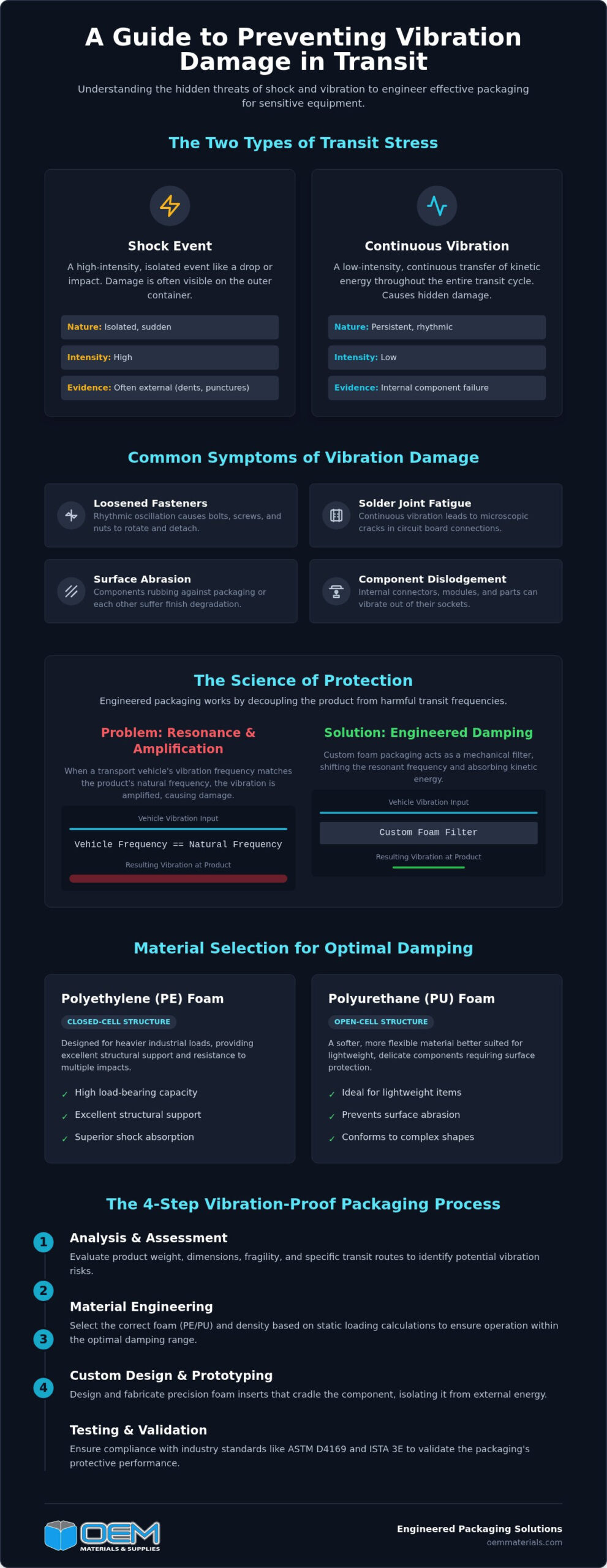
Logistics professionals often prioritize protection against drops and impacts. These are shock events. While shock is a high-intensity, isolated event, vibration represents a low-intensity but continuous transfer of kinetic energy throughout the entire transit cycle. It is a persistent mechanical stress that acts on every component of a shipment from the moment the vehicle starts moving. Knowing how to prevent vibration damage during shipping requires a shift in focus from one-time impacts to the cumulative effect of constant movement.
The most deceptive aspect of vibration is that it often leaves no external evidence. A wood crate or heavy-duty corrugated box can arrive at a facility in Orange County looking pristine, yet the internal electronics may be completely non-functional. This occurs because the energy passes through the outer container and targets the internal structure of the product. Common symptoms of this hidden damage include:
- Loosened Fasteners: Bolts, screws, and nuts can rotate and eventually detach due to rhythmic oscillation.
- Solder Joint Fatigue: Continuous vibration causes microscopic cracks in the solder joints of printed circuit boards.
- Surface Abrasion: Components that rub against each other or their packaging materials can suffer from finish degradation.
- Component Dislodgement: Internal connectors or modular parts can vibrate out of their sockets.
The Mechanics of Shipping Vibration
Every mode of transport introduces a unique vibration profile that engineers must account for. Road vehicles generate a wide range of frequencies through engine operation and interactions with the road surface, such as potholes and expansion joints. Rail transport introduces lateral oscillations known as “hunt” and rhythmic impacts from rail joints. Ocean freight is dominated by low-frequency hull vibrations caused by massive engines and wave action. Each of these environments requires a different damping strategy to protect sensitive industrial components.
Understanding Resonant Frequency and Amplification
The most significant threat to a product is resonance. Resonance occurs when the natural frequency of an object matches the frequency of the transport vehicle. At this “critical frequency,” the object vibrates with maximum amplitude. If your packaging is not engineered correctly, it can actually amplify this energy instead of absorbing it. Understanding vibration isolation principles is essential for creating a system where the packaging acts as a mechanical filter. Engineers use these principles to ensure that the transmissibility of the packaging system remains low, effectively decoupling the product from the vibration of the truck or plane. This technical approach is the only reliable way to ensure that sensitive components remain calibrated and operational upon delivery.
Engineering Protective Packaging to Dampen Transit Frequencies
Protective packaging is more than just a physical barrier. It functions as a mechanical filter that attenuates the energy transferred from the truck bed or aircraft floor to the product. To understand how to prevent vibration damage during shipping, engineers must design a system that shifts the natural frequency of the package assembly. When the natural frequency of the package differs from the forcing frequency of the vehicle, the energy is dampened rather than amplified. This decoupling is essential for protecting sensitive internal components that cannot withstand rhythmic oscillation.
Static loading is a critical variable in this engineering process. It refers to the weight of the product divided by the surface area of the foam it rests upon. If the static load is too low, the cushioning behaves like a stiff spring, transmitting vibrations directly to the component. If it’s too high, the material may bottom out during a bump, losing its ability to isolate the product. Professional engineered packaging solutions balance these factors to ensure the foam operates within its optimal damping range for the specific shipping environment.
Material Selection: Foam Density and Cell Structure
Choosing between Polyethylene (PE) and Polyurethane (PU) depends on product weight and sensitivity. PE foam is a closed-cell material designed for heavier industrial loads, providing excellent structural support and multi-impact resistance. PU foam is an open-cell, softer material better suited for lightweight, delicate electronics that require lower damping frequencies. Foam density is the weight per cubic foot of the material. Higher density foams generally offer more support for heavy items, while lower densities are used to isolate lighter components from high-frequency resonance. Matching the density to the product’s fragility ensures the material acts as an effective energy absorber.
Structural Integrity of Corrugated and Wood Containers
The outer container provides the necessary rigidity to maintain the internal damping system’s geometry. For many industrial applications, custom corrugated boxes with high burst strength provide sufficient external protection. However, large industrial machinery often requires heavy-duty crates to prevent structural flexing during transit. This external stability is a foundational part of how to prevent vibration damage during shipping for oversized loads. Tight tolerances in die-cut foam packaging are also essential. Any gap between the product and the cushion allows for secondary movement, which can turn a simple vibration into a series of internal micro-shocks. If you are dealing with recurring calibration issues, our team can help you evaluate your current material specs to find a more effective damping solution.
Comparing Vibration Protection Strategies for Sensitive Components
Selecting the right defense against transit energy requires a shift from generic protection to precision engineering. Many shippers rely on off-the-shelf cushioning materials like bubble wrap or air pillows. While these are effective for surface protection and minor shock, they are largely ineffective at neutralizing the continuous resonance encountered in LTL or ocean freight. For industrial OEMs in Orange County and San Diego, the cost of a single out-of-calibration medical device often exceeds the investment in a fully engineered packaging system.
Custom Foam Inserts vs Standard Cushioning
Standard loose-fill materials or generic wraps often settle during transit. This creates voids within the container, allowing the product to move and vibrate against the outer walls. In contrast, custom foam packaging is designed to maintain constant contact with the component, acting as a unified damping system. Engineers must calculate material thickness based on the specific load weight and the anticipated vibration profile of the shipping route. Using an incorrect foam density for a heavy aerospace part can lead to bottoming out, where the foam compresses completely and ceases to provide any isolation.
Evaluating Product Fragility and G-Factor Requirements
The G-factor is the primary metric used to determine how to prevent vibration damage during shipping. It represents the maximum acceleration an object can withstand before mechanical failure or loss of calibration occurs. Fragility ratings guide the selection of foam thickness and density. For example, extremely sensitive medical lab equipment might have a G-factor of 15 to 25 Gs, requiring thick, low-density polyurethane foam to absorb energy. In contrast, robust automotive castings might handle 50 to 100 Gs, allowing for thinner, higher-density polyethylene inserts. Understanding these fragility levels prevents over-packaging, which drives up material costs and shipping dimensions without adding functional value.
For high-value industrial sectors, the cost-benefit ratio of custom engineering is clear. When you factor in the expense of sending technicians for on-site recalibration or the brand damage caused by recurrent field failures, a data-driven packaging strategy becomes an operational necessity. Professional design ensures your product arrives in the same condition it left the factory floor, regardless of the transit mode or distance. By matching the material’s dynamic performance to the product’s known G-factor, manufacturers can ensure reliability while optimizing their logistics spend.
A Step-by-Step Process for Implementing Vibration-Proof Packaging
Developing a reliable framework for how to prevent vibration damage during shipping requires moving from guesswork to a structured engineering process. It’s not enough to simply add more material; you must apply a methodical approach to ensure every layer of the packaging system contributes to energy attenuation. This process ensures that sensitive industrial components remain calibrated and functional upon arrival at their destination in San Diego or Los Angeles.
- Step 1: Identify product fragility. Analyze the internal components to determine the G-factor and critical frequencies that could lead to mechanical failure.
- Step 2: Select the primary container. Match the external housing to the weight of the product and the logistical challenges of the route, whether it’s local delivery or long-haul freight.
- Step 3: Calculate foam density and static load. Ensure the cushioning is sized to provide maximum isolation without bottoming out under the product’s weight.
- Step 4: Stabilize the load. Secure the internal components and the external containers to prevent any independent movement that could amplify vibration energy.
Load Stabilization and Palletization Techniques
Unitizing the shipment is a critical final step in the damping process. We use high-performance stretch film to secure containers to pallets, creating a unified load that behaves as a single mass during transit. This reduces the independent movement of individual boxes, which can otherwise lead to internal friction and surface abrasion. To maintain the structural integrity of the containers under the tension of film or strapping, edge and corner protectors are applied. These components prevent the packaging from collapsing at the edges, ensuring the internal foam inserts remain in their intended positions and continue to isolate the product effectively.
Testing and Validation Standards for Transit Simulation
Before moving to full-scale production, packaging designs must be validated through rigorous transit simulation. Standards such as ASTM D4169-23e1 and the updated ISTA 3E-2026 offer frameworks for simulating the hazards of the distribution chain. We emphasize random vibration testing because it replicates the non-periodic, multi-frequency vibrations encountered on modern highways and rail lines more effectively than older, fixed-frequency methods. This testing is foundational to understanding how to prevent vibration damage during shipping for high-value assets. Rapid prototyping allows for physical testing and adjustment of the design, ensuring the final solution meets your specific fragility requirements. If you’re ready to improve your transit reliability, you can contact our engineering team for a prototype based on your product’s dimensions and weight.
Optimizing Your Supply Chain with Engineered Packaging Solutions
Implementing a technical strategy for how to prevent vibration damage during shipping is an investment in your supply chain’s long-term stability. High-precision damping systems generate significant cost savings by reducing return rates and eliminating the need for expensive on-site recalibrations. It’s important to recognize that specific savings depend on variables like your product’s dimensions, material choices, and specific shipping requirements. For manufacturers in Orange County and San Diego, having a local partner who understands these regional logistics challenges is essential. A solution-oriented supplier doesn’t just provide materials. They act as a consultant to improve operational efficiency and ensure your components arrive ready for use.
Leveraging Custom Design and Rapid Prototyping
Precision is paramount when dealing with aerospace components or medical devices. Our custom packaging design services focus on creating the exact geometry needed to isolate your product while minimizing material waste. This targeted approach ensures you aren’t paying for excess foam or oversized corrugated boxes that drive up dimensional weight charges. During new product launches, rapid prototyping allows your engineering team to validate the packaging design against transit simulations before committing to high-volume production. This speed is critical for maintaining tight development schedules in the competitive Southern California manufacturing sector.
Integrating Vendor Managed Inventory for Packaging Reliability
Large industrial packaging components, such as custom wood crates and heavy-duty foam inserts, occupy significant warehouse space. Integrating packaging VMI allows you to maintain optimal stock levels without tying up valuable floor space or capital in excess inventory. This service is particularly beneficial for managing the bulky items required to prevent vibration damage, ensuring that your production line never shuts down due to a shortage of protective materials. By utilizing just-in-time delivery, we help Southern California OEMs streamline their internal logistics and focus on their core manufacturing processes. OEM Materials & Supplies serves as a dependable guide for companies in the Inland Empire and San Diego County, providing the technical expertise and logistical support needed to navigate complex shipping environments successfully.
Securing Your Industrial Supply Chain Against Transit Resonance
Protecting high-value industrial components requires more than standard cushioning. It demands a technical understanding of resonance and material performance. By identifying product fragility and matching it with custom-engineered foam densities, manufacturers can effectively mitigate the silent risks of transit energy. Implementing these strategies is the most reliable way to ensure your sensitive equipment remains calibrated and operational upon arrival at its destination.
Understanding how to prevent vibration damage during shipping is essential for maintaining brand reputation and reducing the high costs of field failures. OEM Materials & Supplies has served aerospace and medical manufacturers since our inception, specializing in custom foam and corrugated solutions across Orange County and San Diego. We offer rapid prototyping along with full-service VMI and JIT packaging programs to keep your operations efficient and your inventory secure. Contact OEM Materials & Supplies for a custom packaging consultation to provide your product dimensions and weight for a tailored recommendation. We look forward to helping you optimize your protective packaging for the modern supply chain.
Frequently Asked Questions
What is the difference between shock and vibration in shipping?
Shock is a singular, high-intensity impact event, such as a package being dropped or a vehicle hitting a curb. Vibration is a continuous, low-intensity energy transfer that occurs throughout the entire transit cycle. While shock causes immediate structural failure, vibration leads to cumulative damage like metal fatigue or loosened internal fasteners. Both require different packaging strategies to ensure total product protection during long-haul or local Southern California transport.
How does resonance damage electronic components during transit?
Resonance happens when the vibration frequency of the transport vehicle matches the natural frequency of an electronic component. This causes the component to oscillate at its maximum amplitude, significantly increasing mechanical stress. In sensitive electronics, this often results in fractured solder joints, dislodged connectors, or microscopic surface abrasion. Engineering your packaging to shift these natural frequencies is a primary method for how to prevent vibration damage during shipping for precision medical or aerospace devices.
Which foam is best for damping vibration in heavy machinery?
Polyethylene (PE) foam is generally the most effective material for damping vibration in heavy industrial machinery. Its closed-cell structure provides the high load-bearing capacity required to support significant weight without bottoming out. For heavy equipment, engineers calculate the static load to ensure the PE foam operates within its optimal damping range. This prevents the machinery from vibrating against the outer wood crate or corrugated walls, maintaining calibration during transit across the Inland Empire.
What are the ISTA testing standards for shipping vibration?
The International Safe Transit Association (ISTA) provides several protocols, with ISTA 3A and ISTA 3E being the most common for industrial shipments. The recently updated ISTA 3E-2026 standard specifically addresses unitized loads for truckload shipments. These protocols utilize random vibration profiles to simulate real-world road and rail conditions. Testing according to these standards helps manufacturers validate their packaging designs and ensure they meet the rigorous requirements of global and local supply chains.
Can corrugated boxes provide enough protection against vibration?
Corrugated boxes provide essential external rigidity and structural support, but they rarely provide sufficient vibration damping on their own. To protect sensitive items, you must integrate custom foam inserts or other cushioning materials that act as a mechanical filter. The synergy between a high-burst-strength corrugated box and engineered foam is the most effective way to isolate a product from transit energy. This combination is a standard solution for electronics manufacturers in Orange County.
How do I calculate the G-factor for my product?
Calculating a product’s G-factor requires fragility testing, typically performed using a shock machine or vibration table in a controlled lab environment. The G-factor represents the maximum acceleration, measured in units of gravity, that a product can withstand before mechanical failure or loss of function. Engineers use this data to determine the required thickness and density of the protective foam. If lab data is unavailable, industry-standard fragility tables provide approximate G-factor ranges for common industrial components.
Is custom foam packaging worth the investment for high-volume shipping?
Custom foam packaging is a highly cost-effective investment for high-volume shipping, particularly for sensitive industrial equipment. While the initial engineering and prototyping have upfront costs, the long-term savings from reduced return rates and eliminated on-site recalibrations are substantial. Custom designs also minimize material waste by using the exact amount of foam needed for protection. This efficiency is critical for OEMs in San Diego looking to optimize their logistics spend while maintaining high reliability.
How does stretch film help with vibration protection?
Stretch film plays a vital role in how to prevent vibration damage during shipping by unitizing the entire load on a pallet. When individual boxes are tightly wrapped together, they behave as a single mass rather than independent units. This reduction in independent movement prevents boxes from vibrating against each other, which reduces surface abrasion and internal shifting. For Southern California manufacturers, properly applied stretch film is a foundational step in securing a shipment for the road.