
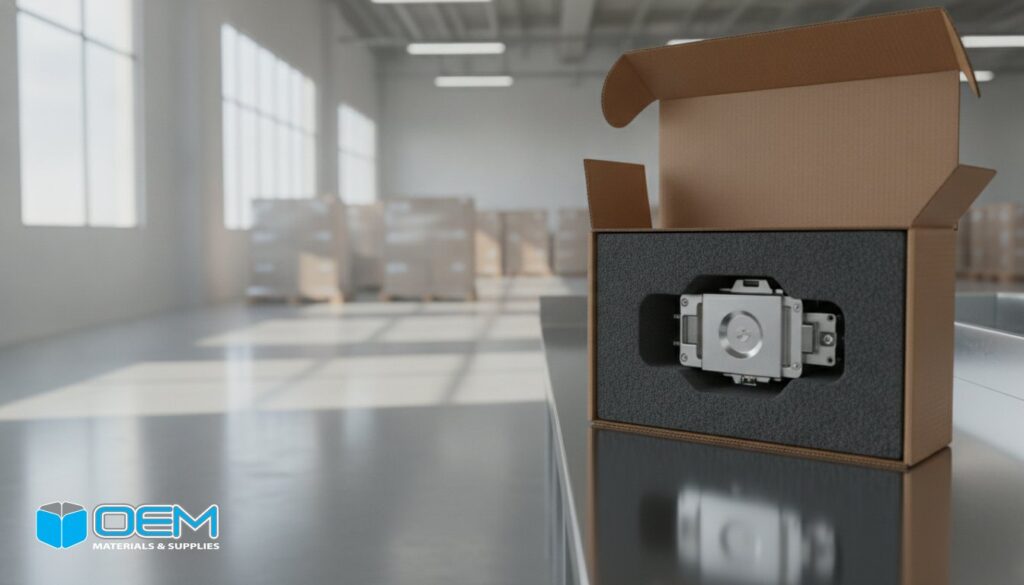
What if the most expensive component in your warehouse isn’t the inventory itself, but the hidden cost of a compromised shipping cycle? For manufacturers in Los Angeles and Orange County, the financial impact of product damage and inefficient kitting often outweighs the initial price of materials. Procuring high-quality custom industrial packaging boxes is no longer a simple purchasing task; it’s a technical requirement for protecting high-value aerospace, medical, and electronic components. With the Ports of Los Angeles and Long Beach handling nearly 17% of the nation’s cargo, your packaging must withstand a demanding logistics environment while complying with the latest California SB 54 regulations that took effect in early 2026.
You likely recognize that commodity vendors often fail to provide the consistency needed for complex supply chains. This article provides a roadmap for designing custom solutions that prioritize zero-damage shipping and operational efficiency. We will explore how updated standards, such as the ISTA 3E-2026 revision for unitized loads, impact your design choices. You’ll learn how to leverage vendor-managed inventory programs to stabilize your supply and utilize pre-assembled kits to cut excessive labor costs. By moving from a catalog-based approach to an engineering-led partnership, you can optimize every stage of your distribution process.
Key Takeaways
- Understand the technical distinction between retail-grade containers and engineered industrial packaging systems designed for maximum product protection.
- Discover how to design custom industrial packaging boxes that utilize specialized foam inserts to eliminate transit damage for high-value electronics and aerospace components.
- Learn to address sector-specific requirements, including sterile packaging for medical devices and heavy-duty crating for oversized industrial machinery.
- Identify opportunities to reduce warehouse overhead and labor costs through value-added services like Vendor-Managed Inventory and pre-assembled packaging kits.
- Evaluate the logistical advantages of partnering with a Southern California supplier to ensure faster prototyping and reliable just-in-time delivery schedules.
Defining the Standard for Custom Industrial Packaging Boxes
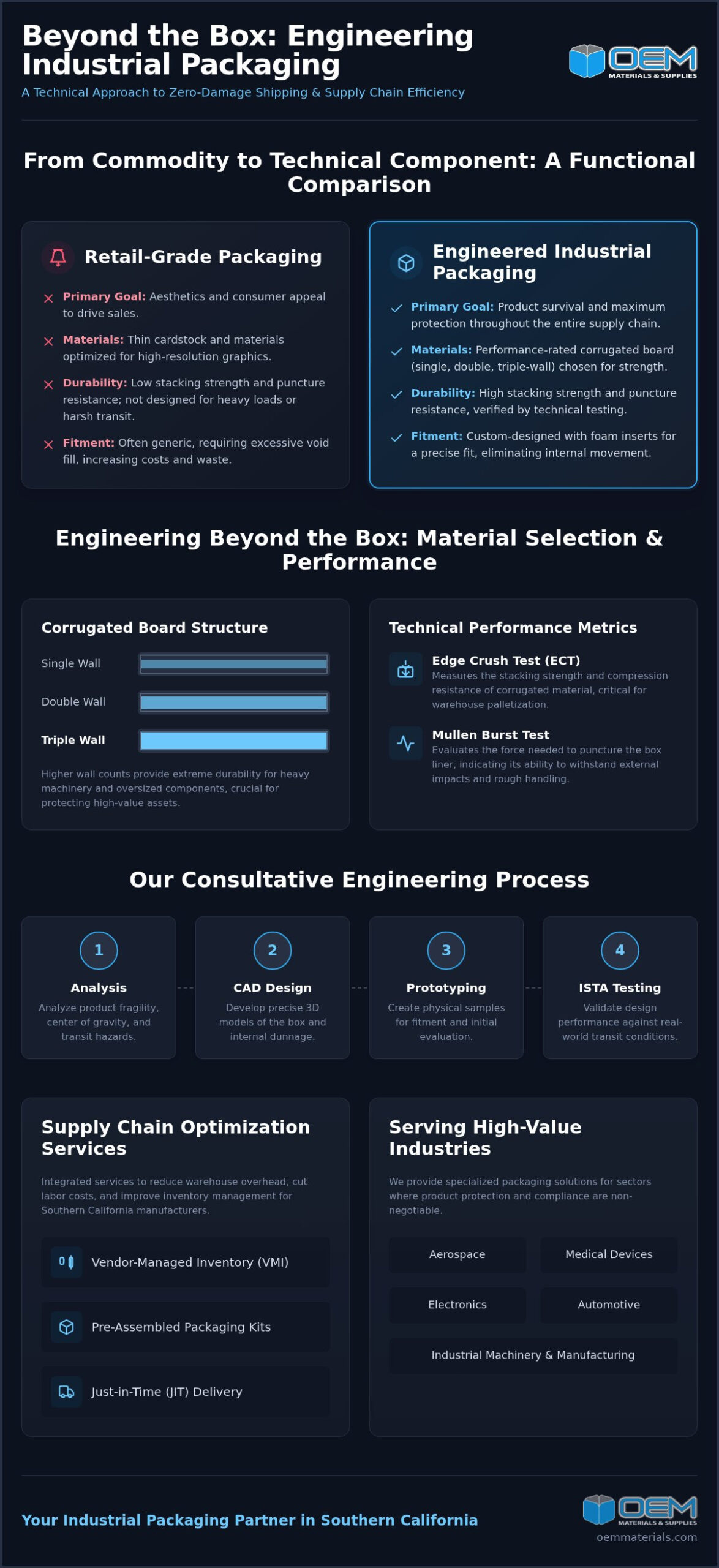
Industrial packaging is an engineered protective system. While retail packaging focuses on aesthetics to drive consumer purchases, custom industrial packaging boxes are designed to ensure product survival throughout the supply chain. In Southern California manufacturing hubs, where high-value aerospace and medical equipment are standard, a box must act as a structural shield. This requires a shift in perspective from viewing packaging as a commodity to viewing it as a technical component of the product itself.
Performance is measured through technical metrics like the Edge Crush Test (ECT) and the Mullen Burst Test. ECT evaluates the stacking strength of the corrugated material, which is critical for warehouse palletization and vertical compression. Mullen testing measures the force required to puncture the liner board, indicating how well the box protects against external impacts. Choosing the right material grade prevents box failure during transit and reduces the risk of expensive product returns. Custom sizing also impacts the bottom line by optimizing dimensional weight. Shipping carriers charge based on the space a package occupies; by eliminating excess void space, manufacturers reduce shipping costs and the need for excessive cushioning materials.
The Role of Corrugated Boxes in Industrial Logistics
The structural requirements for industrial shipping often exceed standard commercial capabilities. Depending on the weight and sensitivity of the contents, designs may utilize single-wall, double-wall, or triple-wall corrugated board. Triple-wall configurations provide the extreme durability needed for heavy machinery and oversized industrial components. High-quality corrugated boxes act as the primary barrier against the mechanical shocks and vibrations common in long-haul trucking and ocean freight. This structural integrity is essential for protecting sensitive components during multi-modal transit across the Inland Empire and beyond.
Industrial vs Retail Packaging: A Functional Comparison
Retail vendors typically prioritize thin cardstock and high-resolution graphics. These materials often fail to meet the durability standards required for an Original Equipment Manufacturer (OEM). When sourcing custom industrial packaging boxes, the priority shifts from visual appeal to measurable durability. Industrial-grade packaging focuses on precise fitment to prevent internal product movement. If a component shifts during transit, the resulting kinetic energy can cause internal damage even if the exterior box remains intact.
Stacking strength is another major differentiator. Industrial boxes are engineered to support the weight of multiple loaded pallets. Without this structural integrity, bottom-layer boxes can collapse under pressure, leading to catastrophic inventory loss in the warehouse. Reliability in these environments requires a partner who understands the mechanical properties of paper and fiber rather than just graphic design.
Engineering Beyond the Box: Material Selection and Design
Effective industrial packaging begins with a consultative design phase rather than a product catalog. For engineers and procurement teams in Los Angeles and Orange County, the goal is to align the structural properties of the container with the mechanical vulnerabilities of the product. This process involves analyzing the center of gravity, fragility ratings, and the anticipated transit hazards. When developing custom industrial packaging boxes, we focus on creating a system where the outer corrugated shell and the internal dunnage work in unison to dissipate kinetic energy.
Prototyping is a non-negotiable step in this engineering cycle. We utilize CAD design and rapid prototyping to create physical samples that undergo rigorous testing. This ensures the design meets real-world performance requirements, such as those outlined in the ISTA 3E-2026 standards for unitized loads. Testing validates that the chosen materials can withstand the compression, vibration, and impact sequences typical of Southern California’s high-volume logistics hubs. If you have specific dimensions and fragility requirements, you can request a quote to begin the technical evaluation of your project.
Engineered Foam Inserts for Sensitive Equipment
Protecting precision instruments requires a deep understanding of foam polymer science. We evaluate materials based on their density and cushioning curves to ensure optimal protection without over-packaging. Polyethylene foam provides a firm, closed-cell structure ideal for heavy or sharp-edged components, while polyurethane foam offers softer, open-cell cushioning for lighter, highly sensitive items. Integrating these materials into custom industrial packaging boxes ensures that products remain stationary and shock-isolated.
- Die-cut foam: Cost-effective for high-volume production with consistent geometries.
- CNC-cut foam: Ideal for complex shapes or low-volume prototypes where precision is paramount.
For a deeper look at material specifications, see our Industrial Guide to Foam Inserts or explore our full range of foam packaging solutions.
Sustainable Industrial Packaging Options
Environmental compliance is now a core operational requirement in California. Following the permanent regulations of SB 54 that took effect on May 1, 2026, manufacturers face increasing pressure to utilize recyclable materials. Fiber-based corrugated solutions are naturally suited for these requirements, offering high recyclability within existing industrial waste streams. By optimizing material usage through custom engineering, we help businesses reduce their carbon footprint while avoiding the significant surcharges associated with single-use plastics. Our focus remains on balancing these sustainability goals with the absolute necessity of product protection.
Industry-Specific Packaging Challenges and Solutions
A generic approach to logistics often leads to catastrophic failure in specialized manufacturing sectors. Industrial sectors in Los Angeles and Orange County require precision engineering that accounts for both physical protection and regulatory compliance. When sourcing custom industrial packaging boxes, the design must reflect the specific stressors of the industry, whether that involves cleanroom compatibility or extreme weight-bearing capacity.
Meeting Aerospace and Defense Standards
Aerospace, defense, and advanced manufacturing have driven approximately five million square feet of industrial leasing demand in Southern California in 2026. This growth necessitates sophisticated packaging for flight hardware and oversized components. Standard boxes cannot support the weight or dimensions of these parts. We utilize custom Industrial Crates and triple-wall corrugated materials to provide the necessary structural rigidity. These systems are designed to meet international shipping standards for military and defense applications, ensuring that high-value components arrive at their destination without structural fatigue or surface damage.
Medical and Life Science Packaging Requirements
Medical device manufacturers face some of the most stringent regulatory environments in the world. In 2026, the ASTM F02 Committee is actively updating standards for medical device packaging, including usability evaluations and seal strength requirements. Our custom industrial packaging boxes for the life science sector utilize sterile-compatible materials and specialized cushioning to protect sensitive diagnostic equipment. We also provide integrated kitting services that organize components for simplified assembly and distribution. This methodical approach ensures labeling accuracy and traceability, which are critical for maintaining regulatory compliance during audit cycles.
Electronics and automotive sectors present their own unique challenges. For printed circuit boards (PCBs), we integrate ESD protection and moisture barrier solutions to prevent electrostatic discharge and oxidation. In the automotive sector, the focus shifts to heavy-duty pallets and crates designed for the transport of engines and transmissions. These loads require packaging that can withstand extreme compression and vibration during long-haul transit. By addressing these sector-specific variables, we help manufacturers reduce inventory loss and improve supply chain reliability.
Optimizing Supply Chain Efficiency through Integrated Packaging Services
Procuring custom industrial packaging boxes is only the first step in a functional supply chain. For high-volume manufacturers in Orange County and Los Angeles, the logistical management of those materials is often as critical as the boxes themselves. High truckload spot rates, which reached $3.83 per mile in 2026, make shipping efficiency a financial priority. Integrating packaging design with logistics services allows businesses to eliminate the hidden costs of warehouse congestion and production delays.
Supply chain visibility is enhanced through custom labeling and tracking systems that align with your internal ERP. This ensures that every pallet of custom industrial packaging boxes is accounted for from the moment it leaves our facility until it reaches your assembly line. By automating the replenishment cycle and utilizing data-driven logistics, operations managers can shift their focus from managing cardboard to optimizing production output. Packaging shouldn’t be viewed as a standalone cost; it’s a critical component of your overall throughput.
Vendor-Managed Inventory for Packaging Supplies
Maintaining a large footprint for packaging inventory is an expensive use of Southern California real estate. A Packaging VMI services program shifts the responsibility of inventory levels to the supplier. We monitor your usage rates and stock levels to ensure you never face a stockout that halts production. This model reduces inventory carrying costs and streamlines the procurement process for high-volume facilities. Instead of managing dozens of individual purchase orders, you’ll benefit from a reliable, automated flow of materials that matches your actual consumption.
Kitting and Assembly: Reducing Production Line Friction
Labor is one of the most significant variables in the total cost of packaging. When your team has to manually assemble boxes, insert complex foam layers, and apply labels, it creates a bottleneck on the production floor. We provide integrated kitting and assembly services that deliver pre-configured sets directly to your line. By bundling boxes, foam, and protective materials into a single SKU, you reduce the time spent on manual handling and simplify your inventory tracking.
Consider the impact of receiving a fully assembled protective system ready for immediate use. This approach eliminates the need for on-site kitting labor and reduces the physical footprint required for component storage. If you want to evaluate the potential labor savings for your specific production volume, you can request a quote for a customized kitting solution. Our goal is to provide a seamless transition from the warehouse to the shipping dock with minimal friction.
Selecting an Industrial Packaging Partner in Southern California
Choosing a vendor for custom industrial packaging boxes requires looking beyond the unit price. Industrial manufacturing demands a technical partner that understands the mechanical requirements of your specific product. A successful partnership is built on a consultative approach where the supplier identifies logistical bottlenecks and engineering vulnerabilities before they result in damaged inventory. This level of support is difficult to achieve with national e-commerce resellers that lack the regional infrastructure to provide on-site technical assistance.
Technical expertise must extend from initial prototyping to high-volume production. Your partner should possess the capability to engineer a complex protective system for a single aerospace component and then scale that design for a production run of thousands. This scalability ensures that the structural integrity of your packaging remains consistent as your manufacturing volume grows. Reliability in the industrial sector is defined by this ability to meet rigorous standards with every shipment, regardless of scale.
Local Service in Orange County, Los Angeles, and San Diego
Geographic proximity offers significant operational advantages for manufacturers in Southern California. Working with a local supplier in Los Angeles or Orange County facilitates faster response times and drastically reduces shipping costs for bulky corrugated materials. Local partners can conduct on-site consultations to observe your packaging line in action, allowing them to identify specific inefficiencies in your current process. These face-to-face interactions often lead to more effective designs and faster resolution of supply chain disruptions.
Proximity also supports the Just-In-Time delivery models discussed in previous sections. When your supplier is located within the same regional hub, the lead times for replenishment are measured in hours rather than days. For more insights on evaluating regional vendors, read our guide on Choosing a Wholesale Industrial Packaging Supplier for Southern California.
Requesting a Quote for Custom Industrial Projects
Accurate recommendations for custom industrial packaging boxes depend on the quality of the data provided during the quoting phase. To develop a functional prototype and provide a reliable cost estimate, we require specific technical details. Engineers and purchasing managers should be prepared to provide the following information:
- Product Dimensions: Precise length, width, and height of the component.
- Weight and Fragility: The total mass and the sensitivity rating of the item.
- Annual Usage: Estimated volume to determine the most cost-effective manufacturing process.
- Environmental Factors: Any requirements for ESD protection, moisture barriers, or cleanroom compatibility.
Once this data is collected, we move into the prototyping phase to validate the design through physical testing. This methodical process ensures that the final solution meets your performance requirements before you commit to a full production run. If you are ready to optimize your protective systems and reduce transit damage, request a quote for a professional consultation and technical evaluation of your project.
Advancing Your Industrial Logistics Strategy
Industrial packaging is a technical requirement that dictates the safety of your high-value inventory and the efficiency of your warehouse. By shifting from a commodity-based purchasing model to a technical partnership, manufacturers in Los Angeles and Orange County can eliminate the recurring costs of transit damage and redundant labor. Implementing specialized designs for aerospace and medical components ensures that your products survive the most demanding logistics environments while remaining compliant with evolving California regulations.
Integrating services like Vendor-Managed Inventory and Just-In-Time delivery stabilizes your supply chain by reducing on-site carrying costs. These logistical optimizations, combined with engineered foam inserts, turn your packaging into a strategic asset. If you’re ready to secure your products and streamline your operations, Contact OEM Materials & Supplies for a Custom Industrial Packaging Quote. Our team provides Southern California local expertise and specialized design for custom industrial packaging boxes to help you achieve zero-damage shipping. To receive an accurate recommendation, please be prepared to provide product dimensions, weight, and annual usage. We look forward to optimizing your protective systems.
Frequently Asked Questions
What is the difference between Edge Crush Test and Mullen Test for industrial boxes?
The Edge Crush Test (ECT) evaluates the vertical compression strength of corrugated material, which is critical for determining how many loaded pallets can be safely stacked in a warehouse. In contrast, the Mullen Test measures the force required to puncture the liner board, indicating a box’s resistance to external impacts and rough handling. Choosing the right metric depends on whether your primary concern is vertical stacking integrity or protection against puncture during transit.
Can you provide custom foam inserts that are ESD-safe for electronics?
We provide specialized antistatic and conductive foam inserts designed to protect sensitive electronic components from electrostatic discharge. These materials are essential for shipping printed circuit boards and other precision electronics that are vulnerable to static buildup. By integrating these inserts into your custom industrial packaging boxes, you create a controlled environment that prevents latent component failure. We offer both polyethylene and polyurethane options in ESD-safe configurations to meet your specific density requirements.
How does a Vendor-Managed Inventory program work for packaging?
A Vendor-Managed Inventory (VMI) program involves the supplier taking responsibility for maintaining agreed-upon stock levels at your facility. We monitor your actual consumption rates and automatically trigger replenishment orders to prevent production-stopping stockouts. This system reduces your administrative burden and lowers inventory carrying costs by ensuring you only store the materials you need for immediate production. It’s an ideal solution for high-volume manufacturers in Orange County looking to optimize warehouse space.
What are the minimum order quantities for custom industrial packaging boxes?
Minimum order quantities for custom industrial packaging boxes vary based on the specific manufacturing process and material requirements of your project. High-volume production runs typically utilize die-cut tooling for maximum cost efficiency; however, lower-volume prototypes may be produced using digital cutting methods. We evaluate each project individually to determine the most economical scale for your needs. Our capabilities allow us to support businesses through the entire lifecycle, from initial design to full-scale production.
Do you provide on-site packaging audits for manufacturers in Southern California?
We conduct on-site packaging audits for manufacturers located throughout Southern California, including Los Angeles, Orange County, and the Inland Empire. Our technical experts visit your facility to observe your current packing and shipping processes to identify material waste or structural vulnerabilities. This consultative approach allows us to recommend specific engineering changes that can reduce product damage and labor costs. These audits are a critical first step in developing a more efficient, integrated logistics strategy.
How do custom boxes help reduce dimensional weight shipping charges?
Custom boxes reduce dimensional weight (DIM) charges by eliminating the excess void space found in standard stock containers. Carriers calculate shipping costs based on the volume of the package rather than just its physical weight. By engineering a box that precisely fits your product dimensions, you minimize the overall footprint of the shipment. This optimization reduces the need for expensive void-fill materials and ensures you aren’t paying to ship empty air across the country.
What industries do you specialize in for custom packaging design?
Our engineering team specializes in developing protective systems for the aerospace, medical device, electronics, and automotive sectors. These industries require high levels of precision and compliance with rigorous standards, such as ISTA testing and cleanroom compatibility. We understand the unique challenges of each sector, from handling oversized flight components to ensuring sterile integrity for life science products. This deep industry expertise allows us to provide solutions that go beyond simple containment to provide true mechanical protection.
Can you handle kitting and assembly of packaging materials before delivery?
We offer comprehensive kitting and assembly services where we pre-configure your packaging materials before they reach your production line. This process includes assembling corrugated boxes, inserting custom foam layers, and bundling all necessary components into a single SKU. Delivering pre-assembled kits reduces the labor hours your team spends on manual packing tasks and minimizes the physical space required for material storage. It is an effective way to lower total operational costs and increase throughput.