
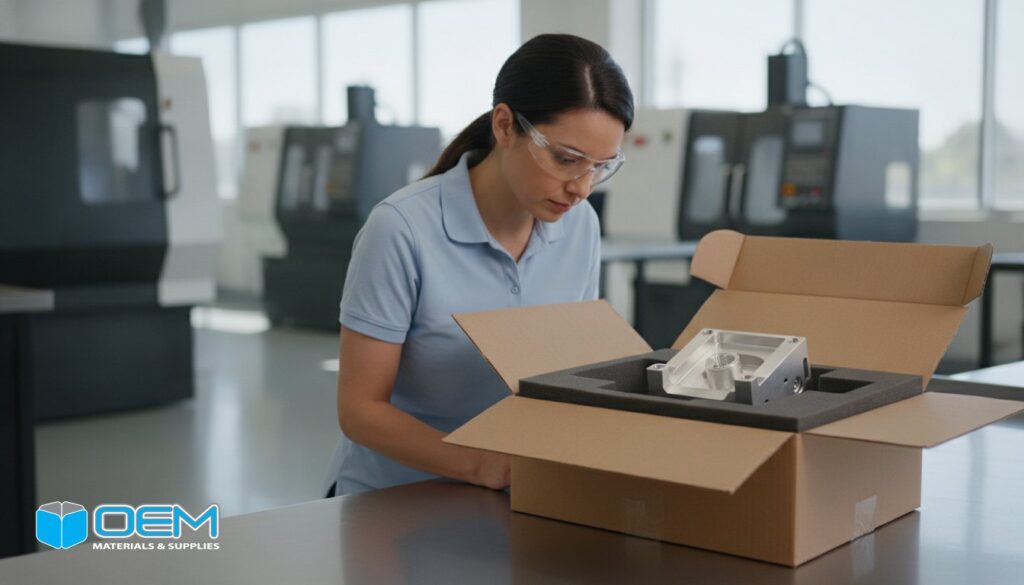
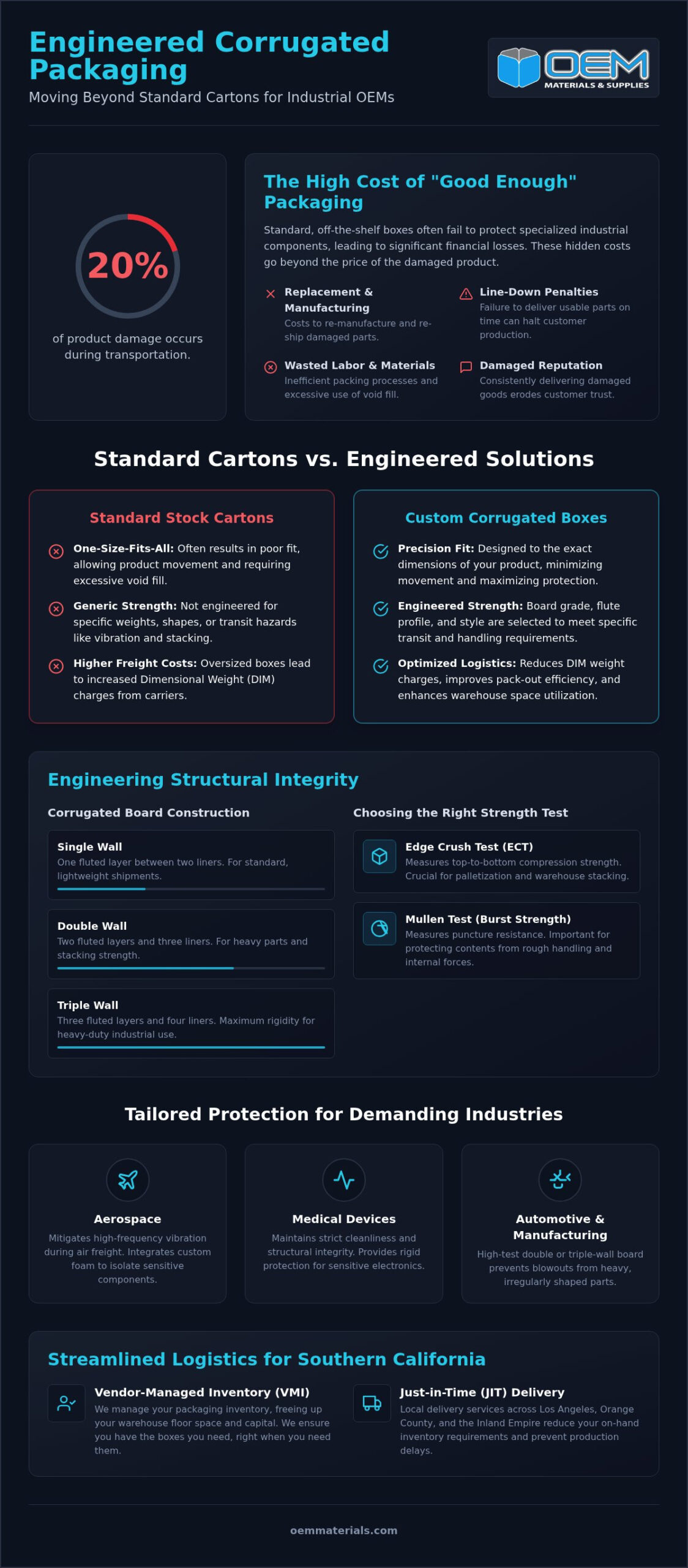
Industry data indicates that approximately 20% of all product damage occurs during transportation, a figure that represents a significant drain on the bottom line for Southern California manufacturers. Many operations managers accept these losses as an unavoidable cost of doing business in a high-volume supply chain. However, relying on standard packaging for specialized industrial components often leads to excessive material waste and unnecessary labor costs during the packing process.
Investing in engineered custom corrugated boxes allows your business to move beyond generic solutions and address the specific vulnerabilities of your product. You’ll learn how to select the correct board grades and structural designs to meet ASTM D642 and ISTA standards, ensuring your shipments survive the rigors of transit. This article explores how Los Angeles businesses can reduce their total cost of ownership by optimizing box dimensions, integrating custom foam inserts, and utilizing local vendor-managed inventory to solve warehouse space constraints. We’ll examine the technical balance between material durability and operational efficiency to streamline your entire packaging workflow.
Key Takeaways
- Learn why standard cartons often fail in industrial supply chains and how custom engineering protects fragile or heavy components.
- Understand the technical differences between board grades and flute profiles to ensure your custom corrugated boxes meet rigorous shipping standards.
- Evaluate how box style selection directly influences your total cost of ownership by balancing material costs with packing labor efficiency.
- See how localized VMI and Just-in-Time programs in Southern California streamline inventory management and optimize warehouse floor space.
- Identify the role of rapid prototyping in validating structural designs and material performance before committing to high-volume production.
Beyond the Standard Carton: Why Industrial OEMs Require Custom Corrugated Solutions
Standard shipping containers are built for average loads, not specialized industrial equipment. When an OEM ships a high-value assembly, a generic box often lacks the structural integrity to withstand vertical compression or lateral impacts. Corrugated fiberboard is a highly engineered material, but its performance depends entirely on how it is specified for the load. Utilizing custom corrugated boxes allows engineers to match the board strength to the product’s center of gravity and fragility rating. This precision is vital for manufacturers in Los Angeles County and Orange County who must navigate complex regional and global logistics networks.
Addressing Industry-Specific Packaging Challenges
Industrial sectors face unique logistical hurdles that a stock catalog cannot solve. A one-size-fits-all approach often results in product movement during transit, which is the leading cause of finish abrasions and mechanical failure. Different industries require tailored protection strategies:
- Aerospace: Precision components require packaging that mitigates high-frequency vibration during air freight. Custom solutions often integrate foam packaging to isolate parts from the outer container.
- Medical: Device manufacturers must maintain strict cleanliness and structural integrity. Packaging must be designed for easy access while providing rigid protection for sensitive electronics.
- Automotive: Heavy, irregularly shaped parts like engine blocks or transmissions require high-test double or triple-wall corrugated board to prevent bottom-blowouts during forklift handling.
The Financial Impact of Improperly Specified Packaging
The true cost of a box isn’t the unit price; it’s the total cost of the shipment. If a $5,000 part is damaged because of a $2 box, the financial loss includes replacement manufacturing, expedited shipping to the customer, and potential line-down penalties. Proper custom packaging design addresses these risks before the first shipment leaves the dock.
Beyond damage prevention, engineered custom corrugated boxes help manufacturers reduce dimensional weight (DIM) charges. Carriers charge based on the space a package occupies, not just its weight. By eliminating excess air space and optimizing the outer dimensions, businesses can see a direct reduction in freight expenses. A precise box fit maximizes cushioning efficiency by preventing the product from gaining momentum inside the container during a drop. This structural synergy ensures that cushioning materials perform as intended, providing predictable protection for every unit shipped.
Engineering Structural Integrity: Material Grades and Flute Profiles
Corrugated board is a structural composite designed to protect its contents through a combination of flat liners and a fluted medium. This sandwich construction creates an incredibly high strength-to-weight ratio, allowing for rigid protection without excessive mass. For industrial applications, the choice between single wall, double wall, and triple wall board dictates the maximum load capacity and stacking endurance. While single-wall corrugated boxes satisfy the requirements for many standard shipments, heavy industrial components often necessitate the added rigidity of double-wall or triple-wall construction. These multi-layered structures provide the necessary resistance to vertical compression and lateral puncture encountered in high-volume distribution centers.
ECT vs. Mullen: Which Strength Test Matters for Your Product?
Selecting the right grade requires understanding how your package will be handled throughout the supply chain. The Edge Crush Test (ECT) measures the board’s ability to resist top-to-bottom compression, which is the primary metric for warehouse palletization where boxes are stacked high. In contrast, the Mullen Test measures the burst strength of the board’s liners. This test is more relevant for protecting heavy, dense contents that might punch through the side of a box during rough handling or shifting in transit. When designing custom corrugated boxes, adhering to official standards for fiberboard boxes ensures your packaging meets the minimum safety requirements for domestic and international transport. Specifying high-performance liners can also help maintain structural integrity in humid or non-climate-controlled environments common in coastal Southern California.
Optimizing Flute Selection for Protection and Space
The flute profile refers to the height and frequency of the waves in the corrugated medium. C-flute remains the industrial standard, offering a balance of cushioning and stacking strength for a wide range of products. B-flute is thinner but provides superior crush resistance and a smoother surface for high-quality printing or labeling. For heavy-duty industrial needs, combining different flutes in a double-wall box provides maximum vertical stacking strength. For instance, a B/C double-wall combination leverages the density of B-flute and the height of C-flute to create a rigid barrier against impact. Engineers use ASTM D642 protocols to evaluate how these different flute combinations perform under compressive loads, ensuring the box doesn’t fail when stacked on a pallet in a high-density warehouse.
Designing custom corrugated boxes involves balancing these material variables against the specific hazards of your supply chain. If you are unsure which board grade fits your product weight and transit route, you can speak with an application specialist to review your requirements and ensure optimal protection.
Selecting the Optimal Box Style for Your Production Line
Selecting the right box style is a strategic decision that impacts both the structural integrity of the shipment and the throughput of the warehouse floor. While dimensions are a primary concern, the way a box folds and closes determines its stacking strength and the labor required for assembly. When specifying custom corrugated boxes for a new product line, engineers must evaluate how the folding pattern affects the box’s ability to resist bulging or collapsing under pressure. For many Los Angeles manufacturers, choosing the correct style is a direct lever for reducing labor costs and improving supply chain reliability.
RSC vs. FOL: Comparing Strength and Material Usage
Regular Slotted Containers (RSC) are the standard for cost-effective shipping. In this design, all flaps have the same length, and the outer flaps meet at the center. This configuration is highly efficient because it minimizes material waste during manufacturing. However, for heavy industrial loads, the Full Overlap Container (FOL) is often a more durable choice. In an FOL box, the outer flaps overlap the full width of the container, creating a double layer of corrugated board on both the top and bottom. This extra thickness provides significant resistance to rough handling and prevents the bottom from sagging under heavy weight. Choosing between these styles requires a balance of material expense and protection needs; you can find more detail on this trade-off in our guide to packaging cost savings.
Specialized Designs for Complex Industrial Kits
Standard boxes don’t always accommodate the unique profiles of specialized industrial parts. One Panel Folders (OPF) are ideal for flat products like circuit boards, metal sheets, or aerospace panels. They wrap around the product, providing a snug fit that prevents lateral movement. For items with variable lengths, such as industrial piping or metal extrusions, telescoping boxes allow for adjustable sizing without the need for multiple SKUs. This flexibility helps operations managers in the Inland Empire and Orange County reduce inventory complexity while maintaining high protection standards.
Precision is critical for high-value components. Die-cut custom corrugated boxes allow for intricate shapes and integrated locking features that can reduce packing time by eliminating the need for excessive tape. These designs are highly effective when integrating custom foam packaging. By engineering the box and the insert together, you ensure that the cushioning stays in place during high-vibration transit. This integrated approach is common in the medical device and electronics sectors, where product failure is not an option and shipping reliability is the top priority.
Optimizing Logistics with Just-in-Time Delivery and VMI
Packaging is a critical component of lean manufacturing, yet it is often overlooked until a stockout occurs. For industrial operations in Southern California, managing the storage and flow of custom corrugated boxes is a significant logistical challenge. Large-scale manufacturing requires a steady supply of protective materials, but dedicating thousands of square feet to empty boxes is an inefficient use of high-cost warehouse space. Transitioning to a service-based partnership allows operations managers to treat packaging as a synchronized part of the production line rather than a static inventory item.
The Benefits of Vendor Managed Inventory (VMI)
A VMI program shifts the responsibility of inventory monitoring and replenishment from your purchasing department to your packaging partner. This proactive approach eliminates the risk of human error in ordering and prevents the high costs associated with emergency rush shipments. By maintaining a buffer of custom corrugated boxes at a local facility, your supplier ensures that your production floor never stops due to a lack of shipping materials. This model improves cash flow because you only pay for the materials as they are released to your facility, effectively reducing the capital tied up in sitting stock. It also provides a strategic buffer against the ongoing price volatility seen in the raw materials market, such as the 2.63% increase in the U.S. Producer Price Index for Woodpulp reported in July 2026.
Streamlining Operations with Just-in-Time (JIT) Packaging
In the competitive manufacturing hubs of Los Angeles County and Orange County, floor space is a premium asset. JIT delivery protocols allow you to reclaim that space for high-value production equipment or finished goods. Instead of receiving monthly bulk shipments, JIT coordinates daily or weekly deliveries that match your specific production schedules. This precision reduces the risk of material damage that often occurs when boxes are stored long-term in high-traffic warehouse areas. It also prevents material obsolescence; if a product design changes, you aren’t stuck with thousands of outdated boxes. Local support in San Diego and the Inland Empire ensures that response times are measured in hours rather than days, providing the agility needed to handle sudden spikes in demand.
Optimizing your supply chain requires more than just a box supplier; it requires a partner that understands the nuances of industrial logistics. To see how a managed inventory program can stabilize your operations, request an inventory management consultation with our team.
Designing Your Custom Corrugated Program with OEM Materials
Developing a robust packaging program is an engineering process that goes beyond selecting a standard SKU from a catalog. A successful implementation begins with a detailed needs assessment to identify the specific stresses your product will face during distribution. For industrial manufacturers, this means analyzing the product’s fragility, weight distribution, and the typical handling procedures of your logistics partners. By treating custom corrugated boxes as a precision component of your production line, you can eliminate the technical guesswork that often leads to shipping damage and operational bottlenecks.
The Prototyping and Design Process
The transition from a concept to a production-ready container requires rigorous validation. Our custom packaging design services utilize CAD software to create precise structural layouts tailored to your product’s unique dimensions. Once the digital design is finalized, we produce physical prototypes for real-world testing. These samples allow your team to verify the fit and function of the box before committing to high-volume manufacturing. Physical testing often includes drop tests and compression analysis to ensure the material meets the necessary ASTM or ISTA standards for your specific industry, whether you’re shipping aerospace components or sensitive medical electronics.
Southern California Logistics Advantage
A packaging program is only as reliable as the supplier’s ability to deliver. Having local support in Orange County and Riverside County provides a level of accountability that out-of-state vendors cannot match. Our proximity to major manufacturing hubs in Los Angeles and San Diego allows for rapid response times and lower freight costs, which directly impacts your total cost of ownership. We don’t just ship boxes; we provide a complete unit load solution by integrating your custom corrugated boxes with high-quality pallets and industrial-grade stretch film.
This holistic approach ensures that your entire palletized shipment remains stable and secure from the moment it leaves the dock until it reaches the end user. For companies managing complex kitting and assembly projects, we offer on-site consultations to optimize the packing workflow and reduce labor requirements. This hands-on partnership helps Los Angeles businesses maintain lean operations while ensuring their high-value products arrive at their destination in perfect condition.
Optimizing Your Industrial Packaging Strategy
Shifting from standard cartons to engineered custom corrugated boxes is a strategic move that reduces product damage and lowers the total cost of ownership. By matching board grades to specific load requirements and leveraging localized inventory programs, manufacturers can reclaim warehouse space while ensuring maximum protection for high-value components. Whether you are shipping sensitive medical devices or heavy aerospace assemblies, the right packaging partner provides more than just materials; they provide operational stability through technical precision.
OEM Materials & Supplies offers specialized engineering expertise and local Southern California support across Los Angeles, Orange County, and San Diego. Our integrated VMI and JIT services are designed to prevent stockouts and streamline your distribution workflow, allowing your team to focus on production rather than packaging logistics. To begin your design assessment and prototyping phase, contact OEM Materials for a custom corrugated quote. We’ll work directly with your engineers to develop a scalable solution that meets your exact technical specifications and supply chain demands. We look forward to helping you build a more efficient operation.
Frequently Asked Questions
What is the difference between single-wall and double-wall corrugated boxes?
Single-wall construction consists of one fluted medium glued between two flat linerboards, providing a balance of lightweight protection and cost-effectiveness for standard shipments. Double-wall board adds a second layer of fluted medium and a third linerboard, significantly increasing stacking strength and puncture resistance. Industrial manufacturers often specify double-wall custom corrugated boxes for heavy components or fragile equipment that requires extra structural support during long-haul transit or high-density warehouse palletization.
How do I determine the correct ECT rating for my shipping boxes?
The Edge Crush Test (ECT) rating is determined by the total weight of your product and the maximum stacking height in your warehouse or shipping container. Higher ECT values indicate greater top-to-bottom compression strength, which is vital for preventing box failure at the bottom of a pallet. While 32 ECT is standard for lighter goods, dense industrial parts often require 44 or 48 ECT ratings to ensure the container maintains its integrity under load.
Can custom corrugated boxes be designed for heavy industrial machinery?
Yes, we engineer specialized solutions for heavy machinery using triple-wall board or reinforced double-wall structures. These designs often integrate with wood crates or plastic pallets to manage extreme weight loads. By combining high-test corrugated board with internal edge protectors and custom bracing, we ensure that heavy equipment remains stable and protected against lateral impacts. This engineered approach provides a reliable alternative to traditional heavy-duty packaging while reducing overall shipping weight.
What information do I need to provide for a custom box quote?
To receive an accurate recommendation, you should provide the internal dimensions (length, width, and height), the weight of the product, and its fragility level. Information regarding your shipping environment, annual usage volume, and whether you require kitting or VMI services is also essential. Providing a physical sample or CAD file of your product allows our engineering team to perform precise prototyping and structural validation, ensuring the final design meets your exact requirements.
How does Just-in-Time (JIT) delivery work for packaging materials?
Just-in-Time delivery involves coordinating the arrival of your packaging materials with your actual production schedule. Instead of storing months of inventory on-site, you receive smaller, frequent shipments based on your real-time needs. This process frees up valuable warehouse floor space in your Los Angeles or Orange County facility and reduces the risk of material damage during long-term storage. It ensures you always have the necessary supplies for outgoing orders without tying up capital.
What are the most common corrugated box styles for manufacturing?
The Regular Slotted Container (RSC) is the standard for most industrial applications due to its material efficiency and cost-effectiveness. For heavier loads, the Full Overlap Container (FOL) is preferred because the overlapping flaps provide superior stacking strength and bottom support. Other common styles include One Panel Folders (OPF) for flat items and die-cut boxes for complex geometries that require integrated locking features or specialized internal inserts to secure the product.
Do you offer custom corrugated inserts for electronic components?
We design custom corrugated boxes with specialized inserts to isolate sensitive electronic components from vibration and impact. These inserts can be combined with ESD-safe materials or custom foam packaging for enhanced protection. By engineering the insert to fit the exact geometry of the component, we eliminate internal movement and reduce the need for excessive void fill. This precision fit streamlines your assembly process and ensures that sensitive electronics arrive at their destination without mechanical failure.
Is there a minimum order quantity for custom industrial boxes?
Minimum order quantities depend on the manufacturing process, material requirements, and the complexity of the box design. While high-volume production offers the best unit price efficiency, we also support mid-range volumes for specialized industrial projects in Southern California. We recommend discussing your annual usage and production cycles with our team so we can tailor a program that balances your budget with your operational needs. Every project is evaluated based on its specific engineering and logistical requirements.