
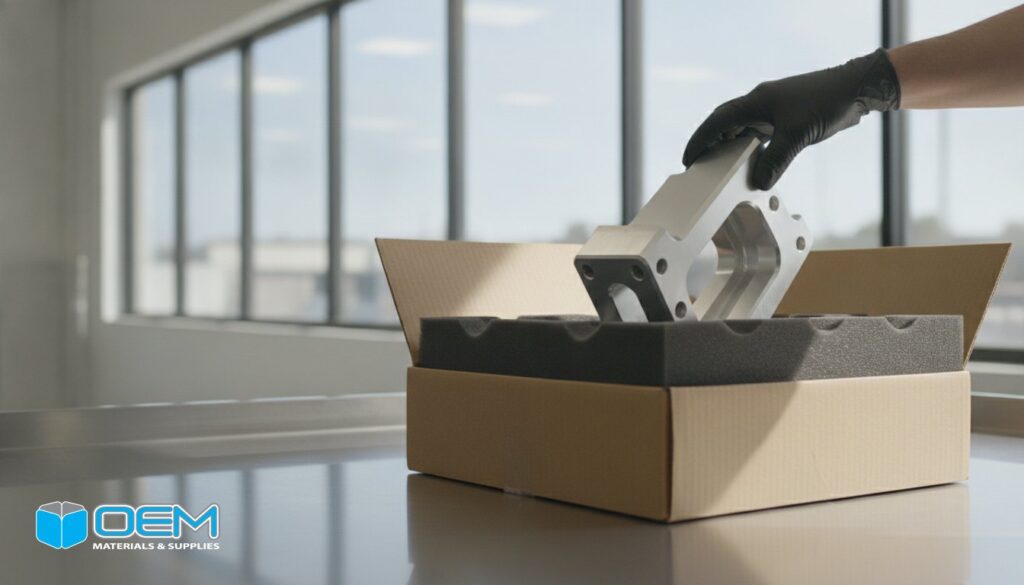
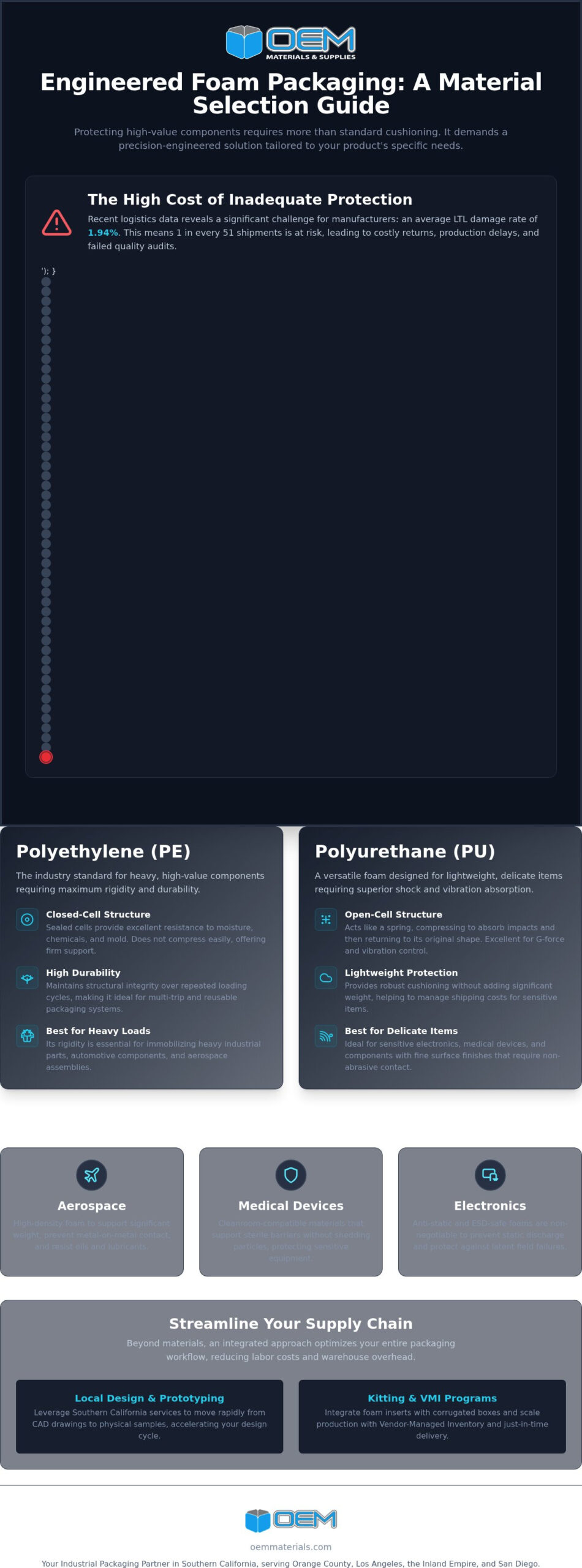
Recent 2026 logistics data indicates that the average less-than-truckload damage rate is approximately 1.94 percent, meaning one in every 51 shipments suffers some form of impact during transit. For Southern California manufacturers in the aerospace and medical sectors, these statistics translate into failed quality audits and stalled production lines. You recognize that standard cushioning is often insufficient for high-value components, making precision-engineered custom foam packaging a necessity for maintaining operational integrity. Relying on inadequate protection leads to excessive product damage and high labor costs during the packing process.
Transitioning to engineered foam solutions provides the protection required to achieve zero damage during shipping while optimizing your internal workflows. This guide explores how localized design and manufacturing in Los Angeles and Orange County help manufacturers meet strict industry standards and improve supply chain efficiency. We will examine the technical benefits of specific foam densities, the cost-saving advantages of integrated kitting, and how a local partner facilitates just-in-time delivery for critical operations throughout Southern California.
Key Takeaways
- Learn how custom foam packaging functions as a precision-engineered internal protection system designed to safeguard high-value aerospace and medical components.
- Understand the technical differences between polyethylene and polyurethane foam to select the optimal material for multi-trip shipping and long-term durability.
- Discover how to manage G-force limits and vibration control through specific foam density calibrations tailored to your product fragility.
- Streamline your design cycle by leveraging local Southern California prototyping services that move quickly from CAD drawings to physical samples.
- Reduce assembly labor and warehouse overhead by integrating foam inserts with corrugated boxes through kitting and Vendor-Managed Inventory programs.
The Role of Custom Foam Packaging in Industrial Protection
Industrial components are the lifeblood of Southern California’s manufacturing sector, yet they are often the most vulnerable assets in the supply chain. True custom foam packaging functions as a precision-engineered internal protection system rather than a simple shipping accessory. While generic solutions like bubble wrap or loose-fill peanuts occupy volume, they rarely provide the deceleration control required for high-value machinery or sensitive instruments. Professional engineering treats foam as a functional extension of the product itself, ensuring that every contour is supported and every potential impact point is shielded.
Using inadequate package cushioning materials often results in more than just physical damage. It signals a lack of operational discipline to your customers. When a manufacturer in Los Angeles or Orange County delivers a high-tolerance part in a professionally designed insert, it reinforces a brand image of stability and technical competence. Reliability in transit is a direct reflection of your reliability in manufacturing. High-performance foam prevents the costly cycles of returns, repairs, and lost production time that erode profitability.
Beyond Void Fill: Engineered Internal Protection
The primary objective of a custom insert is total immobilization. If a component can shift within its corrugated box, it’s already at risk. Engineered foam is die-cut or CNC-routed to the exact dimensions of the part, eliminating the internal movement that leads to structural failure or surface abrasion. For multi-component kits, a precision fit ensures that heavy parts don’t collide with delicate sensors or glass elements during the vibration cycles typical of long-haul freight. This level of protection is impossible to achieve with manual wrapping or generic void fill.
Industry-Specific Packaging Requirements
Standardized packaging fails to meet the rigorous demands of specialized Southern California industries. Each sector requires a specific material profile to ensure compliance and functionality:
- Aerospace: High-tolerance machined parts require high-density foam that maintains its shape under significant weight. These inserts must prevent metal-on-metal contact while resisting the oils and lubricants often present on aerospace components.
- Medical Devices: Protection for surgical tools and diagnostic equipment often requires cleanroom-compatible foam. These materials must support sterile barrier systems without shedding particles.
- Electronics: Sensitive circuit boards and semiconductors are susceptible to static damage. Utilizing anti-static or ESD-safe custom foam packaging is a non-negotiable requirement to prevent latent defects that could lead to field failures.
Polyethylene vs. Polyurethane: Selecting the Right Industrial Foam
Selecting the correct material for custom foam packaging requires an understanding of cell morphology and load-bearing requirements. It isn’t just a matter of choosing the softest material; it’s about providing the necessary deceleration for a specific weight. While Expanded Polystyrene (EPS) is often utilized for bulk shipping and one-way transit due to its low cost and high rigidity, industrial applications in Southern California usually require more resilient polymers like Polyethylene or Polyurethane that can withstand multiple trips without structural failure.
Polyethylene for Heavy Loads and Durability
Polyethylene (PE) is a closed-cell foam known for its rigidity and resistance to moisture. Because the cells are sealed, the material doesn’t compress easily and provides high resistance to chemicals and mold. These characteristics make PE the industry standard for heavy industrial components, automotive parts, and aerospace assemblies. It’s also highly durable, making it the preferred choice for multi-trip shipping containers where the foam must withstand repeated loading cycles without losing its cushioning properties. You can review detailed foam packaging specifications to see which density fits your specific load requirements.
Polyurethane for Delicate and Lightweight Components
Polyurethane (PU) features an open-cell structure, allowing air to flow through the material. This creates a much softer, more flexible cushion that is ideal for lightweight electronics or fragile glass instruments. PU foam is excellent at absorbing low-energy impacts that might shatter a component if it were placed in a more rigid material. Convoluted or egg-crate PU foam is a versatile option for securing items of varying heights within a single container, a common requirement for medical device kitting in Orange County and San Diego.
Specialized Foams: ESD and Cross-Linked Polyethylene
When shipping circuit boards or semiconductors, standard foam can generate static electricity that destroys sensitive components. In these cases, specifying anti-static (ESD) foam is essential. This material is typically dyed pink for easy identification and contains additives that dissipate static charges during transit. For aerospace or medical applications where particle shedding is a concern, Cross-Linked Polyethylene (XLPE) offers a superior solution. XLPE has a much finer cell structure, providing a smooth surface that won’t release debris into a cleanroom environment. For deep technical specs, our Industrial Guide to Foam Inserts can help you navigate engineering data for your specific application.
Identifying the right material early in the design phase prevents costly transit failures and material waste. If you’re unsure which density is right for your project, consult with an industrial packaging expert to discuss your specific product dimensions, weight, and shipping environment.
Engineering for Impact: G-Force and Vibration Control
Effective custom foam packaging is more than just a physical barrier; it’s a deceleration system designed to manage kinetic energy. When a container is dropped or jarred, the foam must compress at a controlled rate to prevent the internal component from experiencing forces that exceed its mechanical limits. Engineers refer to this limit as the G-factor, or the maximum acceleration a product can withstand without failure. For sensitive medical diagnostics or aerospace sensors, this factor is often quite low, requiring precise material selection to ensure the product never reaches its breaking point.
A common mistake in industrial packaging is assuming that more foam always equals more protection. In reality, over-packaging leads to unnecessary material costs and inflated shipping fees due to increased dimensional weight. Precise engineering matches the foam’s load-bearing capacity to the product’s weight and fragility. If the foam is too dense, it won’t compress enough to absorb the shock; if it’s too soft, the product will bottom out against the outer container. Balancing these variables ensures maximum ROI for Southern California manufacturers shipping high-value goods.
Calculating Fragility and Drop Height
Determining the appropriate foam thickness starts with identifying the expected drop height, which varies based on the shipping environment. Standardized testing protocols, such as those established by ASTM, provide a framework for simulating these real-world stressors. By calculating the G-factor, designers can determine the exact density and thickness required to protect a specific instrument. Density selection must balance protection with material volume, as the goal is to provide the required safety margin while minimizing the footprint of the custom foam packaging.
Vibration and Abrasion Prevention
Transit involves more than just sudden drops. Long-haul trucking and air freight subject packages to continuous vibration frequencies that can loosen fasteners or cause internal fatigue. Foam inserts act as dampeners, absorbing these high-frequency movements before they reach the product. Additionally, vibration can cause “transit rub” or surface abrasion on polished metal or plastic finishes. To mitigate this risk, designers often use non-abrasive foam liners or integrate edge and corner protectors to stabilize the load within the box. This multi-layered approach ensures that components arrive not only functional but also aesthetically pristine, which is critical for medical and automotive clients in Orange County and Los Angeles.
The Custom Design and Prototyping Process in Southern California
Transitioning from a technical requirement to a functional solution requires a structured design process. For custom foam packaging, this journey begins with precise digital modeling. By utilizing CAD files of the actual component, engineers can design internal cavities that match every contour, ensuring the product remains immobilized during transit. This digital-first approach allows for rapid adjustments before any material is cut, reducing the risk of design errors and material waste.
Manufacturing techniques are selected based on production volume and design complexity. Die-cutting is typically the most efficient method for high-volume orders, utilizing custom steel-rule dies to stamp out shapes with high repeatability. For low-volume production or highly intricate geometries, CNC waterjet cutting offers a precise alternative that requires no tooling. This flexibility allows Southern California manufacturers to scale from initial prototypes to full-scale production without significant delays or upfront costs.
From CAD Design to Physical Prototype
Beyond industrial shipping, these digital manufacturing techniques are also used to create specialized organizers for field gear; to see how 3D printing provides a durable alternative for equipment storage, check out I LUV 3D PRINT.
The speed of your product launch often depends on the turnaround time of your packaging partner. Rapid prototyping allows engineers to move from a digital concept to a physical sample in a matter of days. This physical prototype is essential for verifying the fit and function of the insert. We recommend testing these prototypes with actual product samples to ensure that weight distribution is correct and that the foam provides the expected level of protection. You can learn more about our specific custom packaging design capabilities to see how we streamline this process.
Local Supply Chain Advantages for SoCal Manufacturers
Sourcing from a regional partner in Los Angeles or Orange County provides logistical advantages that distant suppliers cannot match. Local site visits in San Diego and Riverside allow our team to evaluate complex components in person, ensuring that the final packaging design accounts for all operational variables. This proximity significantly reduces lead times for design iterations, as prototypes don’t need to be shipped across the country for approval.
Working with a local supplier also helps mitigate the high costs of transporting lightweight but bulky foam materials. By maintaining a regional supply chain, manufacturers in the Inland Empire and surrounding counties can implement just-in-time delivery strategies, reducing the need for extensive on-site warehouse space. If you are ready to begin your next project, request a prototype and quote based on your specific component dimensions and annual usage requirements.
Scaling Production with Kitting and Vendor-Managed Inventory
Scaling a manufacturing operation requires more than just high-quality components; it requires a logistical framework that minimizes friction. Procuring custom foam packaging as a standalone item often creates hidden inefficiencies in the assembly line. By adopting a Total Cost of Ownership (TCO) approach, operations managers can look beyond the per-unit price and evaluate how packaging impacts labor, warehouse utilization, and freight costs. Integrated logistical services transform packaging from a commodity into a strategic asset that supports high-volume production.
Integrated Kitting and Assembly Services
Production line bottlenecks often occur when workers must source and assemble multiple packaging components from different storage locations. Sourcing foam inserts pre-kitted with corrugated boxes eliminates these unnecessary touches. When a packaging kit arrives at the station ready for immediate use, assembly labor is significantly reduced. Consolidating your supply chain by sourcing these materials together also simplifies procurement, reducing the administrative burden of managing multiple vendor relationships and separate delivery schedules. This integration ensures that every component is present and correct before it reaches the packer, virtually eliminating errors in the kitting process.
VMI and JIT for Large-Scale Manufacturing
Warehouse space in Southern California markets like Los Angeles and Orange County is among the most expensive in the nation. Storing bulky foam inventory on-site consumes valuable square footage that could be dedicated to production or revenue-generating activities. Utilizing VMI packaging programs allows manufacturers to shift the burden of inventory management to their supplier. Under a VMI model, the supplier monitors stock levels and replenishes materials automatically, ensuring you never face a stockout that halts production. This level of oversight is essential for maintaining the zero-damage goals discussed earlier in this guide.
Just-in-Time (JIT) delivery further optimizes this process by providing frequent, smaller shipments of packaging materials exactly when they are needed. This approach improves cash flow because you only pay for the materials as they are consumed, rather than tying up capital in months of sitting inventory. For manufacturers in San Diego and Riverside, local JIT services provide the agility needed to respond to sudden shifts in demand without maintaining a massive on-site safety stock. Effective scaling requires a partner that understands the intricacies of high-volume manufacturing environments. If you are looking to optimize your packaging spend and reduce operational overhead, contact us for a consultation regarding your high-volume packaging and logistical requirements.
Optimizing Your Industrial Supply Chain
Implementing a robust protection strategy requires a shift from viewing packaging as a commodity to treating it as a technical component. Precision-engineered custom foam packaging ensures that sensitive aerospace, medical, and electronic devices remain functional after the stresses of transit. By selecting the correct material density and utilizing local prototyping, manufacturers in Los Angeles and Orange County can eliminate product damage while maintaining lean inventory levels.
Efficiency gains extend beyond the box through integrated services like kitting and Vendor-Managed Inventory. These solutions address the high labor costs and warehouse constraints common in the Southern California market. Partnering with a regional expert allows you to focus on production while we manage the complexities of protective design and just-in-time delivery. This integrated approach stabilizes your logistics and reduces transit-related losses across your entire operation.
When you’re ready to improve your packaging performance, our engineering team is prepared to assist. Contact OEM Materials & Supplies for a custom foam quote to begin the design process. Please provide your product dimensions, weight, and annual usage for an accurate technical recommendation. We look forward to supporting your next manufacturing project.
Frequently Asked Questions
What is the best foam for shipping sensitive electronics?
Polyurethane (PU) is the preferred choice for lightweight, sensitive electronics because its open-cell structure provides soft cushioning and superior vibration dampening. For heavier electronic assemblies, polyethylene (PE) is often specified for its higher load-bearing capacity. It’s essential to include anti-static additives to protect against electrostatic discharge. Our engineers evaluate your component’s weight and fragility to determine which material provides the best protection for your specific shipping environment.
How do I determine the correct foam density for my product?
Determining the correct foam density requires an engineering-led approach that balances product weight with fragility, often measured as a G-factor. If the density is too high, the foam acts like a solid and transfers shock directly to the part. If it’s too low, the product will bottom out during a drop. We use material performance curves to select the exact density needed to decelerate your product safely within the available cushion space.
Can custom foam inserts be reused for multiple shipments?
Reusability depends on the material selected, but polyethylene (PE) is specifically designed for multi-trip shipping. Unlike brittle materials that deform after one impact, PE maintains its shape and protective qualities over many cycles. This durability is highly beneficial for Southern California manufacturers who operate closed-loop supply chains between facilities in Los Angeles and the Inland Empire. Choosing a durable material reduces the long-term total cost of ownership for your packaging.
Is anti-static foam necessary for all electronic packaging?
Anti-static foam is a requirement for components with integrated circuits or semiconductors that are vulnerable to electrostatic discharge. Even if a part seems robust, latent static damage can cause premature failure in the field, leading to costly returns and damaged brand reputation. Integrating ESD-safe custom foam packaging into your logistics process is a standard industry best practice that ensures your electronics arrive in peak condition without the risk of invisible electrical damage.
What information is needed to get a quote for custom foam?
Accurate quoting requires specific data points including the product’s weight, exact dimensions, and fragility. Providing a CAD drawing or a physical sample is the most effective way to ensure a precision fit. We also need to know your estimated annual usage and whether the foam will be paired with corrugated boxes or wood crates. This information allows us to calculate material yields and recommend the most cost-effective manufacturing process for your project.
How long does the prototyping process take for custom inserts?
Prototyping for custom foam packaging generally takes between three to five business days following the completion of the CAD design. Because we utilize CNC waterjet cutting for prototypes, we can produce physical samples without the delay and expense of creating custom dies. This rapid turnaround is essential for manufacturers in San Diego and Orange County who must meet tight product launch deadlines while ensuring their packaging meets all technical protection requirements.
Does custom foam packaging help with environmental compliance?
Custom foam supports environmental compliance by reducing the total volume of material required to protect a product. Precision engineering eliminates the waste associated with over-packaging or using generic void fill. As California implements stricter regulations like SB 54, optimizing your packaging design becomes essential for meeting source reduction mandates. We focus on creating efficient designs that provide maximum protection with the minimum amount of material, helping your operation stay compliant and sustainable. For those interested in global trends in sustainable materials, Duboxx Packaging LLC offers valuable resources on eco-friendly packaging alternatives.
Foam inserts are designed to integrate seamlessly into outer containers such as corrugated boxes, wood crates, or plastic pallets. This system-based approach ensures that the outer shell provides structural integrity and puncture resistance while the internal foam manages shock and vibration. For aerospace and medical equipment shipped throughout Southern California, we often provide complete kitting services where the foam is pre-installed in the box to streamline your assembly line and reduce labor.