
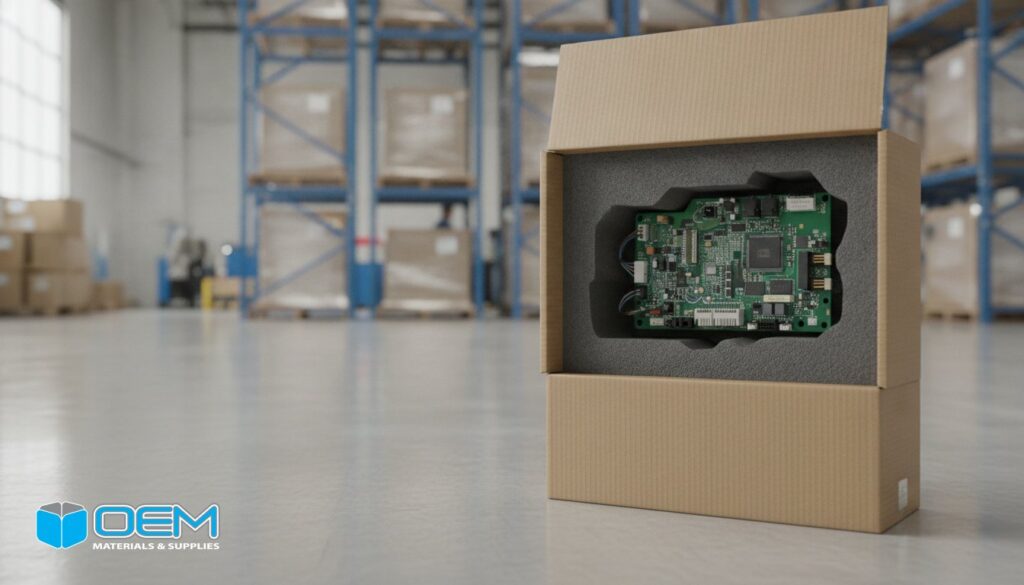
What if the packaging designed to protect your sensitive electronics is actually the primary cause of their failure? For many manufacturers in Los Angeles and Orange County, the most dangerous threat isn’t a dropped box, but the invisible static charge generated by improper materials. Latent component damage can bypass initial quality checks only to fail in the field, leading to costly returns and damaged brand reputations. High-performance ESD foam packaging must do more than just cushion; it must provide a controlled path to ground or prevent charge generation entirely.
We understand that balancing technical protection with material costs and supply chain efficiency is a constant challenge for procurement and engineering teams. You need a solution that guarantees zero-defect shipping without over-engineering the budget. This article provides the technical clarity required to select the correct foam density and electrical properties for your specific application. You’ll learn how to distinguish between dissipative and conductive grades, comply with ANSI/ESD S541-2026 standards, and leverage local Southern California logistics for just-in-time delivery.
Key Takeaways
- Identify how latent electrostatic discharge causes field failures and why technical material selection is critical for aerospace and medical electronics.
- Differentiate between anti-static, dissipative, and conductive grades to ensure your ESD foam packaging meets the latest ANSI/ESD S541-2026 standards.
- Learn to match foam density to product weight by choosing between open-cell polyurethane for delicate items and closed-cell polyethylene for heavy industrial components.
- Reduce assembly labor and eliminate physical shipping shock by utilizing custom-engineered foam inserts designed for complex electronic assemblies.
- Optimize your supply chain by partnering with a local Southern California supplier to implement just-in-time delivery and vendor-managed inventory.
Understanding the Risks of Electrostatic Discharge in Industrial Logistics
Static electricity is a constant threat in the industrial supply chain. While many focus on physical impact, Electrostatic discharge (ESD) causes billions of dollars in losses annually across the global electronics industry. In semiconductor and aerospace manufacturing, the stakes are exceptionally high. A single discharge can render a multi-million dollar satellite component or a medical imaging sensor completely useless. Precision in material selection is the only way to prevent these invisible losses.
The problem begins with triboelectric charging. This occurs when two materials come into contact and then separate, creating a transfer of electrons. During standard shipping and handling, vibration and movement cause components to rub against their packaging. If you use standard cushioning materials like traditional bubble wrap or non-treated polyethylene, you’re essentially creating a static generator inside the box. These materials are insulators that hold a charge for long periods, waiting to discharge into the nearest sensitive circuit.
High-quality ESD foam packaging acts as a critical safeguard. It doesn’t just absorb physical shock; it provides a controlled environment that either prevents charge generation or safely dissipates it. This is essential for maintaining a static-safe workstation during the kitting process or protecting parts throughout the grueling logistics cycle in Southern California’s heat and low humidity. Without these specialized materials, your products are at risk every time they move.
The Difference Between Catastrophic and Latent ESD Failure
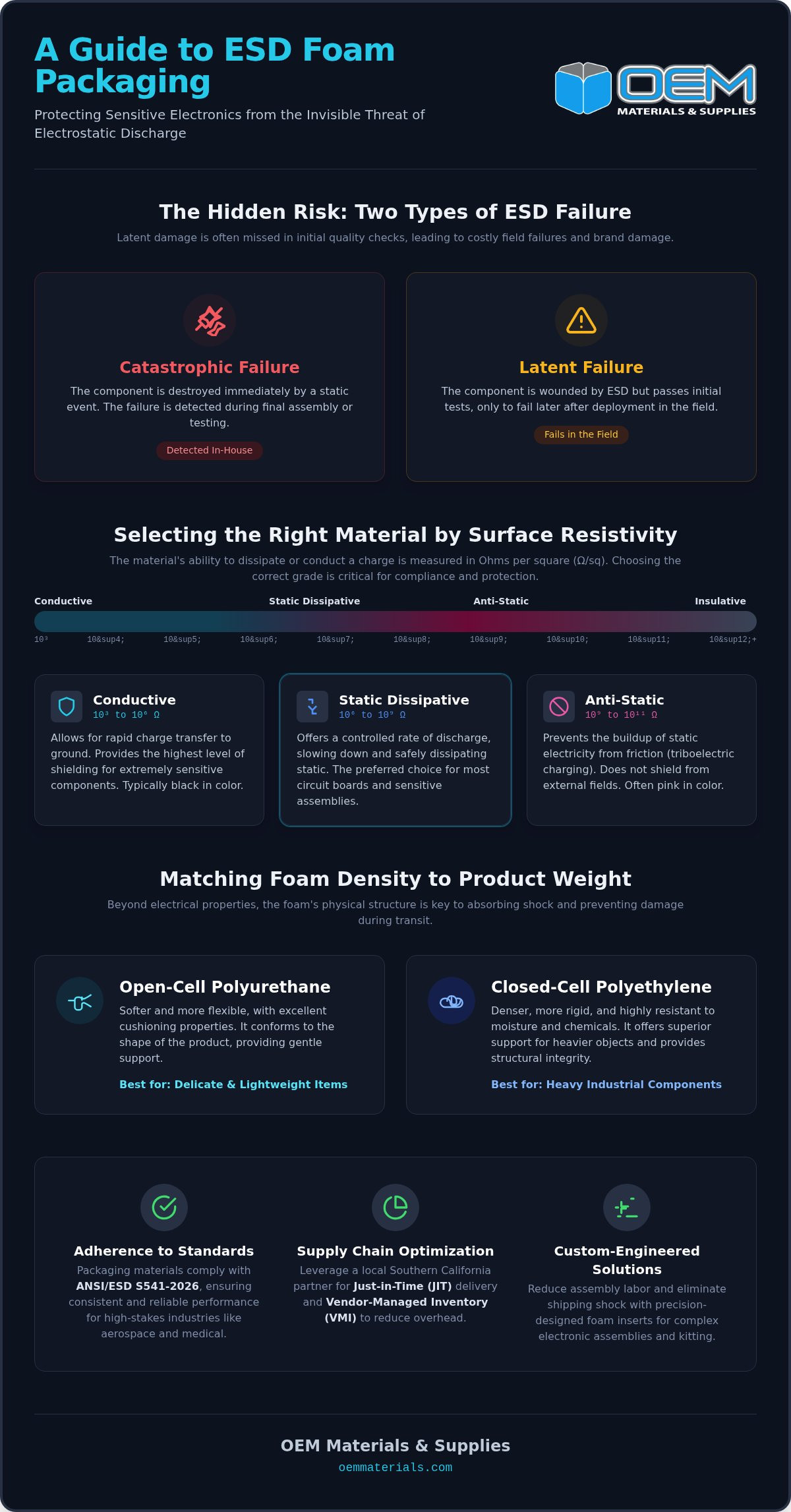
Catastrophic failure is the most obvious risk. The component is destroyed immediately, and the failure is detected during final assembly testing. While frustrating, it’s manageable because the defective part never reaches the customer. Latent failure is far more insidious. The component is wounded by a static event but continues to function during initial testing. It eventually fails after being deployed in the field. This leads to massive warranty claims, expensive field service calls, and a significant blow to your company’s reputation for reliability. Using precision-engineered foam packaging is the only way to mitigate these long-term operational risks.
Regulatory Standards for ESD Protective Materials
Compliance isn’t optional for manufacturers in Los Angeles and Orange County. Industries here must adhere to strict protocols like ANSI/ESD S20.20-2021 for overall static control and ANSI/ESD S541-2026 specifically for packaging materials. These standards define the required surface resistivity and discharge times for materials. Consistent resistivity ensures that every piece of ESD foam packaging in your facility performs exactly as expected. This provides the stability required for high-reliability electronics in the aerospace and medical sectors, where failure is not an option.
Anti-Static vs. Dissipative vs. Conductive Foams
Selecting the right material for ESD foam packaging requires an understanding of surface resistivity. This measurement, expressed in Ohms per square, determines how quickly a static charge moves across or through the material. The ESD Association categorizes materials into three distinct groups: anti-static, static dissipative, and conductive. Choosing the wrong grade can lead to either insufficient protection or unnecessary material expenses.
- Anti-Static (10^9 to 10^11 Ohms): Usually pink, these materials are low-charging. They prevent the buildup of static electricity caused by friction but don’t effectively shield against external electrostatic fields.
- Static Dissipative (10^6 to 10^9 Ohms): These offer a controlled rate of discharge. They’re the preferred choice for most circuit board assemblies and sensitive electronic components.
- Conductive (10^3 to 10^6 Ohms): Typically black, these materials allow for a rapid, safe transfer of charge to ground. They provide the highest level of shielding for extremely sensitive items.
If you’re unsure which resistivity range your components require, you can consult with our engineering team for a material recommendation based on your specific assembly and shipping environment.
When to Use Pink Anti-Static Polyurethane
Pink anti-static foam is a staple in many Southern California shipping departments. It’s an excellent choice for cushioning non-sensitive parts that will be handled within a static-controlled environment. However, engineers should be aware of its limitations. The anti-static property is often achieved through chemical additives that bloom to the surface. Over time, or in high-heat environments common in the Inland Empire, these chemicals can leach out or dissipate. This leaves the foam as a standard insulator and potentially contaminates the product. It’s best used for short-term shipping or as a secondary cushioning layer.
The Engineering Behind Black Conductive Foam
Unlike pink foam, black conductive foam relies on carbon impregnation rather than topical coatings. This creates a permanent, reliable path to ground that won’t wear off or leach onto your parts. It’s the industry standard for lead insertion. When you press the pins of an integrated circuit into conductive foam packaging, the material shunts all the leads together. This keeps them at the same electrical potential and prevents a voltage differential from damaging the internal circuitry. For high-value aerospace components and long-term storage, the durability of conductive polyethylene or polyurethane is indispensable.
Polyurethane vs. Polyethylene: Matching Foam Density to Product Weight
Selecting the correct ESD foam packaging requires a technical assessment of your product’s fragility and static sensitivity. While resistivity protects the internal circuits, foam density protects the physical structure. Density is measured in pounds per cubic foot (pcf) and dictates how much weight the foam can support before it loses its ability to cushion. A common error in industrial packaging is selecting a material based on price rather than load-bearing capacity. If the foam is too soft for the product’s weight, it will “bottom out” during a drop. This means the foam compresses completely, allowing the product to strike the outer corrugated wall with nearly 100% of the impact force.
Polyurethane (PU) features an open-cell structure that allows air to flow freely through the material. This makes it highly compressible and effective for lightweight, delicate items that require a soft landing during a shock event. In contrast, Polyethylene (PE) is a closed-cell material. The cells are sealed and filled with air, creating a much more rigid and durable cushion. PE is the superior choice for heavy industrial parts or components with sharp edges that would easily tear through softer materials. It maintains its shape even under the constant weight of heavy assemblies, ensuring the product stays centered throughout the shipping cycle.
Cushioning Sensitive Medical Devices with PU Foam
Medical sensors and diagnostic tools are often lightweight but highly sensitive to vibration. Soft polyurethane is the preferred choice for these applications because it offers superior vibration dampening. This open-cell custom foam packaging ensures that high-frequency vibrations from truck or air transport don’t loosen internal connections or knock sensors out of calibration. It conforms easily to complex, irregular shapes, providing 360-degree protection without applying excessive pressure to delicate plastic housings. This is essential for manufacturers in Orange County and Los Angeles who ship high-value medical electronics globally.
Protecting Heavy Aerospace Assemblies with PE Foam
Aerospace components, such as machined housings or avionics racks, require the structural integrity of dense PE. Closed-cell polyethylene doesn’t “set” or lose its height under a heavy load, making it ideal for long-term storage or multiple shipping legs between vendors. These foam inserts maintain consistent surface resistivity even after repeated handling. Unlike PU, dense polyethylene is also resistant to moisture and chemicals, which is a frequent requirement in hangar and manufacturing environments. For heavy components, calculating the G-force threshold is vital to ensuring the foam density provides enough deceleration to prevent physical impact damage.
Designing Custom ESD Foam Inserts for Manufacturing Centers
Standard off-the-shelf foam sheets rarely provide the precision required for high-value electronic assemblies. Custom ESD foam packaging solves this by providing form-fitting cavities that keep components stationary during transit. When a part is allowed to shift inside its container, it’s subject to both physical abrasion and the potential for triboelectric charging against the packaging walls. Engineered inserts eliminate this movement, ensuring that sensitive connectors and delicate leads remain suspended and protected from impact.
The design process begins with a technical evaluation of the component’s geometry and weight. We use this data to create multi-level cavities that support the part at its strongest points while leaving clearance for its most fragile areas. This level of customization is often paired with custom corrugated boxes to create a complete, integrated solution. Prototyping allows us to verify that the combination of outer structural support and inner cushioning meets the specific G-force thresholds required for your product’s safety. Testing these designs before full-scale production prevents costly field failures and reduces the need for expensive over-packaging.
Die-Cutting vs. Water Jet Cutting for Foam Inserts
The manufacturing method for your foam inserts depends on your production volume and the complexity of the part. Die-cutting is the industry standard for high-volume runs. It uses a steel rule die to stamp out thousands of identical parts with high speed and consistency. For lower-volume projects or complex prototypes that require deep, intricate cuts, water jet cutting is often the more efficient choice because it requires no physical tooling. Both methods enable a high degree of custom packaging design, allowing for tight tolerances that prevent component rattling. This precision reduces the overall footprint of the package, which can lead to significant savings in dimensional weight shipping costs.
Kitting and Assembly Services for Electronics Manufacturers
Labor efficiency is a critical metric for any manufacturing facility in Southern California. Operations managers in the Inland Empire and Riverside have found that outsourcing the assembly of their ESD foam packaging significantly reduces throughput bottlenecks. Instead of having warehouse staff spend time folding boxes and hand-fitting foam inserts, we provide pre-assembled kits delivered directly to the production line. This just-in-time approach allows your team to focus exclusively on assembly and quality control. By receiving a complete packaging unit—including the box, the ESD foam, and any necessary labels—you eliminate the logistical headache of managing multiple vendors and disparate inventory counts. This streamlined workflow is essential for manufacturers looking to scale production without increasing their internal warehouse headcount.
To see how a tailored insert can improve your operational efficiency, request a quote for a custom prototype. Please include your product dimensions, weight, and estimated annual usage so our engineering team can provide an accurate recommendation.
Scaling Your ESD Packaging Strategy in Southern California
Logistical efficiency is as important as material science. Because ESD foam packaging is inherently bulky, shipping costs can quickly erode the savings found in material optimization. For manufacturers in San Diego, Orange County, and Los Angeles, sourcing from a local partner is a strategic necessity. Working with a nearby supplier eliminates the high cost of “shipping air” from out-of-state vendors and provides the agility needed to respond to sudden production spikes or supply chain shifts. Proximity enables Just-in-Time (JIT) delivery, allowing your facility to maintain lean operations without the risk of a line shutdown.
Vendor Managed Inventory for Packaging Supplies
Inventory management often becomes a bottleneck for growing electronics and aerospace firms. Specialized ESD foam packaging requires significant warehouse footprint, which is at a premium in Southern California. Implementing a packaging VMI program allows you to offload the burden of inventory tracking and storage to your supplier. We monitor your usage levels and replenish stock automatically; this ensures you never face a stockout of critical anti-static or conductive inserts. This model significantly improves cash flow by utilizing pay-as-you-use arrangements, allowing you to reallocate capital toward production equipment and R&D rather than sitting inventory.
Sourcing Wholesale Industrial Packaging in Los Angeles
Consolidating your vendor list reduces administrative friction and lowers total procurement costs. As a comprehensive wholesale industrial packaging supplier, we provide everything from custom corrugated boxes and stretch film to specialized wood crates and edge protectors. This single-source approach ensures that your ESD foam inserts are perfectly compatible with your outer shipping containers. When all components of a packaging system are designed and sourced together, the result is a more cohesive protection strategy that minimizes material waste and labor time during the kitting process. We serve industrial hubs across the Inland Empire and beyond, providing the stability of a seasoned manufacturing partner.
To begin optimizing your protection strategy, contact our team for a technical consultation. We provide accurate recommendations and quotes based on your specific requirements. Please be prepared to provide product dimensions, component weight, and estimated annual usage so we can design a solution that balances technical performance with logistical efficiency.
Secure Your Supply Chain with Precision ESD Protection
Effective static control requires a technical approach that addresses both electrical resistivity and physical cushioning. By selecting the correct grade of ESD foam packaging and matching material density to your product’s weight, you eliminate the risks of latent component failure and shipping damage. High-reliability sectors like aerospace and medical manufacturing in Orange County and Los Angeles depend on these precise standards to maintain zero-defect shipping and brand integrity.
OEM Materials acts as a solution partner through custom engineered design, prototyping, and value-added services like kitting and VMI. Our local proximity to industrial hubs in San Diego and the Inland Empire ensures faster lead times and lower logistical overhead for bulky foam products. We’re ready to help you streamline your operations and reduce material waste through better engineering.
Contact OEM Materials for a custom ESD foam quote and prototype to begin optimizing your packaging strategy. Please provide your product dimensions, weight, and annual usage so our team can develop a recommendation tailored to your specific application. We look forward to supporting your manufacturing goals.
Frequently Asked Questions
What is the main difference between pink and black ESD foam?
Pink foam is anti-static and prevents charge generation from friction, but it doesn’t provide a path to ground. It relies on topical surfactants that can leach over time. Black foam is conductive because it’s impregnated with carbon. This creates a permanent electrical path to ground. While pink foam is suitable for secondary cushioning of non-sensitive components, black conductive foam is required for high-value microchips and components sensitive to extremely low voltage discharges.
How do I determine the correct foam density for my electronic product?
Density is determined by the weight of your product and its G-force fragility rating. You must calculate the static loading by dividing the product’s weight by the surface area in contact with the foam. Lightweight, delicate sensors usually require 1.2 to 1.5 pcf polyurethane. Heavier aerospace assemblies or sharp-edged parts often require 2.0 pcf or higher polyethylene. Selecting the wrong density leads to bottoming out, where the foam fails to decelerate the product before impact.
Does ESD foam lose its protective properties over time?
Anti-static pink foam typically has a shelf life of six to twelve months because the topical chemicals bloom to the surface and eventually dissipate. Environmental factors like high humidity or heat in Southern California warehouses can accelerate this process. Conversely, conductive black foam and dissipative polyethylene are permanent. Their electrical properties are part of the material’s molecular structure and won’t wear off or leach out, making them the superior choice for long-term storage of sensitive components.
Can I use standard polyurethane foam for shipping electronics if I use an ESD bag?
This is a high-risk practice that we don’t recommend for sensitive electronics. Standard polyurethane foam is a powerful insulator that generates and holds high levels of static charge through friction. Even if the part is in an ESD bag, sliding the bag against standard foam can create a significant charge on the bag’s exterior. Opening the bag near the foam can then cause a discharge. Using dedicated ESD foam packaging ensures the entire environment remains static-safe.
What industries require conductive foam instead of dissipative foam?
The semiconductor industry requires conductive foam for lead insertion because it shunts pins together to prevent voltage differentials. Aerospace manufacturers often specify conductive materials for extremely sensitive flight hardware. Most other electronics manufacturers, including those in the medical device and automotive sectors, utilize static dissipative foam. Dissipative materials provide a slower, more controlled discharge rate, which is safer for the majority of printed circuit board assemblies and integrated circuits that don’t require lead shunting.
How does custom die-cut foam reduce overall shipping costs?
Custom die-cut inserts reduce costs by optimizing the dimensional weight of your shipments. By creating a precision-fit cavity, you can often use a smaller outer corrugated box and eliminate the need for secondary void-fill materials like bubble wrap or packing peanuts. This also significantly reduces labor costs during the assembly and kitting process. A form-fitting insert allows workers to pack components in seconds rather than minutes, which increases throughput for high-volume manufacturing centers in Los Angeles.
Is ESD foam safe for use in medical cleanroom environments?
Closed-cell polyethylene ESD foam is the preferred choice for cleanroom environments because it’s non-sloughing and doesn’t shed particles. Open-cell polyurethane can break down and release particulates, which may compromise cleanroom standards. For medical device manufacturers, it’s vital to specify low-sloughing materials to prevent contamination. We provide specialized ESD foam packaging that meets these rigorous cleanliness requirements while maintaining the necessary surface resistivity to protect sensitive diagnostic sensors and surgical electronics from static damage.
What information is needed to get an accurate quote for custom ESD inserts?
To provide an accurate recommendation and quote, our engineering team needs the physical dimensions and weight of your component. It’s also helpful to know the product’s fragility or G-force threshold if it’s been tested. We also request your estimated annual usage and the typical shipping environment. This data allows us to select the most cost-effective material density and electrical grade while ensuring the design meets your specific protection requirements for either local Southern California transport or global logistics.