
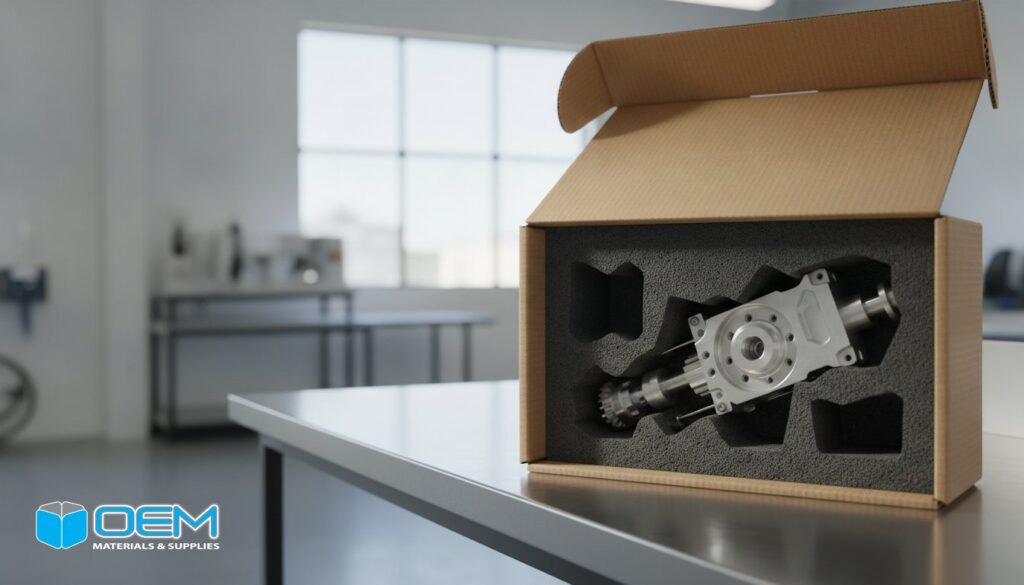
A single damaged shipment does more than just hurt your bottom line; it erodes the hard-earned trust of your aerospace or medical device clients. For manufacturers in Los Angeles and Orange County, high rejection rates due to transit damage are often treated as an unavoidable cost of doing business, but they shouldn’t be. Choosing the right protective foam packaging is a technical decision that impacts everything from labor efficiency to regulatory compliance. It’s a critical component of your supply chain that requires precision and industrial expertise rather than a one-size-fits-all approach.
We understand that managing a packing department involves balancing material costs against the risk of catastrophic product failure. You need a reliable local partner who understands the nuances of custom foam inserts rather than a distant vendor with inconsistent lead times. This guide will show you how to select the ideal foam materials and custom designs to eliminate damage and optimize your industrial shipping workflows. We will examine the critical differences between polyethylene and polyurethane foams, discuss how to meet California SB 54 recycling requirements by 2032, and explain why localized design and sourcing are essential for reducing your total cost of ownership.
Key Takeaways
- Evaluate the structural differences between closed-cell polyethylene and open-cell polyurethane foam to select the correct density and Indentation Load Deflection for sensitive industrial components.
- Identify how custom die-cut inserts reduce the total cost of ownership by decreasing manual packing labor and minimizing material waste compared to generic stock cushioning.
- Apply engineering principles like the fragility factor and standardized drop height requirements to ensure high-value shipments withstand the rigors of parcel and LTL transit.
- Secure a reliable supply chain by sourcing protective foam packaging from a local Southern California partner that offers vendor-managed inventory and rapid prototyping.
- Prepare for California SB 54 regulations by transitioning to compliant, high-performance foam materials that meet state-mandated recyclability and plastic reduction standards.
The Role of Protective Foam Packaging in Industrial Logistics
Protective foam packaging is more than simple void fill; it’s a technical solution designed to mitigate the risks of high-intensity shipping environments. In industrial logistics, foam acts as a calculated barrier against shock, vibration, and abrasion. For manufacturers in the Inland Empire or Orange County, this material is the primary line of defense between an expensive component and the unpredictable forces of transit. Scientifically, Polymeric foam provides the necessary structural integrity to cradle heavy or delicate parts. Unlike generic padding, engineered foam is selected based on its ability to dissipate energy before it reaches the product.
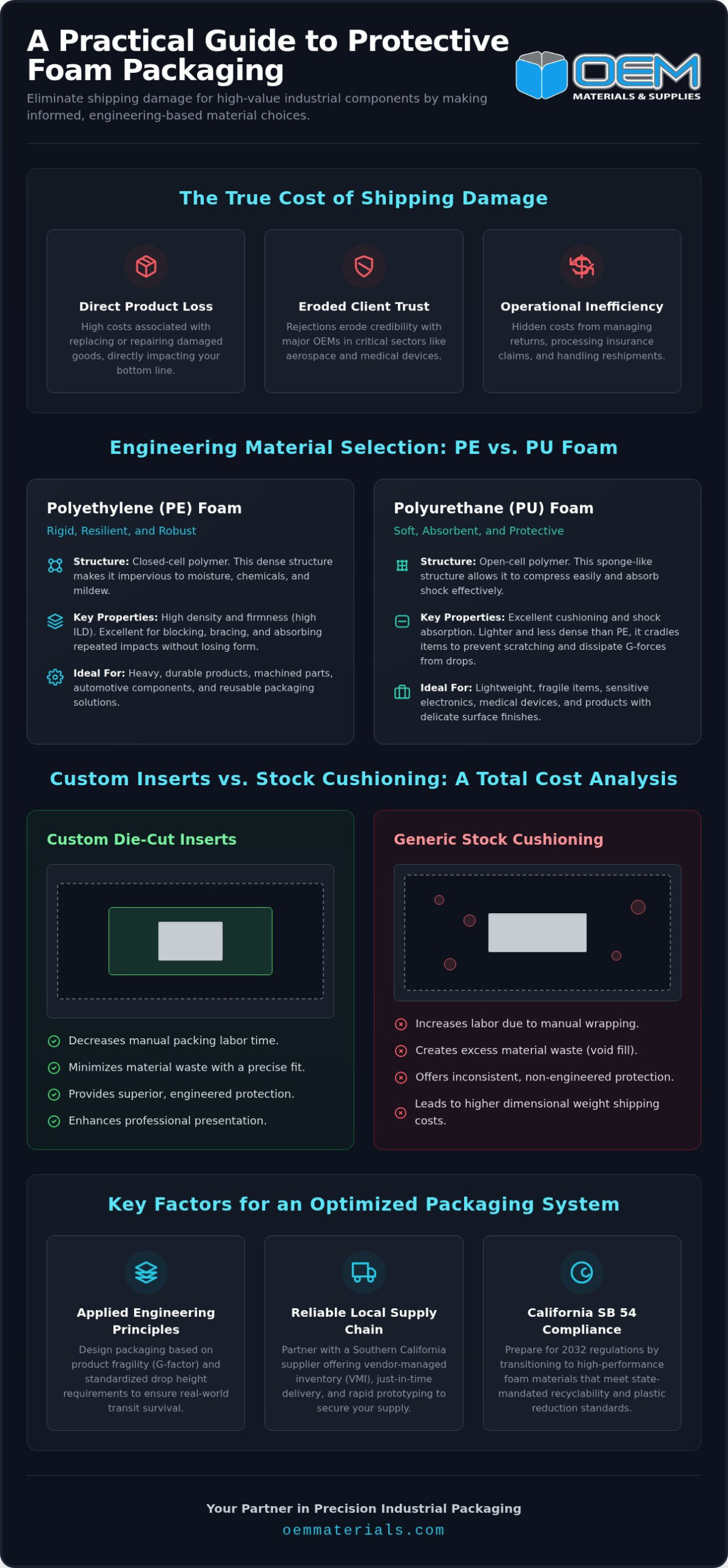
In the aerospace and medical device sectors, the stakes are exceptionally high. A microscopic scratch on a turbine blade or a compromised seal on a surgical instrument leads to immediate rejection. These rejections hurt the bottom line through the direct loss of product and the logistical overhead of returns. They also damage a supplier’s reputation with major OEMs. Investing in high-quality protective foam packaging ensures that your shipments arrive in the same condition they left the factory floor, protecting your brand and your revenue.
Preventing Product Damage and Rejections
When a pallet shifts or a parcel is dropped, kinetic energy must go somewhere. High-performance foam absorbs this energy by compressing at a controlled rate. This deceleration prevents internal components from shattering or losing calibration. Beyond physical impact, foam is essential for maintaining sensitive environments. Certain formulations offer anti-static properties for electronics or cleanroom-compatible structures for medical hardware. Reducing rejection rates through superior cushioning is a direct investment in your operational efficiency. It’s a proactive strategy that minimizes the high costs associated with product replacements and insurance claims.
Foam as Part of an Integrated Packaging System
Foam rarely works in isolation. It’s most effective when integrated into a comprehensive system that includes custom corrugated boxes and secondary cushioning materials. This multi-layer approach ensures that the outer container handles structural stacking loads while the internal foam manages the product’s specific G-factor requirements. Standardizing these components into cohesive packaging kits simplifies the packing process for warehouse teams. It removes the guesswork from the packing station, ensuring that every shipment meets the same rigorous protection standards. By pairing custom die-cut foam inserts with precisely sized containers, manufacturers reduce material waste and optimize the overall footprint of their shipments.
Engineering Material Selection: Polyethylene vs. Polyurethane Foam
Selecting the right protective foam packaging is a technical decision that hinges on how a material manages energy. Procurement managers must look beyond unit price and analyze the structural integrity of the polymer. The choice typically comes down to two primary materials: Polyethylene (PE) and Polyurethane (PU). Each offers distinct mechanical properties that dictate its performance in a shipping environment. Integrating the right material into your supply chain is easier when you have a comprehensive comparison of foam types to reference. Our detailed analysis of Polyethylene vs. Polyurethane explores these engineering trade-offs for specific industrial applications.
Density and Indentation Load Deflection (ILD) are the two most critical metrics for evaluating foam. Density determines the material’s weight-bearing capacity and long-term durability, while ILD measures the firmness or “feel” of the foam. A high ILD indicates a stiffer foam that can support heavier loads without bottoming out. Environmental resistance is another factor. You must consider how moisture, chemicals, and temperature fluctuations in a warehouse or shipping container will affect the material’s ability to protect your product. If you’re unsure which material fits your specific G-factor requirements, you can request a quote for a custom material assessment.
Polyethylene (PE) Foam for Heavy-Duty Protection
Polyethylene is a closed-cell foam known for its rigidity and durability. Because the cells are sealed off from one another, PE foam is naturally resistant to moisture and chemicals. This makes it an excellent choice for long-term storage or international shipping where humidity is a factor. It’s a non-abrasive material, meaning it won’t scratch finished surfaces on automotive components or heavy machinery parts. Its high load-bearing capacity allows it to support significant weight while maintaining its shape, providing consistent protection throughout the logistics cycle.
Polyurethane (PU) Foam for Fragile and Lightweight Items
Custom Foam Inserts vs. Stock Cushioning: A Cost Analysis
Many procurement managers look at the unit price of stock foam rolls and assume they’ve found the most economical path. This is a common oversight in industrial logistics. Stock cushioning often carries hidden burdens that inflate your total expenditure through excessive labor and material waste. When you rely on generic materials, your team spends valuable time measuring, cutting, and wrapping every component. Transitioning to engineered protective foam packaging shifts the focus from manual labor to process efficiency. By utilizing custom packaging design services, you can replace disorganized packing stations with a structured, repeatable workflow.
Streamlining Warehouse Labor with Pre-Cut Inserts
Pre-cut inserts eliminate the variability of manual packing. Warehouse staff in Los Angeles or Orange County can maintain high throughput without specialized training because the foam defines exactly where the product sits. Using pre-assembled packaging kits ensures that every item is secured identically, which removes human error from the station. This consistency is vital for maintaining the integrity of high-value shipments. Custom foam also allows for significant space optimization. By reducing the total footprint of the shipping container, you can fit more units on a pallet and reduce the warehouse space required for bulky stock inventory.
Evaluating the Total Cost of Ownership (TCO)
A true TCO analysis must account for material waste, labor hours, and freight charges. While custom die-cut foam requires an initial tooling investment, the long-term savings are substantial. Precise foam sizing helps manufacturers reduce dimensional weight (DIM) charges. You aren’t paying to ship empty space when the foam is engineered to the exact dimensions of the product. Practical cost management also involves rapid prototyping. This process allows you to verify a design’s performance before committing to high-volume production. Verifying the design early prevents the costly mistake of ordering ineffective materials that lead to product rejections. Savings in this area depend on specific variables like your annual usage and product weight, but the shift toward precision usually results in a leaner, more predictable supply chain.
- Eliminate the “hidden” labor costs of manual wrapping and cutting.
- Reduce material waste by using foam engineered for specific dimensions.
- Lower freight costs by minimizing the dimensional weight of every box.
- Improve packing consistency to reduce damage-related rejections.
Critical Design Factors for High-Value Industrial Packaging
Designing for high-value components requires an engineering mindset that accounts for specific physical forces. Protective foam packaging must be calibrated to the fragility of the product it holds. This calibration starts with the G-factor. The fragility factor, or G-factor, is the ratio of maximum acceleration to the acceleration of gravity. If a medical device has a G-factor of 40, it can withstand 40 times its weight in force before failing. Our engineers use this metric to determine exactly how much foam is required to decelerate a product safely during an impact. Choosing an incorrect density can lead to “bottoming out,” where the foam compresses fully and transfers the remaining shock directly to the product.
Shipping methods also dictate design requirements. Parcel carriers typically subject packages to more frequent drops, often from heights of 30 inches or more. Conversely, Less-Than-Truckload (LTL) shipping involves fewer drops but higher risks of vibration and crushing from static loading in a stacked trailer. Foam must be engineered to resist “creep,” which is the gradual deformation of the material under a constant load during prolonged storage. If the foam loses its structural integrity while sitting in a warehouse in the Inland Empire, it won’t perform correctly when the crate finally moves. You can request a custom material assessment to ensure your packaging meets these rigorous transit standards.
Fragility Assessment and Shock Absorption
Determining the critical drop height is essential for sensitive medical or aerospace parts. We tune the foam density to control the deceleration rate upon impact. A softer foam provides a longer deceleration distance for lightweight, fragile items, while a higher-density foam is necessary to stop heavy industrial components before they hit the outer container wall. This balance ensures that the internal stresses on the product never exceed its rated G-factor. Precision in this area eliminates the trial-and-error approach that often leads to shipping damage.
Specialized Foam Solutions for Niche Industries
Certain sectors require more than just impact protection. For semiconductor shipping in Orange County, anti-static foam is mandatory to prevent electrostatic discharge from destroying sensitive circuits. These foams are chemically treated to dissipate static charges safely. In the medical sector, cleanroom-compatible foams are used to prevent particulate contamination of sterile instruments. These materials are non-dusting and resistant to microbial growth. For larger industrial equipment that doesn’t require a full enclosure, custom edge and corner protectors provide targeted defense for the most vulnerable points of a machine. This modular approach provides high-level protection while minimizing total material usage.
Sourcing Industrial Foam Packaging in Southern California
Sourcing high-performance protective foam packaging requires a partner who understands the specific logistical challenges of the Southern California manufacturing corridor. National vendors often struggle with the lead times and nuanced requirements of local aerospace and medical device manufacturers. Working with a local supplier eliminates the communication gaps that lead to incorrect material selection or missed delivery windows. For companies operating in Orange County, Los Angeles, and San Diego, proximity translates directly into operational agility and reduced logistical overhead.
Local Support for Orange County and Los Angeles Manufacturers
Onsite consultations are a critical advantage for manufacturers in the Inland Empire and surrounding areas. When a packaging challenge involves complex geometries or sensitive calibration, having an expert physically inspect the product ensures a higher level of accuracy in the final design. Local prototyping allows engineering teams to test and refine foam inserts in days rather than weeks. This proximity also significantly reduces freight costs, as bulky foam shipments don’t have to travel across the country. For San Diego based OEMs, local sourcing means faster response times for design changes and more reliable delivery schedules that align with production cycles.
Optimizing the Supply Chain with VMI and JIT
Effective inventory management is essential for maintaining a lean operation. Leveraging a Vendor Managed Inventory (VMI) program allows you to prevent stockouts without tying up capital in excess safety stock. Under a VMI model, your supplier monitors your usage levels and replenishes stock automatically, which improves cash flow and lowers administrative overhead. This synergy is further enhanced by Just-In-Time (JIT) delivery programs. Receiving foam shipments only when they’re needed on the packing line eliminates warehouse clutter and frees up valuable floor space for manufacturing activities.
A reliable partner supports growth by scaling from initial prototypes to high-volume production seamlessly. This continuity ensures that the technical specifications established during the design phase are maintained throughout the product’s lifecycle. To facilitate an accurate recommendation and quote, we request the following data points:
- Exact product dimensions (length, width, and height).
- Total product weight and fragility (G-factor) if known.
- Estimated annual usage and typical order quantities.
- Shipping method and typical transit hazards.
A localized, data-driven approach to sourcing is the most effective way to reduce your total cost of ownership. Providing these specific variables allows for a more precise material assessment and a quote that reflects your actual operational needs.
Optimizing Your Supply Chain with Engineered Foam Solutions
Selecting the right protective foam packaging is a strategic decision that directly impacts your operational efficiency and customer satisfaction. Transitioning from generic stock cushioning to custom engineered foam inserts allows manufacturers in Los Angeles and Orange County to significantly reduce product rejection rates and manual labor costs. As we have discussed, integrating engineering principles like G-factor calculations and precise material selection ensures that high-value components remain secure throughout the most rigorous transit cycles.
A reliable local partner provides the technical expertise needed to navigate the complex requirements of the aerospace, medical, and electronics sectors. Our team offers dedicated support for Southern California OEMs, providing onsite consultations and VMI programs to streamline inventory management and prevent stockouts. We are prepared to help you move from standard packaging to a high-performance system that protects your bottom line and your reputation. Contact OEM Materials & Supplies for a custom foam packaging consultation to begin your design assessment. We look forward to helping you build a more efficient and dependable shipping workflow.
Frequently Asked Questions
What is the difference between polyethylene and polyurethane packaging foam?
Polyethylene is a closed-cell material that offers high rigidity and moisture resistance, making it suitable for heavy industrial components. Polyurethane is an open-cell foam that provides superior softness and vibration dampening for delicate items like electronics. While polyethylene is durable and non-abrasive, polyurethane excels at conforming to complex shapes. The choice depends on whether your product requires structural support or gentle cushioning during transit.
How do I determine the correct foam density for my product?
Determining the correct density requires calculating the product’s weight relative to the surface area of the foam. High-density foams are necessary for heavy items to prevent bottoming out during impact. Conversely, lighter products require lower density foam to ensure the material compresses enough to absorb shock. We analyze your product’s G-factor and typical drop heights to recommend a density that balances protection with material efficiency. It’s a technical process that eliminates guesswork.
Can custom foam inserts really save my company money compared to stock rolls?
Custom inserts reduce the total cost of ownership by eliminating the manual labor required to wrap and cut stock materials. Stock rolls often lead to inconsistent protection and significant material waste. Custom protective foam packaging streamlines the packing station, allowing warehouse staff to secure items in seconds. Additionally, precise sizing reduces the dimensional weight of your shipments, which can lead to substantial freight savings over high-volume production runs. It’s a proven way to lean out operations.
What industries benefit most from custom engineered foam packaging?
Industries shipping high-value or highly sensitive equipment benefit most from engineered solutions. This includes aerospace manufacturers shipping turbine components, medical device companies protecting sterile instruments, and electronics firms transporting circuit boards. Automotive suppliers also utilize custom foam to protect finished surfaces from abrasion. Any sector where product rejection rates or transit damage significantly impact the bottom line will find value in a customized packaging approach.
How does anti-static foam protect sensitive electronics?
Anti-static foam is chemically treated to prevent the buildup and discharge of static electricity. This is critical for electronics because even a small electrostatic discharge can permanently damage internal semiconductor components. These foams are typically pink or blue to distinguish them from standard materials. Using ESD-safe protective foam packaging ensures that sensitive circuit boards and microchips remain functional throughout the entire distribution and handling process. It’s an essential safety standard for semiconductor shipping.
What information is needed to get an accurate quote for custom foam?
To provide an accurate quote, we require specific data points regarding your product and logistics. Essential information includes:
- Exact product dimensions and weight.
- Fragility rating or G-factor.
- Estimated annual usage and order frequency.
- Typical shipping environment (parcel vs. LTL).
This data allows our engineering team to select the right material and design a prototype that meets your performance requirements.
Does OEM Materials & Supplies offer local delivery in San Diego and Orange County?
Yes, we provide localized support and delivery services throughout Southern California. Our service area includes Orange County, Los Angeles County, San Diego County, and the Inland Empire. Local proximity allows us to offer onsite consultations and faster lead times for prototypes and production runs. This geographic advantage is essential for manufacturers who rely on just-in-time delivery or vendor-managed inventory to maintain a lean supply chain. It’s a key part of our service model. Beyond industrial logistics, we are proud to be part of a community that offers exceptional local resources; for those seeking personalized adult family home support in the area, learn more about Olympia Senior Care Services.
Minimum order quantities vary based on the complexity of the design and the required tooling. While we support both high-volume production and specialized low-volume runs, setup costs for custom die-cutting are more efficiently amortized over larger quantities. We recommend discussing your specific annual usage with our team to determine the most cost-effective solution for your budget. We’ll focus on providing scalable options that grow with your manufacturing needs.