
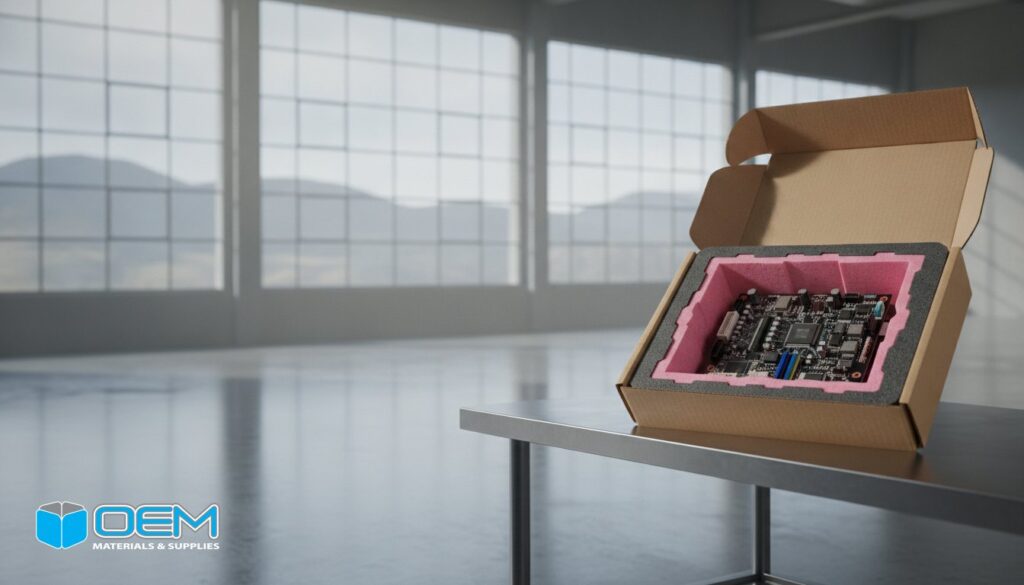
A single spark of electrostatic discharge, often too small for a human to feel, can silently compromise a high-value circuit board long before it reaches your customer in Los Angeles. You likely recognize that latent component failure is one of the most frustrating challenges in electronics manufacturing. It’s a significant logistical setback when a product passes internal quality checks but fails in the field because of invisible damage sustained during shipping. Inconsistent material quality and poorly fitting packaging from commodity resellers only compound these risks.
This article provides the technical clarity you need to select and engineer the right anti-static foam inserts to eliminate ESD risks and protect sensitive components from mechanical shock. We’ll examine the specific performance characteristics of dissipative pink materials versus carbon-impregnated conductive black foams. You will also learn how to align your packaging strategy with the ANSI/ESD S20.20-2021 standard to ensure reliability throughout the Southern California supply chain. By focusing on both material chemistry and physical geometry, you can secure your shipments and reduce the high costs associated with product returns and replacements.
Key Takeaways
- Standard packaging materials can generate thousands of volts of static during movement. Learn how engineered anti-static foam inserts utilize specialized additives to neutralize triboelectric charging and prevent latent component failure.
- Distinguish between dissipative pink foam and carbon-impregnated black conductive foam to determine which material chemistry best suits your product sensitivity and storage duration.
- Discover how precision die-cutting and CNC routing provide a secure physical fit that mitigates both electrostatic discharge and mechanical shock during the shipping process.
- Identify specialized requirements for high-stakes industries, such as high-density foams for aerospace sensors or cleanroom-compatible materials for medical devices that do not outgas.
- Explore the logistical advantages of local Southern California sourcing, including vendor-managed inventory programs that prevent stockouts and reduce warehouse labor costs.
The Critical Role of Anti-Static Foam Inserts in Modern Logistics
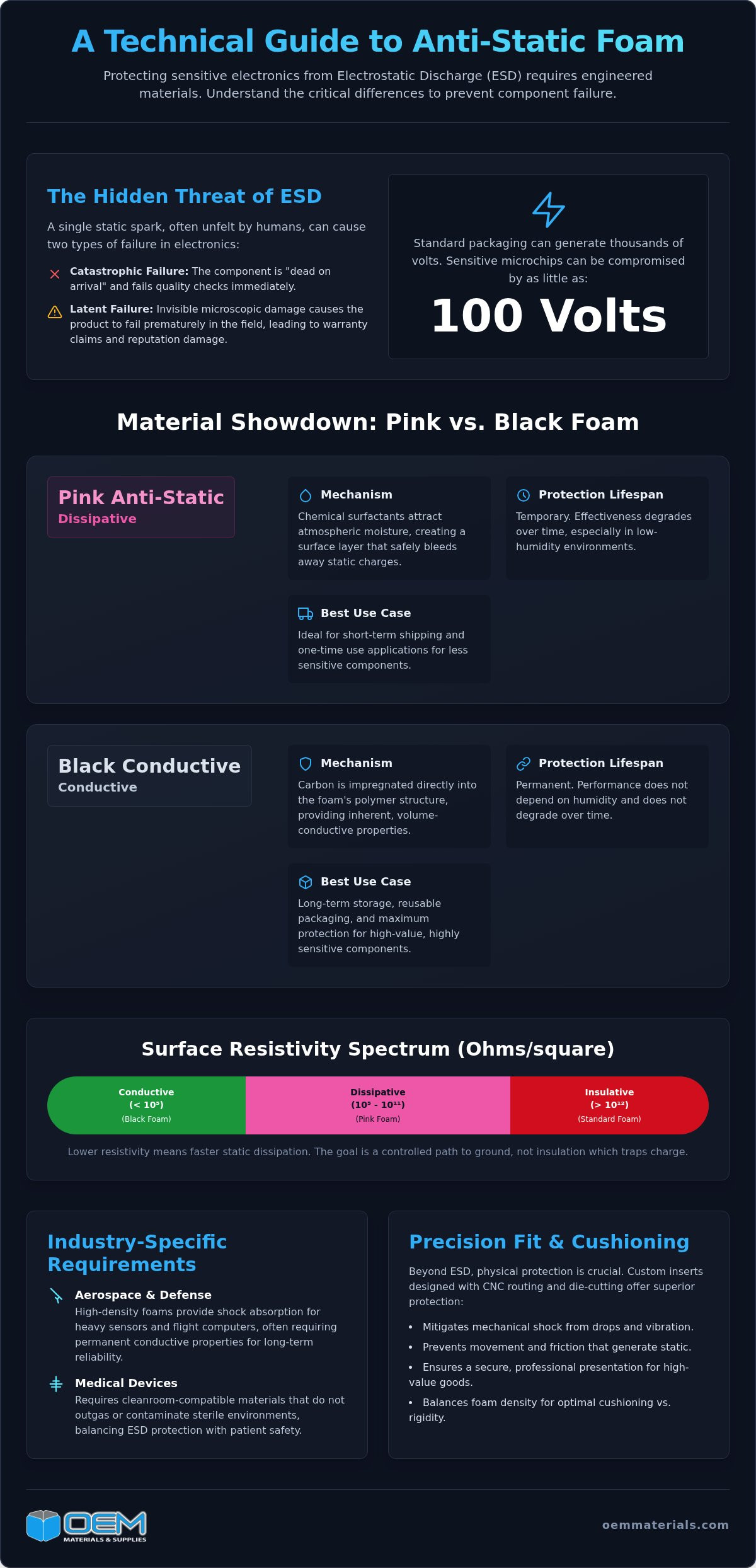
Anti-static foam inserts are not merely a color choice for aesthetic differentiation. They are technically engineered materials treated with specialized chemical surfactants designed to prevent triboelectric charging. Standard packaging foam acts as an insulator, which allows static electricity to accumulate through the simple friction of movement during transit. In a typical shipping environment, a circuit board shifting against standard foam can generate several thousand volts of static electricity. While a human might not feel a discharge until it reaches roughly 3,000 volts, sensitive microchips and integrated circuits can be permanently compromised by as little as 100 volts.
The primary objective for any Los Angeles electronics manufacturer is to eliminate “dead on arrival” (DOA) scenarios that erode profit margins. When a component fails immediately upon receipt, it’s a clear logistical loss. However, the more insidious threat is latent ESD failure. These represent components that leave the factory in working order but possess internal microscopic damage that leads to premature failure weeks or months later. The resulting warranty claims and reputation damage represent a significant hidden cost for industrial manufacturers that far exceeds the price of proper protective materials.
How Static Electricity Damages Sensitive Electronics
The triboelectric effect occurs when two materials come into contact and then separate, transferring electrons in the process. In a shipping environment, this happens constantly as boxes vibrate on pallets or move along conveyor systems. Modern electronics, particularly Metal-Oxide-Semiconductor Field-Effect Transistors (MOSFETs), have extremely thin internal layers that a small spark can easily puncture. Much like an Antistatic bag, specialized foam packaging creates a controlled environment where charges are dissipated safely rather than allowed to build and strike delicate internal traces. This proactive management of electrical potential is the only way to ensure the long term reliability of high density assemblies.
Beyond Static: The Need for Physical Cushioning
Electrical protection is ineffective if the component sustains mechanical damage from poor handling. High value tech equipment requires a precise balance between ESD safety and structural support. If the foam is too soft, the item may bottom out during a drop; if it’s too rigid, the shock is transferred directly to the delicate solder joints and connectors. Selecting the correct foam density ensures that heavy flight computers or medical sensors remain suspended and stationary during the most rigorous transit cycles. Anti-static foam is a specialized material that provides both electrical insulation and mechanical dampening to ensure total product integrity.
Comparing Pink Anti-Static vs. Black Conductive Foam Materials
Choosing the correct anti-static foam inserts requires an understanding of the physics behind charge dissipation. Pink anti-static foam is a dissipative material. It’s treated with chemical surfactants that migrate to the surface to attract atmospheric moisture. This microscopic layer of water creates a path for static charges to bleed away safely before they build up. However, this performance is temporary. Environmental factors like low humidity or high heat can accelerate the degradation of these surfactants. Because the anti-static properties eventually wear off, pink foam is generally recommended for short term shipping rather than multi year storage.
Black conductive foam offers a different level of protection through carbon impregnation. Unlike the chemical treatment in pink foam, the carbon is integrated into the foam’s cellular structure during manufacturing. This provides permanent conductivity that doesn’t rely on humidity or dissipate over time. For manufacturers in the Inland Empire or San Diego County handling high value military hardware, black foam is often the preferred choice for long term reliability and repeated use.
Technical Specifications: Resistivity and Dissipation
Surface resistivity is the primary metric for evaluating these materials. Dissipative materials, typically pink, maintain a resistance range between 10^5 and 10^11 ohms. This slower discharge rate is ideal for most commercial electronics. Conductive materials, such as black carbon-filled foam, have a much lower resistance of less than 10^5 ohms. This allows for a nearly instantaneous discharge to ground. When engineering packaging to meet Defense Logistics Agency packaging standards, you must match the material’s resistivity to the specific ESD sensitivity of the part. High sensitivity military or aerospace components often mandate conductive black foam to ensure maximum protection.
Material Chemistry: Polyethylene vs. Polyurethane
The base polymer dictates the physical performance of your anti-static foam inserts. Polyethylene (PE) is a closed cell foam that is relatively rigid and highly durable. It’s excellent for heavier assemblies and is preferred in medical or aerospace cleanrooms because it doesn’t shed particles. Polyurethane (PU) is an open cell foam that provides a soft feel. It’s the standard choice for lightweight, fragile items that need significant vibration dampening. You can explore our full range of foam packaging options to see how these densities support different product weights. Selecting the wrong material can lead to either product damage or unnecessary cost. If you’re unsure which material is best for your specific dimensions and weight, our engineers can help you request a quote for a custom prototype.
Designing Custom Anti-Static Foam Inserts for Precision Components
Industrial manufacturers cannot rely on generic “pluck” foam or manual cutting for high-volume production. These DIY methods often lead to inconsistent fits that allow for part migration during transit. When a sensitive component shifts within its container, it risks both mechanical damage and contact with non-dissipative surfaces that may have built up a charge. Custom-engineered anti-static foam inserts solve this by providing a precise, negative-space cavity that holds the part securely in place. This level of precision is mandatory for the complex geometries found in medical imaging equipment or aerospace sensors produced throughout Southern California.
The engineering process begins by analyzing your component’s center of gravity and delicate contact points. This data informs the creation of a 3D model that maximizes shock absorption while maintaining electrical safety. Adhering to ESD Association standards is critical during this phase to ensure the packaging meets ANSI/ESD S541 requirements for both shielding and dissipation. We utilize CNC routing for low-volume runs and rapid prototyping, allowing for immediate design adjustments without the cost of tooling. For high-volume production, custom die-cutting offers a faster, more economical path to scale. This dual-track capability ensures that manufacturers in Orange County and Los Angeles can move from prototype to mass production with minimal friction.
The Engineering Process: From CAD to Prototype
Our designers use your CAD files to map the exact dimensions of your product, ensuring the foam provides uniform support. This technical approach eliminates the guesswork associated with commodity packaging. Rapid prototyping plays a vital role in verifying fit and protection levels before mass production begins. We encourage readers to provide specific product dimensions, weight, and annual usage data to facilitate accurate engineering recommendations. This information allows us to determine the optimal foam density and manufacturing method for your specific application.
Optimization for Assembly and Kitting
Beyond protection, custom packaging design focuses on operational efficiency. We engineer inserts to facilitate faster packing on the assembly line, which directly reduces labor hours and associated costs. By kitting multiple components, such as a control unit, specialized wiring, and mounting hardware, into a single foam tray, you streamline the kitting process and simplify inventory management. These inserts are designed to fit perfectly within custom corrugated boxes, creating a unified kit that is ready for immediate shipping. This integrated approach ensures your logistics chain remains organized and your products arrive in factory condition.
Industry-Specific Requirements for Static-Dissipative Packaging
Engineering anti-static foam inserts requires a deep understanding of the specific application environment. A solution that works for a consumer smartphone might fail for a satellite flight computer or a surgical laser. Southern California is a global hub for aerospace, medical technology, and automotive innovation; each of these sectors operates under distinct regulatory and performance frameworks. OEM Materials acts as a technical partner to ensure your packaging aligns with these rigorous demands while maintaining logistical efficiency.
- Aerospace: Requires high-density foam to support heavy flight computers and sensors while mitigating vibration-induced static.
- Medical Devices: Demands cleanroom-compatible materials that do not outgas or shed particles.
- Automotive: Needs durable ESD protection for electronic control units (ECUs) and high-sensitivity drivetrain sensors.
- Consumer Electronics: Focuses on balancing high-volume cost efficiency with reliable protection for retail-ready products.
Aerospace and Defense Standards
In military and defense applications, traceability and material consistency are non-negotiable. Sensitive avionics are frequently subjected to intense vibration during air transport, which can generate significant static charges if the packaging is not properly dissipative. We engineer high-performance foam solutions that comply with industrial standards like ANSI/ESD S20.20-2021 to ensure reliability in extreme conditions. These high-density materials provide the structural integrity needed for heavy assemblies while ensuring that every surface in contact with the electronics remains within a safe resistivity range. This prevents both physical shifting and electrical discharge during long-haul logistics.
Medical Device and Life Science Packaging
Medical manufacturers in Orange County and Los Angeles must prioritize contamination control alongside ESD safety. Many standard anti-static treatments rely on chemical surfactants that can outgas or leave residues, which is unacceptable in sterile environments. For these applications, non-crosslinked polyethylene is often the preferred material because it is chemically inert and low-shedding. It provides excellent cushioning without compromising the integrity of the device. For a deeper look at how these materials integrate into clinical supply chains, you can read our sterile packaging for medical devices guide. Our engineers ensure that the anti-static additives used in your inserts do not interfere with the biocompatibility or sterility requirements of your specific hardware.
Whether you are shipping sensitive ECUs for the automotive sector or high-value medical lasers, the right material chemistry is the foundation of a successful shipment. We can help you navigate these technical requirements to find a balance between protection and cost. If you have a project with specific density or cleanliness requirements, please request a quote and provide your product dimensions and annual usage for a technical recommendation.
Sourcing Custom Anti-Static Packaging in Southern California
Sourcing anti-static foam inserts from a national vendor often results in disproportionately high freight costs. Because foam is a low-density, high-volume material, you are effectively paying to ship air across state lines. For manufacturers in Los Angeles and Orange County, partnering with a local supplier is the most effective way to reduce these logistical overheads. Proximity does more than just lower shipping fees; it enables a level of technical collaboration that national commodity resellers cannot match. Local sourcing ensures that your protective packaging is engineered, produced, and delivered within the same geographic region, tightening your supply chain and improving response times.
Local Service Areas: Orange County to San Diego
We provide specialized support to the primary manufacturing hubs across Southern California, including Riverside, San Bernardino, and the Inland Empire. This regional focus allows our team to conduct on-site packaging audits and design consultations directly at your facility. Seeing your assembly line and storage environment firsthand allows us to identify hidden inefficiencies in your packing process. Choosing a wholesale industrial packaging supplier with local expertise ensures your technical requirements for ESD protection are met with precision and speed. Whether you are in San Diego or the San Fernando Valley, local site visits facilitate faster prototyping and more accurate material selection.
Inventory Solutions for Manufacturers
High-volume users of anti-static foam inserts often face a significant challenge regarding warehouse space. In the Southern California real estate market, every square foot of floor space is a premium asset that should be dedicated to production rather than bulky packaging storage. Our packaging VMI programs solve this problem by shifting the inventory management burden to us. We monitor your stock levels and replenish your supply automatically based on your actual production throughput. This eliminates the risk of stockouts while freeing up your internal resources.
To further optimize your operations, we offer JIT packaging delivery. This service ensures that your custom inserts arrive exactly when they are needed on the assembly line, minimizing the time materials sit in your warehouse. By combining local distribution with engineered design, you reduce the total cost of ownership for your packaging. This integrated approach prioritizes lean manufacturing principles and protects your bottom line. To receive a technical recommendation and a quote, please contact OEM Materials with your product dimensions, weight, and estimated annual usage.
Securing Your Supply Chain with Engineered ESD Protection
Protecting sensitive electronics requires a precise balance of chemical dissipation and physical cushioning. By selecting the correct material chemistry and utilizing custom-engineered anti-static foam inserts, you eliminate the risks of both latent ESD failure and mechanical shock during transit. Whether you require prototypes for a new aerospace sensor or high-volume production for medical devices, the right packaging partner ensures your products arrive in factory condition every time.
Local manufacturers in Los Angeles, Orange County, and the Inland Empire can further optimize their operations through our vendor-managed inventory and just-in-time delivery programs. These services reduce your warehouse footprint while providing the technical reliability your industry demands. We’ve served the aerospace, medical, and electronics sectors since our inception, providing the stability and expertise needed for complex logistical challenges.
To receive a recommendation tailored to your specific requirements, Request a Custom Foam Insert Quote today. Please provide your product dimensions, weight, and annual usage so our engineers can develop the most efficient solution for your needs. We look forward to securing your next shipment.
Frequently Asked Questions
What is the standard shelf life of pink anti-static foam?
Pink foam typically has a functional shelf life of 12 to 24 months depending on your local storage conditions. Because it relies on chemical surfactants that migrate to the surface to attract atmospheric moisture, these additives eventually deplete. High heat and low humidity in a warehouse can accelerate this degradation. For long term storage of sensitive parts, we recommend switching to black conductive foam which offers permanent electrical properties.
Can I reuse anti-static foam inserts for multiple shipments?
Reuse depends on the material chemistry and the sensitivity of your components. Pink dissipative foam is generally intended for one way shipping because the topical anti-static treatment can rub off or degrade through repeated handling. Black conductive foam is much better suited for multi trip applications because its carbon-impregnated properties are permanent. Always inspect the physical integrity of the foam to ensure it still provides adequate cushioning before reuse.
Is pink anti-static foam safe for use in cleanroom environments?
Pink anti-static foam is often discouraged in high level cleanrooms because the chemical surfactants can outgas or leave a microscopic residue on sensitive surfaces. Additionally, open cell polyurethane versions can shed small particles that compromise sterile environments. For medical or aerospace cleanrooms, we typically recommend non-crosslinked polyethylene foam. This material is low-shedding and chemically inert, making it a safer choice for maintaining strict cleanliness standards while providing necessary ESD protection.
How do I know if I need conductive foam or dissipative foam?
The choice depends on the ESD sensitivity of your component and the duration of storage. Dissipative foam, often pink, has a higher resistance and bleeds charges slowly; this is sufficient for most commercial electronics. Conductive foam, usually black, has a lower resistance and drains charges nearly instantly. If you are shipping high value military hardware or items with extremely low voltage tolerance, conductive foam is the more reliable engineered solution.
Do custom foam inserts require expensive tooling or die charges?
Tooling requirements depend on your production volume and the complexity of the design. For prototypes and low volume runs of anti-static foam inserts, we use CNC routing which requires no physical dies or expensive setup fees. High volume production typically uses die-cutting, which involves a one time charge for the steel rule die. This initial investment is often offset by the significant reduction in per-unit costs and the increased speed of the manufacturing process.
What information do I need to provide for a custom foam insert quote?
To provide an accurate quote for anti-static foam inserts, we require the physical dimensions and weight of your component. It’s also helpful to provide a CAD file or a sample part to ensure a precision fit. Additionally, knowing your estimated annual usage helps our team determine the most cost effective manufacturing method. This data allows us to recommend the ideal foam density and material chemistry for your specific application.
Does anti-static foam protect against physical shock as well as ESD?
Yes, anti-static foam is engineered to provide both electrical dissipation and mechanical dampening. The foam’s cellular structure absorbs energy from drops, vibrations, and impacts that occur during transit. While the anti-static additives manage electrical potential, the density and thickness of the material are selected to prevent your product from bottoming out. This dual track protection is essential for ensuring that delicate circuit boards arrive without physical or latent damage.
What is the difference between open-cell and closed-cell anti-static foam?
Open-cell foam is soft and flexible, making it ideal for lightweight and highly fragile items. It provides excellent cushioning but can absorb moisture and may shed more easily. Closed-cell foam, such as polyethylene, is more rigid and durable. It’s resistant to moisture and chemicals, and it offers superior support for heavier assemblies. Closed-cell options are generally preferred for industrial environments where durability and cleanliness are primary concerns.