

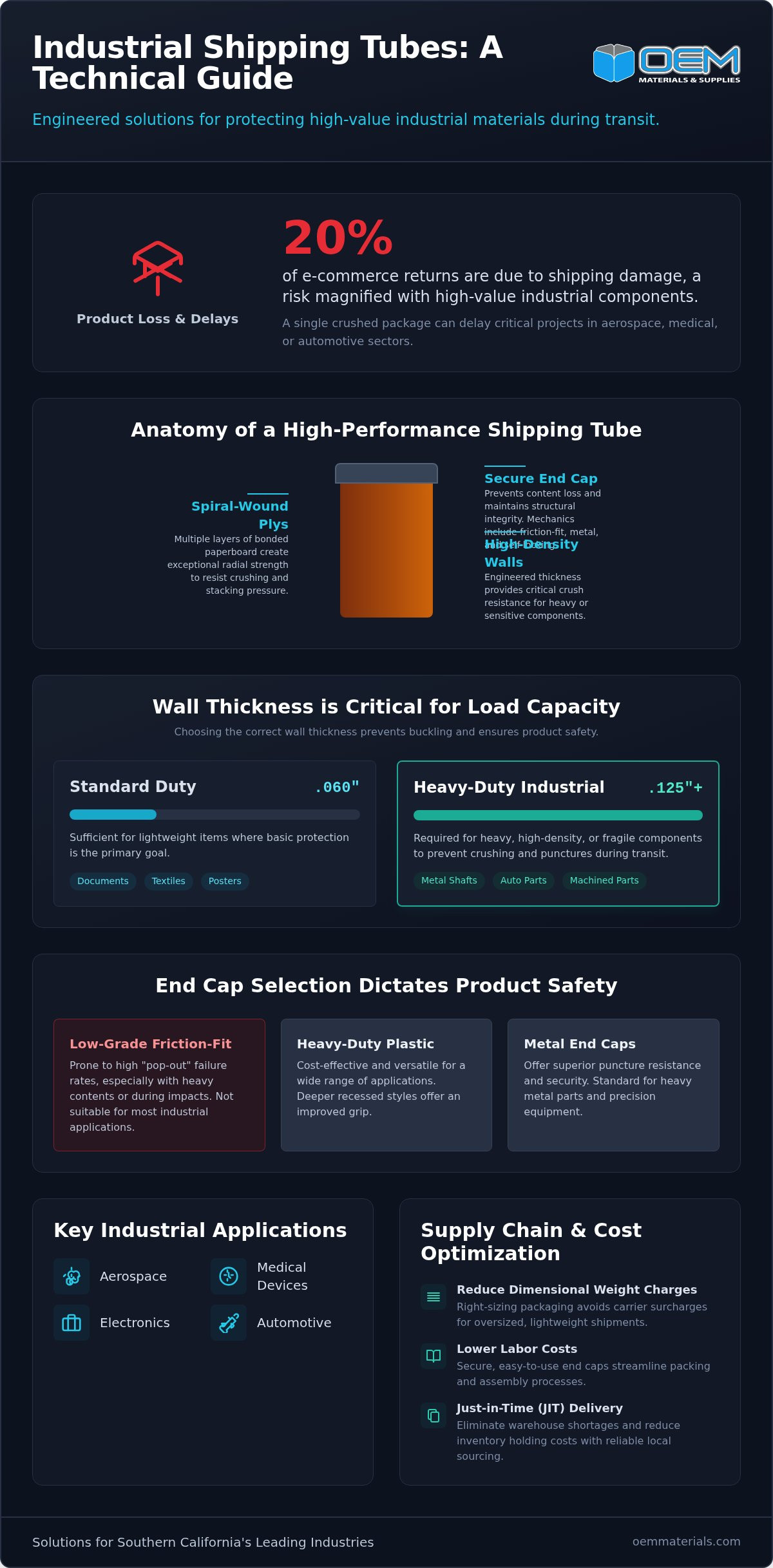
Nearly 20% of all e-commerce returns result from shipping damage, according to June 2026 data from ShipNetwork. In the industrial sectors of Los Angeles and Orange County, a single crushed package can delay a critical aerospace project or compromise a medical device shipment. Most operations managers agree that standard mailing supplies often fail when faced with the rigors of heavy-duty transit. You need a solution that prevents product loss without adding unnecessary labor or inventory bloat.
This article explains how to select the right industrial-grade shipping tubes with end caps to protect your high-value materials and improve your bottom line. You’ll learn the technical requirements for crush resistance and how to ensure cap security during the most demanding transport cycles. We will also examine the impact of 2026 dimensional weight rules and how Southern California manufacturers can use just-in-time delivery programs to eliminate warehouse shortages. By the end of this guide, you’ll have a clear framework for choosing packaging that safeguards your products and streamlines your packing process.
Key Takeaways
- Understand how high-density shipping tubes with end caps provide the structural integrity required to protect precision-machined parts and high-value materials.
- Identify the ideal wall thickness ranges to maximize crush resistance while minimizing unnecessary material weight for your specific products.
- Learn how to optimize your supply chain by right-sizing packaging to reduce dimensional weight charges and mitigate the impact of carrier surcharges.
- Discover the logistical advantages of local Southern California sourcing for rapid prototyping and reliable just-in-time delivery of packaging supplies.
- Evaluate how secure end cap mechanics can reduce labor costs by streamlining packing and assembly processes in the warehouse.
Understanding Industrial Shipping Tubes and Secure End Cap Mechanics
Industrial packaging requires more than just a container; it requires a structural system. An Industrial Shipping Tube is a high-density, spiral-wound paperboard cylinder engineered to withstand the axial and radial stresses of modern logistics. While the tube walls provide the primary protection, the system relies entirely on the integrity of the closure. Without a secure fit, the tube is vulnerable to structural collapse or content loss during transit.
High-quality shipping tubes with end caps are designed to function as a single unit. If the end cap is a weak point, the entire package is compromised. Standard friction-fit caps often fail because they lack the mechanical grip needed for heavy industrial components. In a warehouse environment, these caps can dislodge during sorting or impact, leading to total product loss. Professional operations require a variety of closure options, including heavy-duty plastic, metal, and recessed styles, to match the specific weight and dimensions of the cargo.
Anatomy of a High-Performance Shipping Tube
Spiral-wound construction involves bonding multiple plys of paperboard at an angle to create a rigid, hollow structure. This geometry provides exceptional radial strength, which is vital for stacking and resisting external pressure. Consistent inner and outer diameter tolerances are mandatory for a reliable seal. If the inner diameter varies by even a few thousandths of an inch, the end cap won’t seat correctly. A properly fitted cap prevents ovalization, a common failure where the tube end flattens under pressure and breaks the seal.
Why End Cap Selection Dictates Product Safety
Choosing between plastic and metal caps depends on the weight and fragility of the material inside. Plastic caps are versatile and cost-effective for many mailing tubes and cores used in manufacturing. Metal end caps offer superior puncture resistance and are the standard for heavy metal shafts or precision equipment. For maximum security, self-locking caps or recessed styles provide a deeper grip. In high-vibration shipping environments, additional stapling through the tube wall and into the cap flange is a common practice to prevent movement. Low-grade retail tubes frequently suffer from a high pop-out failure rate because their friction-fit caps cannot withstand the internal pressure of heavy contents shifting during transit.
Technical Specifications: Wall Thickness and Crush Resistance
Wall thickness is the most critical variable when determining the load-bearing capacity of industrial packaging. In the manufacturing sector, a standard mailing tube is often insufficient for protecting high-density components. Industrial-grade shipping tubes with end caps typically utilize wall thicknesses ranging from .060 to .125 inches. While a .060 wall may suffice for lightweight documents or textiles, heavy-duty applications involving metal shafts or automotive parts generally require a .125 wall or higher to prevent the tube from buckling under longitudinal pressure.
Calculating the required strength for stacked pallet shipments involves more than just measuring the weight of the product. You must account for the cumulative weight of the entire stack and the potential for shifting during transit. Industrial tubes are often tested using the ISTA 3A standard, which specifically evaluates elongated packages over 36 inches for drop, vibration, and impact resistance. If you are shipping via LTL, where the industry-wide damage rate is approximately 1.24%, choosing a thickness that exceeds your minimum weight requirement provides a necessary safety margin against crushing.
Measuring Wall Thickness for Industrial Applications
The distinction between light-duty mailing and heavy-duty industrial shipping lies in the radial strength of the cylinder. Aerospace and automotive components often have high point-load weights that can easily puncture thin-walled tubes. Testing methods for tube rigidity focus on sidewall crush resistance and the ability of the tube to maintain its shape when stacked. Thicker walls don’t just protect the contents; they ensure the end caps stay seated by maintaining the circularity of the tube ends under stress. For specialized requirements, you can consult with our engineering team for a technical assessment of your specific load requirements.
Material Grades and Environmental Durability
The structural integrity of a tube is also influenced by the fiber content of the paperboard. While recycled fibers are standard and environmentally responsible, virgin fiber content can be integrated to increase the strength-to-weight ratio for extreme applications. Environmental factors like moisture and humidity significantly impact paperboard performance. High humidity in non-climate-controlled warehouses can soften the adhesive bonds in spiral-wound tubes, reducing their crush rating by as much as 50%. Utilizing mailing tubes and cores with moisture-resistant coatings or specialized liners helps maintain structural stability in the variable climates of the Inland Empire and Orange County.
Industrial Applications for Shipping Tubes with End Caps
While retail suppliers often market cylinders for posters and blueprints, industrial operations require a much higher level of protection. In the manufacturing hubs of Los Angeles and Orange County, shipping tubes with end caps serve as critical protective shells for high-value, long-format components. Precision-machined metal rods, hydraulic shafts, and threaded pipes require rigid housing to prevent surface damage. Unlike standard cardboard boxes, the cylindrical geometry of a tube provides superior resistance to bending and localized impacts that could compromise the straightness of a machined part.
High-value industrial textiles and films also rely on these specialized containers. Materials like carbon fiber pre-preg, specialized optical films, and high-performance laminates cannot be folded or creased without losing their functional properties. Shipping these materials on a core inside a durable tube ensures they remain tensioned and protected from environmental contaminants. Beyond external shipping, many facilities in the Inland Empire use these tubes for internal warehouse storage. Organizing rolled materials in labeled tubes protects them from dust and forklift traffic while optimizing vertical rack space.
Aerospace and Automotive Logistics
Surface integrity is a non-negotiable requirement in aerospace and automotive supply chains. Even a minor scratch on a landing gear component or a drive shaft can lead to a part rejection and significant financial loss. Custom lengths are essential here, as oversized mechanical components rarely fit into stock packaging. Utilizing custom packaging design allows engineers to specify the exact diameter and length needed to minimize internal movement. This precision ensures that the product doesn’t act as a slide hammer against the end caps during transit, which is a primary cause of packaging failure in heavy-duty logistics.
Medical and Electronics Sector Requirements
The medical and electronics sectors present unique challenges regarding cleanliness and sensitivity. Diagnostic sensors and delicate electronic arrays often require a secondary protective layer to shield them from the vibration of parcel carrier sorting systems. In these applications, shipping tubes act as a rigid outer barrier for kitted components that are already wrapped in ESD-safe materials or foam. Cleanroom-compatible materials and debris-free manufacturing processes are vital to prevent contamination of sensitive diagnostic tools. Precise end cap placement is used to create a controlled internal environment, ensuring that high-sensitivity aerospace blueprints or medical sensors arrive in the exact condition they left the cleanroom.
Optimizing Shipping Costs and Warehouse Efficiency
Shipping efficiency is often measured by the ratio of product volume to total package volume. Because shipping tubes with end caps are inherently lightweight but occupy significant space, they are highly susceptible to dimensional weight (DIM) charges. As of July 2026, major U.S. carriers use a DIM divisor of 139 for domestic shipments. This means a lightweight tube can be billed at the rate of a much heavier item if the dimensions are not optimized. Selecting the narrowest viable diameter for your product directly reduces billable weight and mitigates the impact of carrier surcharges.
Carrier measurement rules in 2026 also require rounding every fractional inch up to the next whole number. This makes precision in tube length critical. A tube that is even a fraction of an inch longer than necessary can trigger a higher weight bracket or an additional handling surcharge. Warehouse managers can combat these costs by utilizing custom-cut lengths that match product dimensions exactly, avoiding the “dead space” that leads to inflated shipping invoices. For a detailed analysis of how right-sized packaging can impact your logistics budget, request a quote for a custom design consultation.
Labor Savings in High-Volume Packing
Warehouse throughput depends on the speed of the final seal. Snap-fit end caps allow for rapid assembly without the need for excessive taping, which reduces both material waste and labor hours. In high-volume environments, these small process improvements lead to significant operational gains. Ergonomic station design is also vital when handling heavy industrial tubes to prevent worker fatigue and repetitive strain injuries. Real-world packaging cost savings are often found in labor reduction through these cumulative efficiency gains rather than just material price points.
Load Stabilization for Tube Shipments
Transporting cylindrical items presents a unique logistical challenge because they tend to roll and shift during transit. To prevent load instability in a trailer, tubes must be bundled into secure, non-moving units. Using high-performance stretch film to secure these bundles to a pallet creates a unified block that resists shifting. To protect the tube ends from being crushed by high-tension transit straps, integrating edge and corner protectors is a best practice for long-haul shipments. This multi-layered approach ensures that the structural integrity of the tube and the security of the end cap remain intact throughout the supply chain.
Custom Solutions for Southern California Manufacturers
Proximity to your supplier is a significant competitive advantage in the high-stakes manufacturing environments of Los Angeles and Orange County. Sourcing shipping tubes with end caps locally reduces the logistical friction that often leads to production delays. When you work with a regional partner, you gain access to rapid prototyping services that allow for immediate testing of custom tube diameters and lengths. This agility is essential for OEMs needing to validate packaging for new product launches or specialized industrial components without waiting weeks for transcontinental shipments.
Local sourcing also provides a critical buffer against the evolving regulatory landscape in California. With SB 54 and SB 343 requirements taking effect in 2026, manufacturers must ensure their packaging materials, including plastic end caps, meet strict recyclability and weight reduction standards. A Southern California partner understands these regional mandates and can provide compliant materials that help you meet the May 2026 reporting deadlines while maintaining the structural integrity your products require.
Southern California Logistics Support
Our distribution network is specifically structured to support the diverse manufacturing hubs in San Diego, Riverside, and the Inland Empire. By maintaining local inventory, we can offer significantly shorter lead times than national commodity resellers. This regional focus ensures that your supply chain remains resilient against the volatility of long-haul freight markets. For a deeper understanding of how to evaluate local partners, refer to our guide on choosing a wholesale industrial packaging supplier for Southern California manufacturers.
Strategic Inventory Management
Managing the physical footprint of bulky packaging materials can strain warehouse capacity. Implementing packaging VMI (Vendor-Managed Inventory) programs allows you to offload the burden of stock monitoring and replenishment to your supplier. We monitor your usage rates and ensure that critical sizes are always available, eliminating the risk of stockouts during peak production periods. This system, combined with just-in-time (JIT) delivery, minimizes the amount of floor space dedicated to packaging storage, freeing up valuable square footage for manufacturing operations.
Beyond simple delivery, a full-service partner provides custom kitting services that integrate tubes with other essential materials. Whether your application requires specialized foam packaging inserts or custom-labeled closures, consolidating these requirements under one supplier simplifies procurement. This comprehensive approach transforms packaging from a commodity purchase into a strategic asset that supports operational efficiency and long-term growth for Southern California businesses.
Secure Your High-Value Shipments with Engineered Packaging
Protecting precision-machined parts and sensitive medical equipment requires a move away from generic mailing supplies. You’ve seen how specific wall thicknesses and secure end cap mechanics prevent the costly 20% damage rate common in e-commerce and LTL logistics. By right-sizing your shipping tubes with end caps, you don’t just protect the product; you also insulate your budget from inflated 2026 dimensional weight charges and carrier surcharges. Precise packaging is a direct investment in your bottom line.
OEM Materials & Supplies provides the technical expertise and local Southern California support needed to optimize your warehouse operations. Our team offers custom diameter and wall thickness options alongside reliable JIT delivery to keep your supply chain moving. We’re ready to design a solution tailored to your specific aerospace, automotive, or medical sector requirements. We focus on durability and accuracy so your team can focus on production.
Request a custom quote for industrial shipping tubes and end caps today. Please provide your product dimensions, weight, and annual usage to help us generate an accurate recommendation. We look forward to becoming your dependable packaging partner.
Frequently Asked Questions
What is the standard wall thickness for heavy-duty shipping tubes?
Standard industrial wall thickness typically ranges from .060 to .125 inches. For heavy-duty applications like metal shafts or automotive components, a .125-inch wall is the preferred baseline to ensure adequate crush resistance. Thinner walls may suffice for lightweight textiles or documents; however, industrial-grade protection requires the structural rigidity provided by thicker plys. Selecting the correct thickness is vital for maintaining the integrity of shipping tubes with end caps under stack loads.
How do I choose between plastic and metal end caps for industrial parts?
Plastic end caps are the standard choice for lightweight to medium-duty industrial products due to their versatility and lower cost. Metal end caps are required for heavy components or items with sharp edges that could puncture plastic. Metal closures provide superior structural support for the tube ends, preventing ovalization during handling. Your choice should depend on the total weight of the cargo and the specific puncture risks present in your supply chain.
Can shipping tubes be customized to specific lengths for oversized items?
Yes, shipping tubes can be customized to any specific length and diameter required for oversized mechanical parts. Custom lengths eliminate the dead space that often leads to inflated dimensional weight charges from carriers. This precision is especially important for aerospace and automotive manufacturers in Southern California who need to protect long-format components. Rapid prototyping allows for the creation of custom sizes that ensure a secure, engineered fit for unique product profiles.
What is the best way to secure end caps for heavy shipments?
The most effective way to secure end caps for heavy shipments is through a combination of mechanical locks and industrial stapling. Self-locking or recessed caps provide a deeper grip within the tube wall. For high-vibration environments or heavy metal parts, we recommend driving industrial staples through the tube into the cap flange. This prevents pop-out failures caused by internal contents shifting during transit, ensuring the package remains a single, structural unit.
Are industrial shipping tubes recyclable for corporate sustainability goals?
Industrial paperboard shipping tubes are readily recyclable and support corporate sustainability goals. However, the recyclability of the end caps depends on the material. Under California SB 343, recyclability claims are restricted to materials accessible to 60% of the state population. Most paperboard cylinders meet these requirements easily. We assist manufacturers in selecting compliant materials to meet the May 2026 reporting deadlines while maintaining the necessary protection for their high-value goods.
How do I prevent my shipping tubes from being crushed during palletized transit?
Preventing crush damage during palletized transit requires high-density wall specifications and proper load stabilization. Bundling tubes together using high-performance stretch film creates a unified block that resists shifting. You should also integrate edge protectors to distribute the pressure of transit straps, which can otherwise crush the tube ends. Maintaining the circularity of the tube is essential for keeping the end caps seated and protecting the internal components from external pressure.
Does OEM Materials & Supplies offer VMI for shipping tubes in Orange County?
OEM Materials & Supplies provides full Vendor-Managed Inventory (VMI) services for shipping tubes and other packaging supplies throughout Orange County. This program eliminates the need for you to maintain a large warehouse footprint for bulky cylinders. We monitor your stock levels and provide just-in-time delivery to ensure your production lines never face a shortage. This service is designed to improve supply-chain efficiency for manufacturers in the Los Angeles and Riverside hubs.
What information is needed to get an accurate quote for custom tubes?
To provide an accurate quote for custom shipping tubes with end caps, we require three primary data points. You should provide the exact dimensions of the product, its total weight, and your estimated annual usage. This information allows our engineers to recommend the ideal wall thickness and end cap style for your application. Providing these details ensures that the final recommendation balances structural protection with the need to minimize shipping costs and material waste.