
How much of your Southern California distribution budget is actually paying for product damage caused by inadequate protection for long or narrow components? Shipping industrial parts across Los Angeles and Orange County often results in bent shafts, scratched finishes, or compromised structural integrity when standard corrugated boxes fail to provide the necessary rigidity. Selecting the right custom tube packaging is not just about finding a container. It is about engineering a technical solution that withstands the physical demands of your specific supply chain.
You likely recognize that material waste and transit damage directly impact your bottom line and professional reputation. This article provides a practical guide on how to select, engineer, and optimize custom tube packaging to protect your industrial assets. We will cover accurate technical specifications for procurement, methods to reduce your warehouse footprint, and how vendor managed inventory (VMI) services prevent critical stockouts. This overview will help you improve shipping reliability and operational efficiency throughout the Inland Empire and Southern California.
Key Takeaways
- Understand the critical distinction between standard mailing tubes and high-strength industrial cores to prevent structural failure during transit.
- Learn how to specify the exact dimensions and wall thickness for custom tube packaging to ensure maximum crush resistance for heavy components.
- Discover industry-specific applications for protecting sensitive aerospace parts and medical devices with specialized tube designs.
- Streamline your Southern California supply chain by using vendor managed inventory to eliminate stockouts and optimize warehouse space.
- Leverage local prototyping and on-site consultations in Los Angeles and Orange County to ensure your packaging meets rigorous technical standards.
Defining the Role of Custom Tube Packaging in Industrial Supply Chains
Custom tube packaging serves as a critical barrier for elongated industrial components that are inherently difficult to secure in standard rectangular containers. For manufacturers in Los Angeles and Orange County, parts like drive shafts, hydraulic cylinders, and specialized extrusions require a form factor that matches their specific geometry. Using a shipping tube engineered for these dimensions prevents the structural bending or surface abrasions often seen in oversized packaging. Beyond simple protection, these tubes are foundational in the textile, film, and paper manufacturing sectors. In these industries, they function as high-strength winding cores that must maintain their shape under the extreme tension of high-speed production lines.
Mailing Tubes vs Industrial Cores
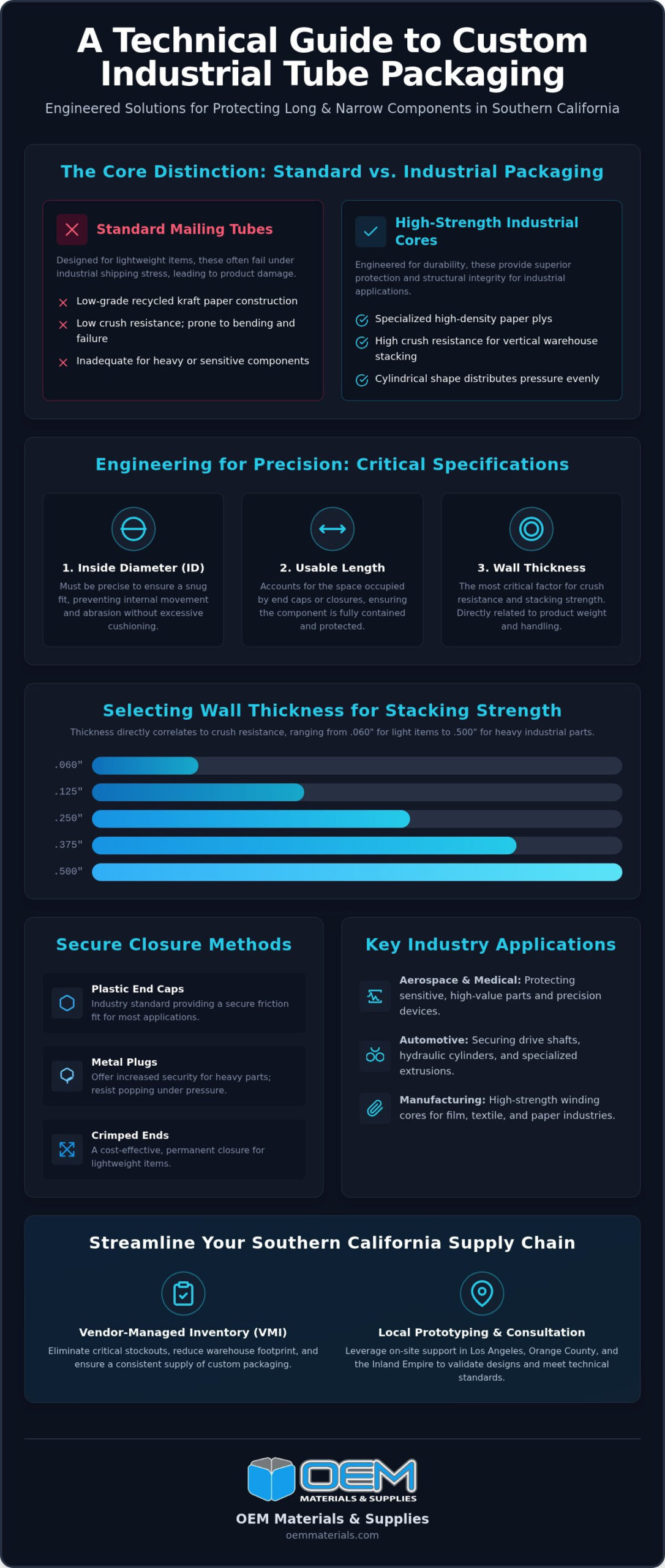
The primary difference between a lightweight mailing tube and an industrial core lies in the crush resistance and ply density. Standard tubes often use lower-grade recycled kraft paper designed for light documents or posters. In contrast, industrial cores utilize specialized high-density plys to withstand vertical stacking pressure in a warehouse. While a custom corrugated box is ideal for bulky, multi-part kits, a tube provides superior structural integrity for single, long items. The cylindrical shape naturally distributes external pressure. This makes the container less likely to collapse under the weight of other freight during transit through the Inland Empire or San Diego County.
The Advantages of Customization for OEMs
Precision is the main driver for selecting custom tube packaging. When a tube is engineered to the exact length and diameter of a part, you eliminate the need for excessive cushioning materials like bubble wrap or loose fill. This reduction in material volume directly lowers your shipping costs and minimizes labor time during the packing process. Secure end-caps are another vital consideration for heavy metal shafts or sensitive aerospace components. Custom end-caps ensure that heavy parts don’t punch through the bottom of the tube during handling. By standardizing these sizes, procurement managers can optimize palletization patterns. This ensures that every square inch of a truck or shipping container is used efficiently. This methodical approach to custom tube packaging supports lean manufacturing goals and reduces the overall cost of goods sold for Southern California OEMs.
Engineering Specs: Selecting the Right Dimensions and Wall Thickness
Specifying custom tube packaging requires a precise understanding of three primary dimensions: inside diameter (ID), usable length, and wall thickness. The inside diameter must provide enough clearance for the part to slide in easily without allowing excessive internal movement. Usable length is distinct from the overall length of the tube because it accounts for the space occupied by end closures. If your part is 48 inches long and you use deep-set plastic end caps, a 48-inch tube will be insufficient. Accuracy in these measurements ensures that your components remain stationary and protected throughout the Southern California logistics network.
Closure methods also dictate the final engineering of the tube. Plastic end caps are the industry standard for most applications, providing a secure friction fit. For heavier industrial parts, metal plugs offer increased security and resistance to popping out under pressure. Crimped ends are a cost-effective alternative for lightweight items, though they offer less structural reinforcement than capped designs. For manufacturers adhering to ASTM D3951 Standard Practice for Commercial Packaging, selecting the correct closure is vital for compliance and safety.
Calculating Required Wall Thickness
Wall thickness is the most critical factor in determining a tube’s crush resistance and stacking strength. Standard industrial tubes typically range from .060 to .500 inches in thickness. The required thickness depends on the weight of the product, the anticipated stacking height in the warehouse, and the shipping method. For example, a heavy steel rod requires a much thicker wall than a lightweight plastic extrusion to prevent the tube from collapsing during transit. Increasing the wall thickness significantly enhances the beam strength of the tube, preventing it from bowing when supporting long, heavy industrial shafts.
Material Options and Protective Liners
The choice between standard kraft paper and white litho plys often depends on the end-use environment. Kraft is the workhorse of industrial packaging, offering durability and high tensile strength at a lower cost. White litho is frequently used when high-visibility labeling or a cleaner aesthetic is required for medical or electronics sectors. For high-value components that are sensitive to vibration, integrating custom foam packaging inserts within the tube provides an additional layer of shock absorption. Specialized liners can also be added to provide moisture resistance or grease-resistant barriers for automotive parts. If you need assistance determining the exact specifications for a high-value part, you can request a technical consultation with our design team to ensure your custom tube packaging meets all performance requirements.
Strategic Applications Across Aerospace, Medical, and Automotive Sectors
In Southern California’s dense manufacturing landscape, custom tube packaging is a specialized tool for high-precision industries. Aerospace hubs in Los Angeles and medical device clusters in Orange County require packaging that does more than just contain a product. It must maintain strict cleanliness standards and provide rigid structural support for components that cannot tolerate even minor surface deflection. From turbine blades to sensitive laboratory sensors, the choice of a cylindrical protective barrier is often a technical requirement rather than a logistical preference.
Aerospace and Defense Protection
Aerospace manufacturers frequently utilize heavy-duty tubes to transport delicate turbine blades and hydraulic lines between specialized finishing facilities. These parts are often oversized or have irregular structural geometries that make traditional boxing inefficient. By customizing the tube length and wall thickness, engineers ensure that components remain suspended and secure during transit across the Inland Empire. For international shipments or long-haul freight, these tubes are often integrated with wood crates to provide a secondary layer of impact resistance. This hybrid approach meets rigorous defense standards for part protection while optimizing the total weight of the shipment.
Medical and Electronics Manufacturing
The medical and electronics sectors demand packaging materials that minimize debris and particulate contamination. In cleanroom environments, standard cardboard can shed fibers that compromise sensitive electronic assemblies or high-precision sensors. We provide tubes manufactured from low-dust materials specifically designed for non-sterile protective transport. These containers are essential for shipping laboratory glass and fragile optical components that require a high degree of crush resistance. To ensure accurate procurement and inventory tracking, these tubes can be paired with high-quality labels and ribbons for clear part identification and barcode scanning at the point of receipt.
Automotive and Industrial Components
Automotive supply chains in San Diego and Riverside rely on custom tube packaging for heavy, elongated parts such as drive shafts, steering columns, and exterior trim pieces. These components are prone to scratching or bending if packed in loose containers. Using a tube with a custom-fit interior prevents shifting and allows for dense palletization of similar parts. This specialized packaging also protects finished surfaces from grease or moisture when treated with protective liners. By selecting a solution tailored to the specific dimensions of the automotive component, manufacturers reduce the frequency of transit-related damage and improve the overall efficiency of their regional distribution networks.
Streamlining Operations via Vendor-Managed Inventory (VMI) for Mailing Tubes
Industrial tubes and cores are notoriously difficult to manage in a standard warehouse environment due to their bulk and awkward dimensions. For manufacturers in Riverside and Los Angeles, storing high volumes of custom tube packaging consumes valuable floor space that could be better utilized for production. Implementing VMI programs allows you to shift the burden of inventory management to your packaging partner. This strategic shift ensures that critical supplies are always available without tying up capital in excessive on-site stock. Local SoCal warehousing allows us to respond rapidly to fluctuations in your production schedule, providing a level of agility that distant suppliers cannot match.
The VMI Process for Industrial Packaging
Our VMI process involves consistent on-site monitoring of your inventory levels. Instead of your procurement team manually tracking dozens of SKUs, we use automated replenishment based on your actual usage rates. This model provides a just-in-time (JIT) delivery flow that is particularly beneficial for bulky items like long shipping tubes. By reducing the frequency of emergency orders and eliminating stockouts, VMI lowers the total cost of ownership for your packaging supplies. You pay for what you use, when you use it, while benefiting from the economies of scale provided by a wholesale industrial packaging partner with deep roots in the Southern California manufacturing sector.
Reducing Labor Through Kitting and Assembly
Operational efficiency is also gained by optimizing the labor spent at the packing station. We can pre-assemble your custom tube packaging with end caps or specialized foam inserts before they arrive at your facility. This reduces the number of touches required by your warehouse staff and significantly improves throughput on the packing line. When tubes are delivered as part of ready-to-use kits, your team avoids the time-consuming task of hunting for matching components. This organized delivery system minimizes handling time and ensures that every part is packed according to your engineering specifications every time. If you are ready to optimize your warehouse footprint and reduce procurement overhead, you can contact our supply chain specialists to design a custom inventory program for your facility.
Partnering with a Southern California Custom Packaging Supplier
Choosing a supplier for custom tube packaging involves more than comparing unit costs. For manufacturers in Los Angeles and Orange County, the logistical burden of shipping bulky, hollow containers can quickly erase any savings offered by distant national vendors. A local partnership provides a direct link between your production floor and the packaging design lab. This proximity allows for on-site consultations where engineers can physically inspect your components to determine the exact wall thickness and closure security required. This hands-on approach eliminates the guesswork common in remote procurement and ensures that the final product meets your technical requirements.
The Local Advantage in Southern California
Beyond simple logistics, local expertise in San Diego and Riverside ensures faster response times during urgent production spikes. When a sudden order requires a non-standard tube size, a regional partner can pivot production much faster than a vendor located halfway across the country. Lower freight costs are another significant benefit; shipping “air” inside empty tubes is expensive, and minimizing the distance between the factory and the warehouse is a primary method for reducing overhead. A full-service supplier also provides a single point of contact for your entire packaging suite. We manage everything from high-performance stretch film for pallet stability to heavy-duty custom crates for international freight. This consolidation simplifies your procurement process and ensures material compatibility across your entire supply chain.
Custom Design and Prototyping Services
Moving from a technical concept to a physical prototype is essential for protecting specialized industrial parts. Our prototyping services allow you to test custom tube packaging under real-world conditions before committing to a high-volume production run. You can evaluate how well a specific end-cap holds up under the weight of a metal shaft or verify that the interior diameter provides the necessary clearance for a sensitive sensor. To receive an accurate recommendation and quote, procurement teams should be prepared to provide specific data points:
- Exact product dimensions including length and maximum diameter
- Total weight per unit
- Anticipated annual usage volume
- Shipping destination and primary transit method
By providing these details, you enable us to engineer a solution that balances material costs with maximum protection. You can request a consultation to optimize your custom packaging design and ensure your components arrive at their destination without compromise.
Optimizing Your Industrial Supply Chain with Engineered Protection
Integrating custom tube packaging into your operations is a strategic move that addresses the specific physical and logistical demands of Southern California’s manufacturing sectors. By prioritizing technical engineering specs like wall thickness and crush resistance, you ensure that high-value components for the aerospace and medical industries arrive without damage. Moving beyond simple containment, these solutions facilitate streamlined warehouse management through vendor managed inventory (VMI) and just-in-time (JIT) delivery.
OEM Materials & Supplies has served manufacturers across Los Angeles, Orange County, and the Inland Empire for decades. Our expertise in specialized sectors allows us to provide more than just a product; we offer a partnership focused on reliability and operational efficiency. When you are ready to reduce transit damage and optimize your distribution footprint, our team is prepared to provide rapid prototyping and technical consultations tailored to your specific requirements.
To begin your optimization project, please Request a Custom Tube Packaging Quote. We look forward to helping you secure your supply chain and improve your operational throughput.
Frequently Asked Questions
What is the standard lead time for custom industrial mailing tubes?
Lead times for custom industrial tubes vary based on the complexity of your specifications and current production volume. We prioritize rapid prototyping for custom designs to ensure the engineering meets your technical requirements before starting a high-volume run. Because we serve manufacturers across Southern California from local facilities, we can often provide faster turnarounds than national vendors. We recommend contacting our team with your specific project details to receive a reliable production schedule.
Can custom tubes be made to specific lengths for oversized parts?
Yes, we manufacture custom tubes to the exact usable length required for your oversized industrial components. This precision eliminates the need for excess cushioning materials and prevents products from sliding within the container. Whether you are shipping long extrusions or specialized aerospace assemblies, we can engineer a solution that matches your part geometry. Custom sizing ensures your products remain secure while optimizing palletization efficiency in your regional distribution network.
What wall thickness is required for shipping heavy metal components?
Heavy metal components typically require a wall thickness between .125 and .500 inches to ensure adequate crush resistance. The specific thickness depends on the total weight of the part and the anticipated stacking height in your warehouse or transit vehicle. Thicker walls provide the necessary beam strength to prevent the container from bowing or collapsing under heavy loads. We analyze your product’s weight to recommend the most cost-effective thickness for maximum protection.
Are plastic or metal end caps better for industrial applications?
The choice between plastic and metal end caps depends on the weight and handling requirements of your component. Plastic caps are the industry standard for most lightweight to medium-weight applications due to their secure friction fit. However, metal plugs are often preferred for heavy metal shafts or sharp-edged parts to prevent the item from punching through the closure. Metal caps offer superior durability for the rigorous demands of inter-facility transport across Los Angeles and Orange County.
How does vendor-managed inventory work for packaging supplies?
Our vendor-managed inventory (VMI) programs involve on-site monitoring of your packaging supplies by our technical team. We track actual usage rates and trigger automated replenishment orders to prevent stockouts of critical custom tube packaging. This just-in-time delivery model reduces your on-site storage requirements and frees up valuable floor space in your Riverside or San Diego facility. It effectively shifts the burden of inventory management to us, allowing your team to focus on production.
Can I get custom-printed tubes for industrial identification?
We provide custom-printed tubes to facilitate clear part identification and branding for industrial manufacturers. This includes printing part numbers, barcode identifiers, or company logos directly on the tube surface. Clear identification is vital for high-precision sectors like aerospace and medical device manufacturing to ensure traceability throughout the supply chain. This service helps reduce picking errors and improves the efficiency of your receiving department by ensuring every component is clearly marked before it leaves the factory.
What information is needed to receive a custom tube packaging quote?
To provide an accurate custom tube packaging quote, we require the exact inside diameter, usable length, and weight of your product. Additionally, providing your anticipated annual usage volume and primary shipping method helps us determine the most efficient material specifications. Knowing whether the parts will be palletized or shipped via parcel carriers allows our engineers to recommend the correct wall thickness and closure type to minimize transit damage while controlling material costs.
Do you provide on-site packaging assessments for SoCal manufacturers?
Yes, we offer on-site packaging assessments for manufacturers located throughout Southern California, including Orange County and Los Angeles. Our technical specialists visit your facility to inspect your products, observe your packing process, and identify opportunities for cost savings or damage reduction. These consultations allow us to design engineered solutions like custom foam inserts or high-strength cores that are perfectly tailored to your operational environment and the specific requirements of your regional supply chain.