
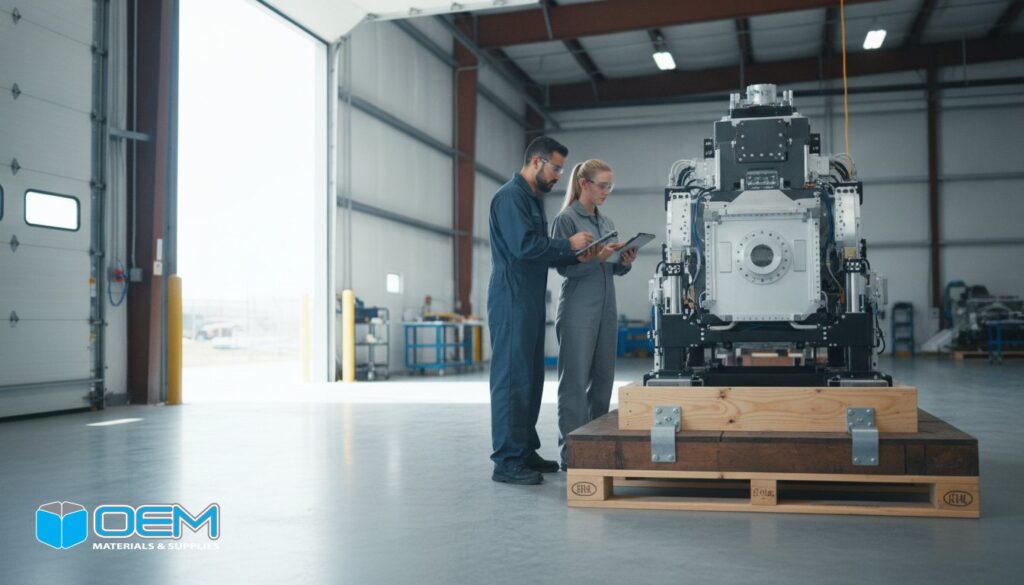
A standard 48×40 pallet is often the most expensive component of your supply chain, not because of its unit cost, but because of the product damage it fails to prevent. For manufacturers in Los Angeles and Orange County handling high-value machinery or sensitive electronics, relying on commodity-grade shipping platforms instead of custom wood pallets often leads to costly transit failures and labor-intensive packing workarounds. It’s no secret that specialized equipment requires more than a one-size-fits-all solution to survive the rigors of global logistics.
This guide demonstrates how custom wood pallets serve as the engineered foundation of a secure packaging system that reduces labor costs and ensures total compliance with international shipping standards like ISPM 15. We provide a technical overview of how precision-designed wood packaging addresses the unique requirements of the aerospace and medical device sectors. You’ll see how tailored designs and local inventory programs streamline operations, providing stable loads and reliable protection for your most critical shipments without the overhead of excess warehouse space.
Key Takeaways
- Identify the specific logistical indicators that signal when standard GMA pallets are insufficient for protecting specialized industrial machinery.
- Understand the structural differences between stringer and block designs to optimize the load capacity and durability of your custom wood pallets.
- Ensure 100% compliance for international exports by following current ISPM 15 heat treatment requirements and IPPC marking standards.
- Reduce warehouse overhead in Los Angeles and Orange County by leveraging Vendor-Managed Inventory and Just-In-Time delivery programs.
- Evaluate the cost-to-strength ratio and environmental benefits of wood compared to plastic alternatives for high-volume manufacturing sectors.
Beyond the Standard 48×40: When to Specify Custom Wood Pallets
Standard GMA pallets serve a vital purpose in retail distribution, but they are rarely the right fit for specialized industrial machinery. While standard pallet dimensions are optimized for consumer goods, they often lead to vulnerabilities when used for high-value aerospace or medical equipment. In these sectors, relying on custom wood pallets becomes a necessity when the safety of the cargo is at stake. If your team is using excessive stretch film or makeshift wood bracing to bridge the gap between a product and its base, you’re likely facing a structural mismatch that invites damage.
Identifying the need for a custom solution usually starts with analyzing your arrival data. Look for recurring patterns of crushed corners, shifting loads, or cracked deck boards. These aren’t just shipping accidents; they’re symptoms of a pallet footprint that fails to stabilize the center of gravity. When the pallet matches the load, the entire unit moves as a single, secure block. This significantly reduces the kinetic energy that causes internal component failure during transit.
Addressing Non-Standard Product Dimensions
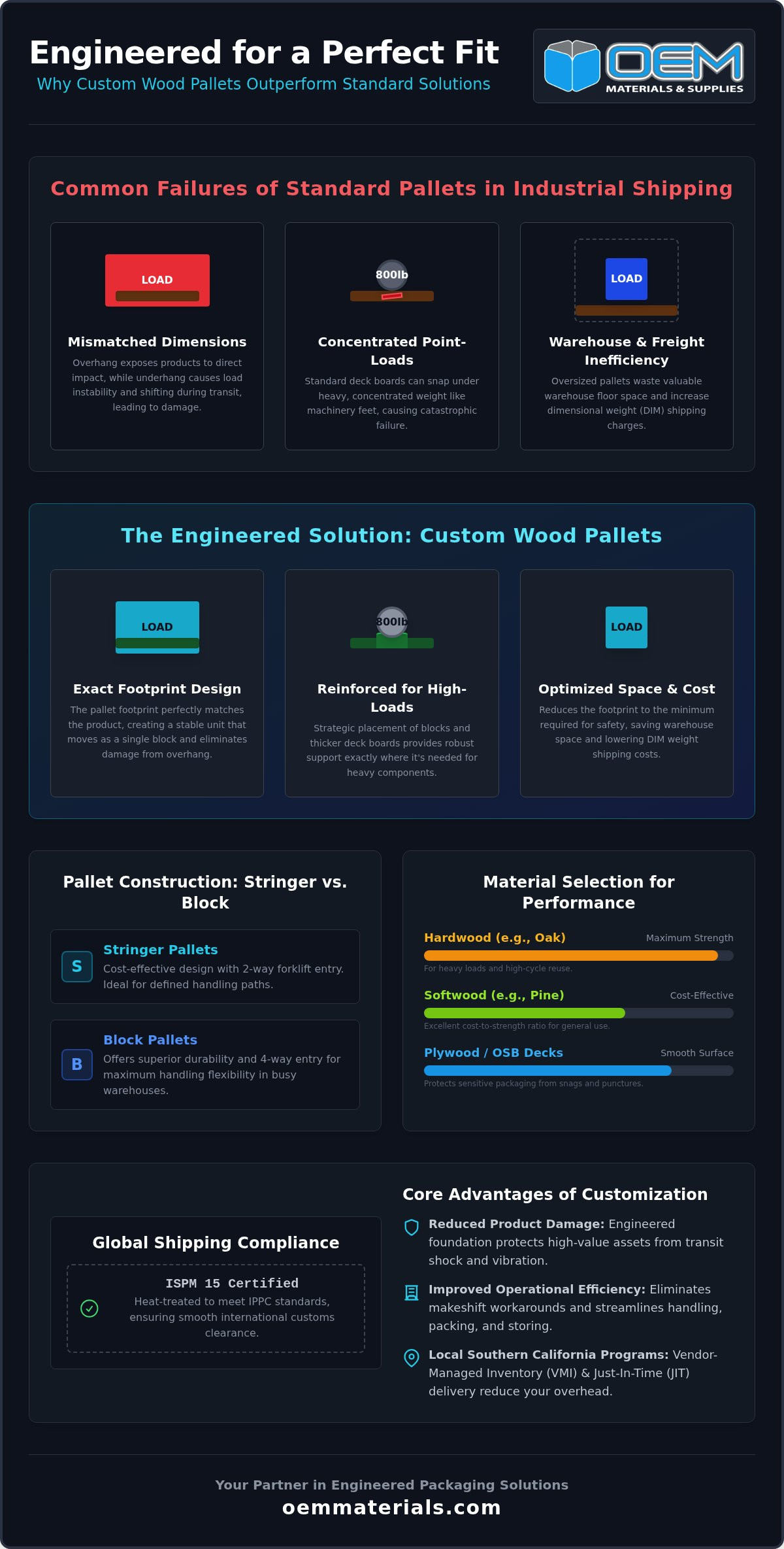
Overhang is a primary driver of shipping damage in industrial sectors. When a component extends beyond the pallet edge, it loses the structural buffer zone provided by the wood. Conversely, significant underhang allows the load to shift within a container, leading to instability. For oversized aerospace components or long medical imaging beds, custom wood pallets are engineered to match the exact footprint of the part. This prevents contact with other freight and secures the load for the duration of the journey. We also design specifically for heavy point-loads; while a standard pallet might handle 2,500 pounds of distributed weight, a concentrated 800-pound motor mount can easily snap a standard deck board if the support isn’t reinforced.
Improving Warehouse and Freight Efficiency
Operating efficiency in Southern California facilities depends heavily on maximizing floor space. In warehouses across Orange County and Los Angeles, every square foot is a significant expense. Precise custom packaging design ensures that pallets don’t occupy more space than necessary in your racking systems. This precision also helps manage dimensional weight (DIM) charges. Carriers calculate costs based on the volume a shipment occupies; by reducing the pallet footprint to the minimum required for safety, you avoid paying for the transport of empty air. Additionally, custom designs ensure compatibility with your specific forklift and conveyor systems, preventing the handling errors that often occur with irregular, non-standardized loads.
Engineering for Performance: Materials and Construction of Custom Pallets
Engineering a pallet is a matter of physics and structural integrity, not just carpentry. High-value industrial machinery requires a precise calculation of static versus dynamic load capacities. Static capacity refers to the weight a pallet supports while stationary on a flat floor or in a racking system. Dynamic capacity accounts for the significant forces exerted when a forklift accelerates, turns, or encounters uneven surfaces. For heavy industrial loads, we often specify hardwood species like oak to ensure deck boards don’t flex or fail under concentrated pressure. Engineering deck board spacing is equally critical; for products with small footprints or heavy caster wheels, narrow spacing prevents the load from dipping between boards, which is a common cause of structural failure during transit.
Material Selection for Durability and Cost
Softwoods like Southern Yellow Pine are cost-effective for many general applications, but sensitive manufacturing sectors require precision materials. Kiln-dried lumber is essential for moisture-sensitive electronics to prevent warping or mold growth within sealed shipments. For medical device packaging, utilizing plywood or OSB decks provides a smooth, snag-free surface that prevents damage to primary packaging. These material choices also dictate compliance with ISPM 15 regulations, which require specific heat treatment to prevent the spread of pests in international trade. The grade of wood used directly impacts the pallet’s longevity; high-grade lumber maintains its structural integrity through more reuse cycles, offering better long-term value for closed-loop supply chains.
Structural Design Features
The choice between stringer and block construction dictates how efficiently a load moves through your facility. Stringer pallets use solid wood boards running the length of the pallet to support the deck. They are typically two-way entry, though notched stringers allow for partial four-way access. Block pallets utilize individual wood blocks, providing true four-way entry for forklifts and pallet jacks. This versatility is critical in congested Southern California warehouses where maneuverability is often limited. To prevent lead-board damage from forklift tines, we often incorporate chamfered edges, which allow the forks to slide over the wood rather than impacting it directly.
Beyond the base structure, we often integrate custom wood pallets with other protective elements like custom foam packaging to dampen vibration. For high-impact transport, we reinforce joints with specialized fasteners or integrate the pallet directly into the base of wood crates. This holistic approach ensures the pallet is a functional component of a custom packaging design. If you need to determine the specific load requirements for your equipment, you can request a technical consultation to review your dimensions and weight distribution.
Custom Wood Pallets vs. Alternatives: A Performance Comparison
Selecting the right shipping platform requires a balance between structural necessity and total cost of ownership. While plastic and metal options exist, custom wood pallets remain the industrial standard for heavy-duty manufacturing due to their superior cost-to-strength ratio. Wood provides a high degree of frictional resistance, which prevents loads from shifting as easily as they might on smoother plastic surfaces. This is a critical safety factor when transporting high-value machinery through the varied terrain of the Inland Empire and San Diego County. Additionally, wood is infinitely customizable. Unlike plastic pallets, which require expensive molds and high minimum orders, wood can be engineered to any dimension to support unique equipment footprints without a massive upfront investment.
Wood vs. Plastic Pallets in Industrial Settings
Industrial environments often dictate material choice based on hygiene and durability. Plastic pallets are the necessary alternative for cleanroom applications in the medical device and pharmaceutical sectors because they don’t shed particles and are easy to sanitize. However, for the high-impact world of aerospace and automotive manufacturing, wood offers better repairability. If a deck board on a wood pallet cracks, it can be replaced; a cracked plastic pallet usually requires a total replacement. This repairability extends the life of the unit in closed-loop systems, providing a more sustainable long-term solution for local distribution. Wood also integrates seamlessly with other protective materials, such as edge protectors and stretch film, to create a unified load.
Hybrid and Remanufactured Options
Sustainability is a primary concern for Southern California supply chains, especially with the finalized regulations of California SB 54. As of May 1, 2026, reusable wood pallets are exempt from many of the registration and fee requirements that affect single-use packaging. This makes a well-designed, reusable wood system an attractive option for meeting corporate environmental goals. Many firms also utilize remanufactured pallets to reduce costs. These are built using reclaimed components from retired units, providing a functional solution for non-critical shipping or one-way freight. While they may not offer the same aesthetic finish as new lumber, they meet rigorous industrial load standards when engineered correctly.
For complex logistics, we often design custom wood pallets as part of a comprehensive kitting solution. This might involve mounting custom foam packaging directly to the pallet deck or sizing the wood base to fit perfectly inside heavy-duty corrugated boxes. This integrated approach ensures that every layer of protection works together, minimizing the risk of internal component failure. Reviewing your current pallet specifications against your actual load requirements often reveals opportunities for significant operational efficiency and long-term material savings.
Regulatory Compliance and Global Shipping Standards
Non-compliance is a leading cause of shipment rejection at the Port of Los Angeles and the Port of Long Beach. For international exports, custom wood pallets must adhere to ISPM 15 standards to prevent the cross-border movement of wood-boring pests. Failure to display the correct markings can result in the immediate quarantine or return of your entire shipment, leading to cascading supply chain delays and significant financial penalties. As of January 1, 2026, the USDA has resumed full enforcement of the ISPM 15 hyphen requirement. This means every IPPC stamp must clearly display the hyphen between the country code and the facility code, or it will be deemed non-compliant at the port of entry.
The ISPM 15 Certification Process
The heat treatment (HT) process involves heating the wood core to at least 56°C (132.8°F) for a minimum of 30 continuous minutes. This method is preferred in the medical and aerospace sectors because it eliminates biological threats without using chemical fumigants like methyl bromide, which can leave residues on sensitive equipment. For companies shipping to the European Union, an EU Declaration of Conformity under Article 39 is also required as of August 12, 2026. Maintaining accurate documentation and a clear audit trail for every batch of heat-treated lumber is a standard operating procedure for our quality management teams, ensuring your logistics stay moving through San Diego and Los Angeles customs checkpoints.
Specialized Industry Standards
Compliance extends beyond international law into industry-specific technical requirements. In automotive manufacturing, pallets must often meet precise footprint and strength specifications to integrate with automated assembly lines. Medical device manufacturers require pallets that support sterile containers without risk of splintering or contamination, often necessitating the use of higher-grade lumber or specific deck designs. For electronics, we consider how the pallet interacts with ESD packaging to ensure static discharge doesn’t damage internal components. Using custom wood pallets allows for the integration of specialized materials that meet these technical benchmarks while maintaining the structural integrity required for heavy-duty freight.
Navigating these requirements requires a partner who stays current with shifting global trade laws and technical specifications. If you are preparing for an international export or need to verify your current packaging compliance, contact us for a regulatory consultation and quote to ensure your shipments move through customs without friction.
Optimizing Procurement: Custom Pallet Programs in Southern California
Procurement of custom wood pallets often presents a significant logistical challenge for high-volume manufacturers. Pallets are bulky and consume valuable warehouse space that is better utilized for production. In the high-rent industrial corridors of Orange County and Los Angeles, space optimization is a financial necessity. Transitioning from a transactional purchasing model to a managed inventory program allows firms to reclaim floor space while ensuring they never face a line-down situation due to an inventory shortage.
Vendor-Managed Inventory for Industrial Facilities
A Vendor-Managed Inventory (VMI) program shifts the burden of stock monitoring to your packaging partner. We utilize your usage data to trigger automated replenishment, maintaining a consistent supply of pallets at your facility without the need for excessive on-site storage. This model improves cash flow because you only pay for the inventory as it is consumed. For manufacturers in San Diego and the Inland Empire, this approach eliminates the safety hazards associated with large pallet stacks. By leveraging our local warehousing, you expand your effective storage capacity without increasing your facility lease costs.
Designing Your Custom Pallet Solution
Starting a project requires precise technical data to ensure structural integrity. When specifying custom wood pallets, our engineering team requires the exact product dimensions, total weight, and projected annual usage. We also evaluate the handling environment; for instance, will the load be stored in high-bay racking or stacked in a shipping container? This information allows us to provide a custom packaging design that minimizes material costs while maximizing protection.
Integrated kitting is a proven strategy for reducing labor costs on the assembly line. Instead of sourcing pallets, custom foam packaging, and corrugated boxes separately, we provide a unified assembly. Your team receives the pallet with foam inserts already installed and the outer container staged for immediate use. This reduces packing time and streamlines the entire procurement process. For high-volume sectors, we offer Just-In-Time (JIT) delivery to align with your daily production schedule. If your current operation faces rising labor or storage expenses, we can conduct a site assessment at your Southern California facility to identify specific optimization opportunities.
Securing Your Supply Chain Foundation
Transitioning to precision-engineered shipping platforms is a strategic move that addresses the root causes of shipping damage and logistical friction. By matching the structural integrity of your base to the specific technical requirements of your equipment, you eliminate the risks associated with overhang and improper load distribution. Implementing custom wood pallets ensures your high-value cargo is protected by a design that adheres to both industrial load standards and international trade regulations like ISPM 15.
We provide local support for manufacturers across San Diego, Riverside, and Orange County, offering specialized expertise in aerospace and medical packaging compliance. Our integrated VMI and JIT delivery programs are designed to optimize your facility space and reduce inventory overhead, allowing you to focus on production rather than pallet storage. These managed solutions provide the stability and reliability required for complex global logistics.
To begin optimizing your logistics and reducing transit risks, request a custom pallet quote and design consultation today. We recommend providing your product dimensions, weight, and annual usage to help our engineering team develop the most efficient and cost-effective recommendation for your specific application. We look forward to supporting your operations.
Frequently Asked Questions
What is the standard lead time for custom wood pallets in Southern California?
Lead times for custom wood pallets in Southern California vary based on the complexity of the design and the required volume. Rapid prototyping for new designs is often completed quickly to validate structural integrity before full production begins. For established programs, lead times are managed through Just-In-Time (JIT) delivery and Vendor-Managed Inventory (VMI) services. These programs ensure that manufacturers in Los Angeles and Orange County have a consistent supply without waiting for standard production cycles.
How much weight can a custom-designed wood pallet safely support?
The weight capacity of a custom-designed wood pallet is determined by the specific engineering of its deck boards and support structure. A well-engineered pallet can support several thousand pounds of static weight, but the dynamic load capacity is the more critical metric for transport. We calculate these limits based on the distribution of the product’s weight and the specific wood species used. Hardwoods like oak are often selected for the heaviest industrial machinery to prevent structural failure.
What information is required to get an accurate quote for custom pallets?
To provide an accurate quote for custom wood pallets, we require specific technical data including the dimensions and weight of your product. It is also essential to know the annual usage volume and the specific handling environment, such as whether the pallets will be used in high-bay racking or for international export. This information allows our engineering team to recommend the most cost-effective materials and construction methods while ensuring the safety of your high-value cargo.
Do custom wood pallets need to be heat treated for domestic shipping?
Heat treatment is generally not a legal requirement for domestic shipping within the United States. However, ISPM 15 compliance is mandatory for all wood packaging moving across international borders, including shipments from ports in Los Angeles and San Diego. Some domestic manufacturers in the medical and electronics sectors still specify heat-treated lumber to reduce the risk of mold or biological contamination. We provide both standard and heat-treated options based on your specific industry compliance needs.
Can custom pallets be designed for use in automated storage and retrieval systems?
Yes, custom pallets can be engineered specifically for use in automated storage and retrieval systems (ASRS). These systems require much tighter dimensional tolerances and higher structural rigidity than standard manual handling. Block pallets are frequently preferred for automation because they provide true four-way entry and consistent footprints. Our design process ensures that every pallet interacts seamlessly with your specific conveyor and racking sensors, preventing costly system jams or handling errors in high-volume facilities.
What is the difference between a stringer pallet and a block pallet for heavy loads?
The primary difference lies in the support structure and entry access for forklifts. Stringer pallets use solid wood boards running the length of the pallet and are typically two-way entry, offering a cost-effective solution for many industrial loads. Block pallets utilize individual wood blocks at the corners and center, providing true four-way entry. This makes block pallets more versatile for heavy loads and easier to maneuver in congested warehouses throughout the Inland Empire, San Diego, and Riverside.
How do custom pallets help in reducing overall shipping and labor costs?
Custom pallets reduce overall costs by eliminating product damage and optimizing freight efficiency. When a pallet is engineered to match the product dimensions, it prevents overhang and shifting, which are the leading causes of transit failures. Additionally, precise sizing helps avoid dimensional weight (DIM) surcharges from carriers. Managed programs also lower labor costs by delivering pre-assembled packaging kits directly to your production line, allowing your team to focus on manufacturing rather than packaging assembly.