
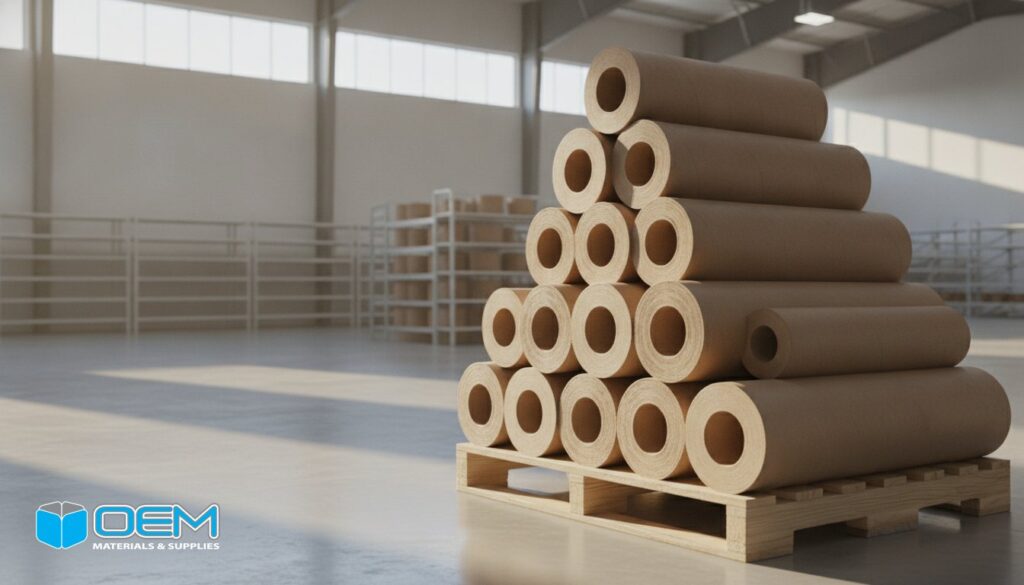
How much does a single collapsed paper core actually cost your production line when high-speed winding equipment grinds to a halt? For manufacturers across Southern California, the frustration of inconsistent tube strength is more than a minor inconvenience; it is a direct threat to operational efficiency and product integrity. Sourcing reliable industrial paper cores Los Angeles manufacturers can trust is often the difference between a seamless shift and an afternoon spent clearing jammed machinery or damaged products.
We understand that you cannot afford the delays caused by out-of-state suppliers or the inventory stockouts that freeze production. This article will help you select the right industrial paper cores for high-speed winding and streamline your Southern California supply chain. We will examine the critical technical specifications for high-strength tubes, the logistical benefits of a local partner, and how vendor-managed inventory can reduce your storage costs while maintaining a consistent flow of materials for your facility.
Key Takeaways
- Learn how selecting the correct core strength prevents material waste and avoids expensive machinery downtime during high-speed production cycles.
- Understand how inner diameter, outer diameter, and wall thickness determine the crush resistance for industrial paper cores Los Angeles manufacturers require.
- Discover why specialized technical requirements vary significantly across sectors like textiles, flexible packaging, and plastic film converting.
- Identify the logistical advantages of local Southern California sourcing and vendor-managed inventory to eliminate long lead times.
- Explore how a technical partnership provides access to custom packaging design and integrated supply chain solutions for specialized needs.
Understanding the Critical Role of Industrial Paper Cores in Production
Industrial paper cores serve as the structural backbone for rolled materials. They are not simple cardboard tubes; they are high-strength, engineered components designed to withstand intense mechanical stress. When a core fails, the results are immediate and expensive. Product damage, material waste, and extended machinery downtime can derail an entire production shift. Manufacturers across Southern California rely on these cores to maintain the integrity of their finished goods from the winding stage through final distribution. Sourcing industrial paper cores Los Angeles businesses can depend on requires an understanding of how these tubes perform under pressure.
Unlike standard mailing tubes designed for document protection, industrial-grade cores are engineered for load-bearing and rotational stability. Primary industries in Los Angeles County, including aerospace, automotive, and flexible packaging converters, require specific tolerances that common retail tubes cannot meet. A failure in a medical-grade film roll or an aerospace composite wrap is more than a packaging issue; it is a manufacturing disaster. High-strength cores provide the necessary rigidity to support thousands of pounds of material without buckling or losing dimensional accuracy.
Why Core Quality Impacts High Speed Winding
High-speed winding equipment exerts significant centrifugal force on the core during operation. As the roll diameter increases, the torque and speed create a demanding environment where minor defects become catastrophic. If the core has inconsistent wall thickness, vibration occurs. This vibration often leads to core slippage on the spindle, causing uneven winding and product uniformity issues. Maintaining a precise inner diameter is critical for a secure spindle fit. This ensures the core stays centered and stable, allowing for maximum machine speed without the risk of material telescoping or equipment damage.
Preventing Roll Collapse and Material Distortion
Heavy-duty materials like textiles or industrial films generate immense radial pressure as they are wound. This pressure pushes inward toward the center of the roll with incredible force. If the core lacks sufficient crush resistance, it will buckle or collapse entirely, making the material impossible to unwind. Environmental factors in the Inland Empire or Los Angeles warehouses, such as high humidity, can also soften standard paper fibers. High-quality industrial cores utilize moisture-resistant adhesives to prevent this softening while maintaining structural integrity. For sensitive thin-film applications, the surface smoothness of the core is equally vital. Any bump or seam on the core surface can telegraph through the layers of film, leaving permanent marks and rendering the inner layers of the product unusable.
Key Technical Specifications for High Performance Paper Cores
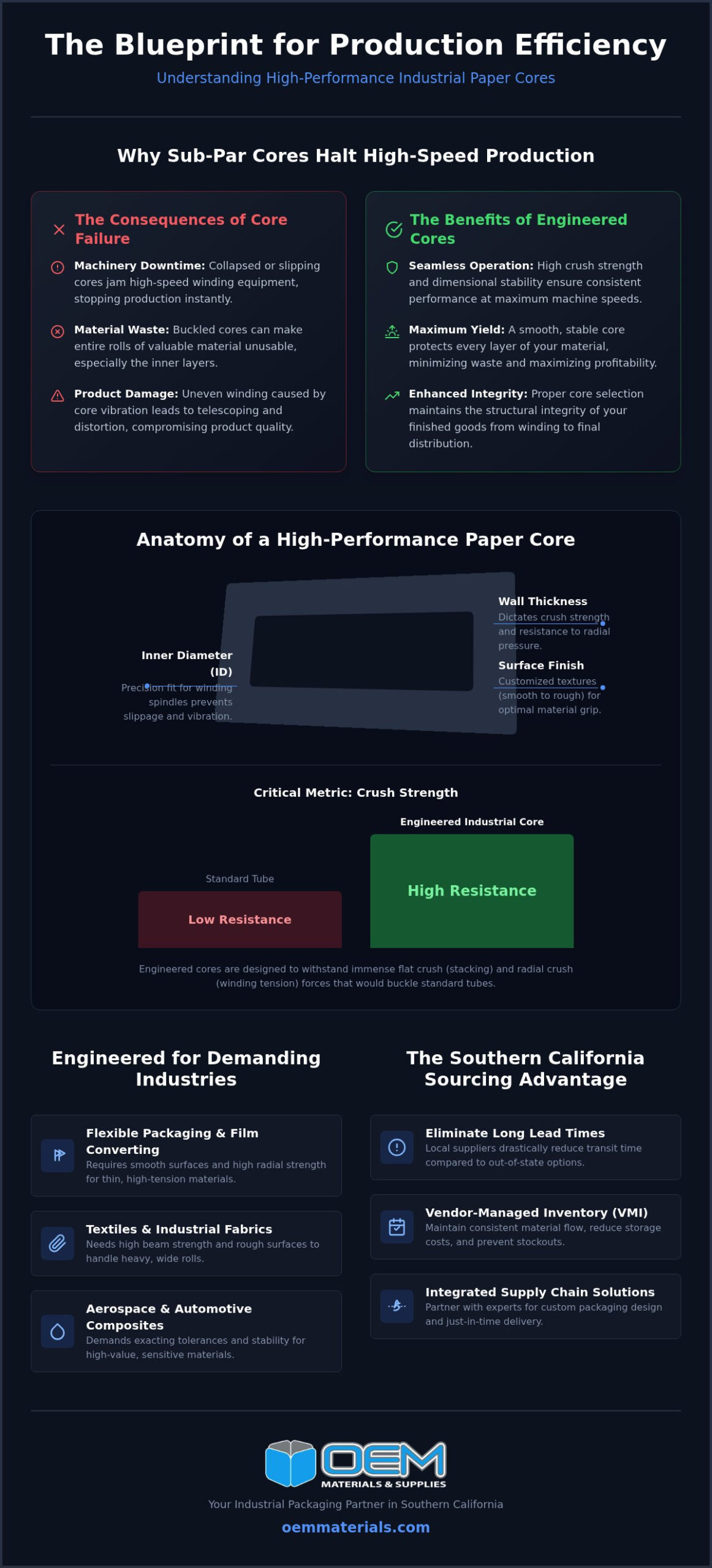
Selecting the right industrial paper cores Los Angeles manufacturers need requires more than just picking a length and diameter. Precision engineering is essential. The performance of a core is defined by three primary dimensions: the inner diameter (ID), the outer diameter (OD), and the wall thickness. The ID must match your winding spindle with tight tolerances to prevent mechanical slippage or loading issues. The wall thickness, combined with the density of the paperboard, dictates the tube’s ability to withstand the immense pressure of a full material roll without collapsing.
Surface finish is another technical variable that impacts production. Depending on the material being wound, you may require a specific texture to ensure proper “grab” at the start of the winding process. Finishes range from rough-ground surfaces for heavy textiles to mirror-polished finishes for sensitive medical films. These specifications ensure the material transfers smoothly to the core without slipping or creating surface defects on the inner layers of the product.
Calculating Required Crush Strength
Crush resistance is the most critical metric for core performance. In industrial settings, we differentiate between flat crush and radial crush strength. Flat crush measures the tube’s resistance to pressure applied from the sides, which is vital for stacked warehouse storage. Radial crush measures the ability to resist the inward pressure generated by the material as it is wound under tension. If you are winding heavy-duty textiles or high-tension plastic films, you must match the PLI (pounds per linear inch) rating of the core to the total expected roll weight. High-density paperboard plies significantly improve beam strength, which prevents long rolls from sagging or bowing during transport. When your application requires specific tolerances, consulting with a technical expert can ensure your cores meet the necessary PLI requirements for your specific machinery.
Materials and Adhesive Engineering
The rigidity of a multi-ply spiral wound core depends heavily on adhesive engineering and material selection. While many cores use recycled fiber to meet sustainability goals, the bond between the plies determines the final structural integrity. Specialized industrial glues create a monolithic structure that resists delamination even under high torque. Environmental conditions in Southern California, such as fluctuating humidity in non-climate-controlled facilities, can impact paperboard performance. High-quality adhesives act as a moisture barrier, maintaining core rigidity even when moisture levels shift. This prevents the core from softening, which is a leading cause of roll collapse in long-term storage.
Selecting the Right Core for Specific Industrial Applications
The diverse manufacturing base in Southern California means that a one-size-fits-all approach to core selection is insufficient. For converters in the flexible packaging sector, the requirement for industrial paper cores Los Angeles suppliers provide often centers on surface integrity. These manufacturers wind thin plastic films that are highly sensitive to surface irregularities. Any minor seam or “bump” on the core can telegraph through thousands of feet of film, leading to material waste in the inner layers of the roll. Maintaining a smooth, consistent surface is the only way to protect the value of the wound material.
Industrial tape and metal foil producers face a different challenge: extreme radial pressure. As these high-tension materials are wound, the inward force can crush a standard tube. These applications require ultra-high-density mailing tubes and cores with specialized adhesives to maintain a consistent inner diameter throughout the production run. Similarly, medical device and electronics manufacturers require cores that meet strict cleanliness standards. In these environments, we provide cores manufactured to minimize particulate shedding, ensuring they are compatible with cleanroom protocols for sensitive components.
Aerospace and Automotive Applications
Los Angeles and Orange County are hubs for aerospace innovation, where materials like carbon fiber pre-preg are standard. Winding these expensive composites requires cores with exceptional dimensional stability. Because these materials are often stored in specialized cold environments, the cores must resist warping or shrinking that could distort the material weave. Heavy industrial automotive components also demand high-strength tubes that can support significant weight without bowing. This ensures that the material remains perfectly aligned for automated assembly lines, preventing the feed errors that cause production stops.
Textile and Paper Conversion Requirements
The garment district and textile converters throughout Southern California utilize specific core diameters, typically ranging from two to three inches, for fabric rolls. Using custom lengths is a practical strategy to reduce material overhang. When a core is too long for the fabric width, the exposed ends are susceptible to damage during handling or shipping, which can lead to edge tears in the material. Many operations also utilize colored inner or outer liners. This simple addition allows warehouse teams to identify different material types or grades at a glance, improving inventory accuracy and reducing picking errors in high-volume distribution centers.
Sourcing Logistics: Inventory Management for SoCal Manufacturers
Sourcing bulky components like the industrial paper cores Los Angeles manufacturers require presents a unique set of logistical challenges. Because these tubes are essentially hollow, you are often paying to ship air when ordering from out-of-state vendors. Beyond the cost, long-distance transit increases the risk of moisture absorption or physical damage during multiple cross-docking maneuvers. By partnering with a local supplier with strategic warehousing in Orange County and Los Angeles, you stabilize your lead times and protect your production schedule from the delays common with national carriers. This local proximity allows for a more responsive supply chain, where urgent production changes can be accommodated without the week-long delays associated with cross-country shipping.
Implementing a Vendor Managed Inventory Program
Establishing a program through OEM Materials & Supplies VMI services is the most effective way to eliminate the risk of stockouts. We work with your team to determine precise minimum and maximum stock levels based on your historical usage and production forecasts. This data-driven approach shifts the responsibility of inventory tracking from your procurement team to our technical experts. It reduces the administrative burden of constant purchase order cycles and ensures you always have the right core specifications on hand. When production spikes occur, the VMI system automatically triggers replenishment, providing a safety net that standard ordering processes lack.
Optimizing Lead Times and Shipping Costs
Cores are low-density, high-volume items that are highly sensitive to freight cost fluctuations. Sourcing from a partner with a local delivery fleet bypasses the common surcharges and delays associated with national LTL carriers. This is particularly advantageous for manufacturers serving San Diego and Riverside, where consistent delivery windows are essential for lean manufacturing operations. A local logistics network allows for more flexible delivery schedules and smaller, more frequent shipments. This optimization helps you maintain a lower on-site inventory, freeing up valuable floor space for your primary manufacturing equipment. By reducing the volume of safety stock you need to store on-site, you can repurpose that square footage for higher-value activities. If you are ready to streamline your supply chain, request a quote today for a comprehensive logistics and inventory assessment.
Partnering with a Full Service Industrial Packaging Supplier
Sourcing industrial paper cores Los Angeles businesses rely on is more effective when those cores are part of a broader, integrated supply strategy. Most rolled materials require a comprehensive protection plan to reach their destination without damage. When you partner with a full-service supplier, you move away from managing multiple vendors and toward a unified supply chain. This integration reduces administrative friction and ensures that every component of your packaging is engineered to work together seamlessly. A consolidated approach also improves quality control, as all materials are designed to meet the same rigorous durability standards.
Integrated Solutions Beyond the Core
A high-strength core protects the center of the roll, but the exterior remains vulnerable during transit and storage. We frequently pair custom cores with corrugated boxes designed to accommodate specific roll diameters and weights. To prevent edge crushing during forklift handling or long-distance shipping, edge protectors provide essential reinforcement. Applying high-performance stretch film stabilizes palletized rolls, preventing the shifting that leads to core misalignment or surface abrasions. Consolidating these items under one partner simplifies your procurement process and ensures material compatibility across your entire packaging suite.
Custom Design and Prototyping Capabilities
Every industrial manufacturing process has unique requirements that stock products cannot always meet. We provide custom packaging design to develop core specifications tailored to your specific winding equipment and material types. OEM Materials & Supplies supports both short runs for initial prototypes and high-volume programs for established production lines. To provide the most accurate technical recommendation, we typically request data including your product dimensions, roll weight, and annual usage. This data-driven approach ensures your cores meet the rigorous standards of your industry while avoiding the costs of over-engineering.
Our expertise in the industrial paper cores Los Angeles manufacturers depend on is backed by a commitment to technical precision. We invite manufacturers to contact our team for a consultation to audit your current core usage and identify potential efficiency gains. Let us help you build a more resilient supply chain through technical expertise and dependable local support. By integrating your core supply with broader packaging requirements, you create a more streamlined and cost-effective operation.
Optimizing Your Production with Engineered Core Solutions
High-performance winding requires more than just a standard tube; it demands a precision-engineered component designed for specific radial and flat crush strengths. By prioritizing technical specifications and local logistical reliability, manufacturers can eliminate the product damage and downtime associated with inferior or delayed supplies. Selecting the right industrial paper cores Los Angeles suppliers provide is the first step toward a more stable manufacturing process.
Leveraging a partner with a local Southern California delivery fleet and vendor-managed inventory (VMI) programs ensures your production line never stops due to a stockout. Our deep expertise serving the aerospace and medical sectors allows us to provide the high-tolerance solutions required for even the most demanding industrial applications. We focus on solving real-world supply chain problems through technical consultation and integrated packaging support.
Contact OEM Materials & Supplies for a custom core quote to start optimizing your Southern California supply chain today. For the most accurate recommendation, please provide your specific product dimensions, roll weight, and annual usage. We look forward to helping you achieve greater operational efficiency and reliability.
Frequently Asked Questions
What is the difference between a paper tube and an industrial paper core?
An industrial paper core is specifically engineered to withstand the mechanical stresses of high-speed winding and heavy material loads. While a standard paper tube is often designed for simple document protection or shipping, industrial cores utilize high-density paperboard and specialized adhesives to ensure structural integrity. These cores must maintain precise dimensional tolerances to fit industrial spindles and prevent rotational vibration during manufacturing cycles. They serve as the structural foundation for rolled goods rather than just a protective outer shell.
How do I determine the correct wall thickness for my winding application?
Determining the correct wall thickness requires an analysis of your total roll weight, winding tension, and the radial pressure of the material. Heavy materials like metal foils or high-tension plastic films exert significant inward force that can crush a thin-walled core. We recommend evaluating the pounds per linear inch (PLI) requirements of your machinery. Thick-walled industrial paper cores Los Angeles manufacturers use are typically necessary for high-tension applications to prevent roll collapse during storage or transit.
Can industrial paper cores be customized for specific lengths and diameters?
Industrial paper cores can be fully customized to meet your specific equipment requirements and product dimensions. Customization includes the inner diameter for precise spindle fit, the outer diameter for material capacity, and the exact length to eliminate material overhang. We support both rapid prototyping for new product development and high-volume production runs. Providing specific data such as your annual usage and machinery specs allows us to design a core that optimizes your production efficiency while minimizing material waste.
What are the standard lead times for industrial paper cores in Los Angeles?
Lead times for industrial paper cores Los Angeles vary based on the level of customization and order volume. Sourcing from a local supplier with a Southern California delivery fleet significantly reduces transit times compared to out-of-state vendors. For manufacturers with high-volume requirements, implementing a vendor-managed inventory (VMI) program eliminates lead time concerns entirely. This ensures that stock is staged locally in Orange County or Los Angeles for immediate delivery, preventing production line shutdowns due to inventory stockouts.
How does moisture and humidity affect the strength of paper cores?
Moisture and high humidity soften paperboard fibers, which drastically reduces the radial and flat crush strength of a core. In non-climate-controlled warehouse environments, this softening can lead to roll collapse or delamination of the plies. High-quality industrial cores utilize moisture-resistant adhesives to create a monolithic structure. These specialized glues act as a barrier, helping the core maintain its structural rigidity even when environmental conditions fluctuate. This protection is vital for maintaining product integrity during long-term storage in the Inland Empire.
Are industrial paper cores recyclable or made from recycled materials?
Most industrial paper cores are manufactured using recycled paperboard fibers and are fully recyclable after use. This supports corporate sustainability goals and helps manufacturers comply with California’s evolving packaging regulations. The recycling process for these high-density tubes is efficient, as the fibers can be reclaimed for future industrial paper products. We focus on providing sustainable solutions that do not compromise the technical performance or crush resistance required for demanding manufacturing sectors like aerospace, automotive, and medical device production.
What is the maximum weight capacity for a standard 3 inch industrial core?
The weight capacity of a 3 inch core depends on its wall thickness, the density of the paperboard, and the total roll width. A core’s beam strength is critical for preventing sagging in wider rolls, while its radial crush resistance determines how much weight it can support from the wound material. Because variables like winding tension and material density change the load requirements, we recommend a technical consultation to determine the specific PLI rating needed for your application. This ensures the core provides adequate support without over-engineering.