

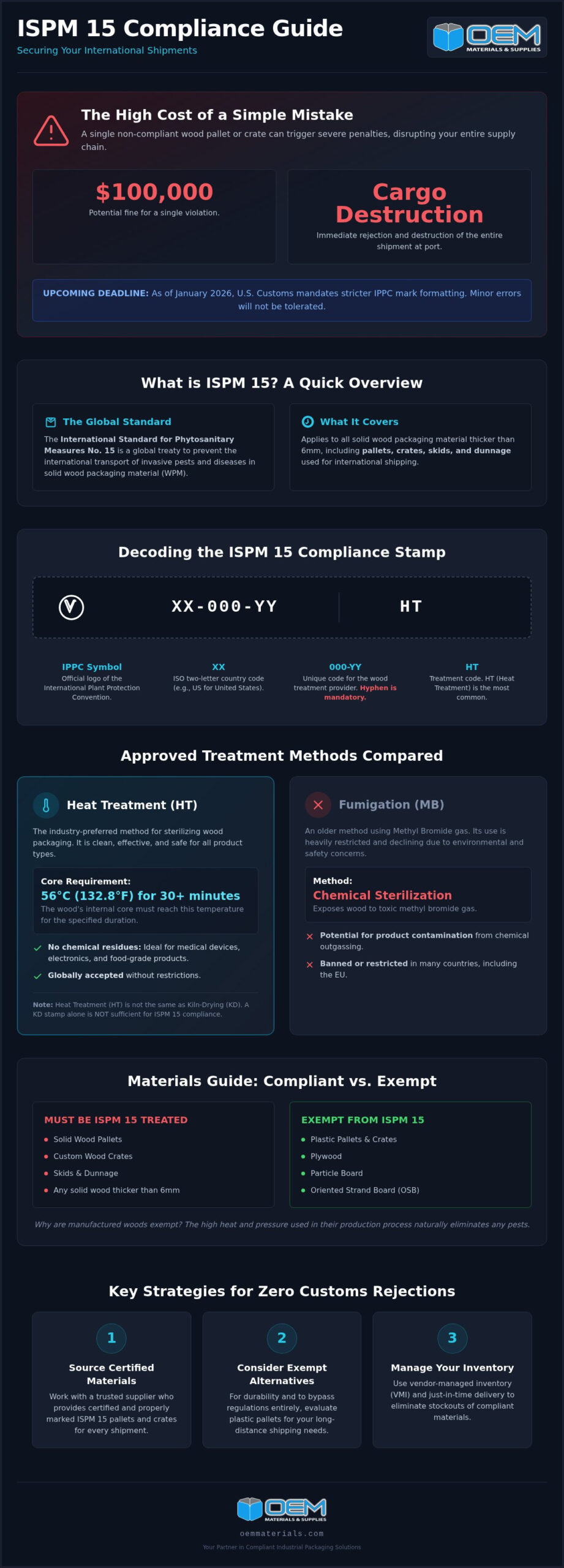
A single missing hyphen on a shipping crate can result in a $100,000 fine and the immediate destruction of your entire international shipment. As of January 2026, U.S. Customs and Border Protection mandates strict formatting for the IPPC mark, proving that even minor clerical errors in heat treatment labeling carry massive logistical risks. Managing the procurement of compliant ISPM 15 pallets is no longer just a warehouse task; it’s a critical component of risk management for any manufacturer in Los Angeles or Orange County.
We understand the frustration of navigating fluctuating lumber costs and the constant fear of a shipment being quarantined at a foreign port. This article provides a technical breakdown of current export standards to help you achieve zero customs rejections. You’ll learn the specifics of the 2026 marking requirements, the heat treatment process, and how to identify when exempt materials like plastic or manufactured wood offer a more efficient path for your global supply chain. By mastering these technical requirements, you can ensure your goods move through international borders without delays or costly penalties.
Key Takeaways
- Understand the specific heat treatment parameters and marking standards required to prevent costly border rejections and cargo destruction.
- Learn how to source certified ISPM 15 pallets in Southern California to maintain a reliable export supply chain for aerospace and medical sectors.
- Compare heat treatment and fumigation methods to identify the most stable and safe preparation for your sensitive electronics or industrial equipment.
- Identify when to transition to plastic pallets to bypass wood treatment regulations entirely while improving durability for long distance shipping.
- Use vendor-managed inventory and just-in-time delivery to eliminate the risk of stockouts and ensure every international shipment remains compliant.
What are ISPM 15 Pallets and Why are They Required?
International shipping involves more than just logistics; it requires strict adherence to global biosecurity standards. The International Standard for Phytosanitary Measures No. 15 is the governing protocol developed by the International Plant Protection Convention (IPPC). It mandates that all wood packaging material (WPM) used in international trade must be treated to prevent the spread of pests and diseases. For manufacturers in Los Angeles and Orange County, using certified ISPM 15 pallets is a non-negotiable requirement for crossing international borders.
The regulation specifically targets solid wood packaging material thicker than 6mm. This includes common shipping components such as pallets, skids, and dunnage. In Southern California, industries like aerospace, medical device manufacturing, and electronics are most impacted by these rules. These sectors often ship high-value, sensitive equipment that cannot afford the delays associated with customs inspections or quarantine. Maintaining a consistent supply of compliant ISPM 15 pallets ensures that your cargo moves through the supply chain without technical friction.
The Environmental Importance of Phytosanitary Standards
The primary goal of these standards is to protect local ecosystems from invasive species. Pests like the Emerald Ash Borer or the Asian Longhorned Beetle can travel inside raw timber, devastating forests in regions where they have no natural predators. Because international trade volumes are so high, manual inspection of every individual pallet is impossible. Standardized treatment provides a reliable, uniform method to neutralize pathogens and insects before they reach a new environment. This protection is vital for maintaining the health of timber resources and agricultural stability worldwide.
Regulatory Scope: Pallets, Crates, and Dunnage
It’s necessary to distinguish between solid timber and manufactured wood. ISPM 15 applies strictly to raw, solid wood. Materials like plywood, particle board, and oriented strand board (OSB) are exempt from these requirements. This is because the manufacturing process for these materials involves high heat and pressure, which naturally eliminates pests. However, any solid wood bracing or custom wood crates used alongside these materials must still carry the official IPPC mark. Failure to stamp even a small piece of dunnage can lead to an entire container being rejected at the port. For complex shipments, working with a knowledgeable partner ensures every component of your packaging meets the required standards.
ISPM 15 Treatment Methods: Heat Treatment vs. Fumigation
Selecting the right treatment method is a functional decision that impacts both regulatory compliance and product safety. While the IPPC allows for several sterilization techniques, heat treatment (HT) and methyl bromide (MB) fumigation remain the most recognized. However, the industry has shifted decisively toward heat treatment due to its efficiency and lack of chemical residues. For manufacturers in Orange County and Los Angeles, choosing the correct ISPM 15 pallets depends on the sensitivity of the cargo and the destination’s environmental regulations.
Heat treatment requires the wood core to reach a minimum temperature of 56°C (132.8°F) for at least 30 continuous minutes. This process effectively neutralizes pests without introducing harmful toxins into the supply chain. It’s often confused with kiln-drying (KD), but they aren’t interchangeable. Kiln-drying focuses on reducing moisture content to prevent warping or mold. While many HT pallets are also kiln-dried, a KD stamp alone does not satisfy international phytosanitary requirements unless the 56°C core temperature threshold is verified and documented.
The Heat Treatment Process (HT)
Thermal sterilization is the preferred standard for the medical device and electronics sectors. Because the process uses only heat and airflow, there’s no risk of chemical outgassing that could damage sensitive components or contaminate sterile environments. Modern facilities use sophisticated probe systems to monitor the internal temperature of the thickest timber pieces. This ensures every pallet in a batch meets the rigorous standards for ISPM 15 treatment and certification. If you aren’t sure which treatment fits your specific application, you can consult with our team for a technical recommendation based on your product’s requirements.
Fumigation and Chemical Pressure Impregnation
Methyl Bromide (MB) was once the primary method for treating ISPM 15 pallets, but its use is declining rapidly. Many countries have restricted or banned MB due to its status as an ozone-depleting substance. Beyond environmental concerns, fumigated pallets require strict safety protocols for warehouse staff. Chemical residues can linger, necessitating specific compliance documentation and handling procedures that often complicate logistics. Dielectric heating (DH) is an emerging alternative that uses microwaves to heat wood cores quickly, though it hasn’t yet reached the same level of widespread commercial adoption as traditional HT kilns. Most Southern California exporters find that heat-treated wood provides the most reliable balance of cost and compliance.
Understanding the ISPM 15 Marking Requirements
A compliant heat treatment is functionally useless if the physical marking on the wood is incorrect or illegible. The IPPC mark, commonly referred to as the wheat stamp, serves as the permanent record of sterilization for international customs officials. For manufacturers in Los Angeles and Orange County, ensuring that ISPM 15 pallets are marked according to the latest standards is the only way to prevent shipments from being flagged for inspection or quarantine.
The standard requires the mark to be placed on at least two opposite sides of the pallet or crate. It must be permanent, non-transferable, and highly visible. A common logistical failure occurs when the stamp is obscured by stretch film or shipping labels. If an inspector cannot verify the mark without dismantling a load, the risk of delay increases significantly. Furthermore, the mark must be legible; stamps that are faded, bleeding, or applied to rough-sawn timber with poor clarity are frequent grounds for rejection at international borders.
Decoding the Compliance Mark
The mark consists of several mandatory components that provide a clear audit trail for regulators. It begins with the IPPC symbol on the left, followed by the two-letter ISO country code, such as US for United States. A critical update as of January 2026 requires a hyphen between the country code and the unique facility identification number. For example, a mark must read US-1234 rather than US1234. Following the facility ID is the treatment code, typically HT for heat treatment. These facility numbers are traceable to national agencies, ensuring that the ISPM 15 pallets you use were processed by an accredited vendor.
Dunnage and Component Marking
The rules for ISPM 15 pallets also extend to dunnage, which includes the loose wood used for bracing and securing heavy machinery within a container. International regulations follow the “Every Piece” rule for dunnage. Every individual block or plank of solid wood bracing must carry a visible compliance mark. This presents a challenge for small components or custom-cut bracing where a standard-sized stamp may not fit. In these cases, smaller, specialized stamps are used to maintain compliance without compromising the structural integrity of the bracing. When shipping complex industrial equipment from San Diego or the Inland Empire, verify that your warehouse team is using pre-marked dunnage to avoid the total rejection of a high-value container due to a single unmarked block of wood.
Plastic Pallets: An Exempt Alternative to ISPM 15 Wood
While heat-treated wood is the standard for international trade, plastic pallets offer a strategic alternative that bypasses the complexities of sterilization. Because plastic is a non-porous, manufactured material, it does not harbor the pests or pathogens that ISPM 15 was designed to control. Consequently, plastic pallets are naturally exempt from all IPPC treatment and marking requirements. For exporters in Los Angeles and Orange County, this exemption provides a maintenance-free path to compliance that eliminates the risk of customs delays due to illegible stamps or expired treatment certifications.
Transitioning to plastic is particularly advantageous for high-stakes industries such as medical device manufacturing and aerospace. In these sectors, the presence of wood dust, splinters, or mold can compromise sterile environments or damage sensitive electronic components. Heavy-duty plastic pallets provide a consistent, hygienic platform that wood simply cannot match. While the initial investment in plastic is higher than wood, the long-term reliability often justifies the cost by removing the variable of potential border rejections. If you’re evaluating your current shipping platform, you can request a quote for plastic alternatives to compare the total landed cost against treated wood.
Benefits of Plastic Pallets in Global Logistics
One of the primary logistical advantages of plastic is its resistance to environmental factors. Unlike wood, plastic doesn’t absorb moisture. This prevents it from gaining weight or harboring mold during long sea voyages. This weight consistency is critical for air freight calculations, where even small fluctuations in pallet weight can lead to unexpected shipping surcharges. For a deeper technical breakdown, see our Industrial Guide to Heavy Duty Plastic Pallets. This stability ensures that your freight estimates remain accurate from the warehouse floor to the final destination.
When to Choose Wood vs. Plastic for Exports
The choice between materials often depends on the nature of the shipment. Wood remains the most cost-effective solution for one-way export shipments where the pallet won’t be returned to the sender. It’s also the preferred material for custom wood crates designed for massive, irregular machinery that requires specific load-bearing bracing. Conversely, plastic is the superior choice for closed-loop supply chains where the assets can be recovered and reused. For more information on making this decision, read our guide on Wooden vs. Plastic Pallets: An Industrial Comparison. Evaluating these variables helps procurement managers balance regulatory safety with operational budgets while maintaining a reliable supply of ISPM 15 pallets when wood is the only functional option.
Sourcing ISPM 15 Pallets in Southern California
Sourcing compliant ISPM 15 pallets in Southern California requires more than finding the lowest price point. It requires a partner who maintains strict accreditation and understands the logistical pressures of the Port of Los Angeles and the Port of Long Beach. For manufacturers in Orange County and San Diego, the proximity of a supplier directly impacts lead times and the ability to respond to urgent export requirements. A local presence ensures that you aren’t waiting on long-distance freight while your cargo sits on the dock.
Reliability in this sector is built on documentation. Every batch of heat-treated wood must be verifiable through an audit trail. This isn’t just about the physical stamp on the wood; it’s about the certification that proves the core temperature reached the mandatory 56°C. During a customs audit, having these records readily available can be the difference between a minor inquiry and a full shipment seizure. Your supplier should be prepared to provide these certifications upon request to ensure your internal compliance standards are met.
Vendor Managed Inventory for Export Packaging
Managing inventory for international shipments is a complex task that often leads to warehouse congestion. Stocking out of compliant materials can halt production lines for days, while overstocking ties up valuable capital. Packaging VMI Services provide a functional remedy by outsourcing inventory tracking to the supplier. This ensures that your facility always has the necessary ISPM 15 pallets and stretch film on hand without over-committing warehouse floor space. This system also reduces labor costs, as your team no longer needs to manually count and reorder pallets during peak shipping seasons.
Partnering with a SoCal Packaging Expert
For manufacturers in Riverside and the Inland Empire, local support is a significant operational advantage. A Custom Industrial Packaging Supplier acts as a technical consultant rather than a simple vendor. This expertise is vital when designing custom wood crates for irregular aerospace components or sensitive medical equipment. We ensure that every component, from the base pallet to the internal dunnage, meets the rigorous standards of the IPPC. By utilizing just-in-time (JIT) delivery, we help Los Angeles manufacturers reduce warehouse congestion while maintaining a 100 percent compliance rate for their international shipments.
Securing Your Global Supply Chain
Maintaining compliance with global phytosanitary standards is a fundamental requirement for successful export operations. By selecting certified ISPM 15 pallets and ensuring precise mark placement, manufacturers can eliminate the risk of costly customs delays and shipment rejections. Selecting the right material for your specific application ensures a seamless, risk-free transition across international borders.
OEM Materials & Supplies provides an accredited supply chain specifically designed for the rigorous demands of the aerospace, medical, and electronics sectors. We support Southern California manufacturers with local delivery and just-in-time inventory management to keep your warehouse efficient. Our team offers custom sizing for wood crates and pallets to meet the exact technical requirements of your industrial equipment.
If you are ready to streamline your export logistics, Request a Quote for ISPM 15 Compliant Pallets today. Please include your product dimensions, weight, and annual usage requirements to facilitate an accurate recommendation. We look forward to helping your next shipment clear customs without delay.
Frequently Asked Questions
Do plastic pallets need an ISPM 15 stamp?
Plastic pallets are naturally exempt from the IPPC 15 mandate because they are non-biological, manufactured products. They don’t harbor the specific pests or pathogens that ISPM 15 was designed to control. This makes them a reliable choice for medical and aerospace manufacturers in Orange County who want to eliminate the risk of customs delays. Because they aren’t wood, no stamps or treatment certifications are required for international border crossings.
What happens if my shipment is found with non-compliant pallets?
Customs officials at the port of entry can order the immediate destruction of the packaging or the rejection of the entire container. This often results in a total loss of the goods or significant re-exportation costs. In some cases, fines for non-compliance can exceed $100,000 per violation. For Los Angeles exporters, these technical failures lead to massive logistical disruptions and the potential loss of international distribution contracts.
Are plywood and OSB exempt from ISPM 15 requirements?
Plywood, OSB, and particle board are classified as manufactured wood and are exempt from ISPM 15 regulations. The manufacturing process involves high heat, pressure, and adhesives that naturally eliminate any pests or pathogens. While solid wood bracing in a container must be treated, a crate built entirely from plywood doesn’t require an IPPC stamp. This provides a practical alternative for San Diego businesses looking to simplify their export packaging requirements.
How long is an ISPM 15 treatment valid?
An ISPM 15 treatment is valid for the life of the pallet as long as it remains in its original state. If a pallet is repaired or reconstructed with new wood, it must be re-treated and re-stamped by an accredited facility to maintain its certification. For manufacturers in Riverside, maintaining a strict separation between new and repaired units ensures that your export inventory stays compliant and ready for immediate international shipment.
Can I heat treat my own pallets for export?
You cannot legally heat treat your own wood unless your facility carries official accreditation from a national inspection agency. The process requires certified kilns with specialized thermal probes to verify the 56°C core temperature threshold. Most manufacturers in Southern California find it more efficient to partner with OEM Materials & Supplies. We handle the documentation and sterilization protocols, allowing you to focus on production without managing complex biosecurity audits.
Does ISPM 15 apply to shipments between the US and Canada?
Yes, ISPM 15 standards apply to all wood packaging material moving between the United States and Canada. While a bilateral exemption existed historically, full enforcement is now the standard for all international trade in North America. This includes pallets, crates, and dunnage used for industrial machinery or automotive parts. Ensuring your Canadian exports utilize certified ISPM 15 pallets is necessary to prevent border hold-ups and maintain a smooth cross-border supply chain.
What is the difference between kiln-dried and heat-treated wood?
Kiln-dried (KD) wood is processed to reduce moisture content and prevent structural warping or mold. Heat treatment (HT) is a sterilization protocol specifically designed to neutralize invasive insects. While many HT pallets are also kiln-dried, the KD mark alone doesn’t satisfy international biosecurity standards. To clear customs, the wood must carry the HT mark, which verifies the core temperature reached the mandatory 56°C threshold for at least 30 continuous minutes.
How do I verify if a pallet supplier is legitimately accredited?
You can verify a supplier’s status by checking the American Lumber Standard Committee directory. Legitimate suppliers will have a unique facility ID number hyphenated with the country code on their IPPC stamp. For example, a mark must read US-1234 rather than US1234. If a supplier cannot provide recent audit documentation or if their mark lacks the 2026 hyphenation format, they aren’t a compliant partner for your Southern California export operations.