
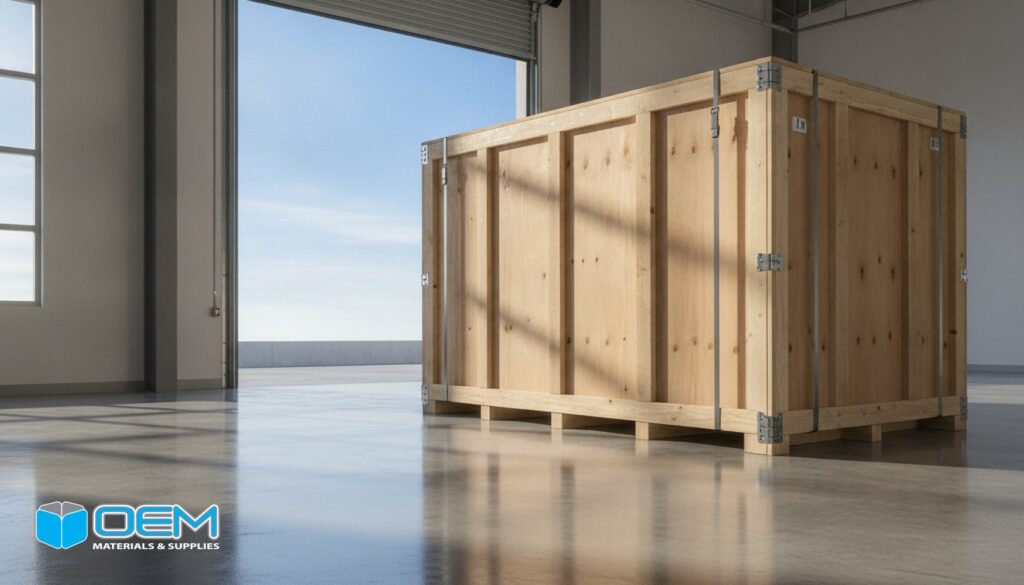
What if a single missing stamp on a piece of lumber determined whether your shipment reached its destination or sat for weeks in a quarantine dock? For manufacturers in Los Angeles and Orange County, the stakes of international logistics leave no room for error. You already know that a crate is more than just a wooden box; it’s a precision-engineered tool designed to withstand the rigors of ocean freight and the scrutiny of customs officials. A minor oversight in wood treatment or internal bracing can lead to costly rejections and damaged reputations.
This article provides the technical insights you need to master the engineering standards of export shipping crates to eliminate transit damage and regulatory delays. We will examine the critical role of ISPM-15 compliance for international trade and how advanced internal blocking techniques protect sensitive equipment. You’ll also discover how Southern California manufacturers use vendor-managed inventory and just-in-time delivery to solve warehouse space constraints while ensuring zero customs rejections and reduced shipping claims.
Key Takeaways
- Understand the technical requirements for ISPM-15 certification to ensure your export shipping crates clear international customs without quarantine delays.
- Identify the optimal framing and sheathing materials to maintain structural integrity and moisture resistance for heavy industrial loads.
- Compare knock-down and fully assembled crate designs to balance warehouse space efficiency with production line speed.
- Learn how to integrate custom wood crates with engineered foam inserts for high-value aerospace and medical device protection.
- Streamline your operations using vendor-managed inventory to ensure a reliable supply of packaging materials without overstocking your facility.
Understanding ISPM-15 Standards for Export Shipping Crates
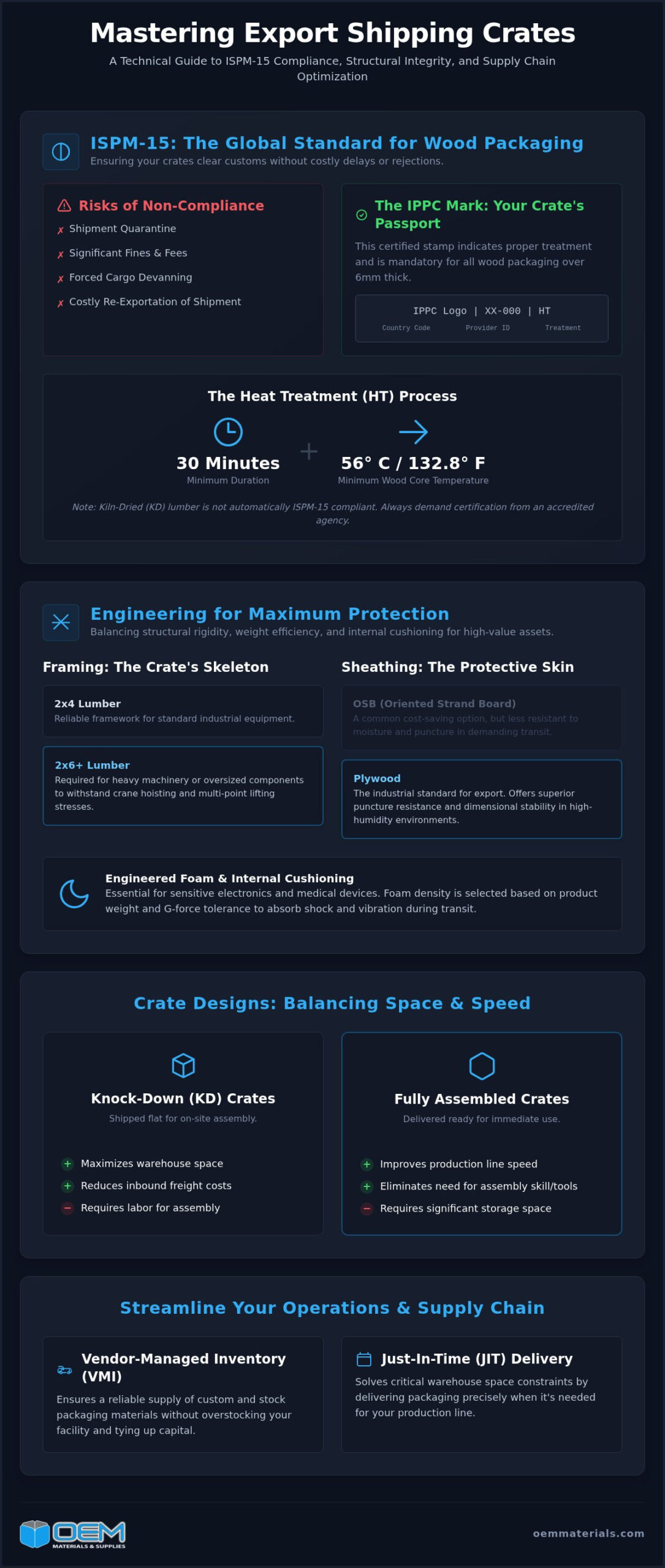
International trade depends on a strict regulatory framework designed to protect global ecosystems. The primary regulation governing wood packaging is the International Standards for Phytosanitary Measures No. 15, commonly known as ISPM-15. This mandate requires all wood packaging materials thicker than 6mm to be treated to prevent the international spread of invasive pests and pathogens. For manufacturers shipping from the Port of Los Angeles or Long Beach, ensuring your export shipping crates carry the official International Plant Protection Convention (IPPC) mark is the difference between a successful delivery and a logistical nightmare.
The IPPC mark serves as a passport for your crate. It typically includes a two-letter country code, a unique identification number for the treatment provider, and a code indicating the treatment method used. HT stands for heat treatment, while MB indicates methyl bromide fumigation. If this mark is missing, illegible, or fraudulent, customs authorities have the legal right to quarantine the shipment. The consequences of non-compliance are severe. You may face significant fines, the cost of immediate cargo devanning, or the forced re-exportation of the entire shipment at your company’s expense. Compliance is binary; there is no middle ground in international wood standards.
The Heat Treatment (HT) Process
To meet ISPM-15 international standards, the wood used in your export shipping crates must undergo a specific thermal process. The lumber’s core temperature must reach a minimum of 56 degrees Celsius (132.8 degrees Fahrenheit) for at least 30 consecutive minutes. This technical requirement ensures the elimination of wood-borne larvae and insects. It is a common misconception that kiln-dried (KD) lumber is automatically compliant. While kiln drying reduces moisture content to prevent warping, it does not always reach the sustained core temperatures required for HT certification. Always verify that your supplier provides a documented certification trail from an accredited agency to satisfy international audits.
Global Variations in Regulation
While ISPM-15 provides a global baseline, enforcement intensity varies by region. Countries like Australia, China, and members of the European Union are known for rigorous inspection protocols. These nations often require additional documentation or specific wood-free zones within the packaging. Domestic timber used for shipments within Orange County or the Inland Empire does not require these treatments, but using domestic-grade wood for international transit is a frequent cause of customs rejections. “Bug-free” is a legal status, not a marketing claim. Selecting export shipping crates built from certified materials is the only way to avoid quarantine holds and the resulting storage fees that can cripple a project’s budget.
Engineering Export Crates for Maximum Product Protection
Engineering a crate requires a balanced approach to structural rigidity and weight efficiency. The framing serves as the skeleton of the assembly, and material choice depends entirely on the payload. For standard industrial equipment, 2×4 heat-treated lumber provides a reliable framework. However, heavy machinery or oversized aerospace components often require 2×6 or larger framing to maintain integrity during crane hoisting and multi-point lifting. These export shipping crates must withstand significant vertical and lateral stresses that domestic packaging rarely encounters.
Sheathing selection is another critical variable. While OSB is a common cost-saving option, plywood remains the industrial standard for international transit due to its superior puncture resistance and dimensional stability. Plywood doesn’t swell or delaminate as easily as OSB when exposed to high-humidity environments found in cargo holds. Additionally, the base of the crate must include heavy-duty skids or integrated pallets. These features allow forklift operators at terminals in Los Angeles and Orange County to move the cargo safely without risking contact with the sheathing or the product itself. Meeting industry-specific crating requirements ensures the exterior is compliant, but the outer shell is only half the battle.
Custom Foam Inserts and Internal Cushioning
Internal protection must be engineered in tandem with the crate’s exterior. Custom foam packaging is essential for sensitive electronic and medical payloads that are vulnerable to vibration and shock. Engineers select foam density based on the G-force tolerance and weight of the product. High-density polyethylene foam is ideal for blocking and bracing heavy components, while softer polyurethane options provide delicate cushioning for fragile instruments. Proper blocking prevents the load from shifting, which is the primary cause of damage during the turbulent conditions of ocean or air transit.
Vapor Barriers and Moisture Control
Ocean freight exposes your equipment to salt air and extreme temperature fluctuations. Protecting metal components from corrosion requires a sophisticated moisture management strategy. We utilize heat-sealed vapor barrier bags and vacuum sealing to create a controlled environment inside the crate. Desiccants are placed within the barrier to absorb any residual moisture, while strategic ventilation in the outer sheathing prevents “container rain” from forming on the crate’s interior surfaces. This dual-layer approach ensures that components arrive at their destination free of oxidation and mold growth. If you’re unsure which materials suit your payload, consult with a packaging engineer to define your specific requirements.
Comparing Crate Designs: Knock-Down vs. Fully Assembled
Selecting the configuration of your export shipping crates involves a calculated trade-off between warehouse footprint and operational throughput. Fully assembled crates offer immediate utility. They’re the preferred choice for rapid production environments where packing must happen the moment a product leaves the assembly line. While they eliminate on-site labor, they’re inefficient to transport. You’re essentially paying to ship air, which increases inbound freight costs and requires significant dock time for unloading bulky deliveries.
Knock-down (KD) designs provide a high-density alternative. These units ship as flat components—bases, sides, and lids—that occupy minimal space. Hybrid crate kits offer a middle ground. They arrive flat but feature modular components that snap or bolt together with minimal hardware. Evaluating the total cost of ownership (TCO) requires looking beyond the unit price. You must factor in the square footage cost of storage, the hourly rate of assembly labor, and the freight impact of inbound deliveries to find the most efficient balance for your facility.
Space Optimization in Southern California Facilities
Industrial real estate in Los Angeles and Orange County remains a premium commodity. In these high-rent areas, warehouse efficiency is a competitive necessity. Storing 50 assembled crates can consume over 1,000 square feet of floor space, whereas the same number of KD crates often fits onto just two or three pallet racks. This vertical density allows for better inventory management and keeps the production floor clear of bulky packaging materials. Referencing an industrial packaging supplier guide helps manufacturers in Southern California align their storage capabilities with their actual shipping volume.
Assembly Labor and Efficiency
Labor efficiency is the final piece of the TCO puzzle. Assembling KD export shipping crates requires dedicated floor space and man-hours. If your facility isn’t equipped with pneumatic nailers or rapid-closure tooling, the time spent on assembly can quickly erode the savings gained from lower freight costs. Personnel must be trained to follow specific engineering standards to ensure the crate maintains its structural integrity during transit. Using specialized closure systems like steel clips or pre-drilled screw holes can speed up the process. However, when labor is scarce or production deadlines are tight, the convenience of fully assembled crates often outweighs the storage benefits of flat-packed alternatives.
Industry-Specific Requirements for High-Value Exports
High-value assets require more than just a compliant exterior. They demand precision engineering tailored to the specific vulnerabilities of the payload. Manufacturers in Los Angeles and Orange County often deal with complex equipment that cannot be protected by a standard one-size-fits-all approach. Whether you are moving sensitive flight hardware or calibrated medical instruments, your export shipping crates must serve as a controlled environment that mitigates the risks of shock, vibration, and contamination. We analyze the physical properties and regulatory landscape of each industry to design a solution that ensures safe arrival and immediate operational readiness.
Electronics and precision instruments face unique challenges during international transit. These components require advanced ESD (Electrostatic Discharge) protection to prevent invisible damage to circuitry. We integrate anti-static materials with custom vibration dampening to isolate the product from the high-frequency tremors common in air and ocean freight. Similarly, the automotive sector requires heavy-duty crating for engines and transmissions. These crates must support concentrated weights of several thousand pounds while maintaining structural rigidity to prevent the sheathing from bowing or cracking under stress.
Aerospace and Defense Crating
Aerospace components often feature irregular geometries and extreme sensitivity to impact. Meeting MIL-SPEC requirements for military-grade shipping containers is a baseline for defense contractors in Southern California. We engineer custom cradles and saddles to support turbine blades, fuselage sections, or satellite components. These internal structures ensure the load is distributed across designated structural points rather than delicate surfaces. To provide a transparent record of handling, we often integrate shock indicators and tilt sensors on the exterior of the export shipping crates, allowing receiving teams to verify the integrity of the hardware before uncrating.
Medical and Life Science Logistics
Medical and life science logistics demand strict adherence to contamination control and sterile barrier protection. Selecting non-shedding materials is critical when crates must enter or sit adjacent to cleanroom environments. For secondary containment, many manufacturers utilize specialized medical device packaging inside the primary wood crate. This dual-layer strategy ensures compliance with global healthcare supply chain standards while shielding the product from the salt air and humidity typical of ocean transit. If your equipment requires a specialized engineering approach to meet these rigorous standards, contact our design team for a technical consultation based on your specific dimensions and weight requirements.
Optimizing Your Supply Chain with Custom Crating Services
Supply chain efficiency is often won or lost at the packaging stage. For manufacturers handling non-standard equipment, custom export shipping crates offer more than just physical protection; they provide a blueprint for operational cost control. By tailoring crate dimensions to the exact payload, you eliminate excess material costs and maximize container cube utilization. This engineering-first approach reduces inbound freight expenses and ensures that your shipping materials align perfectly with your production schedule. When packaging is treated as a component of the product itself, the entire logistics flow becomes more predictable.
Beyond the physical crate, the method of procurement and storage significantly impacts your bottom line. We provide integrated solutions that address the common friction points of industrial packaging, such as high labor costs and inventory stock-outs. By leveraging kitting and assembly services, you can receive crates pre-fitted with custom foam or vapor barriers, ready for immediate loading. This reduces the time your team spends on secondary packaging tasks and streamlines the transition from the assembly line to the shipping dock.
Vendor-Managed Inventory for Crates
Managing large-scale crate inventory can be an administrative bottleneck for growing firms. Our VMI services remove the burden of inventory tracking from your warehouse team. We monitor your actual production usage and trigger automated replenishment before stock levels reach a critical point. This system reduces administrative overhead through consolidated billing and reporting, allowing your procurement team to focus on higher-value tasks. It ensures you never run out of critical shipping supplies, even during unexpected production spikes, while maintaining a lean warehouse footprint.
For manufacturers in San Diego, Riverside, and the Inland Empire, we offer just-in-time (JIT) delivery to minimize on-site storage requirements. This service is particularly effective for large-format export shipping crates that would otherwise consume valuable floor space. By aligning deliveries with your shipping manifest, we help you maintain a high velocity of movement through your facility without the burden of excess safety stock.
Collaborating with a Southern California Partner
A local partnership provides a distinct advantage during the design and prototyping phases. Being based in Southern California allows us to offer on-site consultations for heavy machinery and complex load-outs in Los Angeles and Orange County. We facilitate rapid design iterations, ensuring that any engineering adjustments are made in real-time before full-scale production begins. This proximity transforms the vendor-client relationship into a technical partnership, supporting both regional operations and nationwide distribution from a centralized Southern California hub. Working with a partner who understands the local regulatory environment and port requirements ensures your cargo moves without friction.
Implementing Engineered Export Crating Solutions
Manufacturers in Los Angeles and Orange County require more than just a wooden container; they need a compliant, engineered shield for high-value assets. Achieving zero customs rejections starts with strict ISPM-15 adherence, but long-term success depends on internal protection strategies like custom foam inserts and vapor barriers. By selecting the right configuration for your export shipping crates, you can effectively balance warehouse space constraints with production speed requirements.
OEM Materials & Supplies serves as a technical partner for the aerospace and medical sectors, providing specialized engineering that meets rigorous industrial standards. Our local Southern California support ensures rapid prototyping, while our VMI and JIT programs eliminate the risk of inventory shortages. We focus on solving real-world logistical challenges so your team can focus on manufacturing excellence. To start optimizing your packaging workflow, Request a Quote for Custom Export Crating. Providing your specific product dimensions, weight, and annual usage allows us to develop a precise recommendation for your next global shipment. We’re ready to help you secure your international supply chain.
Frequently Asked Questions
What is the difference between a domestic crate and an export crate?
The primary difference is the wood treatment and certification. Domestic units don’t require ISPM-15 heat treatment. In contrast, export shipping crates must use lumber treated to reach a 56 degree Celsius core temperature for 30 minutes. This prevents the spread of wood-borne pests. Additionally, export designs often feature enhanced moisture protection, such as vapor barriers and desiccants, to withstand long ocean transits that domestic shipments rarely face.
How do I know if my crate is ISPM-15 certified?
Look for the official IPPC mark stamped directly onto the wood components. This mark must include the IPPC wheat symbol, the two-letter country code (US for United States), a unique registration number for the treatment facility, and the treatment code (HT for Heat Treatment). The stamp must be permanent and legible. If your crate lacks this visible marking, customs officials in international ports may refuse entry or quarantine the shipment.
Can I reuse export shipping crates for multiple shipments?
You can reuse export shipping crates as long as they remain structurally sound and the IPPC mark is still legible. However, any repairs made with new wood must also use certified heat-treated lumber and carry a valid stamp. Frequent reuse is common in closed-loop supply chains between Los Angeles and international hubs. Always inspect the joints and framing for damage before reuse, as the integrity of the crate is critical for product safety.
What wood materials are exempt from ISPM-15 regulations?
Manufactured wood products are generally exempt because the high heat and pressure used during their production eliminate pests. This includes materials like:
- Plywood and OSB
- Particle board and MDF
- Veneer and corrugated paper products
- Wood wool or sawdust
Any wood components thinner than 6mm are also exempt. If your crate is constructed entirely from these materials, it doesn’t require the IPPC stamp for international transit.
How do I calculate the weight capacity of a custom wood crate?
Weight capacity depends on the framing dimensions, the thickness of the base skids, and the type of sheathing used. Our engineers calculate load limits by evaluating the static and dynamic stresses the crate will face during forklift handling and stacking. For heavy industrial equipment, we often use 2×6 framing and 3/4-inch plywood sheathing. It’s essential to provide accurate product dimensions and weight so we can design a crate that prevents structural failure.
What are the common causes of damage in international shipping crates?
Most damage occurs due to improper internal blocking or moisture infiltration. While the exterior of export shipping crates might remain intact, shifting loads can crush internal components. Vibration during ocean freight can also loosen fasteners. In Southern California’s coastal climate, container rain or condensation inside the crate is a frequent issue. We solve this by using custom foam inserts for stabilization and vapor barrier bags with desiccants for moisture control.
Is plywood considered a manufactured wood that is exempt from HT rules?
Yes, plywood is a manufactured wood product and is exempt from ISPM-15 heat treatment requirements. Because it’s created using heat, glue, and high pressure, it’s considered processed wood that is free of live pests. This makes plywood an excellent choice for crate sheathing. However, if the plywood panels are attached to a frame made of solid raw lumber, that framing must still be heat-treated and stamped to clear international customs.
How much lead time is typically required for a custom export crate design?
Lead times for custom designs typically range from a few days to two weeks, depending on the complexity of the payload. Simple designs move quickly, while aerospace or medical device crates requiring custom foam inserts and internal cradles require more engineering. We offer rapid prototyping for manufacturers in Orange County and San Diego to speed up the approval process. Our VMI programs can further reduce lead times by maintaining a ready stock of your specific crate components.