
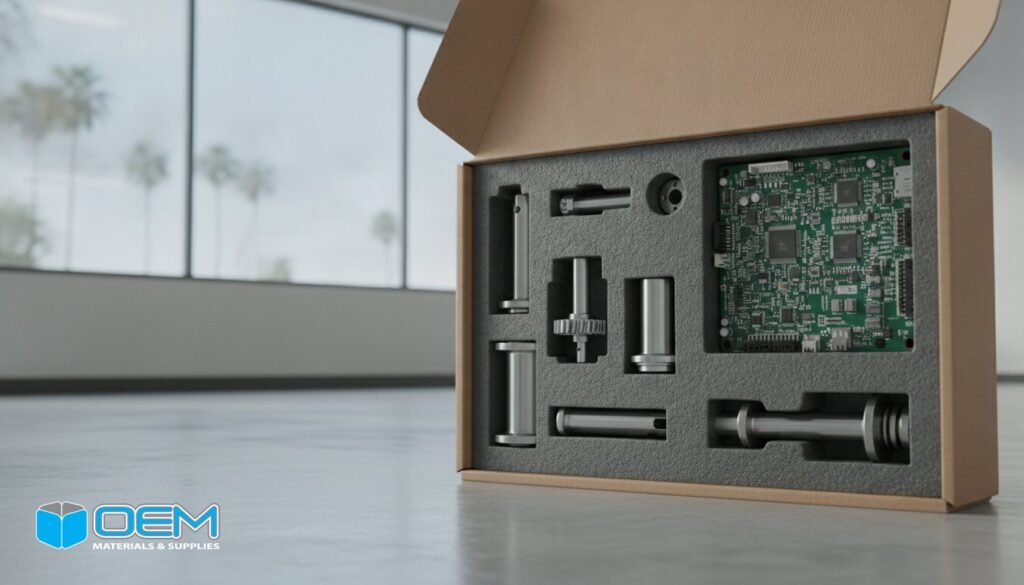
A single hairline fracture in a high-value industrial component can turn a profitable shipment into a total loss. For manufacturers operating in the Inland Empire, the cost of product damage and inefficient kitting processes can quickly erode profit margins. Selecting the right protective foam packaging for electronics riverside requires more than just picking a soft material; it demands an engineering-first approach to shock absorption and vibration dampening. We understand that local OEMs face unique pressure to maintain zero-damage shipping cycles while managing fluctuating material costs and new regulatory requirements like California SB 54.
You likely recognize that a reliable packaging partner must provide more than just a commodity; they must offer technical precision and logistical stability. This guide provides the framework for selecting the correct foam materials and fabrication methods to protect industrial components throughout the Southern California supply chain. We will cover how custom-engineered inserts reduce labor costs through kitting-ready designs and how local sourcing eliminates the long lead times typical of non-local vendors. By the end of this article, you’ll have the technical context needed to optimize your transit protection and streamline your warehouse operations.
Key Takeaways
- Learn how custom-engineered protective foam packaging for electronics riverside eliminates internal migration to secure high-value components during transit.
- Identify the performance differences between high-density polyethylene for heavy equipment and soft polyurethane for delicate medical instruments.
- Evaluate whether CNC routing or die-cutting provides the best balance of precision and cost for your specific production volumes.
- Reduce warehouse congestion and procurement costs by utilizing local Riverside sourcing for Just-in-Time delivery cycles.
- Streamline the transition from design to delivery by integrating CAD fitment services with scalable manufacturing capabilities.
Protecting Industrial Assets in Riverside Manufacturing Hubs
Riverside functions as a critical node in the Southern California manufacturing landscape. High-value sectors here, ranging from medical laser assembly to semiconductor fabrication, require specialized protection that stock materials cannot provide. Standard cushioning often fails under the repetitive shock loads encountered during long-haul transit or even local drayage. Implementing protective foam packaging for electronics riverside ensures an exact fitment that eliminates internal product migration. This is a foundational engineering requirement; if a component can move within its container, it can break. Our custom foam packaging solutions are designed to mitigate these risks by locking components into a secure, static position.
The Cost of Inadequate Packaging
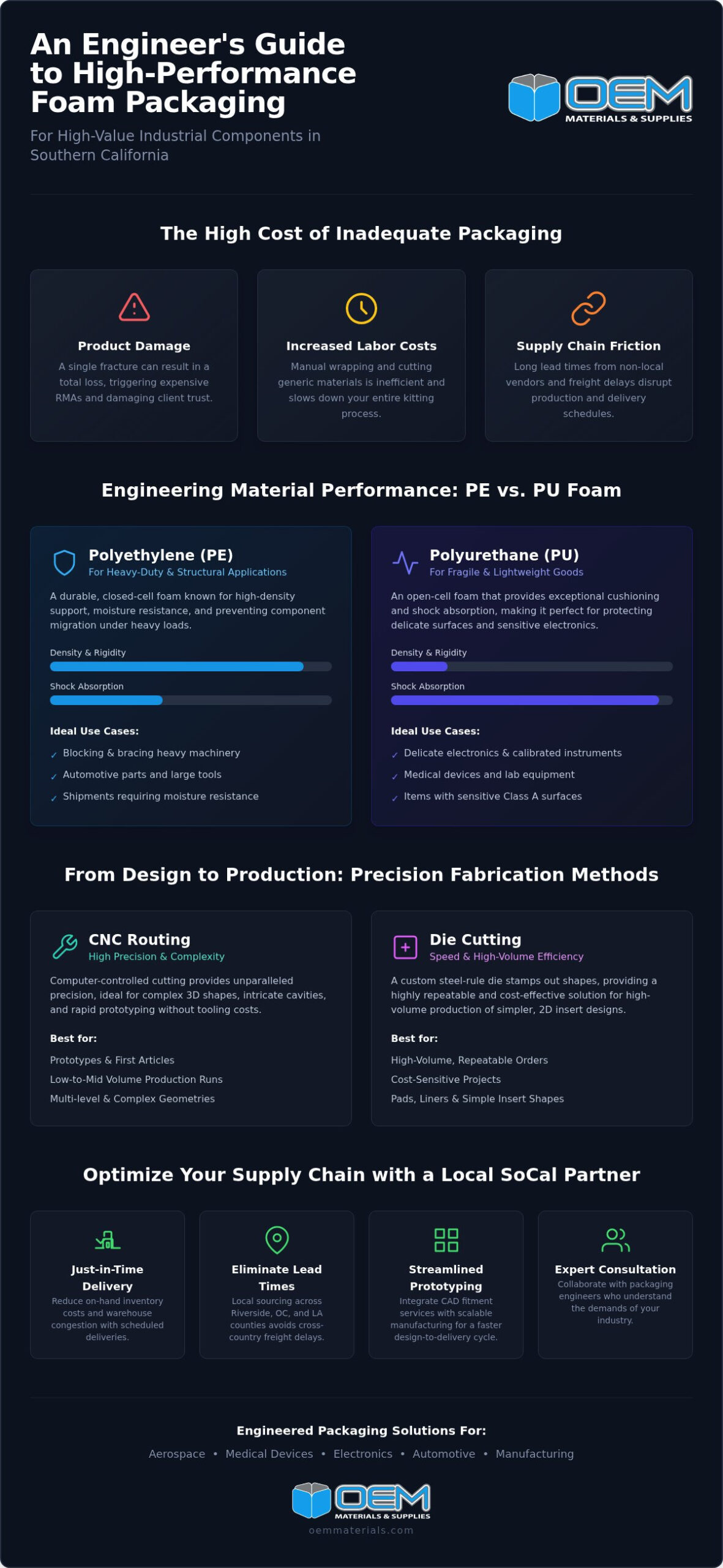
Failure to invest in precision-engineered package cushioning results in more than just broken parts. It triggers a cycle of expensive Return Merchandise Authorizations (RMAs) and erodes the trust of your industrial partners. Labor costs also climb when warehouse teams are forced to manually wrap items or cut generic foam sheets to size. Using pre-configured inserts allows for a streamlined kitting process, significantly reducing the time spent at the packing station. When foam is designed alongside custom corrugated boxes, the overall footprint of the shipment is minimized. This optimization leads to improved freight density and lower logistics costs, depending on your specific product dimensions and shipping frequency.
Industry Requirements in the Inland Empire
Different sectors within the Inland Empire demand specific material properties. Aerospace manufacturers require rigid foam support to prevent structural stress on sensitive airframe components. Medical device companies often necessitate cleanroom-compatible materials that are non-abrasive and non-dusting. For those sourcing protective foam packaging for electronics riverside, the focus shifts to static dissipation and harmonic vibration dampening. These are not merely safety features; they’re functional requirements for maintaining the calibration of delicate circuitry.
Beyond protection, these engineered inserts serve as a professional brand interface. When a B2B customer opens a shipment to find a perfectly organized, custom-fit foam kit, it communicates a level of technical competence and reliability that loose-fill packaging simply cannot match. This attention to detail reinforces your position as a high-tier supplier in a competitive regional market where precision and presentation go hand-in-hand.
Engineering Material Performance: Polyethylene vs. Polyurethane
Selecting the optimal material requires a precise understanding of your product’s fragility and the logistical environment it will encounter. For professionals procuring protective foam packaging for electronics riverside, the choice usually begins with a comparison between polyethylene and polyurethane. These materials perform differently under load; choosing the wrong density can lead to bottoming out or excessive vibration transfer. Academic research on foam material properties demonstrates that cellular geometry dictates how energy is dissipated during impact, making material science a critical part of the design process.
Polyethylene for Heavy-Duty Applications
Polyethylene (PE) is a durable, closed-cell foam known for its high-density support and moisture resistance. It’s the standard choice for blocking and bracing heavy industrial machinery, automotive parts, and large-scale tools. Because it has a rigid structure, PE foam maintains its shape under significant weight, preventing heavy items from shifting within the container. It’s available in various densities, allowing engineers to calibrate the support based on the specific weight-to-surface-area ratio of the component. If your shipment requires high tear resistance and protection against environmental moisture, PE is the functional remedy.
Polyurethane for Fragile and Lightweight Goods
Polyurethane (PU) foam features an open-cell structure that provides exceptional shock absorption for lightweight or highly fragile items. It’s significantly softer than polyethylene, making it ideal for delicate instrumentation and consumer electronics kitting. Many manufacturers utilize convoluted or egg crate PU foam to secure items with irregular shapes. This material is designed to compress easily, cradling the product to distribute pressure evenly across its surface. It’s a cost-effective solution for high-volume packaging programs where protecting sensitive surfaces is the primary objective.
Specialized Foams for Technical Sectors
For aerospace and medical device manufacturers in the Inland Empire, standard foams might not meet rigorous cleanliness or safety standards. Cross-linked polyethylene (XLPE) is often specified for medical and cleanroom applications because of its low outgassing properties and non-abrasive surface. Similarly, sourcing effective protective foam packaging for electronics riverside necessitates the use of anti-static foam variants. These pink-tinted foams are chemically treated to prevent electrostatic discharge (ESD), which can permanently damage sensitive circuitry during transit. If you’re unsure which density or specialized variant fits your application, you can request a technical consultation to review your CAD files and weight requirements. Our team frequently helps Riverside OEMs integrate these materials into custom foam packaging systems that meet specific industry certifications.
Fabrication Methods for Custom Industrial Inserts
Fabrication is the technical bridge that transforms raw foam planks into functional protection systems. For Riverside OEMs, selecting the right production method is a balancing act between initial tooling investment and long-term per-unit costs. While material choice provides the necessary cushioning properties, the fabrication process determines the precision of the fitment. Implementing the correct method ensures that protective foam packaging for electronics riverside meets the tight tolerances required for sensitive industrial components.
CNC Routing for Precision and Flexibility
CNC routing uses computer-controlled bits to carve precise cavities directly into foam planks. Because this process is driven by CAD files, it requires no physical tooling or dies. This makes it the standard choice for rapid prototyping and low-to-medium production runs. It’s particularly effective for complex geometries where a single insert requires multiple depths to accommodate various component heights. If your product specifications are subject to frequent design iterations, CNC routing allows for immediate adjustments without the lead times or costs associated with new tooling. This flexibility is essential for the fast-moving electronics and medical device sectors in the Inland Empire.
Die-Cutting for High-Volume Production
When production scales into large-scale runs, die-cutting becomes the most efficient fabrication method. This process utilizes custom steel rule dies to punch shapes out of foam sheets with unmatched speed. While there is an initial investment required for the dies, the per-unit cost for high-volume orders is significantly lower than routing. To maximize supply chain efficiency, these inserts are often designed to integrate seamlessly with custom corrugated boxes, creating a complete, kitting-ready solution. This pairing reduces packing time and ensures that the outer container provides the necessary structural integrity for the foam system.
Advanced Industrial Techniques
Certain high-precision applications require methods beyond standard routing or cutting. Water jet cutting uses a high-pressure stream of water to slice through thick foam planks with extreme accuracy. Unlike thermal methods, water jetting produces no heat distortion; this ensures that the edges of the foam remain clean and the material properties are not compromised. For manufacturers in the aerospace sector, this precision is vital for maintaining exact fitment for sensitive flight hardware.
Additionally, laminating different foam layers allows for the creation of complex, multi-depth tool trays or kitting inserts. By bonding layers of polyethylene or polyurethane, we can create high-contrast 5S shadow boards that improve warehouse organization and reduce labor errors. Selecting the right fabrication strategy for your protective foam packaging for electronics riverside ensures that your industrial assets are secured by the most efficient and accurate means possible.
Optimizing the Riverside Supply Chain with Local Sourcing
Riverside manufacturers often struggle with the logistical friction caused by long lead times from distant suppliers. Sourcing protective foam packaging for electronics riverside locally eliminates many of these supply chain bottlenecks. Reducing the physical distance between the fabrication facility and your production floor directly lowers total procurement costs by minimizing freight charges and transit risks. Proximity also enables Just-in-Time (JIT) delivery. This strategy prevents warehouse congestion in Inland Empire facilities by aligning material arrival with your specific assembly schedules, ensuring that bulky foam stock doesn’t occupy valuable floor space until it’s needed.
Vendor-Managed Inventory (VMI) for Foam
Tracking inventory levels for custom-engineered inserts is a complex task that often pulls focus away from core manufacturing operations. Implementing packaging VMI services removes this administrative burden from your purchasing department. We monitor your stock levels and replenish foam inserts based on your actual production usage. This ensures you never face a line stoppage due to packaging shortages. For high-output electronics and medical device hubs, this level of reliability is a functional requirement for maintaining a consistent shipping cadence.
Kitting and Assembly Services
Floor labor remains one of the highest variable costs in Southern California manufacturing. Receiving foam pre-inserted into custom corrugated boxes saves significant labor hours during the final packing phase. This kitting-ready approach streamlines your outbound logistics, allowing for faster shipping cycles. By outsourcing the assembly of your custom foam packaging, your procurement team can also reduce the total number of vendors they manage, simplifying the overall supply chain structure.
Proximity also facilitates faster engineering cycles. Local design consultations allow our team to visit your Riverside facility, review your product dimensions, and produce physical prototypes for immediate fitment testing. This hands-on approach ensures that your protective foam packaging for electronics riverside is perfectly calibrated for your specific components before you commit to high-volume production. If you’re ready to optimize your Inland Empire logistics and reduce warehouse overhead, request a supply chain consultation to discuss your specific volume and kitting requirements.
Precision Prototyping and Production with OEM Materials
Our engineering team at OEM Materials & Supplies utilizes your CAD files to ensure every insert provides an exact fit. This level of precision is non-negotiable for high-value components where even minor internal movement can lead to failure. We support Riverside manufacturers through every stage of growth, from initial one-off prototypes to high-volume production runs. For heavy industrial exports, we integrate these foam systems with wood crates and pallets to provide a comprehensive, multi-layered shipping solution. Our focus remains on reducing your total cost of ownership through smarter, more efficient packaging designs that prioritize material yield and labor efficiency.
The Custom Design Process
The process begins with an initial consultation to evaluate product fragility and the specific shipping environment. We select materials based on weight, surface finish, and static requirements. If you’re shipping sensitive circuitry, we prioritize anti-static properties in our material selection to prevent ESD damage. We then provide rapid physical prototypes for real-world drop testing. This ensures the protective foam packaging for electronics riverside performs as expected under the stresses of the Southern California logistics corridor before you commit to a full production order.
Requesting an Industrial Quote
To provide an accurate recommendation and competitive pricing, our team requires specific data points. Please have your product dimensions, weight, and expected annual usage ready for our review. We also encourage discussing your kitting needs during this phase. Identifying where we can pre-assemble components or provide pre-inserted foam can remove significant labor costs from your production line. These variables allow us to calibrate the most cost-effective fabrication method, whether that involves CNC routing for lower volumes or die-cutting for large-scale programs.
You can contact the OEM Materials & Supplies custom packaging design team to begin your project. By focusing on engineering accuracy and local Riverside proximity, we help you achieve zero-damage shipping cycles and reduced operational overhead. Our role as an industry partner is to provide the technical context and reliable supply chain support that Riverside OEMs need to maintain a competitive edge in the global market. We invite you to share your specifications and CAD files to see how an engineered approach to protective foam packaging for electronics riverside can optimize your outbound logistics.
Optimizing Your Riverside Logistics Strategy
Securing high-value industrial assets requires a transition from generic cushioning to engineered safety systems. By aligning material density with product weight and utilizing precision fabrication methods like CNC routing, manufacturers can virtually eliminate transit damage. Selecting the right protective foam packaging for electronics riverside is the first step toward a more resilient supply chain. Proximity to our Riverside fabrication hub allows for rapid prototyping and local support that non-local vendors cannot match.
OEM Materials & Supplies serves as a technical partner for aerospace and medical OEMs throughout Southern California. Beyond design, we provide Vendor-Managed Inventory (VMI) and Just-in-Time (JIT) programs to keep your production lines moving without warehouse congestion. Our goal is to reduce your total cost of ownership through smarter fitment and reduced labor requirements. To begin your project, please Request a Custom Foam Packaging Quote. We look forward to reviewing your CAD files and product specifications to design a solution that meets your exact performance standards.
Frequently Asked Questions
What is the difference between polyethylene and polyurethane foam for shipping?
Polyethylene (PE) is a closed-cell, durable material that provides rigid support for heavy industrial components. It resists moisture and is ideal for blocking and bracing applications. Polyurethane (PU) is an open-cell, soft foam designed for superior shock absorption of lightweight or highly fragile items. While PE handles heavy machinery, PU cradles delicate instruments. Selecting the right material depends on your specific product’s weight and fragility rating to ensure it doesn’t bottom out during transit.
How do I determine the correct foam density for my industrial product?
Determining the correct density requires calculating the weight-to-surface-area ratio and understanding the product’s fragility, often measured in G-force. Our engineering team reviews your CAD files to design an insert that provides the necessary deceleration during a drop. Higher density foams are required for heavy equipment to prevent the material from compressing fully. Conversely, lighter products need softer, lower-density foams to provide adequate cushioning without transferring excessive vibration to the component.
Does custom foam packaging require expensive tooling or die costs?
Custom solutions don’t always require expensive tooling. CNC routing is a tool-less process that carves shapes directly from foam planks, making it ideal for prototypes and short production runs. This method allows for rapid design changes without cost penalties. For high-volume programs, we utilize die-cutting. While this requires an initial investment in steel rule dies, it provides the lowest per-unit cost for large orders. We help you evaluate which fabrication method balances your budget and volume needs.
Can custom foam inserts be made with anti-static properties for electronics?
Yes, we provide specialized anti-static foam variants specifically designed to protect sensitive circuitry. These materials are chemically treated to dissipate electrostatic discharge (ESD) that can occur during shipping and handling. Using anti-static protective foam packaging for electronics riverside is a standard requirement for aerospace and medical device manufacturers. These foams are usually pink for easy identification and are available in both polyethylene and polyurethane to match your specific cushioning requirements.
What information is needed to get an accurate quote for custom foam inserts?
To generate an accurate industrial quote, we require the physical dimensions and weight of the product. Additionally, providing the expected annual usage helps us determine the most cost-effective fabrication method. If you have CAD files, sharing them allows our design team to ensure exact fitment. Information about the shipping environment and any kitting requirements also helps us identify opportunities to reduce your floor labor through pre-assembled packaging kits or vendor-managed inventory programs.
How does local sourcing in Riverside benefit my supply chain efficiency?
Local sourcing in the Inland Empire significantly reduces lead times and transit costs. By partnering with a Riverside-based supplier, you gain access to faster physical prototyping and on-site design consultations. This proximity is vital when developing protective foam packaging for electronics riverside. It also enables value-added services like Just-in-Time (JIT) delivery. These programs prevent warehouse congestion by ensuring foam stock arrives exactly when your production line needs it, effectively streamlining your Southern California supply chain.
Are there eco-friendly or recyclable foam options for industrial use?
We offer several options to help manufacturers meet sustainability goals and comply with regulations like California SB 54. Polyethylene foam is often recyclable in specific industrial streams, and we focus on engineering designs that maximize material yield to reduce overall waste. Some applications can also utilize foams with recycled content. Our team works with you to balance the necessary protective performance with environmental requirements, ensuring your industrial packaging remains both functional and responsible.
Can you provide foam inserts already assembled inside corrugated boxes?
Yes, we provide complete kitting and assembly services where foam inserts arrive pre-installed in custom corrugated boxes. This service is designed to remove significant labor costs from your production floor. Instead of your team spending time cutting or inserting foam, they receive a ready-to-use packaging system. This integration is particularly beneficial for high-volume electronics and medical device manufacturers in the Inland Empire who need to maintain fast outbound shipping cycles while minimizing warehouse labor.