
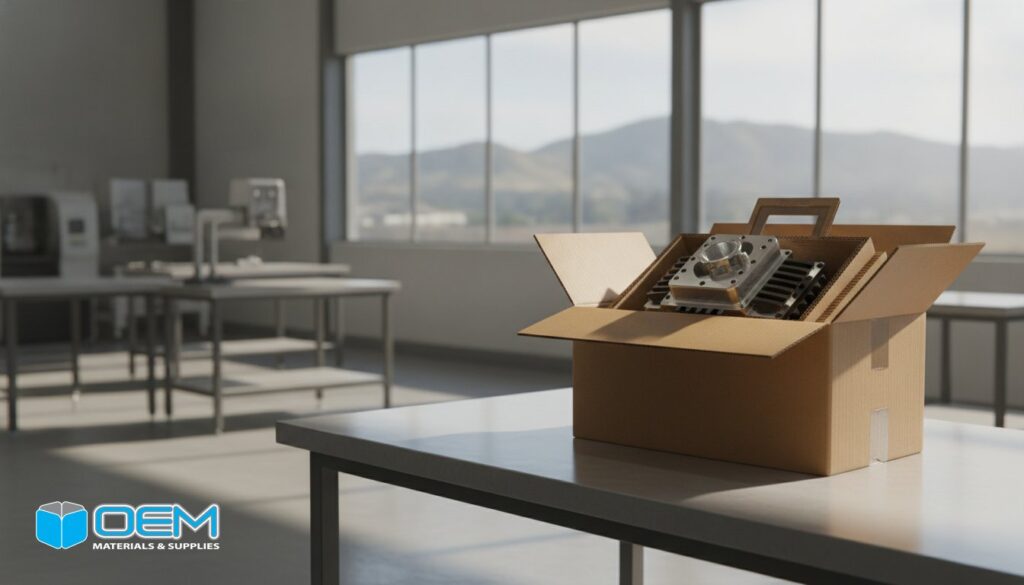
If a precision component arrives at a Tier 1 aerospace facility with even a hairline fracture, does the cost of that single rejection outweigh the pennies saved on a generic shipping container? For many manufacturers, the answer is a resounding yes. High product rejection rates and inefficient kitting processes often stem from a lack of specialized internal protection. Most procurement professionals already know that a standard box is only as good as the engineering inside it. Relying on generic solutions frequently leads to damaged goods and wasted warehouse labor.
This guide will show you how to select, engineer, and source high-quality corrugated inserts and partitions in Orange County to eliminate transit damage and streamline your Southern California supply chain. With the Producer Price Index for corrugated paperboard reaching a record high of 372.312 in July 2026, optimizing material use is now a critical cost-control strategy. We’ll explain how custom-engineered internals improve pallet density and reduce shipping costs while ensuring your products survive the rigors of local and national transit. You’ll also learn how a reliable local supplier with just-in-time capabilities can help you maintain leaner inventory levels without risking stockouts.
Key Takeaways
- Identify the critical differences between primary containers and internal stabilizers to ensure maximum structural reinforcement for high-value components.
- Select the appropriate Edge Crush Test ratings and flute sizes to optimize stacking strength and material durability for your specific shipping environment.
- Compare the cost implications of die-cut tooling against the labor requirements of standard partitions to determine the most efficient solution for your production volume.
- Learn how to provide accurate product weight and fragility ratings when sourcing corrugated inserts and partitions in Orange County to ensure a precision fit.
- Explore how local vendor-managed inventory and kitting services can reduce in-house labor costs and improve overall supply chain reliability in Southern California.
The Role of Corrugated Internals in Industrial Protective Packaging
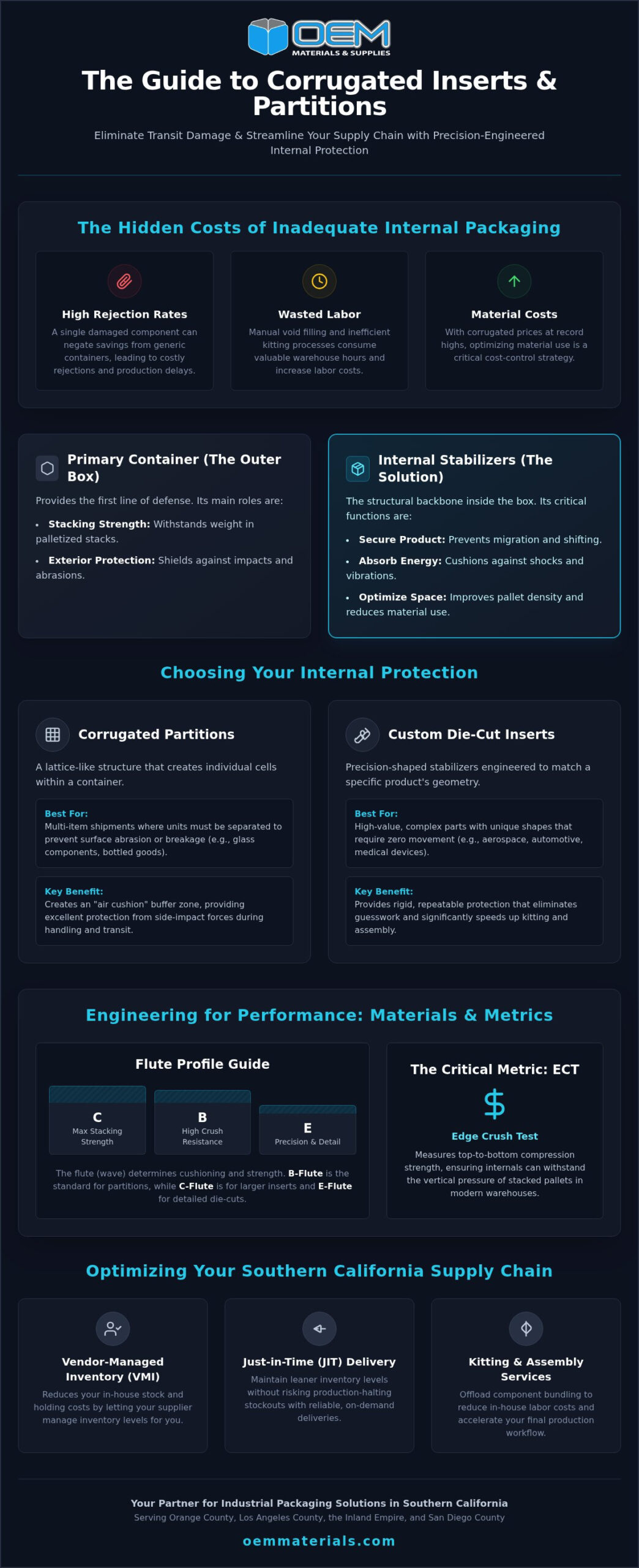
Industrial packaging success depends on what happens inside the box. While a standard shipping container provides a basic barrier, corrugated internals serve as the structural backbone of the unit load. These components are precision-engineered stabilizers that prevent product migration and absorb kinetic energy during transit. For manufacturers sourcing corrugated inserts and partitions in Orange County, understanding the distinction between the primary container and internal stabilizers is the first step toward reducing product rejection rates.
The primary container is designed for stacking strength and exterior protection. In contrast, internals are engineered to secure the product’s specific center of gravity. By applying established Corrugated box design principles, engineers can create a system where the internal components bear the weight of the product. This often allows for lighter outer boxes without compromising safety. This strategic engineering reduces the total cost of ownership by minimizing material waste and decreasing shipping damage across the Southern California supply chain.
What are Corrugated Partitions?
Partitions, or dividers, utilize a lattice-like structure to create individual cells within a container. This configuration is standard for multi-item shipments where units must stay separated to prevent surface abrasion or breakage. The cell size determines the level of item stability. An accurately sized cell prevents shifting, while integrated air space around the perimeter creates a buffer zone. This air cushion is vital for protecting glass components or sensitive electronics from side-impact forces during forklift handling or transit.
What are Custom Die-Cut Inserts?
Die-cut components are precision-shaped stabilizers designed for specific product geometries. Unlike generic void fill materials that can shift or settle, die-cuts provide rigid, repeatable protection. This level of accuracy is mandatory for aerospace, automotive, and medical device shipping. These inserts lock complex parts into a fixed position, ensuring they remain suspended and immobile. Using custom packaging design for these internals eliminates the unpredictability of manual void fill and significantly speeds up the kitting process on the warehouse floor.
Engineering the Right Fit: Material and Style Selection
Selecting the correct substrate for corrugated inserts and partitions in Orange County is a technical requirement that directly impacts the durability of the unit load. Engineering these internals requires a balance between cushioning and compression strength. While the outer box handles external friction, the internal components must withstand the weight of the product and the vertical pressure of stacked pallets. According to the Fibre Box Association (FBA), standardized testing ensures that materials perform reliably under these specific industrial stresses.
Flute Sizes and Their Industrial Applications
Flute size refers to the height and spacing of the arched waves between the linerboard. For internal components, the choice of flute determines the level of protection and the accuracy of the fit. B-Flute is the industry standard for partitions due to its high flat crush resistance and puncture strength. It takes up less space than C-Flute, allowing for more cells per box while maintaining rigid cell walls. C-Flute is better suited for larger structural inserts that require vertical stacking strength. E-Flute is the preferred choice for precision die-cuts or small electronics packaging where high-detail folding and a smooth surface for printing are required. If you aren’t sure which flute fits your application, you can request a quote to get an expert recommendation based on your product dimensions.
ECT vs. Mullen Test: Which Metric Matters for Internals?
The Edge Crush Test (ECT) measures the top-to-bottom compression strength of the corrugated board. It’s the most relevant metric for modern warehouse environments where palletized goods are stacked high. For most corrugated inserts and partitions in Orange County, a high ECT rating ensures the internals won’t buckle under the weight of the load above. In contrast, the Mullen Test measures burst strength, or the force required to puncture the board. While Mullen was the historical standard, it’s now primarily used for heavy, sharp-edged parts that might pierce the linerboard during handling.
Heavy loads often require a transition from single-wall to double-wall corrugated. Double-wall construction provides superior cushioning and stacking strength for automotive parts or industrial machinery. It’s also important to consider environmental factors. Even in the relatively dry climate of Southern California, moisture and humidity during transit to coastal ports can weaken corrugated fibers. Specifying a higher ECT rating or moisture-resistant coatings provides a necessary safety margin for goods moving through the regional supply chain.
Corrugated Partitions vs. Die-Cut Inserts: Strategic Application
Selecting the right internal configuration determines the operational efficiency of your packing line. While both options provide essential protection, the choice between partitions and die-cut inserts depends on your specific product geometry and available labor. For many industrial buyers sourcing corrugated inserts and partitions in Orange County, the decision hinges on the total cost per shipped unit rather than just the material price. You must weigh the upfront tooling costs of die-cuts against the ongoing labor requirements of assembly.
Labor requirements differ significantly between these two formats. Corrugated partitions usually arrive pre-assembled and collapsed; a worker simply expands the lattice and drops it into the box. In contrast, die-cut inserts often require multiple folds and tucks to achieve their final protective shape. While die-cuts offer superior stabilization for irregular items, they increase the labor time per package. Additionally, die-cut solutions require an upfront investment in custom tooling, whereas partitions can often be manufactured using standard setups, making them more cost-effective for uniform product runs.
When to Choose Corrugated Partitions
Partitions are the optimal choice for high-volume shipments of uniform, smaller items. They create a series of identical cells that prevent item-to-item contact, which is essential for glass containers or metal components prone to scratching. Because partitions utilize the full interior volume of the corrugated boxes, they maximize pallet density and reduce shipping costs per unit. This efficiency is particularly valuable for automated packing lines where speed and consistency are the primary objectives.
When to Choose Die-Cut Inserts
Die-cut inserts are recommended for irregular shapes or heavy components, such as automotive engines or specialized aerospace hardware. These internals are engineered to create specific cushioning zones that suspend the product away from the box walls, absorbing shocks that would otherwise reach the item. For sensitive medical equipment, a die-cut insert provides a level of precision that a simple partition cannot match. If your product requires a unique protective footprint, utilizing custom packaging design for prototype development ensures the final insert matches your exact weight and fragility specifications.
Sourcing and Measuring for Orange County Manufacturers
Procurement success for corrugated inserts and partitions in Orange County begins with technical precision. An inaccurate measurement of just one eighth of an inch can lead to internal collapsing or assembly friction on the production line. When requesting a quote, manufacturers must provide more than just dimensions. You need to specify the product weight and fragility rating. This data allows engineers to determine if a standard 32 ECT board is sufficient or if a 44 ECT double wall substrate is required to prevent crushing during transit through the Inland Empire or Los Angeles.
Step-by-Step Measurement Guide
Always measure the internal dimensions of the outer shipping container, not the exterior. For partitions, specify the cell count using a length by width configuration, such as a 3×4 grid for 12 units. This ensures the lattice fits snugly against the box walls, providing maximum stacking strength. If you’re using custom die-cut inserts, factor in a clearance of 1/16 to 1/8 inch. This small buffer ensures that warehouse staff can insert and remove the stabilizers quickly without tearing the corrugated liners or slowing down the kitting process.
Lead times for custom tooling in Southern California typically range from five to ten business days for initial prototypes. Once the design is finalized, production runs for standard partitions are often faster. Providing accurate annual usage data helps your supplier plan production cycles, ensuring that custom tooling is ready and material is staged for your specific requirements. To get started with an accurate assessment of your needs, request a quote by providing your product dimensions and weight.
The Advantage of Proximity in Orange County
Sourcing locally from an Orange County partner offers distinct logistical advantages. Bulky corrugated materials are expensive to transport over long distances because they occupy significant trailer space relative to their weight. By working with a supplier near Irvine or Anaheim, you significantly reduce freight costs and carbon footprint. Proximity also facilitates faster site visits for packaging audits. If a damage issue arises in your warehouse, a local expert can troubleshoot the failure point in person. This local presence enables rapid testing cycles, where prototypes are delivered and revised within days rather than weeks, keeping your supply chain agile and responsive to production changes.
Optimizing Supply Chain Efficiency with OEM Materials & Supplies
Reliability in the supply chain depends on more than just material quality. It requires a partner that understands the logistical constraints of Southern California manufacturing. OEM Materials & Supplies functions as a technical consultant rather than a simple vendor. We help manufacturers identify hidden costs in their packaging workflows. By integrating advanced logistics programs, we ensure that your corrugated inserts and partitions in Orange County are available exactly when they are needed, without tying up excessive capital in floor space.
Vendor-Managed Inventory (VMI) for Packaging
Stockouts of critical packaging internals can halt an entire production line. To mitigate this risk, we offer packaging VMI programs that automate the replenishment process. Our team monitors your usage patterns and manages inventory levels on your behalf. This system eliminates the administrative overhead associated with small, recurring purchase orders. It ensures a consistent supply of protective components while allowing your procurement team to focus on higher-value strategic tasks. By using automated replenishment based on real-time usage, you maintain a lean inventory without the threat of a manufacturing bottleneck.
Kitting and Assembly Services
In-house labor is one of the most significant expenses for OC factories. Our kitting and assembly services address this by delivering boxes with partitions already inserted and ready for the packing line. This pre-assembly reduces the physical footprint of materials on your manufacturing floor. For high-value electronics or medical devices, we often combine corrugated internals with custom foam packaging to provide hybrid protection. This approach ensures that complex parts are secured within a single, ready-to-use unit, significantly speeding up your throughput.
Just-In-Time (JIT) delivery further optimizes your operation by freeing up valuable warehouse space in high-rent areas like Irvine and Anaheim. Instead of storing months of bulky corrugated inventory, you receive smaller, more frequent shipments that align with your production schedule. This lean approach to corrugated inserts and partitions in Orange County reduces the risk of inventory damage and improves overall cash flow. Our focus is on creating a seamless extension of your production line, providing the stability and precision required to meet rigorous industry standards.
Secure Your Supply Chain with Engineered Internals
Protecting high-value industrial products requires more than a sturdy outer box. It demands internal stabilizers engineered for the specific stresses of the Southern California supply chain. By selecting the correct Edge Crush Test ratings and choosing between high-volume partitions or precision die-cut inserts, you can significantly reduce product rejection rates and material waste. These technical decisions directly impact your bottom line by optimizing pallet density and lowering the total cost of ownership in logistics.
OEM Materials & Supplies serves as a technical partner for aerospace, medical, and electronics manufacturers. We provide local warehousing, rapid prototyping, and reliable delivery across the region. Our value-added services, including vendor-managed inventory and kitting, are designed to eliminate the logistical bottlenecks that slow down your production line. When you source corrugated inserts and partitions orange county from a local expert, you gain the agility needed to respond to shifting manufacturing requirements.
Ready to optimize your protective packaging? To receive a detailed recommendation, please request a quote for custom corrugated inserts and partitions. Providing your product dimensions, weight, and annual usage will help our engineers develop a solution that balances durability with operational efficiency. We look forward to strengthening your logistics operations and protecting your critical components.
Frequently Asked Questions
What is the difference between ECT and Mullen ratings for corrugated inserts?
ECT ratings measure the vertical compression strength of the board, which is critical for stacking palletized loads in a warehouse. Mullen ratings measure the burst strength, or the pressure needed to puncture the linerboard. For most industrial applications, ECT is the primary metric because it determines how much weight a box can support when stacked. Mullen is typically reserved for heavy or sharp-edged parts that might pierce the material during handling.
Can corrugated partitions be customized for different cell sizes in one box?
Yes, corrugated partitions can be engineered with variable cell sizes within a single container. This configuration is ideal for kitting applications where a single box contains multiple components of different dimensions. By customizing the lattice structure, we ensure each item has a precision fit, preventing internal migration and surface abrasion. This method optimizes space and reduces the need for multiple separate shipping containers for a single assembly.
How long does it take to get a prototype for a custom die-cut insert in Orange County?
Lead times for custom die-cut corrugated inserts and partitions in Orange County depend on design complexity and current production schedules. We focus on rapid prototyping to ensure your Southern California operations remain on schedule. By working with a local supplier, you can expect faster turnaround times for revisions compared to out-of-state vendors. Our engineering team provides precision CAD designs to match your product’s specific geometry before moving into high-volume production.
Are corrugated inserts strong enough to replace engineered foam for heavy parts?
Corrugated material offers significant structural reinforcement, but it may not always replace engineered foam for extremely heavy or fragile components. Foam provides superior shock absorption and vibration dampening for sensitive electronics or medical devices. However, for many automotive or industrial parts, high-ECT double-wall corrugated is a cost-effective alternative. We often recommend hybrid solutions that combine corrugated outer structures with foam contact points to balance cost and protection.
What information do I need to provide for a custom partition quote?
To provide an accurate quote, we require the internal dimensions of your shipping container and the desired cell count, such as a 3×4 configuration. You should also provide the weight and fragility rating of each individual item. Knowing your annual usage helps us plan production cycles and manage inventory effectively. Providing these details ensures our engineers select the correct board grade and flute size to prevent internal collapsing during transit.
Does OEM Materials offer JIT delivery for manufacturers in Irvine or Anaheim?
OEM Materials provides Just-In-Time (JIT) delivery services for manufacturers throughout Irvine, Anaheim, and the broader Orange County area. This service allows you to receive packaging materials in smaller, frequent shipments that align with your daily production schedule. By utilizing JIT delivery, you can free up valuable warehouse floor space and reduce the amount of capital tied up in bulky inventory. Our local Southern California warehousing ensures reliable, fast transit to your facility.
Can I get corrugated partitions that are pre-assembled in the box?
Yes, we offer kitting and assembly services where partitions are pre-inserted into the boxes before they arrive at your facility. This value-added service significantly reduces the labor time required on your packing line. Instead of warehouse staff expanding and inserting the lattice manually, they can begin packing products immediately. This process streamlines your operation and is particularly beneficial for high-volume manufacturing environments in Southern California where labor efficiency is a priority.
Are corrugated inserts recyclable for companies with sustainability goals?
Corrugated materials are highly recyclable and align with corporate sustainability goals and California’s evolving packaging regulations. Most corrugated board is considered readily recyclable under state criteria like SB 343 because at least 60% of Californians have access to recycling programs for it. Utilizing corrugated inserts and partitions in Orange County helps producers meet the requirements of SB 54, which aims for 100% of single-use packaging to be recyclable or compostable by 2032.