
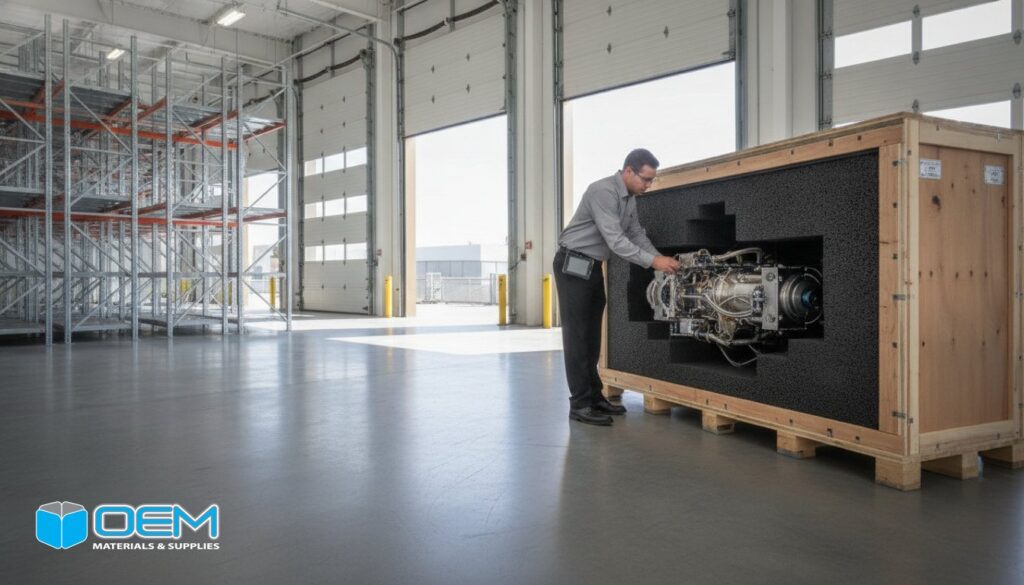
A custom shipping crate is not just a wooden box; it’s an engineered protective system designed to safeguard millions of dollars in precision equipment. You likely understand that standard pallets and off-the-shelf solutions often fail when subjected to the rigors of international freight or long-haul trucking. The risk of product damage or a costly customs hold due to non-compliant wood treatment is a constant concern for operations and warehouse managers. This guide will show you how to source and specify custom shipping crates southern california manufacturers rely on to meet the strict demands of the aerospace, medical, and electronics sectors.
Selecting the right industrial packaging partner requires more than just looking for the lowest price per unit. It involves understanding material science and regulatory shifts, such as the full enforcement of the ISPM 15 hyphen requirement starting January 1, 2026. We’ll examine internal cushioning strategies to reduce damage rates, the importance of ASTM D6251 structural standards, and how a local partner can stabilize your supply chain through vendor-managed inventory and just-in-time delivery. By the end of this guide, you’ll have a clear framework for securing your high-value assets while maintaining international compliance.
Key Takeaways
- Identify when high-value industrial equipment requires engineered wood crates instead of standard corrugated boxes to prevent structural failure and transit damage.
- Ensure international shipping compliance by verifying ISPM 15 heat treatment standards and the specific marking requirements for export wood packaging.
- Reduce your total cost of ownership by sourcing custom shipping crates southern california manufacturers utilize to lower damage rates and streamline packing labor.
- Evaluate local partners based on their ability to provide rapid prototyping and their proximity to major industrial hubs in Orange County, Los Angeles, and San Diego.
- Optimize your supply chain by integrating value-added services such as custom foam inserts and vendor-managed inventory for better warehouse efficiency.
Selecting the Right Custom Shipping Crates for Southern California Manufacturers
High-value industrial equipment requires a level of protection that standard packaging simply cannot provide. While corrugated boxes are efficient for lighter goods, heavy machinery and sensitive instruments demand the structural rigidity of a shipping crate. In Southern California, where aerospace and electronics manufacturing drive the regional economy, the stakes for transit damage are exceptionally high. A single failed shipment can result in production delays and lost contracts.
Choosing custom shipping crates southern california businesses trust involves evaluating the specific stresses of your distribution cycle. Custom crates allow for exact-fit engineering, which eliminates excess movement and reduces the overall footprint of the shipment. This precision directly impacts your bottom line by minimizing dimensional weight charges. You don’t want to pay to ship empty space or utilize oversized containers that exceed your actual requirements. Engineered crates ensure that every inch of the enclosure serves a protective purpose.
Industrial Challenges in the SoCal Supply Chain
Manufacturers operating out of hubs in Orange County and Riverside face unique logistical hurdles. Moving sensitive medical devices to research labs in San Diego or transporting components to the Port of Los Angeles for export requires packaging that withstands both mechanical vibration and environmental shifts. Humidity is a particular concern for sea freight; poorly designed enclosures can trap moisture, leading to corrosion of electronic components or structural degradation of the crate itself. Selecting materials that resist these variables is essential for long-haul reliability.
Defining Your Crate Specifications
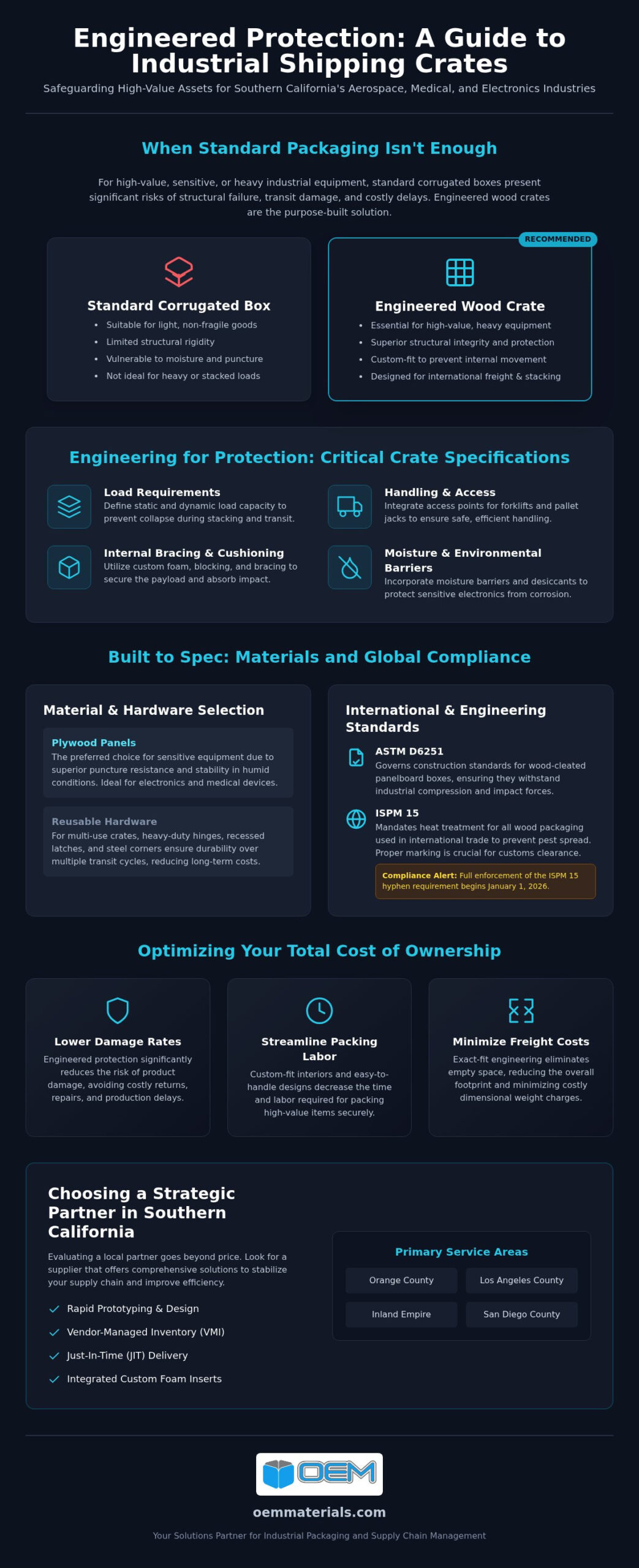
Effective crate design starts with a detailed analysis of the payload. You must determine the weight capacity and identify where structural reinforcement is necessary to prevent bowing or collapse during stacking. For fragile internal components, integrating custom foam packaging provides the necessary deceleration during impact. Consider these critical factors when defining your specs:
- Static and dynamic load requirements for stacking in warehouses or transit.
- Access points for forklifts and pallet jacks to ensure safe handling.
- Internal blocking and bracing locations to secure the center of gravity.
- Moisture barrier and desiccant needs for sensitive electronics.
The total load-bearing capacity of an industrial crate is determined by the combined strength of its base skid and the vertical compression resistance of its side panels.
Engineering Standards for Industrial Wood Crates
Industrial crating is a precise engineering discipline that relies on material science to ensure structural integrity. When designing custom shipping crates southern california manufacturers use for high-value assets, engineers must adhere to rigorous standards such as ASTM D6251. This specification governs the construction of wood-cleated panelboard shipping boxes, ensuring they can withstand the compression and impact forces common in industrial logistics. Material selection is the first step in this process. While solid lumber provides the primary frame and load-bearing strength, panel choices between plywood and OSB depend on the specific application. Plywood offers superior puncture resistance and moisture stability, making it the preferred choice for sensitive electronics and medical equipment.
For reusable crate systems, hardware selection becomes a critical factor. Integrating heavy-duty hinges, recessed latches, and reinforced steel corners allows a crate to survive multiple transit cycles without structural failure. This approach reduces long-term packaging costs for companies managing closed-loop distribution between regional facilities. If you are planning a complex shipment, you can request a detailed crating quote to evaluate the best hardware and material configuration for your specific payload.
International Shipping and Export Compliance
Exporting industrial goods requires strict adherence to ISPM 15 standards to prevent the spread of timber pests. All solid wood packaging must undergo Heat Treatment (HT), reaching a core temperature of 56°C for a minimum of 30 minutes. A critical regulatory update takes effect on January 1, 2026, when the U.S. Animal and Plant Health Inspection Service (APHIS) will resume full enforcement of the ISPM 15 hyphen requirement. This means the IPPC mark must clearly include a hyphen between the country code and the facility code. Non-compliant markings can lead to immediate re-export or destruction of the shipment at the importer’s expense. Documentation must always match the physical stamps on the crates to avoid customs delays.
Internal Protection and Cushioning
The exterior shell of a crate is only half the solution; internal engineering prevents damage from vibration and shock. Integrating custom foam packaging is essential for dampening the frequencies encountered during air or sea freight. Foam density must be matched to the product’s static loading and fragility. For instance, high-density polyethylene foam is often used for heavy machine bases, while softer polyurethane foam protects delicate optical components. Proper blocking and bracing techniques further secure the load, preventing any shifting that could compromise the crate’s center of gravity. For a deeper look at material properties, refer to The Industrial Guide to Foam Inserts.
Custom Crating vs. Standard Shipping Containers: A Cost-Benefit Analysis
Procurement professionals often focus on the unit price of a container. While this is a visible metric, it fails to account for the total cost of ownership (TCO) across the entire supply chain. A true analysis must factor in damage rates, insurance claims, and the labor required for packing and unpacking. For high-value assets, the cost of a single transit failure can exceed the total annual expenditure on packaging materials.
Analyzing the Risk of Product Damage
The aerospace and medical sectors in Southern California deal with equipment that is both heavy and delicate. Standard shipping containers often lack the structural integrity to prevent internal shifting. When a precision instrument arrives misaligned, the hidden costs include administrative time for claims, expedited shipping for replacements, and potential penalties for missed delivery windows. Custom engineering provides superior protection by securing irregular shapes at their strongest structural points. Investing in custom crating for high-value assets delivers a measurable return through the near-total elimination of replacement costs and the preservation of your brand’s reputation for reliability.
Operational Efficiency and Labor Savings
Efficiency on the packing line is a critical variable in the cost equation. Utilizing custom shipping crates southern california manufacturers provide can significantly reduce the time spent on manual wrapping and dunnage application. These crates often arrive as pre-configured kits, allowing your team to secure a product in minutes rather than hours. Better design also leads to improved warehouse utilization. Crates engineered for uniform stackability and easy forklift access allow you to maximize vertical storage and trailer capacity. This reduces the number of shipments required and lowers overall freight expenses.
There are instances where heavy-duty wood is unnecessary. For lighter components or domestic routes with minimal handling, high-quality corrugated boxes offer a cost-effective alternative. The decision should be based on a combination of product weight, dimensions, and the fragility of internal electronics. Reusable crates provide the best long-term savings for closed-loop shipping between your regional facilities in Los Angeles, Orange County, and San Diego.
How to Evaluate a Southern California Crating Partner
Proximity to major manufacturing hubs in Los Angeles and San Diego is a primary consideration for any procurement team. A local supplier understands the regional infrastructure and the specific logistical challenges of the West Coast. When you source custom shipping crates southern california professionals design, you gain access to faster site visits and more accurate technical consultations. This proximity allows for a level of collaboration that long-distance vendors simply cannot match. It ensures that the partner you choose acts as a consultant rather than a commodity reseller.
Local Logistics and Lead Times
Suppliers located in Orange County or Riverside significantly reduce your freight overhead. Shipping empty wood crates across state lines is cost-prohibitive due to the high volume and dimensional weight involved. A local partner facilitates just-in-time delivery, which is essential for manufacturers with limited warehouse floor space. Utilizing Vendor Managed Inventory (VMI) ensures you never face a production stoppage due to packaging shortages. This model allows the supplier to monitor your usage and replenish stock automatically, aligning with the rigorous production schedules of the region’s industrial sectors.
Local operational costs in California are rising, with the statewide minimum wage reaching $16.90 per hour on January 1, 2026. This adds pressure to manufacturing margins, making operational efficiency a top priority. A crating partner that offers VMI and JIT services helps you mitigate these costs by reducing the labor required for internal inventory management and material handling. They understand that in Southern California, speed and reliability are the keys to maintaining a competitive supply chain.
Quality Control and Design Support
Technical expertise in specialized sectors like automotive and electronics is non-negotiable. Your partner must possess robust custom packaging design capabilities to handle complex geometry and sensitive components. Automotive parts often require high-density foam integration to prevent surface abrasions, while medical electronics might need ESD-safe environments. A partner with experience in these diverse sectors will recognize these requirements during the initial design phase.
Rapid prototyping is another key differentiator. Seeing a physical sample before committing to a high-volume run prevents costly engineering errors and ensures the crate fits your product perfectly. Many SoCal manufacturers produce high-value, low-volume equipment that doesn’t justify massive production runs. A flexible partner scales their operations to meet your specific annual usage. For more detailed criteria on vendor selection, read our guide on Choosing a Wholesale Industrial Packaging Supplier.
If you have a project with specific weight and dimension requirements, contact us for a custom crating quote to discuss your protection needs and prototype requirements.
Comprehensive Crating and Logistics Solutions with OEM Materials
OEM Materials & Supplies operates as an extension of your engineering and production teams. We provide full-service industrial packaging, moving from initial concept and design to final assembly. Our expertise in custom shipping crates southern california ensures that your high-value equipment is protected by systems engineered specifically for aerospace and medical standards. While we maintain a nationwide reach to support your broader distribution network, our core operations focus on the manufacturing centers of Orange County, Los Angeles, and San Diego. We don’t just sell components; we deliver integrated solutions that stabilize your supply chain.
Integrated Packaging for Complex Shipments
Most industrial shipments require more than a single material to ensure safety. We specialize in integrated packaging that combines heavy-duty wood crates with custom foam packaging and corrugated components. This multi-material approach addresses every potential point of failure in the shipping cycle. By delivering complete packaging kits directly to your production line, we eliminate the need for your staff to manage multiple vendors or assemble components manually. Our engineering team solves unique logistical challenges by designing internal blocking and bracing that secures the payload while minimizing total package weight and dimensional freight costs.
VMI and Inventory Management
Managing bulky wood crates and large sheets of foam can consume significant warehouse floor space. Our Vendor Managed Inventory (VMI) and just-in-time delivery programs allow you to reclaim that space for manufacturing operations. We monitor your inventory levels and replenish stock based on your actual production rates, effectively ensuring zero stockouts. This model is particularly valuable for manufacturers in Riverside and San Bernardino counties where industrial space costs are a major operational factor. By reducing on-site packaging stock, you improve cash flow and warehouse efficiency simultaneously.
A reliable partnership is built on precision and data. To receive a recommendation tailored to your specific application, contact us for a professional consultation. Please be prepared to provide your product dimensions, weight, and estimated annual usage to help our team develop an accurate prototype and quote for your next project.
Optimize Your Industrial Logistics with Engineered Crating
Securing high-value assets requires a shift from viewing packaging as a commodity to treating it as a critical engineering requirement. By prioritizing ASTM D6251 standards and ISPM 15 compliance, you protect your products from physical damage and your business from costly regulatory delays. Sourcing custom shipping crates southern california manufacturers trust allows you to leverage local expertise for rapid prototyping and vendor-managed inventory. These integrated solutions reduce dimensional weight and streamline your packing line, directly impacting your bottom line.
OEM Materials & Supplies provides the technical expertise and local support needed to manage the specific requirements of aerospace, medical, and electronics logistics. Our team specializes in combining wood crates with custom foam inserts to create a comprehensive protective environment for your most sensitive equipment. We’re ready to help you stabilize your distribution cycle and reduce transit risks through precision design and reliable local delivery across Orange County, Los Angeles, and San Diego.
Request a quote for custom shipping crates tailored to your industrial specifications. Provide your product dimensions and weight to help our engineers develop the most efficient solution for your needs.
Frequently Asked Questions
What is ISPM 15 and why is it required for custom shipping crates?
ISPM 15 is an international standard requiring solid wood packaging to be heat-treated to eliminate pests. It’s mandatory for all wood crates crossing international borders to prevent customs delays or re-exportation. Starting January 1, 2026, the IPPC mark must strictly include a hyphen between the country code and the facility code. Maintaining compliance is essential for any industrial operation in Southern California shipping high-value equipment to global markets.
How do I determine if my equipment needs a wood crate instead of a corrugated box?
You should choose a wood crate if your equipment exceeds the structural capacity of a corrugated box or has a high center of gravity. Heavy machinery, sensitive medical lasers, and aerospace components require the rigid protection of wood to withstand stacking and mechanical handling. While corrugated boxes work for lightweight items, crates provide the necessary compression strength and puncture resistance for high-value assets moving through complex distribution networks.
Can custom crates be designed for reuse in a closed-loop supply chain?
Yes, custom shipping crates southern california manufacturers utilize are often engineered for reuse in closed-loop supply chains. By integrating heavy-duty hardware like recessed latches and hinges, a crate survives multiple transit cycles between regional facilities in Los Angeles and San Diego. This strategy lowers the long-term cost per shipment compared to single-use options. Reusable crates are a practical, sustainable choice for frequent, short-haul industrial logistics within the region.
What information is needed to get an accurate quote for custom shipping crates?
To provide an accurate quote, we require the exact dimensions and weight of your product, along with its specific fragility requirements. You should also provide your estimated annual usage and the final shipping destination, as international routes require ISPM 15 compliance. Details regarding internal mounting points or the need for custom foam inserts are also helpful. This data allows our engineering team to design a crate that optimizes material costs and freight efficiency.
Do you provide internal cushioning like foam inserts with the crates?
We provide integrated internal protection as part of our full-service packaging solutions. Our engineering team designs custom foam packaging inserts, utilizing various densities of polyethylene or polyurethane foam to dampen vibration and absorb shock. These inserts are precision-cut to fit the geometry of your equipment, ensuring it remains secure inside the crate. Combining wood exteriors with engineered foam interiors provides the highest level of protection for delicate electronics and medical devices.
What are the typical lead times for custom crate prototypes in Southern California?
Lead times for custom crate prototypes depend on the complexity of the design and the specific materials required. As a local provider of custom shipping crates southern california manufacturers rely on, we offer rapid prototyping that outpaces distant vendors. Our proximity to hubs in Orange County and Los Angeles allows for immediate site visits and faster design iterations. This local support ensures your project stays on schedule while meeting the high standards of the regional supply chain.
How do custom crates help reduce international shipping costs?
Custom crates reduce international shipping costs by optimizing the external dimensions of the package to match the payload. This precision engineering minimizes dimensional weight, which is a primary factor in air and sea freight pricing. By eliminating excess space and reducing the overall footprint of the shipment, you avoid paying for unused volume. Additionally, custom designs ensure your cargo fits efficiently into standard shipping containers, maximizing trailer and cargo hold utilization.
Are there specific crate standards for the aerospace or medical industries?
The aerospace and medical industries frequently require crates built to ASTM D6251 standards for structural integrity. These specifications ensure the enclosure can withstand the dynamic loads and environmental stresses encountered during transport. Medical device packaging often requires additional cleanroom-compatible materials, while aerospace components may need specific blocking and bracing to secure heavy, irregular shapes. Our engineering team specializes in these sectors, designing crates that meet both structural and phytosanitary regulatory requirements.