
When industrial rent in Southern California reaches $1.49 per square foot, using your warehouse to store stacks of empty corrugated boxes is no longer just a logistical habit; it’s an expensive drain on your bottom line. Many operations managers in Los Angeles and Orange County find themselves trapped between two equally difficult options: tie up capital in excessive safety stock or risk a production line shutdown because a custom foam insert didn’t arrive on time. Implementing a vendor managed inventory for packaging program solves this dilemma by shifting the burden of stock management to an expert partner.
You shouldn’t have to choose between floor space and operational reliability. This guide details how a tailored VMI program eliminates the threat of stockouts and reduces on-site inventory footprints for industrial manufacturers. We’ll examine how to streamline your procurement process, lower labor costs through efficient kitting, and achieve 100 percent packaging availability without the overhead of traditional warehousing.
Key Takeaways
- Implement a vendor managed inventory for packaging program to reclaim valuable floor space in high-rent regions like Orange County and Los Angeles.
- Shift inventory ownership to a reliable partner to eliminate production line shutdowns caused by missing custom boxes or foam inserts.
- Evaluate the differences between VMI and traditional just-in-time delivery to determine which model best supports your manufacturing volume and kitting requirements.
- Use a comprehensive packaging audit to identify critical components and establish clear performance benchmarks for delivery accuracy.
- Leverage specialized packaging logistics to meet the rigorous quality and reliability standards required in aerospace, medical device, and electronics manufacturing.
The Hidden Costs of Conventional Packaging Procurement
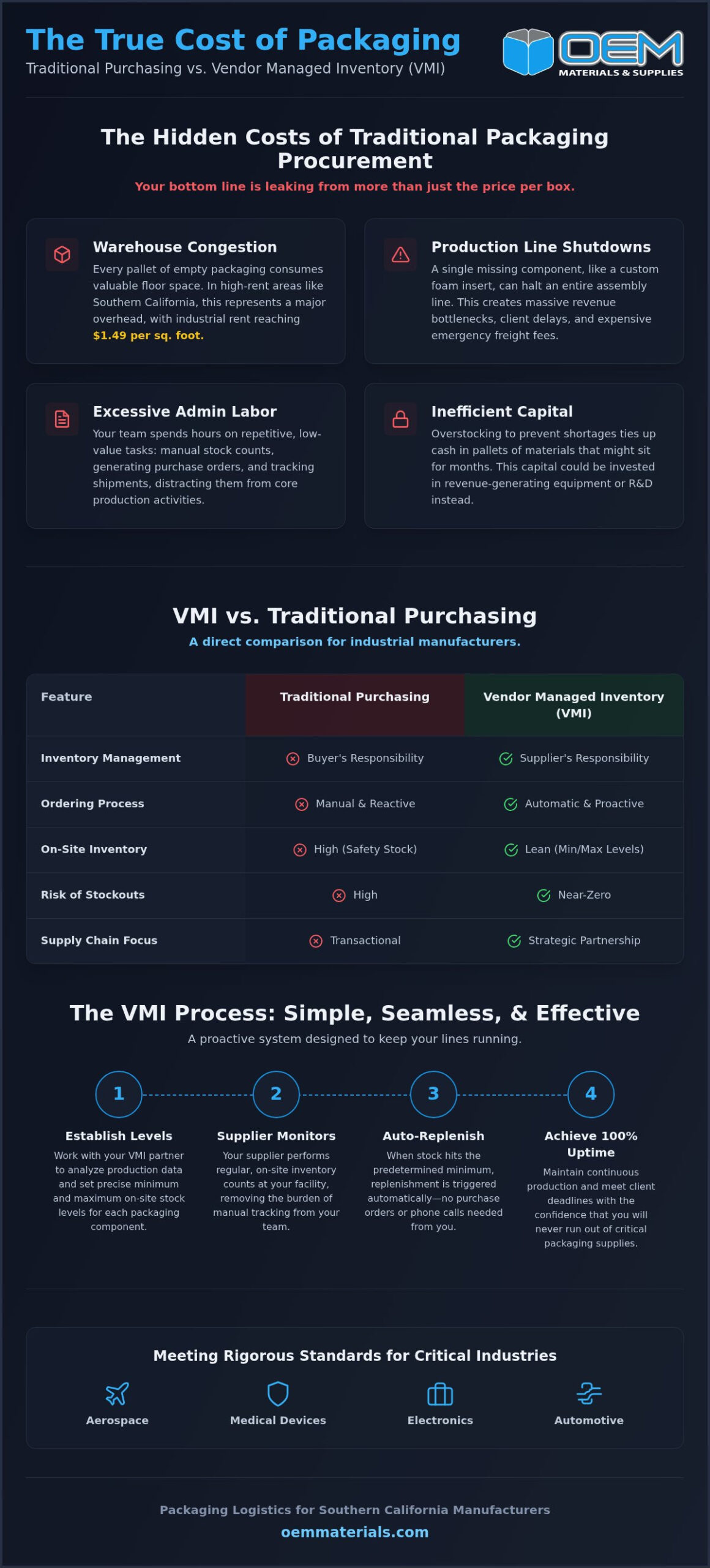
Traditional procurement models often hide the true total landed cost of materials. While a purchasing manager might focus on the price per unit of corrugated boxes, the actual expense includes administrative labor, storage requirements, and the financial risk of shortages. Relying on manual ordering processes forces your team into a reactive cycle that drains resources and limits operational flexibility. Implementing vendor managed inventory for packaging ensures that stock levels are monitored in real-time, preventing the critical failures that occur when packaging is treated as an afterthought.
Stockouts and Production Latency
A single missing component can halt an entire assembly line. For manufacturers of high-value electronics or medical devices, the inability to ship because of a shortage in foam packaging or custom inserts creates a massive revenue bottleneck. These shutdowns lead to cascading delays in client delivery schedules and often necessitate expensive emergency shipments. The financial impact of a production stoppage usually dwarfs any perceived savings from bulk material discounts. Emergency freight and expedited production fees quickly erase any margin gained through traditional bulk purchasing.
Warehouse Congestion and Space Optimization
Real estate in Southern California industrial zones is a premium asset. With industrial rent in Orange County reaching as high as $1.49 per square foot in 2026, every pallet of empty packaging represents a significant monthly overhead. Storing slow-moving inventory in-house takes up floor space that could otherwise support revenue-generating manufacturing lines or new equipment. This congestion limits your ability to scale operations effectively. Transitioning to Vendor-managed inventory (VMI) allows you to reclaim that square footage, shifting the storage burden to your supplier while maintaining immediate access to materials.
Beyond storage and stockouts, manual inventory management carries heavy labor costs. Your team spends hours counting stock, generating purchase orders, and tracking shipments. This repetitive administrative work is an inefficient use of skilled labor. Overstocking to avoid these headaches only leads to capital inefficiency, as cash remains tied up in pallets of materials that might not be used for months. A structured program streamlines these processes, allowing your staff to focus on production rather than procurement logistics. This shift improves cash flow and ensures that your capital is working for your business rather than sitting on a warehouse shelf.
Defining Vendor Managed Inventory for Packaging Systems
Vendor managed inventory for packaging is a strategic partnership that moves beyond simple commodity supply. In a traditional wholesale model, the buyer monitors stock and initiates orders when levels look low. Under a VMI arrangement, the responsibility for maintaining inventory levels shifts entirely to the supplier. This shift is supported by academic research on VMI, which indicates that transferring management tasks to the vendor reduces administrative overhead and improves supply chain responsiveness. For manufacturers in the Inland Empire or San Diego, this means your custom foam packaging and corrugated boxes are always available without your team having to lift a finger.
The VMI Mechanism: How It Works
The process begins by establishing precise minimum and maximum stock levels based on your historical production data. Instead of waiting for a purchase order, the supplier performs regular on-site inventory counts at your facility. When stock hits the predetermined minimum, replenishment is triggered automatically. This eliminates the need for manual counting and prevents the frequent purchase order generation that bogs down procurement departments. It’s a proactive system designed to keep your lines running while keeping your on-hand stock lean.
A successful VMI program must integrate with custom packaging design services. Unlike generic wholesale, VMI for industrial sectors often involves complex components like die-cut foam inserts or specialized wood crates. By managing these custom-engineered items, the supplier ensures that even the most technical packaging requirements are met without the long lead times typically associated with custom manufacturing. If you’re managing complex kitting projects, you can request a consultation to see how these custom components fit into a managed flow.
Data Integration and Usage Tracking
Transparency is the foundation of this model. Suppliers use usage data to predict seasonal surges common in the aerospace and medical device sectors. Procurement managers maintain full visibility through regular reporting, ensuring that inventory levels align with actual floor consumption rather than rough estimates. Vendor managed inventory for packaging is a data-driven replenishment model where the supplier assumes full responsibility for maintaining optimal stock levels based on real-time consumption data. This level of integration transforms the supplier from a mere vendor into a seasoned industry partner.
VMI vs. Traditional Purchasing: A Comparison for Manufacturers
While many manufacturers utilize just-in-time (JIT) delivery, it still requires internal staff to monitor bins and trigger orders. In contrast, vendor managed inventory for packaging removes the monitoring burden from your warehouse team. In a JIT model, if your buyer misses a reorder point, production stops. In a VMI model, the supplier assumes the risk and responsibility for replenishment. This distinction is critical for high-volume OEMs in Southern California where labor costs for administrative oversight are high.
Cost Savings and Capital Allocation
Traditional bulk purchasing often appeals to procurement departments looking for the lowest unit price. However, this strategy ignores the high cost of capital and the physical space required to store months of corrugated boxes. VMI allows you to leverage bulk pricing while keeping the inventory off your balance sheet. You only pay for what you consume, which significantly improves cash flow. By consolidating multiple invoices into a single monthly statement, you also reduce administrative overhead. For a deeper look at these financial benefits, review our packaging cost savings frameworks.
Risk Mitigation and Quality Control
Supply chain volatility can lead to sudden shortages of critical materials like stretch film or foam packaging. A VMI partner maintains a dedicated safety stock specifically for your facility, acting as a buffer against market disruptions. This arrangement also protects you from the risk of obsolete inventory. If an engineering change renders a specific wood crate design obsolete, you aren’t stuck with thousands of dollars in useless stock. The supplier manages the transition, ensuring quality remains consistent across all custom components.
Quality control is inherently stronger in a VMI relationship. Because the supplier is responsible for the entire flow, they’re incentivized to catch defects before materials reach your floor. This proactive approach is essential for aerospace and medical device sectors where precision is non-negotiable. By choosing vendor managed inventory for packaging, you’re investing in a system that prioritizes operational uptime over simple material acquisition.
Implementing a VMI Program in Industrial Facilities
Successfully launching a vendor managed inventory for packaging program requires a systematic approach to ensure long-term reliability. It’s not enough to simply deliver materials; the system must be calibrated to the specific rhythm of your production line. This process begins with a comprehensive packaging audit that identifies high-volume and critical items. By understanding exactly which materials drive your operation, we can set performance benchmarks for delivery speed and inventory accuracy that keep your facility running without interruption.
The Packaging Audit and Design Phase
Engineering is the foundation of a reliable VMI system. We conduct a thorough review of your current corrugated box specifications and foam insert requirements to uncover hidden efficiencies. Often, a custom packaging design can consolidate multiple components into a single kit, which reduces material waste and streamlines the assembly process. This phase ensures that every piece of packaging on your floor is optimized for protection and cost-effectiveness before it ever enters the managed inventory rotation.
Logistics and On-Site Integration
Once the design phase is complete, the focus shifts to physical integration within your facility. We determine the frequency of on-site visits needed to maintain your specific safety stock levels based on historical usage data. Establishing designated VMI zones within your warehouse or production floor keeps the workflow organized and predictable. For manufacturers in Orange County or Los Angeles County, this local presence is vital for maintaining the high-frequency replenishment required by modern industrial sectors.
Integrating kitting and assembly services into the VMI workflow provides a secondary layer of labor savings. Instead of your team spending time folding boxes or inserting foam, components arrive pre-assembled and ready for the line. We establish clear communication channels between plant managers and the supplier to ensure that any sudden shifts in production volume are handled proactively. This level of coordination eliminates the reactive “firefighting” common in traditional procurement. To begin your facility audit and optimize your supply chain logistics, you can request a quote for a customized program.
OEM Materials: Scaling Packaging Logistics for Southern California Manufacturers
OEM Materials & Supplies functions as a seasoned industry partner for manufacturers across Orange County, Los Angeles, San Diego, and Riverside. We understand that industrial packaging is not a one-size-fits-all commodity. By implementing a vendor managed inventory for packaging, we provide a localized support structure that responds to the high-stakes requirements of the aerospace, medical device, and electronics sectors. Our proximity to these Southern California hubs allows for a level of responsiveness that distant vendors simply can’t match.
Local Expertise and Regional Support
A significant advantage of partnering with a local wholesale industrial packaging supplier is the ability to execute rapid prototyping and short-run production. When an engineering team in San Diego needs a revised custom foam insert for a new medical component, we can design, prototype, and integrate that change into the VMI flow without disrupting the supply chain. This regional distribution model also reduces transportation costs and minimizes the carbon footprint associated with long-haul freight. It’s a logistical advantage that keeps your operations lean and agile.
We specialize in the technical integration of custom-engineered materials. While many providers treat VMI as a simple storage solution for standard boxes, we focus on the synergy between custom foam packaging and automated replenishment. Our team ensures that die-cut inserts and specialized protective materials are manufactured and stocked in direct alignment with your assembly schedule. This technical precision prevents the accumulation of obsolete stock while guaranteeing that high-value components always have the protection they require.
Comprehensive Industrial Solutions
Our programs are designed to consolidate your entire packaging footprint. We integrate corrugated boxes, pallets, and stretch film into a single, cohesive VMI program. This consolidation simplifies the procurement process and provides better visibility into your total landed costs. For facilities with complex requirements, our kitting services further reduce labor costs by delivering pre-assembled packaging sets directly to the production line.
While our core strength lies in Southern California, we maintain nationwide service capabilities to support manufacturers with multiple distribution centers across the country. This ensures consistency in packaging quality and inventory management across your entire organization. To optimize your facility’s operations and eliminate the risk of stockouts, you can request a consultation for a custom vendor managed inventory for packaging program tailored to your annual usage and specific material requirements.
Optimizing Your Industrial Supply Chain Through VMI
Transitioning to a vendor managed inventory for packaging program allows your facility to pivot from reactive procurement to proactive floor management. By reclaiming valuable square footage and eliminating the threat of production line shutdowns, you ensure that your capital is invested in growth rather than idle stock. A successful partnership integrates custom foam packaging and corrugated boxes into a seamless flow that matches your specific assembly rhythm. This shift doesn’t just save space; it stabilizes your entire operation against market volatility.
OEM Materials & Supplies has served the Southern California manufacturing sector since its inception, providing specialized custom engineering for the aerospace and medical sectors. Our comprehensive stock of corrugated materials and protective foam ensures that your most critical components are always ready for shipment. We can help you identify hidden inefficiencies through a detailed packaging audit and kitting analysis. Contact OEM Materials & Supplies for a VMI Program Consultation to discuss your facility’s annual usage, product dimensions, and technical requirements. Let’s build a more resilient and efficient supply chain together.
Frequently Asked Questions
What are the primary benefits of vendor managed inventory for packaging?
The primary benefits of vendor managed inventory for packaging include the total elimination of stockouts and a significant reduction in on-site inventory footprints. By shifting management responsibility to a seasoned industry partner, manufacturers free up capital that was previously tied up in safety stock. This model ensures 100 percent packaging availability while streamlining the procurement process. It allows operations teams to focus on production rather than monitoring bin levels or generating frequent purchase orders.
How does VMI reduce labor costs for Southern California manufacturers?
VMI reduces labor costs by automating the replenishment cycle and removing the need for manual inventory counts by your internal staff. In high-cost labor markets like Los Angeles and Riverside, reallocating warehouse personnel from administrative tracking to revenue-generating production tasks provides a clear financial advantage. The program also consolidates multiple invoices into a single monthly statement. This simplification reduces the administrative burden on your procurement and accounting departments, lowering overall operational overhead.
Is VMI suitable for custom packaging like foam inserts and die-cut boxes?
Yes, VMI is particularly effective for managing custom packaging such as engineered foam inserts and die-cut corrugated boxes. These items often have longer manufacturing lead times and are critical for protecting high-value aerospace or medical components. By holding dedicated safety stock of your custom designs, a VMI partner ensures these specialized materials are available for immediate use. This proactive approach prevents production delays that typically occur when custom orders are placed reactively.
How do manufacturers maintain control over their inventory in a VMI program?
Manufacturers maintain control through transparent reporting and real-time visibility into their usage data. While the supplier handles the physical replenishment, the client sets the minimum and maximum stock levels that govern the program. Regular inventory audits and usage reports provide procurement managers with the data needed to adjust levels based on seasonal demand or engineering changes. This collaborative structure ensures you always have oversight without the daily burden of manual management.
What is the difference between VMI and Just-in-Time packaging delivery?
The main difference lies in who manages the reorder point. Just-in-Time (JIT) delivery focuses on the timing of shipments, but the manufacturer is still responsible for monitoring stock and initiating orders. In a vendor managed inventory for packaging program, the supplier takes over the monitoring and replenishment tasks entirely. VMI is a more comprehensive service that includes on-site inventory management, whereas JIT is primarily a specialized delivery schedule that requires client-initiated triggers.
Does a VMI program require a minimum annual packaging spend?
Most VMI programs are designed for manufacturers with consistent, high-volume packaging requirements. While specific requirements depend on material types and delivery frequency, the program is generally most cost-effective for operations with a steady annual usage. This volume justifies the logistical costs of regular on-site monitoring and dedicated safety stock. Smaller operations may find that traditional wholesale ordering or JIT delivery models better suit their current production scales and administrative capabilities.
How does VMI help with warehouse space constraints in Orange County?
VMI helps reclaim valuable floor space by moving the bulk of your safety stock to the supplier’s warehouse. In Orange County, where industrial rent can reach $1.49 per square foot, every pallet of empty boxes represents a significant monthly expense. By receiving only what you need for immediate production, you can convert storage areas into revenue-generating manufacturing lines. This space optimization is essential for companies looking to scale operations within their existing footprint.
Can VMI programs include kitting and assembly services?
Yes, integrating kitting and assembly services into a VMI program is a common strategy to further reduce production line labor. Instead of receiving individual components, your team receives pre-assembled kits containing corrugated boxes, foam inserts, and edge protectors. This solution streamlines the final assembly process and reduces the time spent on the packaging line. It’s an effective way to simplify complex supply chains for electronics and medical device manufacturers in San Diego and beyond.