
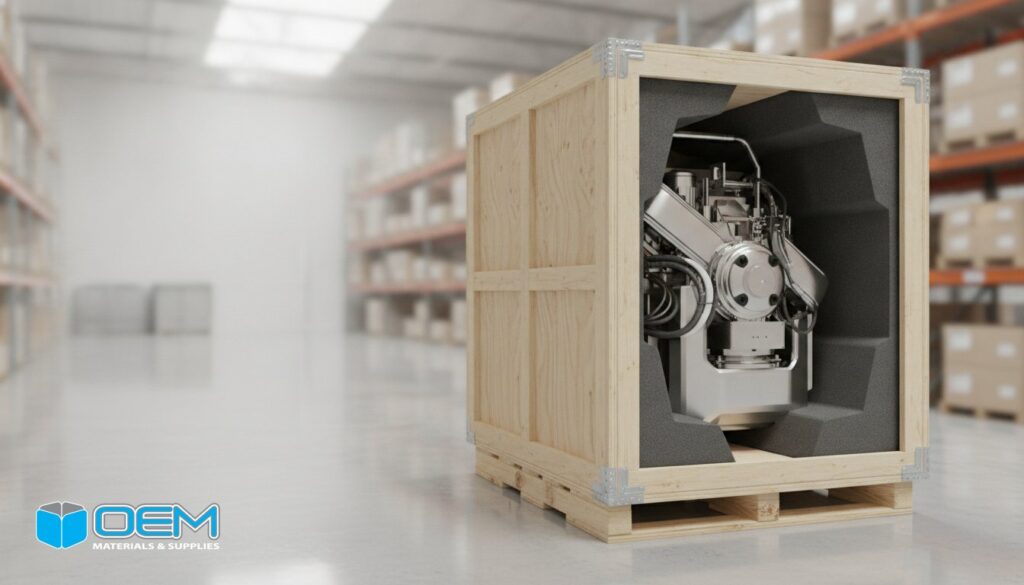
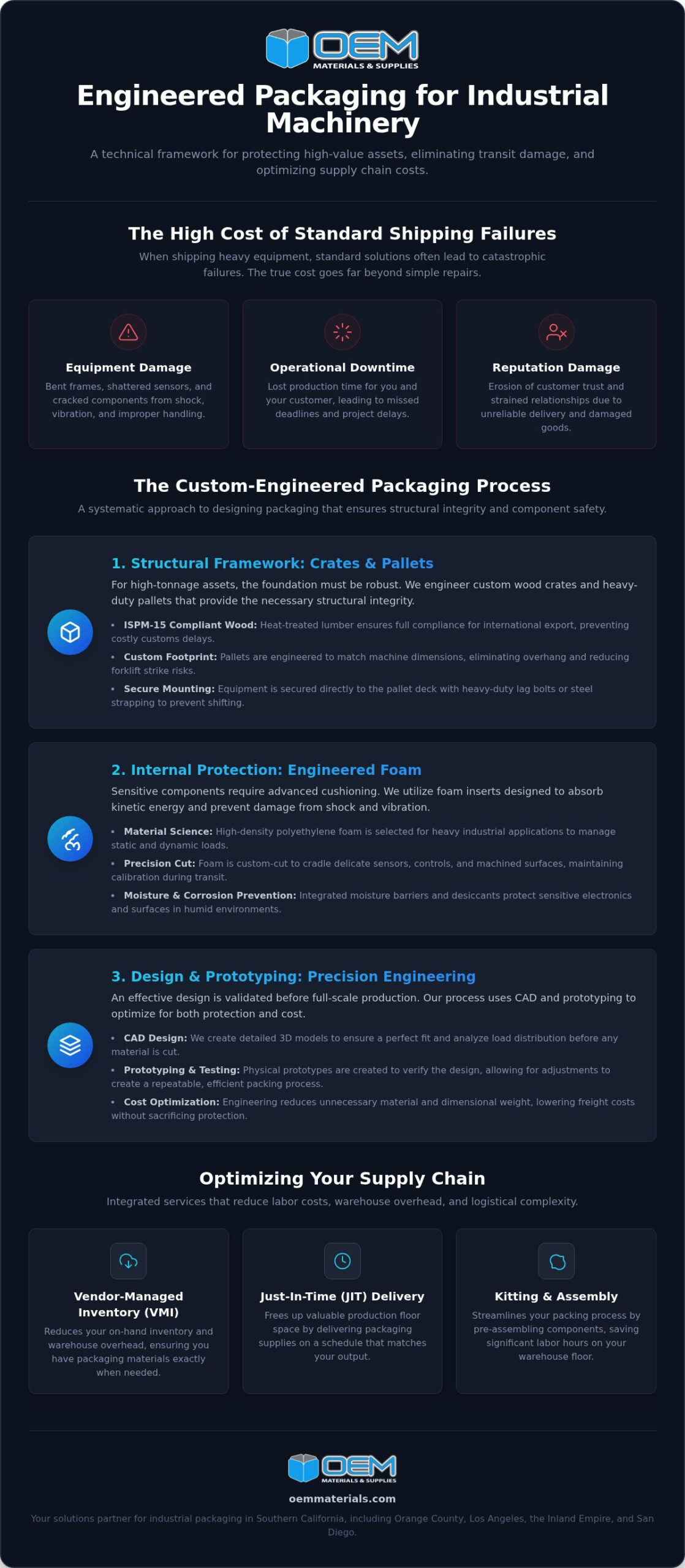
Shipping a high-value CNC mill or a precision medical assembly line isn’t just a logistics task; it’s an engineering challenge where the stakes include your reputation and your profit margin. You likely already realize that standard solutions often fail heavy equipment, leading to bent frames, shattered sensors, or astronomical freight bills from unnecessary crate weight. When transit damage occurs during LTL or international shipping, the true cost isn’t just the repair. It’s the lost production time and the strain on your customer relationships.
This guide provides the technical framework you need to select and engineer custom packaging for industrial machinery. You’ll learn how to eliminate transit damage through better material density and load distribution while optimizing shipping costs. We’ll cover everything from ISPM-15 wood crating standards to custom foam inserts and how manufacturers in Orange County and across Southern California use these strategies to create a repeatable, efficient packing process.
Key Takeaways
- Understand the total cost of transit damage and how engineered packaging protects both your equipment and your customer relationships.
- Learn to evaluate equipment dimensions and sensor fragility to determine when to use heavy-duty wood crates versus custom pallets.
- Discover the role of CAD design and prototyping in developing effective custom packaging for industrial machinery before moving to high-volume production.
- Identify opportunities to lower labor costs and warehouse overhead by integrating vendor-managed inventory and just-in-time delivery services.
- Ensure your logistics process meets international shipping standards to prevent costly delays during international transit.
The Critical Role of Custom Packaging in Industrial Machinery Logistics
High-value industrial assets are the lifeblood of manufacturing. When a CNC machine or medical imaging device arrives at a facility with a warped frame or a cracked sensor, the financial fallout extends far beyond the repair bill. You face lost production time, missed deadlines, and a compromised reputation with your client. The Critical Role of Custom Packaging becomes evident when you consider that standard shipping supplies are rarely rated for the extreme weights and sensitive tolerances of heavy machinery.
Shipping hazards are constant. Less-than-truckload (LTL) environments subject equipment to repeated forklift handling, significant road vibration, and varying environmental conditions. Standard off-the-shelf solutions often fail because they don’t account for specific center-of-gravity requirements or fragile external components. High-quality custom packaging for industrial machinery bridges this gap by providing an engineered framework that absorbs shock and maintains structural alignment throughout the supply chain.
Protecting High-Value Assets from Transit Damage
Machinery faces intense physical stress during transit. Internal components can shift if the base isn’t properly secured to a custom pallet or wood crate. We focus on structural integrity by engineering the packaging to distribute the machine’s weight evenly, preventing point-load failures. For manufacturers in Los Angeles County or San Diego County shipping equipment through humid coastal ports, moisture barriers and desiccants are essential. These elements prevent oxidation and corrosion on precision-machined surfaces. Utilizing custom packaging for industrial machinery ensures that even the most delicate sensors remain calibrated during heavy-duty transport.
Reducing Total Cost of Ownership through Engineering
Effective custom packaging design does more than just stop damage; it optimizes your entire budget. Over-engineered crates add unnecessary dimensional weight, which spikes freight costs. By using precision engineering, you can reduce the footprint of the package without sacrificing protection. For OEMs in Orange County or the Inland Empire, this efficiency is vital for maintaining competitive margins. Integrating vendor-managed inventory (VMI) and specialized kitting processes reduces the labor hours your team spends on the warehouse floor. Faster packing times and fewer insurance claims mean a lower total cost of ownership for every unit shipped.
Essential Materials for Machinery Protection and Stabilization
Selecting the right materials for custom packaging for industrial machinery is a technical decision based on static and dynamic load requirements. Heavy equipment requires more than just a container; it needs an engineered system that manages center of gravity and absorbs kinetic energy during transport. For manufacturers in the Inland Empire and Orange County, choosing between wood, corrugated, and foam substrates depends entirely on the equipment’s mass, fragility, and destination.
Professional carriers, such as those represented by The Machinery Haulers Association, often emphasize that the stability of the load is as critical as the vehicle’s capacity. Using high-density materials ensures that the structural integrity of the package remains intact even under the stresses of multi-modal shipping. This approach prevents the sagging or buckling that often occurs with standard, off-the-shelf shipping supplies.
Custom Wood Crates and Heavy-Duty Pallets
For high-tonnage assets, custom crates and industrial pallets provide the necessary foundation. We utilize heat-treated wood to ensure full compliance with ISPM-15 international export standards, preventing costly customs delays at foreign ports. A custom pallet footprint is engineered to match the specific dimensions of your machine, eliminating overhang. This precision reduces the risk of forklift strikes, a common cause of damage in busy LTL terminals. By securing the machine directly to the pallet deck with heavy-duty lag bolts or steel strapping, we eliminate internal shifting during transit.
Engineered Foam Inserts for Sensitive Components
Internal protection requires a deep understanding of foam chemistry. For heavy industrial applications, polyethylene (PE) foam is the preferred choice due to its closed-cell structure and high load-bearing capacity. It provides excellent vibration dampening for heavy metal components. In contrast, polyurethane (PU) foam is softer and better suited for lighter, highly sensitive electronic panels or internal sensors. Calculating the correct foam density is vital; too much surface area results in a ride that is too stiff, while too little can cause the foam to bottom out. We use precise calculations based on product weight and fragility to ensure the cushioning remains effective throughout the journey.
Beyond the primary structure, multi-wall corrugated boxes provide a cost-effective solution for mid-weight components and sub-assemblies. When combined with edge protectors and high-performance stretch film, these materials create a comprehensive barrier against surface abrasions and environmental exposure. If you need a technical assessment of your current material specifications, you can request a quote to see how an engineered approach can improve your outcomes.
Selecting the Right Packaging Framework Based on Equipment Specs
Choosing the correct framework for custom packaging for industrial machinery requires a precise audit of the machine’s physical characteristics. You shouldn’t treat a 500-pound laboratory centrifuge with the same specifications as a 5,000-pound industrial lathe. To design an effective solution, we start by mapping the equipment’s footprint and identifying the exact center of gravity. This data determines whether the machine requires a full wood crate, a reinforced pallet, or a heavy-duty corrugated system.
The shipping environment also dictates the final design. Less-than-truckload (LTL) shipping involves multiple terminal transfers and frequent forklift handling, which increases the risk of side-impact damage. Ocean freight introduces long-term exposure to salt air and high humidity, necessitating the use of VCI (Volatile Corrosion Inhibitor) films to prevent surface rust on machined steel. By analyzing these variables before the design phase, manufacturers in Los Angeles County and Orange County can avoid the common pitfalls of over-packaging or under-protecting their assets.
Weight-Bearing Requirements and Load Distribution
Center-of-gravity calculations are the foundation of crate safety. An off-center load is prone to tipping during forklift maneuvers or sharp turns in a trailer. We use heavy-duty blocking and bracing techniques to lock the equipment into a fixed position, preventing any lateral or vertical movement. While wood is the standard for extreme weights, triple-wall corrugated boxes provide a high-strength alternative for mid-weight industrial components. Triple-wall material can often support up to 1,000 pounds when the load is distributed correctly, offering a significant reduction in tare weight compared to traditional timber crates.
Sensitivity Analysis for Sensitive Electronics
Many modern machines contain high-precision sensors or delicate electronic control panels that require specialized protection beyond basic structural support. For these components, ESD (Electrostatic Discharge) packaging is essential to prevent invisible damage to sensitive circuitry. We integrate specialized cushioning materials to dampen the high-frequency vibrations inherent in long-haul trucking and ocean transit. Additionally, edge and corner protectors are utilized to reinforce the rigid load, ensuring that strapping tension doesn’t crush the machine’s external housing or finish. This multi-layered approach ensures that the most fragile parts of your equipment remain calibrated and undamaged upon arrival at the customer site.
The Custom Design and Prototyping Process for Industrial OEMs
Industrial equipment often involves unique geometries and sensitive calibration points that standard containers cannot accommodate. For a custom-built medical scanner or an aerospace turbine, a “close enough” fit is a liability. Precision engineering in the design phase is what separates a successful shipment from a costly insurance claim. We utilize advanced CAD software to develop a digital twin of your equipment, ensuring that every internal support and foam buffer aligns perfectly with the machine’s structural hardpoints. This engineering-first approach eliminates the guesswork often found in generic shipping solutions.
Manufacturers in Orange County and the Inland Empire rely on this technical accuracy to maintain lean operations. By identifying the exact packing sequence during the design phase, you can optimize your warehouse labor and reduce the time each unit spends on the packing floor. This process isn’t about creating “memorable moments” for consumers; it’s about industrial performance and the absolute security of your high-value assets during the rigors of the supply chain.
From CAD Design to Rapid Prototyping
Digital designs translate directly to CNC cutting tables, allowing for tolerances within millimeters. This level of precision is essential for custom packaging for industrial machinery, as it prevents the internal shifting that causes component fatigue. Prototyping is a mandatory step before moving to high-volume production. It allows your engineering team to validate the fit and functionality of the custom packaging design services in a real-world environment. Short-run production for specialized machinery ensures you don’t over-invest in materials that haven’t been field-tested for your specific application.
Testing Standards and Compliance
Validation requires more than just a visual inspection. We follow ISTA (International Safe Transit Association) testing standards to simulate the physical stresses of the logistics environment. This includes compression testing to verify stacking strength and vibration tables that replicate long-haul trucking through varied terrain. For the aerospace and medical device sectors, compliance often extends to material purity and ESD safety. If you’re shipping wood crates internationally from ports in Los Angeles County or San Diego County, we ensure all materials meet ISPM-15 heat-treatment standards. This includes providing the necessary documentation to prevent your equipment from being quarantined at international borders. To start validating your protection strategy, you can request a quote for a physical prototype based on your equipment’s CAD files.
Optimizing the Supply Chain with Integrated Packaging Services
Efficient supply chain management for high-volume OEMs in Southern California requires more than just high-quality materials. It demands a logistical strategy that integrates packaging into the production flow. By leveraging local expertise in Los Angeles County and the Inland Empire, manufacturers can transition from reactive ordering to a proactive, integrated model. This approach reduces the administrative burden on procurement teams and ensures that custom packaging for industrial machinery is available exactly when the machine rolls off the assembly line. Using local suppliers also mitigates the risks associated with long-distance freight delays and fuel surcharges, which remain volatile in the current market.
A fragmented approach to packaging procurement often leads to hidden costs, such as excess warehouse labor and emergency shipping fees for missing supplies. When you treat packaging as a strategic component of the manufacturing process rather than a secondary commodity, you gain better control over your total landed costs. This level of integration is particularly vital for the aerospace and medical device sectors, where precision and timing are non-negotiable.
Vendor-Managed Inventory for SoCal Manufacturers
Maintaining a consistent supply of multi-wall boxes and engineered foam is a challenge when warehouse space is at a premium. Our packaging VMI services solve this by shifting the responsibility of inventory management to our team. We monitor your usage rates and replenish stock automatically, preventing the production stoppages that occur when a critical crate or pallet is missing. For manufacturers in Orange County, this model frees up valuable floor space that was previously dedicated to bulk storage. By converting storage areas into active production zones, you can increase facility throughput without the need for physical expansion. This system also provides better visibility into material costs, helping you manage the 7.56% year-over-year price increase seen in the corrugated sector as of late 2026.
Just-In-Time Delivery and Kitting Solutions
Lean manufacturing principles rely on the precise timing of material arrivals to minimize waste. Our JIT packaging services ensure that your custom shipping frameworks arrive shortly before they are needed, reducing the amount of capital tied up in stagnant inventory. To further optimize the process, we offer pre-assembled packaging kits. Instead of your warehouse staff spending time pulling individual components like edge protectors, stretch film, and specialized cushioning materials, they receive a single, organized kit. This kitting strategy significantly lowers on-site labor costs and reduces errors on the packing line. It ensures every machine is packed with the exact specifications designed in the CAD phase, maintaining the repeatability of your shipping process across San Diego County and beyond.
Securing Your Industrial Assets for Global Distribution
It’s essential to view packaging as a technical requirement rather than a secondary commodity when shipping heavy equipment. By integrating CAD design and ISTA testing standards, you ensure that every crate and pallet is engineered specifically for your machine’s weight distribution and fragility. This technical precision protects your profit margins and your brand reputation by preventing the high costs of transit damage.
Utilizing custom packaging for industrial machinery allows manufacturers in Orange County, Los Angeles, San Diego, and the Inland Empire to eliminate shipping hazards while lowering total landed costs. Beyond the physical materials, implementing vendor-managed inventory and just-in-time delivery services helps streamline your warehouse operations and reduce labor overhead. For those in the aerospace or medical device sectors, a repeatable and engineered packaging process is the foundation of a reliable supply chain.
We are ready to help you develop a protective strategy that meets your specific technical requirements. To facilitate an accurate recommendation, please provide your product dimensions, weight, and annual usage. Request a custom packaging quote for your machinery today and move your equipment with confidence.
Frequently Asked Questions
What is the difference between a wood crate and a heavy-duty corrugated box for machinery?
Wood crates provide the highest level of structural protection for high-tonnage assets. They are essential for equipment that requires point-load support or heavy-duty stacking. Heavy-duty corrugated boxes, such as triple-wall varieties, are a cost-effective alternative for mid-weight industrial components. Corrugated solutions significantly reduce tare weight, which helps lower freight costs. The choice depends on your equipment’s mass and the physical stresses of your specific shipping environment.
How do I determine the correct foam density for my industrial equipment?
Correct foam density is determined by analyzing the product’s weight and fragility. We use static loading calculations to ensure the cushioning material provides adequate shock absorption without bottoming out. For heavy industrial components, high-density polyethylene foam is typically used for its durability. Sensitive electronic panels often require lower-density polyurethane foam. Engineering the right density ensures that your equipment remains secured and calibrated throughout the entire logistics chain.
Do wood crates for international shipping require specific certifications?
International shipping requires all wood packaging to meet ISPM-15 standards. This regulation mandates that wood crates and pallets are heat-treated to prevent the spread of invasive pests. Compliant materials must carry a certified IPPC stamp. If you are shipping from ports in Los Angeles or San Diego, ensuring this compliance is vital to avoid costly delays or the rejection of your cargo at international borders.
Can custom packaging help reduce the dimensional weight of my shipments?
Engineering custom packaging for industrial machinery is an effective way to lower dimensional weight. Standard boxes often include unnecessary void space that increases shipping volumes. By creating a precise fit for your equipment, we minimize the package’s external dimensions. This optimization reduces the cubic volume of your shipment, which directly impacts freight rates for ocean and air transport, ensuring you don’t pay to ship air.
What information do I need to provide for a custom packaging quote?
For an accurate quote, you need to provide the machine’s length, width, height, and total weight. It’s also important to identify the center of gravity and any fragile areas like external sensors or glass panels. Providing annual usage data and your preferred shipping method allows us to recommend the most efficient material mix. Manufacturers in Riverside and Orange County often provide CAD files to ensure the highest level of design precision.
How does vendor-managed inventory work for industrial packaging supplies?
Vendor-managed inventory (VMI) streamlines your supply chain by shifting stock management to the supplier. We monitor your inventory levels of boxes, foam inserts, and pallets at your facility. When stock reaches a predetermined minimum, we automatically replenish it. This model eliminates the risk of stockouts and allows your team to focus on production. It’s an ideal solution for Southern California OEMs looking to optimize their warehouse footprint.
Are there specific packaging requirements for sensitive medical or aerospace machinery?
Aerospace and medical machinery often require specialized ESD packaging to protect sensitive electronics from static discharge. Cleanroom-compatible materials and moisture barriers are frequently used to maintain equipment integrity. These sectors demand high-performance cushioning and rigid load stabilization to protect delicate calibrations. We design these solutions to meet rigorous industry standards, ensuring your high-value assets arrive in the same condition they left your production floor.
What is the lead time for a custom machinery packaging prototype?
Lead times for a custom packaging prototype typically range from two to five business days, depending on the complexity of the design. Using CAD files allows for rapid digital design and precision cutting on CNC equipment. For manufacturers in Los Angeles and the Inland Empire, this speed is essential for meeting tight production deadlines. Prototyping ensures the fit and protection levels are validated before you move into high-volume production.