
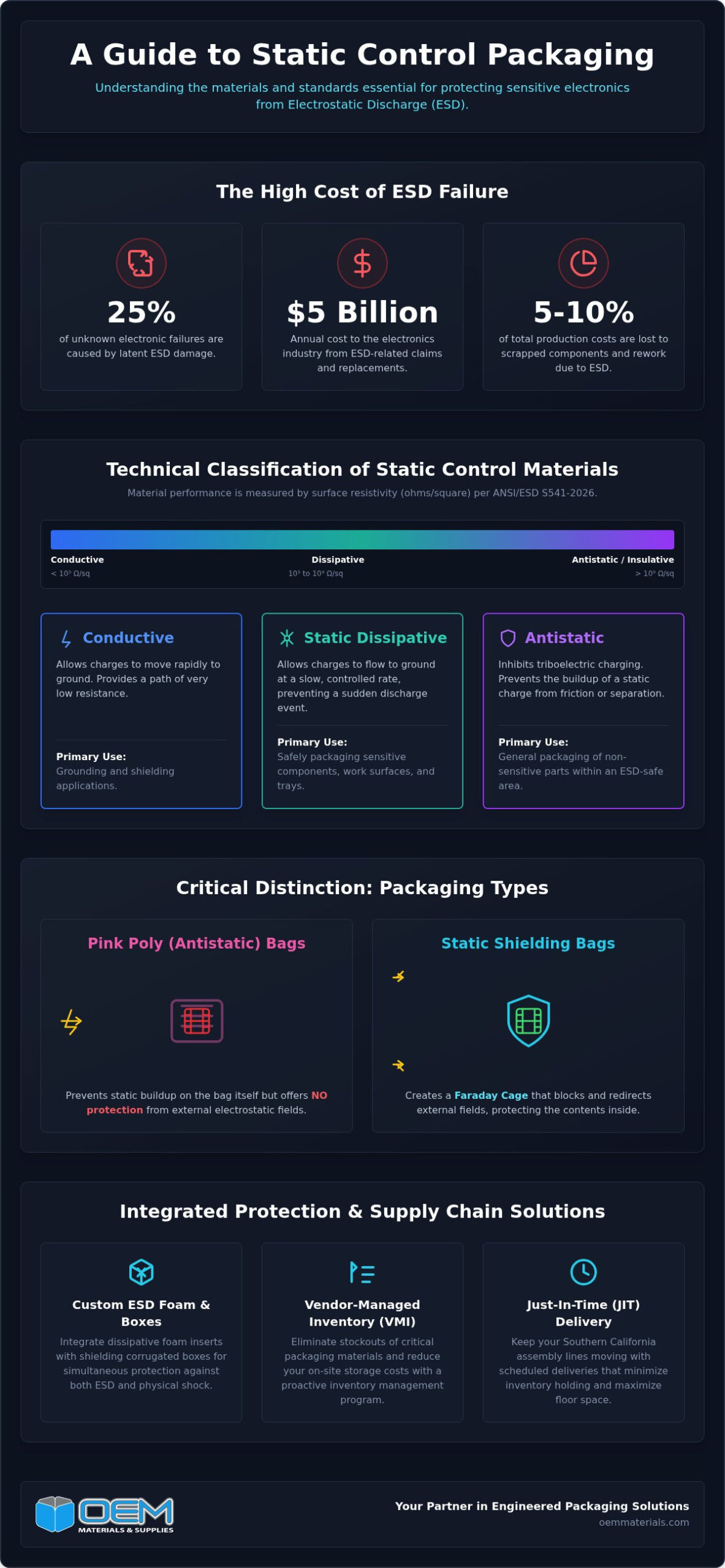
Did you know that an estimated 25 percent of all unknown electronic failures are actually caused by electrostatic discharge? This invisible threat costs the electronics industry approximately 5 billion dollars annually in replacement parts and warranty claims. For operations managers in Southern California, managing these risks is a constant challenge. High failure rates from latent ESD damage and confusion between shielding and dissipative materials can cripple a production schedule. You need a packaging strategy that moves beyond basic bags to an engineered system of protection.
With electronics production forecast to grow by 11 percent in 2026, securing high-performance static control packaging for electronics los angeles supply chains is more critical than ever. This guide provides the technical clarity needed to secure your supply chain and achieve zero-defect shipping for sensitive components. We will examine the latest ANSI/ESD S541-2026 requirements and how to select the right materials for aerospace and medical compliance. You will also learn how local vendor-managed inventory and just-in-time delivery can eliminate stockouts and keep your assembly lines moving across Orange County and the Inland Empire.
Key Takeaways
- Identify the technical differences between antistatic, dissipative, and conductive materials to ensure your packaging meets the ANSI/ESD S541-2026 standard.
- Learn how to source high-performance static control packaging for electronics los angeles to protect sensitive components from the high costs of latent ESD damage.
- Discover the benefits of integrating custom ESD foam with corrugated boxes to provide simultaneous protection against electrostatic discharge and physical shipping shocks.
- Explore how local VMI and JIT delivery programs help Southern California manufacturers eliminate inventory stockouts and reduce on-site storage costs.
The Financial Impact of ESD Damage in Los Angeles Manufacturing
Manufacturing high-value electronics in Southern California involves high-stakes logistics where a single spark can compromise an entire production run. Electrostatic discharge (ESD) often acts as a silent profit killer, contributing to industry estimates of 5 percent to 10 percent in total production cost losses. These expenses aren’t always immediate; they frequently surface as scrapped components, extensive rework, and diminished throughput. Choosing the right static control packaging for electronics los angeles is a fundamental risk management strategy for any facility handling sensitive assemblies.
Standard corrugated boxes and generic foam packaging present a significant liability for electronics manufacturers. These materials are typically insulators that generate and hold static charges through friction. In the unique climate of the Los Angeles basin, seasonal Santa Ana winds can drop humidity levels to single digits. This dry air significantly increases the potential for triboelectric charging, making specialized packaging essential to prevent catastrophic failures during transport between vendors in the Inland Empire or San Diego.
Latent Defects and Product Reliability
The most dangerous form of ESD damage is the latent defect. Unlike a catastrophic failure that is easily identified during initial testing, a latent defect creates a “walking wounded” component. The part may pass factory inspection but contains internal microscopic damage that leads to premature failure in the field. This results in expensive warranty claims and damages your brand reputation. Utilizing high-performance ESD materials ensures that your components arrive with their long-term reliability intact. Investing in proper shielding and dissipative materials is significantly more cost-effective than managing the logistical nightmare of a field recall.
Regulatory and Industry Standards in SoCal
Compliance is a non-negotiable requirement for the aerospace and medical sectors that anchor the Southern California economy. Facilities in El Segundo and Long Beach must adhere to rigorous ANSI/ESD S20.20 control programs to maintain their standing as Tier 1 suppliers. Similarly, medical device manufacturers in Orange County require packaging that meets strict cleanliness and ESD safety protocols to ensure patient safety and device efficacy. Modern static control packaging for electronics los angeles must now align with the ANSI/ESD S541-2026 standard. This ensures that every bag, box, and foam insert provides the specific resistance levels required for sophisticated 2026-era circuitry.
Technical Classification of Static Control Materials
Selecting the correct static control packaging for electronics los angeles requires a precise understanding of material science. Not all “ESD safe” products provide the same level of protection. The primary metric for evaluating these materials is surface resistivity, measured in ohms per square. This measurement determines how effectively a material prevents the buildup of static or how safely it bleeds a charge away from a component. Adhering to ESD Association standards ensures that your selection aligns with the technical requirements of modern semiconductor and circuit board manufacturing.
Materials are generally classified into three categories based on their resistivity levels. Antistatic materials prevent the generation of static electricity caused by friction. Dissipative materials allow charges to flow to the ground at a slow, controlled rate. Conductive materials have very low resistance, allowing charges to move rapidly across the surface. Choosing the wrong category can lead to catastrophic results. For instance, using a highly conductive material where a slow bleed is required could cause a spark, damaging the very component you intended to protect.
Static Shielding vs. Antistatic Bags
There is often confusion between pink poly antistatic bags and metalized static shielding bags. Pink polyethylene bags are treated with an antistatic agent to prevent triboelectric charging. They do not, however, protect the contents from external electrostatic fields. If a charged object comes near a pink poly bag, the field can pass right through the plastic and damage the electronics inside.
High-quality static shielding bags utilize a multi-layer construction, typically featuring a buried metal layer between polyester and polyethylene. This creates a Faraday Cage effect, which redirects external charges around the exterior of the bag rather than through the contents. For components sensitive to humidity, moisture barrier bags (MBB) add an extra layer of foil to prevent oxidation and “popcorning” during reflow. If you are unsure which barrier is necessary for your specific application, you can speak with an applications engineer to review your component sensitivity levels.
Dissipative and Conductive Properties
Dissipative materials are the preferred choice for most work surfaces and packaging inserts. With a resistivity range typically between 10^4 and 10^11 ohms, they provide a path to ground that is slow enough to prevent a sudden discharge. This controlled removal of charge is essential for the safe handling of microchips and sensitive assemblies.
Conductive materials are used when permanent ESD protection or grounding is required. These materials are often carbon-loaded, giving them a black appearance. Because they have a resistivity of less than 10^4 ohms, they act as a lightning rod for static. Utilizing these in a custom packaging design requires careful engineering to ensure they are used in the correct context within the supply chain.
Custom ESD Foam and Corrugated Integration
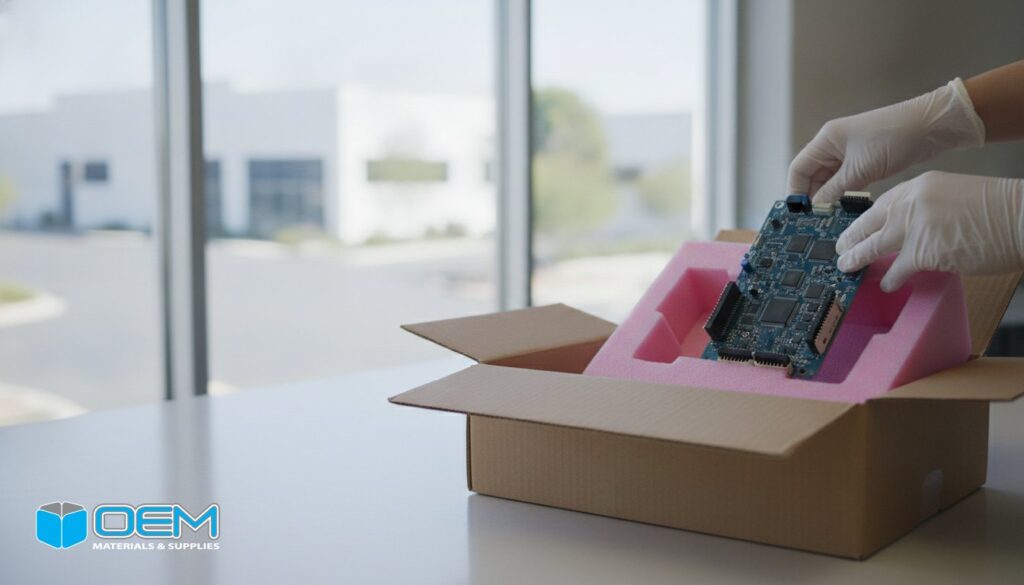
Providing robust static control packaging for electronics los angeles requires more than just a surface-level barrier. While bags provide essential shielding, complex electronic assemblies often require structural support to survive the physical rigors of transport throughout the Southern California supply chain. Integrating ESD properties directly into custom engineered foam and corrugated outer containers creates a comprehensive protection system. This dual-purpose approach addresses both electrostatic discharge and mechanical shock in a single, efficient package.
Effective integration begins with selecting the right material for the specific sensitivity of the component. For instance, high-value circuit boards might require a combination of static-shielding bags nested within a custom-cut dissipative foam insert. This layered defense ensures that the product remains immobilized and protected from external static fields simultaneously. By combining these materials, manufacturers can reduce the total footprint of their packaging, lowering shipping costs without compromising the safety of the electronics.
Engineered Foam for Electronic Assemblies
Engineered foam serves as the primary defense against physical impact and vibration. When configuring these inserts, engineers must choose between polyethylene and polyurethane based on the component’s weight and fragility. Polyethylene is a closed-cell foam that offers excellent support for heavier items, while polyurethane is an open-cell material ideal for cushioning lighter, more delicate parts. Both materials are available in antistatic (pink) or conductive (black) versions to meet specific resistivity requirements.
Precision is critical for sensitive electronics. CNC-routed ESD foam provides an exact fit that prevents movement during transit, which is a major source of triboelectric charge generation. This level of customization ensures that every edge and connector is supported, minimizing the risk of mechanical stress. You can find detailed material specifications and density options on our foam packaging page to help determine the best fit for your application.
Corrugated Solutions for Static Protection
The outer container is the final piece of the ESD protection puzzle. Standard cardboard is an insulator and can be a source of static, but specialized custom corrugated boxes can be manufactured with conductive fluting or liners. These boxes act as a secondary Faraday cage for bulk transport, providing an additional layer of safety for components moving through high-volume warehouses in the Inland Empire or Orange County.
For smaller shipments, die-cut ESD mailers offer a compact and cost-effective solution. These mailers often feature a conductive coating that eliminates the need for separate shielding bags in some low-sensitivity applications. This reduces the time and labor required for packing, which is a significant factor in high-volume electronics manufacturing. Integrating these corrugated solutions into your workflow ensures that your static control program remains consistent from the assembly line to the end-user facility.
Sourcing Static Control Packaging in Los Angeles
Procuring static control packaging for electronics los angeles requires more than finding a vendor with a catalog. High-volume electronics manufacturing in Southern California demands a partner who understands the technical nuances of the local ecosystem. From the aerospace hubs in El Segundo to the medical device clusters in Orange County, the ability to source materials quickly and accurately is a competitive necessity. Reliability in the supply chain ensures that your production lines remain active and your shipments meet rigorous quality standards.
Inventory depth and technical expertise are the two most critical factors when evaluating a supplier. A partner must maintain a robust stock of standard shielding bags and dissipative foams while possessing the engineering capability to develop custom solutions. Prototyping speed is essential. For many industrial buyers, waiting weeks for a sample is not an option. A local supplier can often provide rapid physical prototypes that allow for immediate testing and validation on your assembly line.
Proximity and Lead Times
Utilizing a local supply chain in the Inland Empire, San Diego, or Los Angeles County significantly improves operational agility. Short transit times reduce the need for massive on-site safety stocks, freeing up valuable warehouse space. Freight costs also play a major role in procurement. Bulky items like custom foam inserts or large corrugated boxes are expensive to ship over long distances. Sourcing these materials from a regional partner minimizes transportation expenses and reduces the carbon footprint of your operations.
Agility in the face of design changes is another advantage of local sourcing. When an engineering team updates a circuit board layout, the packaging must often change as well. A Southern California partner can respond to these adjustments with minimal friction. This proximity allows for face-to-face consultations and faster iterations, ensuring that your static control program evolves alongside your product development cycle.
Supplier Technical Support
Technical support should extend beyond the point of sale. Your supplier must have a deep understanding of current industry benchmarks, including ANSI/ESD S20.20 and the latest ANSI/ESD S541-2026 requirements. This knowledge ensures that the materials you receive are compliant with the strict audit requirements of Tier 1 aerospace and medical OEMs. A knowledgeable partner can also assist with on-site packaging audits to identify potential gaps in your existing ESD control program.
Collaboration is the key to cost-effective protection. By working closely with engineers on custom packaging design, you can often identify opportunities to reduce material waste or labor costs. For example, a well-designed kitting solution can consolidate multiple components into a single ESD-safe tray, streamlining the assembly process. If you are ready to optimize your current packaging strategy, you can request a technical consultation and quote to review your specific component requirements and annual usage.
Optimizing the Supply Chain with VMI and JIT
Managing the logistics of an electronics production line in Southern California requires more than just technical material knowledge. It demands a supply chain that is as precise as the components being manufactured. Stockouts of critical ESD bags or custom foam inserts can halt a production line, leading to missed deadlines and increased overhead. By implementing a consolidated industrial supply program, manufacturers can secure their static control packaging for electronics los angeles while streamlining their procurement processes.
Los Angeles and Orange County facilities often face high warehouse costs, making on-site storage of bulky packaging materials inefficient. Just-In-Time (JIT) delivery programs address this by providing the exact amount of material needed for current production runs. This reduces the footprint required for storage and improves cash flow by minimizing capital tied up in inventory. This logistical agility is a necessity for manufacturers serving the fast-moving aerospace and medical technology sectors.
Vendor Managed Inventory for Electronics
A packaging VMI program shifts the burden of inventory monitoring from your purchasing team to your supplier. Under this model, the supplier tracks usage levels and replenishes stock automatically based on pre-set minimums and maximums. This eliminates the manual friction of frequent purchase orders and ensures that critical ESD shielding materials are always available when needed. It effectively removes the risk of human error in the ordering process.
Consistent quality is another major benefit of VMI. When a single partner manages your inventory, you avoid the variability that comes from switching between multiple vendors. This is particularly important for high-volume production where material specifications must remain identical across every batch to ensure compliance with rigorous industry standards. Automated replenishment also allows your operations team to focus on manufacturing rather than monitoring pallet counts in the warehouse.
Kitting and Assembly Services
Labor costs in Southern California are a significant factor in total manufacturing expenses. Receiving individual packaging components separately, such as boxes, foam, and bags, requires your team to spend valuable time on pre-assembly. Custom kitting services solve this by delivering ready-to-use assemblies directly to your pack-out station. These kits arrive with the ESD foam already integrated into the corrugated box, often with the shielding bag pre-inserted, which significantly reduces the touch-time per unit.
Improving repeatability is essential for high-mix production environments. When your team uses a standardized kit, the risk of packing errors decreases, ensuring that every shipment meets your quality control benchmarks. This consistency is vital for maintaining the integrity of the Faraday cage protection required for sensitive electronics. If you are ready to optimize your process and reduce assembly labor, you can request a quote for custom ESD kits designed for your specific component dimensions and annual usage.
Securing Your Electronics Supply Chain for 2026
Protecting high-value components requires a shift from commodity buying to engineered protection. We have discussed how latent defects contribute to significant industry losses and why specific material classifications like those in ANSI/ESD S541-2026 are non-negotiable for aerospace and medical compliance. Effective ESD management is a technical requirement that demands precision at every stage of the packaging process. Relying on generic materials is a liability your production schedule cannot afford.
By integrating custom ESD foam with corrugated solutions and utilizing local VMI or JIT programs, you can reduce total landed costs while eliminating production delays. Securing reliable static control packaging for electronics los angeles is about more than just a bag; it is about partnering with a supplier that understands the specific logistics of Orange County, San Diego, and the Inland Empire. Our team is ready to assist with custom engineering and inventory management tailored to your specific production volume and component sensitivity.
Request a Quote for Custom Static Control Packaging to begin optimizing your Southern California supply chain today. We look forward to helping you achieve zero-defect shipping and improved operational efficiency.
Frequently Asked Questions
What is the difference between antistatic and static shielding bags?
Antistatic bags, typically pink, only prevent the generation of static electricity from friction, while static shielding bags protect against external electrostatic fields. While pink poly is treated with chemicals to prevent friction-based charging, shielding bags use a buried metal layer to create a Faraday cage. This distinction is vital when selecting static control packaging for electronics los angeles to ensure sensitive components aren’t damaged by external discharge during transit between Southern California facilities.
How do I know if my electronics require dissipative or conductive packaging?
The choice depends on the resistivity range required for your specific electronic components and their sensitivity to discharge. Dissipative materials, with a resistivity between 10^4 and 10^11 ohms, allow charges to bleed off slowly and safely, which is ideal for most semiconductor handling. Conductive materials have a resistivity of less than 10^4 ohms and move charges rapidly. You should consult your component’s ESD sensitivity classification to determine which resistance level provides the safest discharge rate.
Can custom foam inserts be made with permanent ESD properties?
Yes, custom foam inserts can be manufactured with permanent ESD properties by loading the material with carbon during the extrusion process. Unlike topical antistatic treatments that can wear off or wash away over time, carbon-loaded conductive foam maintains its resistivity indefinitely. This is a reliable solution for long-term storage or reusable shipping containers. We provide these permanent foam solutions for aerospace and medical manufacturers across Orange County and Los Angeles County.
What are the standard lead times for custom ESD packaging in Los Angeles?
Lead times for custom ESD solutions generally vary based on the complexity of the design and current material availability. Standard stock shielding bags are often available for immediate delivery, while custom-engineered foam inserts or die-cut corrugated boxes typically require more time for design and production. Sourcing from a local Southern California partner allows for faster turnaround times compared to out-of-state vendors. This proximity helps you avoid production delays and inventory shortages at your facility.
Does static control packaging have an expiration date or shelf life?
Topical antistatic bags and foams do have a limited shelf life, often ranging from 12 to 24 months depending on storage conditions. The antistatic agents in pink poly bags can migrate to the surface and dissipate over time, especially in low-humidity environments like the Inland Empire. In contrast, metalized shielding bags and carbon-loaded conductive foams do not expire. It is best practice to test the surface resistivity of older materials before use.
How do I choose the right thickness for a static shielding bag?
The standard thickness for a static shielding bag is typically around 3.0 mils, though heavier applications may require 3.5 to 4.0 mils for increased durability. Choosing the right thickness involves balancing puncture resistance with the flexibility needed for efficient packing. If your electronics have sharp edges or heavy heat sinks, a thicker bag prevents the metalized layer from being compromised. Maintaining the integrity of this layer is essential for providing a functional Faraday cage.
Are there specific ESD packaging requirements for aerospace components?
Aerospace components must strictly adhere to ANSI/ESD S20.20 and the updated ANSI/ESD S541-2026 standards for protection during transport and storage. These regulations require that packaging provide both physical protection and specific levels of electrostatic shielding. Many Tier 1 aerospace OEMs in the South Bay also require moisture barrier properties to prevent oxidation. Utilizing specialized static control packaging for electronics los angeles ensures that your shipments meet these rigorous military and commercial aviation quality audits.
How can a VMI program help my electronics manufacturing facility?
A Vendor Managed Inventory (VMI) program eliminates the friction of manual ordering by allowing your supplier to monitor and replenish your packaging stock automatically. For facilities in Los Angeles and San Diego, this prevents costly stockouts of critical ESD materials while reducing the amount of capital tied up in safety stock. It also frees up valuable warehouse space, as you only receive the inventory you need for your immediate production schedule.