
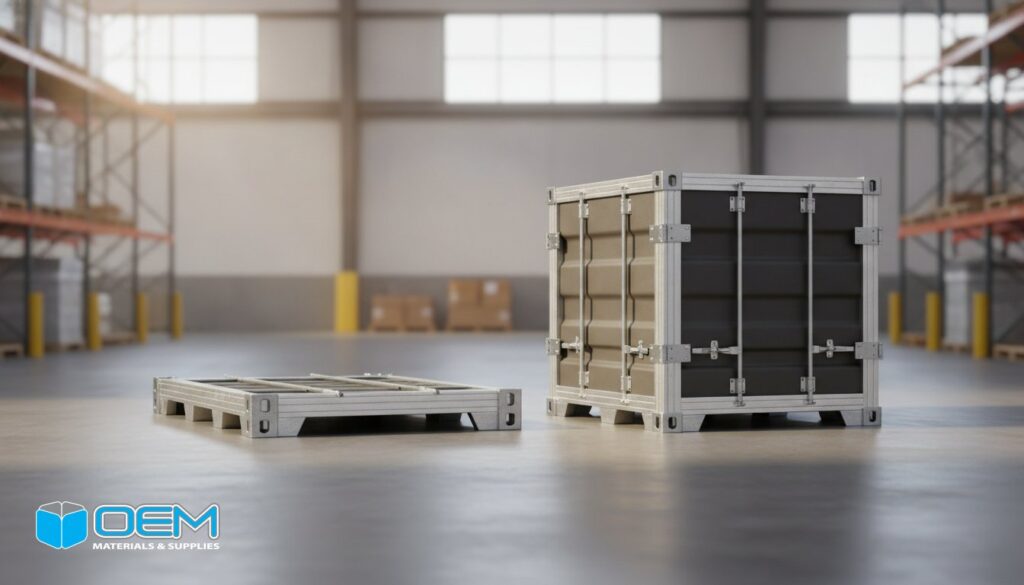
Shipping empty, rigid packaging is essentially paying to transport air, a logistical inefficiency that modern supply chains can no longer afford. In standard 53-foot dry van operations, switching to collapsible shipping crates can reduce the number of required return trailer loads by as much as 70 percent. You likely recognize that warehouse clutter and escalating reverse logistics costs are primary drains on your operational budget. While rigid containers provide necessary protection, they often create significant bottlenecks when they aren’t in active use.
This guide provides the technical framework to select collapsible shipping crates that maximize your facility footprint and slash return freight expenses without compromising industrial load protection. We will examine material performance standards such as ASTM D4169-23e1, evaluate the impact of California SB 54 on packaging strategy, and identify the specific latching systems that prevent product damage during transit. By focusing on the intersection of material engineering and reverse logistics, you can transform your packaging from a recurring expense into a reliable tool for supply chain optimization.
Key Takeaways
- Evaluate collapse ratios to maximize storage footprints and reduce the costs associated with transporting empty containers.
- Compare the structural performance and durability of plastic, steel, and wire collapsible shipping crates to find the ideal match for your specific payload requirements.
- Calculate the ROI of transitioning from consumable corrugated packaging to returnable assets by identifying your specific break-even trip count.
- Learn why integrating custom foam dunnage is essential for protecting sensitive components while maintaining the ability to fold the outer shell.
- Prioritize suppliers that offer regional design support and prototyping for facilities across Southern California, including San Diego and the Inland Empire.
Understanding the Mechanics of Collapsible Shipping Crates
In the context of industrial logistics, collapsible shipping crates function as durable, multi-trip assets designed for high-frequency distribution cycles. Unlike single-use corrugated boxes that require constant replenishment, these containers serve as reusable transport packaging engineered to withstand the rigors of heavy-duty freight. The primary engineering objective is to maximize volumetric efficiency by achieving an optimal ratio between the container’s expanded volume and its folded height. This capability allows manufacturers in sectors like automotive and aerospace to maintain consistent shipping footprints while minimizing the space required for empty storage.
Industrial collapsible designs differ significantly from standard nesting or stack-and-nest plastic totes. While nesting containers save space by sliding inside one another, they often feature tapered walls that reduce internal cubic capacity and can complicate the use of custom foam inserts. Collapsible units utilize straight vertical walls to provide maximum internal protection and structural rigidity. This design is particularly effective in closed-loop supply chains where containers move between a dedicated production facility in the Inland Empire and an assembly plant in Orange County, ensuring that every square inch of trailer space is utilized effectively.
Key Components of a Collapsible Crate
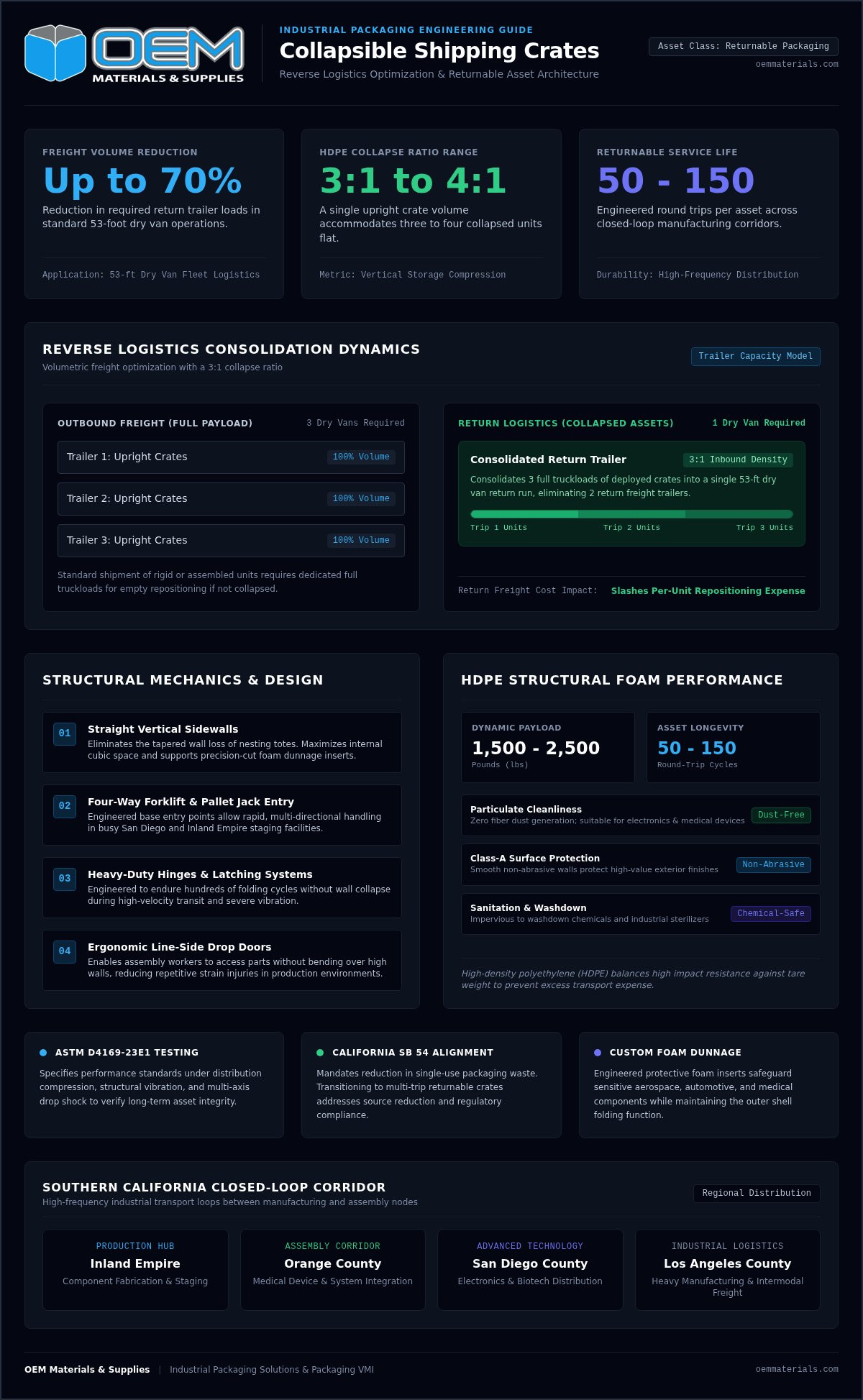
The structural integrity of a collapsible unit depends on heavy-duty side wall hinges and secure latching mechanisms. These components must remain functional over hundreds of cycles to prevent wall collapse during high-velocity transit. The base is typically engineered with four-way forklift and pallet jack entry points to facilitate rapid handling in busy San Diego County distribution centers. Additionally, many designs include ergonomic drop doors. These gates allow assembly line workers to access parts easily without reaching over high container walls, improving workplace safety and reducing the risk of repetitive strain injuries.
The Standard Collapse Ratio Explained
The collapse ratio is the percentage or factor by which the vertical height of a container is reduced when it is folded flat. High-density polyethylene (HDPE) bulk bins typically offer ratios between 3:1 and 4:1, meaning a single upright unit takes up the same vertical space as three or four collapsed units. These ratios directly dictate the density of your reverse logistics. For example, a 3:1 ratio allows a logistics manager to consolidate three truckloads of empty crates into a single return shipment. This efficiency is a cornerstone of any robust packaging VMI program, as it drastically lowers the per-unit cost of return freight and prevents warehouse clutter from accumulating at the destination site.
Comparing Crate Materials: Plastic vs. Steel vs. Wire
Selecting the appropriate construction material for collapsible shipping crates requires balancing payload requirements against tare weight and environmental factors. While structural foam molded plastic is the standard for high-volume distribution, heavy industry often requires the extreme durability of steel or the visibility provided by wire mesh. Research from the Center for Packaging and Unit Load Design emphasizes that material performance under vibration and compression directly impacts the longevity of returnable assets. Choosing the wrong substrate can lead to premature failure or excessive freight costs due to unnecessary weight. Each material choice influences how a container interacts with automated sorting systems and manual handling protocols.
Heavy-Duty Plastic Collapsible Containers
High-density polyethylene (HDPE) is the preferred material for sectors requiring high impact resistance and moisture protection. These containers are essential for medical device manufacturers in Orange County and electronics firms in San Diego because they don’t produce particulate dust or harbor contaminants. The smooth interior walls prevent surface abrasion on finished goods, making them ideal for protecting Class-A surfaces. Plastic units typically support dynamic payloads between 1,500 and 2,500 lbs and are engineered to last between 50 and 150 round trips. They are impervious to most washdown chemicals, allowing for easy sterilization between uses in food-grade or cleanroom environments.
Collapsible Wire and Steel Mesh Crates
For operations involving heavy forgings, castings, or automotive power train parts, steel and wire mesh offer the highest available structural strength. These containers can handle payloads ranging from 2,000 to 4,000 lbs, comfortably exceeding the limits of most plastic designs. Wire mesh variants provide 100 percent visibility for inventory checks and allow for full sprinkler water penetration in high-rack storage environments. To prevent oxidation in humid transit conditions, these crates are finished with galvanized or powder-coated surfaces. This durability is critical for manufacturing facilities in the Inland Empire and Los Angeles County where containers may be stored in non-climate-controlled spaces. Welded heavy-gauge steel crates often exceed a 10-year service life, providing a low cost-per-trip over the long term. If you need assistance determining the optimal material for your specific payload and transit environment, you can request a quote for a custom evaluation based on your annual shipping volume and product dimensions.
Calculating the ROI of Collapsible Returnable Packaging
Transitioning from single-use corrugated boxes to collapsible shipping crates represents a fundamental shift in procurement strategy. It’s a move from recurring material expenses to the management of capital assets. To determine the true ROI, operations managers must look beyond the initial purchase price and evaluate the total cost of ownership. This calculation includes the number of trips required to reach a break-even point, factoring in the avoided costs of new packaging materials and the labor required for waste disposal. Unlike expendable packaging, returnable crates are designed for longevity; they often pay for themselves within the first year of a high-turn closed-loop cycle.
The efficiency of a returnable loop depends heavily on the financial impact of the collapse ratio. If a container offers a 3:1 ratio, you’re able to return three folded units in the same trailer space required for a single rigid unit. This math is the primary driver of freight savings. In a standard 53-foot trailer, an upright load of bulk bins might max out at 84 units. When folded flat, that same trailer can hold up to 252 units. This drastic reduction in empty return trailer loads significantly lowers the per-unit shipping cost, making the transition financially viable even for medium-distance regional routes.
Reverse Logistics and Freight Efficiency
Optimizing backhaul logistics involves more than just filling trucks; it requires standardized footprints that minimize the cost of shipping air. By following EPA sustainable packaging guidance, companies can align their financial ROI with corporate sustainability goals. Reducing the frequency of return shipments lowers the overall carbon footprint of the supply chain. Standardized collapsible shipping crates ensure that backhaul loads are predictable and dense, which provides better leverage during carrier rate negotiations and improves overall fleet utilization across your distribution network.
Storage Density in Southern California Facilities
Real estate costs in Los Angeles and Orange County are among the highest in the nation, making warehouse square footage a premium resource. Rigid packaging often leads to warehouse clutter that slows down operations and increases overhead. Collapsible designs address this by allowing for high-density vertical stacking in rack systems when containers aren’t in active use. A stack of ten folded crates occupies the same floor space as two or three assembled units, allowing facilities in the Inland Empire and San Diego to maintain higher inventory levels without expanding their physical footprint.
Labor and ergonomics also play a critical role in the ROI equation. Modern collapsible designs feature intuitive latching systems that allow a single operator to assemble or collapse a unit in seconds. This speed reduces the labor hours dedicated to packaging setup and breakdown compared to the time spent tape-sealing and palletizing corrugated waste. These incremental savings in labor and storage space, when aggregated across thousands of annual shipments, create a compelling business case for durable returnable systems in manufacturing environments.
Integrating Custom Internal Protection and Dunnage
While the outer shell of collapsible shipping crates provides essential impact resistance, the internal environment dictates whether a component arrives in specification. For industries like aerospace or medical manufacturing, the outer container is only half of the protection equation. Without engineered internal dunnage, high-value parts are susceptible to vibration damage and surface abrasion during transit. The primary challenge in a returnable system is ensuring that the internal protection doesn’t negate the space-saving benefits of the collapsible shell. Effective designs utilize folding fabric partitions or modular foam sets that store flat within the collapsed unit, preserving the return ratio of the fleet.
Custom Foam Inserts for Collapsible Shells
Matching foam density to component fragility is critical for preventing transit damage. We utilize CNC-routed cross-linked polyethylene (XLPE) for high-purity applications or polyurethane (PU) for softer cushioning requirements. For technical details on material properties, see our industrial guide to foam inserts. Engineering inserts that are permanently bonded or mechanically fastened to the container walls prevents loss during return cycles. This ensures that the dunnage returns with the shell, maintaining the integrity of your closed-loop fleet across San Diego and Orange County facilities.
Engineered Pallet and Crate Systems
A truly optimized system requires that the crate base integrates seamlessly with heavy duty plastic pallets to ensure stability during high-rack storage. In many Southern California warehouses, using edge protectors provides additional stack stabilization, preventing side-shift during forklift maneuvers. To combat asset shrinkage, manufacturers in the Inland Empire are increasingly adopting RFID UHF transponders or 2D QR codes molded directly into the crate walls. These tracking tools integrate with your WMS to monitor turn rates and ensure that your capital investment remains in the loop.
For electronics and sensitive medical assemblies, managing ESD requirements is non-negotiable. We design kitting solutions that incorporate anti-static foam and conductive fluted plastic dividers, allowing assembly line workers to pull parts directly from the shipping container. This eliminates secondary handling and reduces labor costs. If you are ready to optimize your internal protection strategy, request a quote for a custom dunnage prototype designed specifically for your part dimensions and weight.
Selecting a Supplier for Industrial Collapsible Crates
Choosing a supplier for collapsible shipping crates is a strategic decision that affects long-term supply chain reliability. It’s not just about finding the lowest unit price; it’s about finding a partner that understands industrial load profiles and reverse logistics. A qualified supplier should offer comprehensive design support and the ability to produce functional prototypes before you commit to a full fleet investment. Selecting a partner with deep technical expertise ensures your containers will withstand the rigors of the distribution cycle while meeting specific regulatory requirements like SB 54 in California.
Regional Support for SoCal Manufacturing Hubs
For manufacturers in San Diego, Orange County, and the Inland Empire, local proximity is a major operational advantage. Working with a wholesale industrial packaging supplier in the region allows for faster response times and lower inbound freight costs. Local partners can provide on-site consultations to identify warehouse space optimization opportunities that a distant vendor might miss. Regional support also facilitates just-in-time (JIT) delivery for crate replenishment, ensuring you have the necessary containers without overstocking your floor. Implementing a packaging VMI program simplifies the management of returnable assets by delegating inventory tracking and buffer stock management to the supplier.
Custom Design and Prototyping
While standard bulk bins work for many, irregular footprints or extremely fragile components often require custom engineering. Transitioning from off-the-shelf sizes to custom footprints can improve cube utilization in your trailers and racks. A reliable supplier will test latch durability and stack strength specifically for your load profiles to ensure the containers survive the 50 to 150 round trips expected of heavy-duty HDPE units. You can reach out to our team for a custom packaging design consultation to evaluate your current transit challenges and develop a prototype that addresses specific product vulnerabilities.
To receive an accurate quote and ensure the selected container meets your operational needs, you’ll need to provide specific baseline data. This transparency allows for a more precise ROI calculation and prevents the selection of under-engineered or over-engineered solutions. Please prepare the following information:
- Exact part dimensions, geometry, and center of gravity.
- Gross weight per container and static stacking requirements for warehouse storage.
- Handling methods, such as automated conveyors, robotic pickers, or standard forklifts.
- Annual shipment volume and the expected number of turns in the return loop.
- Geographic route details, particularly for facilities in Los Angeles County or San Diego County, to account for regional freight variables.
Optimizing Your 2026 Industrial Supply Chain
Transitioning to collapsible shipping crates is a strategic commitment to operational efficiency and long-term cost reduction. By prioritizing high collapse ratios and selecting materials tailored to your specific payload, you can significantly lower return freight expenses while meeting California’s evolving sustainability requirements. Successful implementation depends on more than just the outer container; it requires the integration of custom dunnage and a reliable partner who understands the nuances of regional logistics.
OEM Materials & Supplies serves as a technical consultant for manufacturers in the aerospace, medical, and automotive sectors across Southern California. Our expertise in VMI and JIT logistics allows facilities in Orange County, San Diego, and the Inland Empire to maintain lean inventories without risking stockouts. We provide the engineering support needed to design custom internal protection that works in tandem with your returnable fleet. To begin evaluating your specific requirements, please request a quote for collapsible shipping crates and custom dunnage. Providing your product dimensions, weight, and annual usage will allow our team to develop an accurate ROI projection for your facility. We look forward to helping you streamline your distribution cycles.
Frequently Asked Questions
How many trips can a typical plastic collapsible crate withstand?
Industrial structural-foam molded HDPE collapsible shipping crates are engineered to last between 50 and 150 round trips under rigorous industrial conditions. This durability far exceeds single-use corrugated alternatives, which typically fail after one or two cycles. To maximize this lifespan, facilities in Orange County should implement regular inspection protocols to check for hinge wear. Proper handling and avoiding exceedance of dynamic load ratings will ensure the container remains a viable capital asset for several years.
Are collapsible shipping crates suitable for heavy machinery exports?
Yes, heavy-duty steel or engineered plywood collapsible crates are specifically designed for high-capacity loads ranging from 2,000 to 4,000 lbs. For international exports, wood components must comply with ISPM 15 phytosanitary standards, requiring heat treatment and the official IPPC stamp. Manufacturers in Riverside often utilize these systems for heavy machinery because they provide the necessary structural rigidity during ocean transit while allowing for a flat return, which reduces the cost of repatriating empty packaging.
What is the most common footprint for industrial collapsible containers?
The most common footprint for industrial collapsible containers in North America is the 48 inch by 45 inch standard established by the Automotive Industry Action Group (AIAG). This dimension is optimized for standard 53-foot dry van trailers and maximizes cube utilization. Common external heights include 25, 34, 42, and 50 inches. Using this standardized footprint allows logistics managers in Los Angeles to maintain consistent pallet patterns and improve stacking stability within high-density warehouse racking systems.
Can collapsible crates be used in cleanroom environments?
High-density polyethylene (HDPE) collapsible crates are ideal for cleanroom and medical environments because they are non-porous and don’t produce particulate dust. Unlike wood or corrugated materials, plastic is impervious to moisture and common sterilization chemicals. This makes them a preferred choice for medical device manufacturers in San Diego who must maintain strict cleanliness standards. These containers can be washed or steam-cleaned between cycles without compromising the structural integrity of the side walls or hinges.
How do I prevent hinges from breaking on collapsible crates?
Preventing hinge failure requires a combination of proper operator training and selecting crates with reinforced latching mechanisms. Most damage occurs during improper forklift entry or when walls are forced into position without clearing the locking tabs. We recommend using containers with ergonomic, spring-loaded latches that provide tactile feedback when secured. Regularly clearing debris from the hinge tracks in your Riverside or Orange County facility will prevent mechanical stress and extend the functional life of your returnable fleet.
Are there collapsible crates designed specifically for the automotive industry?
The automotive sector extensively uses collapsible shipping crates designed to AIAG standards, featuring structural foam walls and ergonomic drop doors. These gates allow assembly line workers to access heavy components without reaching over the top of the container, reducing the risk of strain. These crates are often paired with custom foam inserts or fabric partitions to protect Class-A surfaces. Many automotive suppliers in the Inland Empire utilize these standardized systems to ensure compatibility across the entire OEM supply chain.
Do collapsible crates require special pallets for stacking?
Most industrial collapsible containers feature an integrated pallet base with four-way forklift entry, eliminating the need for a separate pallet. However, for high-rack storage in Los Angeles warehouses, we recommend ensuring the crate base is compatible with heavy-duty plastic pallets or specific rack decking. Using integrated systems improves stacking stability and workplace safety. If your application involves irregular loads, adding edge protectors can provide additional stabilization to prevent the stack from shifting during high-velocity transit.
How do I calculate the potential freight savings of switching to collapsible crates?
Freight savings are calculated by comparing the collapse ratio of the container against your standard shipping volumes. For example, a 3:1 ratio allows you to return three folded units in the space of one upright unit. In a standard 53-foot trailer, this typically increases capacity from 84 erect units to approximately 252 collapsed units. By reducing the number of return trailer loads by up to 70 percent, you significantly lower the per-unit transportation cost for your Southern California distribution loop.