
Over 80 percent of global trade shipments rely on solid wood packaging, yet a single missing stamp can lead to an entire container being quarantined or destroyed at a foreign port. For procurement professionals and operations managers, the risk of a shipment rejection isn’t just a logistical hurdle. It’s a costly disruption that can damage long-term client relationships and stall production lines.
Most industrial buyers agree that managing international compliance shouldn’t come at the expense of operational efficiency. This guide explains how to select the right heat treated pallets for international shipping to ensure your cargo moves through customs without friction. You’ll learn the critical differences between kiln-dried and ISPM-15 certified wood, the specific marking requirements for 2026, and how to optimize your supply chain with reliable local sourcing in Southern California. We provide the technical clarity needed to maintain compliance while protecting your bottom line from unnecessary fees and delays.
Key Takeaways
- Understand the ISPM-15 regulations to avoid costly customs delays, fines, or the total destruction of your international cargo.
- Learn why heat treated pallets for international shipping must reach a core temperature of 56 degrees Celsius to meet global phytosanitary standards.
- Compare the cost efficiency of heat-treated wood pallets with the inherent compliance advantages of plastic alternatives for export.
- Use our buyer’s checklist to verify load capacities and destination-specific requirements before your shipment leaves the warehouse.
- Discover the logistical benefits of partnering with a Southern California supplier for just-in-time delivery near the Ports of Los Angeles and Long Beach.
Navigating ISPM-15 Requirements for Global Logistics
ISPM 15 stands for the International Standards for Phytosanitary Measures No. 15. It is the global standard for wood packaging material in international trade. These ISPM 15 regulations exist to prevent the introduction and spread of invasive pests, such as the emerald ash borer or the Asian longhorned beetle, which can devastate local ecosystems and timber industries. More than 180 countries currently enforce these rules, making compliance a non-negotiable requirement for any business moving goods across borders.
Many procurement managers confuse kiln-dried (KD) lumber with heat-treated (HT) lumber. While kiln-drying reduces moisture content to prevent warping and mold, it doesn’t necessarily meet the phytosanitary requirements for export. Heat treatment requires the wood to reach a specific core temperature for a set duration to ensure all larvae and pests are eliminated. Using heat treated pallets for international shipping is the only way to guarantee your wood packaging carries the official IPPC stamp required by customs authorities worldwide.
The Logistical Impact of Non-Compliant Pallets
When a shipment arrives at a port without the proper certification, customs officials don’t just issue a warning; they often quarantine the entire container. The logistical breakdown that follows is expensive and time-consuming. You may face daily demurrage fees while your goods sit in a bonded warehouse. In many cases, officials require the cargo to be repalletized onto compliant wood or plastic. This process involves high labor costs, the purchase of new pallets at port-inflated prices, and the potential destruction of the original non-compliant packaging at your expense. These delays break supply chain efficiency and can lead to missed production deadlines for your customers.
Identifying Exempt Materials
Not every shipping platform requires heat treatment. Materials that undergo significant pressure, heat, and glue during manufacturing are considered processed and are therefore exempt from ISPM-15 stamping. These include:
- Plastic Pallets: Naturally pest-proof and exempt from all phytosanitary regulations.
- Plywood and OSB: The manufacturing process eliminates pest risks, making these ideal for custom crates.
- Corrugated Materials: For lightweight or one-way air freight, corrugated boxes and heavy-duty paperboard pallets provide a compliant solution without the weight of solid wood.
While heat treated pallets for international shipping remain the standard for heavy industrial loads, selecting exempt materials can simplify the documentation process for your logistics team. The right choice depends on your cargo’s weight, the destination’s environment, and your overall shipping budget. Working with an experienced partner helps you determine which material balances compliance with cost-effectiveness for your specific application.
The Technical Standard: How Heat Treatment Ensures Compliance
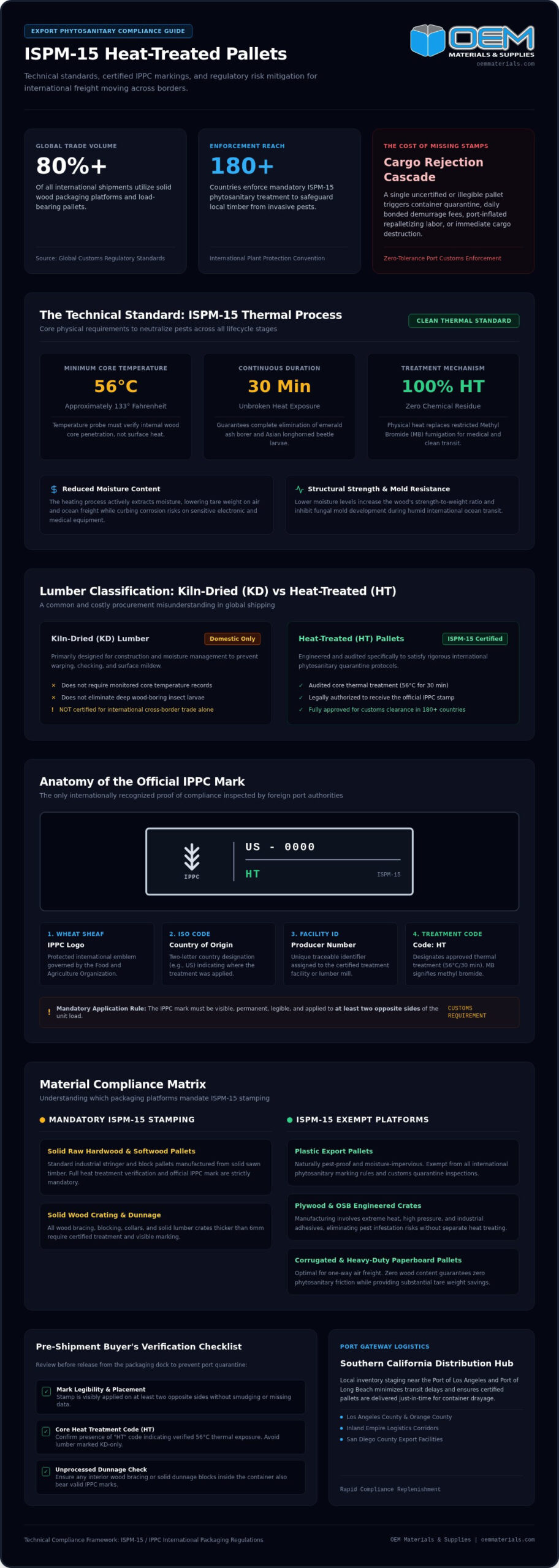
The reliability of heat treated pallets for international shipping depends on a precise thermal process. To meet the IPPC wood packaging material standards, solid wood must reach a minimum core temperature of 56 degrees Celsius (approximately 133 degrees Fahrenheit) for at least 30 continuous minutes. This specific threshold ensures the elimination of wood-boring pests at every life stage, from larvae to adults. Unlike chemical fumigation using Methyl Bromide (MB), which is increasingly restricted due to environmental and safety concerns, heat treatment (HT) is a clean, physical process that leaves no chemical residue on the packaging.
Beyond compliance, heat treatment offers structural benefits. The process naturally reduces the moisture content of the wood, which decreases the overall weight of the pallet and improves its resistance to mold and fungal growth. For manufacturers in the medical device or electronics sectors, controlling moisture is critical to preventing corrosion or contamination during long ocean transit. Reducing the moisture content also increases the wood’s strength-to-weight ratio, making the pallets more durable for multi-stage logistics chains.
Anatomy of the IPPC Mark
The IPPC stamp is the only document customs officials recognize as proof of treatment. This mark must be permanent, legible, and placed on at least two opposite sides of the pallet. It consists of four main parts: the IPPC symbol (the wheat sheaf), the ISO country code (e.g., US), the unique identification number of the certified producer, and the treatment code (HT). If a stamp is smudged or missing, the pallet is legally considered untreated. If you need assistance verifying your current inventory for export readiness, you can consult with our packaging specialists for a compliance review.
Heat Treatment vs. Kiln Drying
It’s common to see pallets marked as both KD (Kiln-Dried) and HT. While they both involve heat, their purposes differ. Kiln-drying is a manufacturing process designed to reduce moisture to a specific percentage to ensure the wood remains stable and doesn’t warp. Heat treatment is a phytosanitary requirement specifically for pest control. A pallet can be kiln-dried without meeting the 56 degree core temperature requirement, which would make it illegal for international export.
For high-value exports like aerospace components, using lumber that is both KD and HT provides the best of both worlds: the structural stability of dried wood and the legal compliance required for global logistics. Understanding these technical nuances helps procurement teams avoid purchasing pallets that look right but fail to meet the rigorous demands of international port authorities.
Wood vs. Plastic Pallets for International Shipping
Choosing the right platform for global transit involves balancing material costs with long-term logistical risks. While heat treated pallets for international shipping are the most common choice, plastic pallets provide a distinct advantage by bypassing phytosanitary requirements entirely. According to the U.S. Customs and Border Protection WPM guidelines, packaging made from non-wood materials like plastic, metal, or aluminum is not subject to ISPM-15 regulations. This exemption eliminates the risk of a shipment being rejected due to a missing or illegible stamp.
Weight is another critical factor in the wood versus plastic debate. A standard solid wood pallet typically weighs between 40 and 55 pounds. In contrast, a nestable plastic export pallet often weighs between 15 and 28 pounds. This represents a 40 to 60 percent reduction in tare weight, which significantly lowers air freight costs. In ocean freight, where weight is often less of a constraint than volume, the lower upfront cost of wood usually makes it the preferred choice for one-way journeys where pallet retrieval is impossible.
Industry-specific requirements also dictate material selection. The medical device and food sectors often favor plastic for its inherent cleanliness. Plastic pallets don’t absorb moisture, harbor bacteria, or produce wood dust, making them ideal for pharmaceutical cleanrooms and sensitive electronics. They also eliminate the risk of mold growth during transit through humid tropical environments, a common issue with wood that hasn’t been properly dried.
When to Choose Heat-Treated Wood Pallets
HT wood pallets are the industrial workhorse for one-way exports. They offer the lowest upfront acquisition cost and can be easily customized to support irregular loads or extremely heavy machinery. If your cargo exceeds standard weight capacities or requires a unique footprint, wood provides the flexibility needed for a secure fit. For high-value or oversized equipment, many manufacturers pair these pallets with custom wood crates to provide maximum physical protection during multi-stage international handling.
When Plastic Pallets are the Superior Export Choice
Plastic pallets are the superior choice for closed-loop international supply chains where the units can be returned and reused. While the initial investment is higher, high-density polyethylene (HDPE) pallets can last for hundreds of trips, whereas wood stringer pallets often require repair after only five to eight uses. To understand the full range of heavy-duty options, you can consult our Industrial Guide to Heavy Duty Plastic Pallets. This material choice is particularly effective for air shipments where the fuel savings from reduced tare weight can offset the higher pallet cost in a single trip.
A Buyer’s Checklist for Export-Ready Pallets
Before heat treated pallets for international shipping leave your facility, a rigorous verification process is required to ensure they meet the standards of the destination country. While ISPM-15 is a global framework, enforcement levels vary significantly at different ports of entry. A procurement manager must confirm that every unit in the shipment is structurally sound and legally compliant to avoid the high costs of re-palletizing goods in a foreign bonded warehouse.
Your inspection should begin with the physical condition of the lumber. Under ISPM-15 Annex 1, all solid wood must be debarked. While small tolerances exist, bark pieces must be less than 3 cm in width or, if wider, have a total surface area of less than 50 square centimeters. Beyond the wood itself, the IPPC stamp must be permanent and perfectly legible. If the stenciled code is smudged or incomplete, customs officials may treat the pallet as untreated, regardless of its actual thermal history.
Load capacity is the final critical check. You must verify that the pallet’s static and dynamic ratings match your cargo requirements. Static capacity refers to the load while the pallet is stationary on a flat floor, while dynamic capacity accounts for the stress of forklift transit and motion during ocean or air travel. Overloading a compliant pallet leads to structural failure, which can damage high-value industrial components and create safety hazards in the warehouse.
Material and Design Specifications
The choice between stringer and block pallet designs often depends on the handling equipment used at the destination. Stringer pallets are common in North American logistics, but many European and Asian facilities prefer block pallets for their true four-way entry capabilities. For manufacturers shipping sensitive electronics or medical devices, the pallet is only one part of the solution. Integrating foam packaging or custom inserts ensures that vibration and impact do not compromise the product during the rigors of international handling.
Documentation and Quality Assurance
Relying solely on the physical stamp is a risk. Professional buyers should always request heat treatment certificates from their supplier for every lot purchased. These documents serve as an essential paper trail during internal audits or customs inquiries. For high-volume exporters in Southern California, integrating pallet compliance into vendor-managed inventory services ensures that export-ready stock is always available, preventing last-minute scrambles for certified lumber. If you are preparing a shipment for export and need to verify your specifications, you can request a quote for compliant pallets to ensure your supply chain remains uninterrupted.
Sourcing Heat-Treated Pallets in Southern California
Southern California is a primary gateway for global trade. For manufacturers in Orange County, Los Angeles, San Diego, and Riverside, sourcing heat treated pallets for international shipping from a local partner is a strategic necessity. Proximity to the Ports of Los Angeles and Long Beach allows for a rapid response to shifting logistics requirements. When a container booking opens unexpectedly, waiting for a long-distance shipment of certified pallets creates a bottleneck that can lead to missed sailings and increased demurrage fees.
OEM Materials & Supplies manages compliance for aerospace and medical OEMs by providing a transparent documentation trail for every lot. These high-value sectors require more than just a pallet; they need a partner that understands the technical rigors of global transit. By working with a regional Southern California supplier, you reduce the physical distance your packaging travels before use. This minimizes the risk of damage or contamination during domestic transit and ensures your export-ready stock is available when production hits peak levels.
Solutions for SoCal Manufacturers
We provide more than just the base shipping platform. A complete export solution often requires integrating the pallet with other protective materials to ensure the cargo arrives intact. This includes using high-performance stretch film for pallet wrapping and heavy-duty edge protectors to stabilize the load. For specialized industrial equipment or sensitive electronics, we can integrate custom foam inserts directly into the pallet or crate design. This unified approach simplifies the packing process for your warehouse team and reduces the labor hours required to prepare a shipment for sea or air travel.
Streamlining Your Export Supply Chain
Transitioning from transactional purchasing to a strategic packaging partnership allows you to leverage just-in-time (JIT) delivery models. This approach is particularly effective for facilities in the Inland Empire and Los Angeles, where warehouse space is often at a premium. By maintaining a lower on-site inventory and relying on our regional distribution network, you can reduce overhead while ensuring a constant supply of ISPM-15 compliant materials.
Contact OEM Materials & Supplies for a quote on ISPM-15 compliant pallets tailored to your dimensions and load requirements. Please provide your specific product dimensions, weight, and estimated annual usage so our team can facilitate an accurate recommendation and provide a prototype for your next international shipment.
Securing Your Global Logistics Chain
Maintaining ISPM-15 compliance is a critical baseline for any manufacturer moving goods through international ports. Selecting the right heat treated pallets for international shipping involves more than just checking for a stamp; it requires a technical understanding of thermal standards and material durability. Whether you require the versatility of custom-built wood skids or the inherent compliance of plastic platforms, the goal remains the same: seamless customs clearance and product protection.
OEM Materials & Supplies has served aerospace, medical, and automotive OEMs for years, providing the technical expertise needed for complex industrial loads. Our local Southern California inventory and just-in-time delivery models help facilities in Orange County and Los Angeles reduce warehouse overhead while maintaining a reliable supply of export-ready packaging. We specialize in custom designs that integrate pallets with foam and corrugated components for maximum efficiency.
To ensure your next shipment meets all global phytosanitary requirements, Request a Quote for ISPM-15 Export Pallets today. Please include your product dimensions and annual usage to help our team provide a precise recommendation. We’re ready to help you optimize your international shipping operations.
Frequently Asked Questions
What does the ISPM-15 stamp on a pallet mean?
The stamp signifies that the wood packaging material has been treated according to International Standards for Phytosanitary Measures No. 15. It includes the IPPC wheat sheaf symbol, the ISO country code, a unique facility identification number, and the “HT” code for heat treatment. This mark is the only proof customs officials recognize to verify that the pallet is free of invasive pests that could threaten local ecosystems.
Do plastic pallets need to be heat treated for international shipping?
No, plastic pallets are inherently exempt from ISPM-15 regulations. Since they aren’t made of solid wood, they don’t harbor the wood-boring pests the standard targets. This exemption makes them a reliable alternative for exporters in Orange County and Los Angeles who want to eliminate the risk of customs delays caused by missing or illegible stamps on traditional wood packaging.
How long is a heat-treated pallet compliant for export?
An ISPM-15 certified pallet remains compliant for its entire functional lifespan as long as no repairs or alterations occur. If you replace a single board or stringer, the entire unit must be retreated and re-stamped by a certified facility. Using untreated lumber for repairs immediately voids the certification and risks shipment seizure at international ports, making regular inspections of your export stock essential.
Can I heat treat my own pallets for international shipping?
You cannot legally apply an IPPC stamp unless your facility is enrolled in an official heat treatment program and inspected by an accredited agency. Compliance requires specialized kilns capable of maintaining a core temperature of 56 degrees Celsius for 30 minutes. Most manufacturers in Southern California partner with certified suppliers to manage these technical requirements and ensure their heat treated pallets for international shipping meet all legal standards.
Is there a difference between kiln-dried and heat-treated pallets?
Kiln-drying and heat treatment serve different purposes. Kiln-drying is a manufacturing process designed to reduce moisture content for structural stability and mold prevention. Heat treatment is a phytosanitary process specifically for pest elimination. While a pallet can be both kiln-dried and heat-treated, only the heat treatment certification and the official IPPC stamp make the pallet legal for international export across the globe.
What happens if my pallet arrives at customs without an IPPC stamp?
Customs officials may quarantine the entire container, issue significant fines, or order the total destruction of the wood packaging. In many cases, the shipment is rejected and returned to the point of origin at the exporter’s expense. To avoid these costly disruptions, your warehouse team must verify that every pallet features a clear, legible stamp on at least two opposite sides before loading the container.
Are there specific wood types that are exempt from heat treatment?
While all solid wood is subject to the standard, engineered wood products are exempt. Materials such as plywood, OSB, and particleboard are manufactured using heat, glue, and pressure, which naturally eliminates pest risks. Additionally, solid wood components thinner than 6 mm (0.24 inches) are not required to be treated or stamped. These materials are often used for custom crates or lightweight export solutions in the electronics sector.
How much more do heat-treated pallets cost compared to standard pallets?
The cost difference between standard and heat-treated pallets depends on variables like lumber market fluctuations, pallet dimensions, and order volume. Heat treatment adds a premium over standard domestic pallets to cover the energy costs of the kiln and mandatory certification fees. For exporters in San Diego and Riverside, this investment is a small fraction of the potential costs associated with shipment rejections and port demurrage fees.