

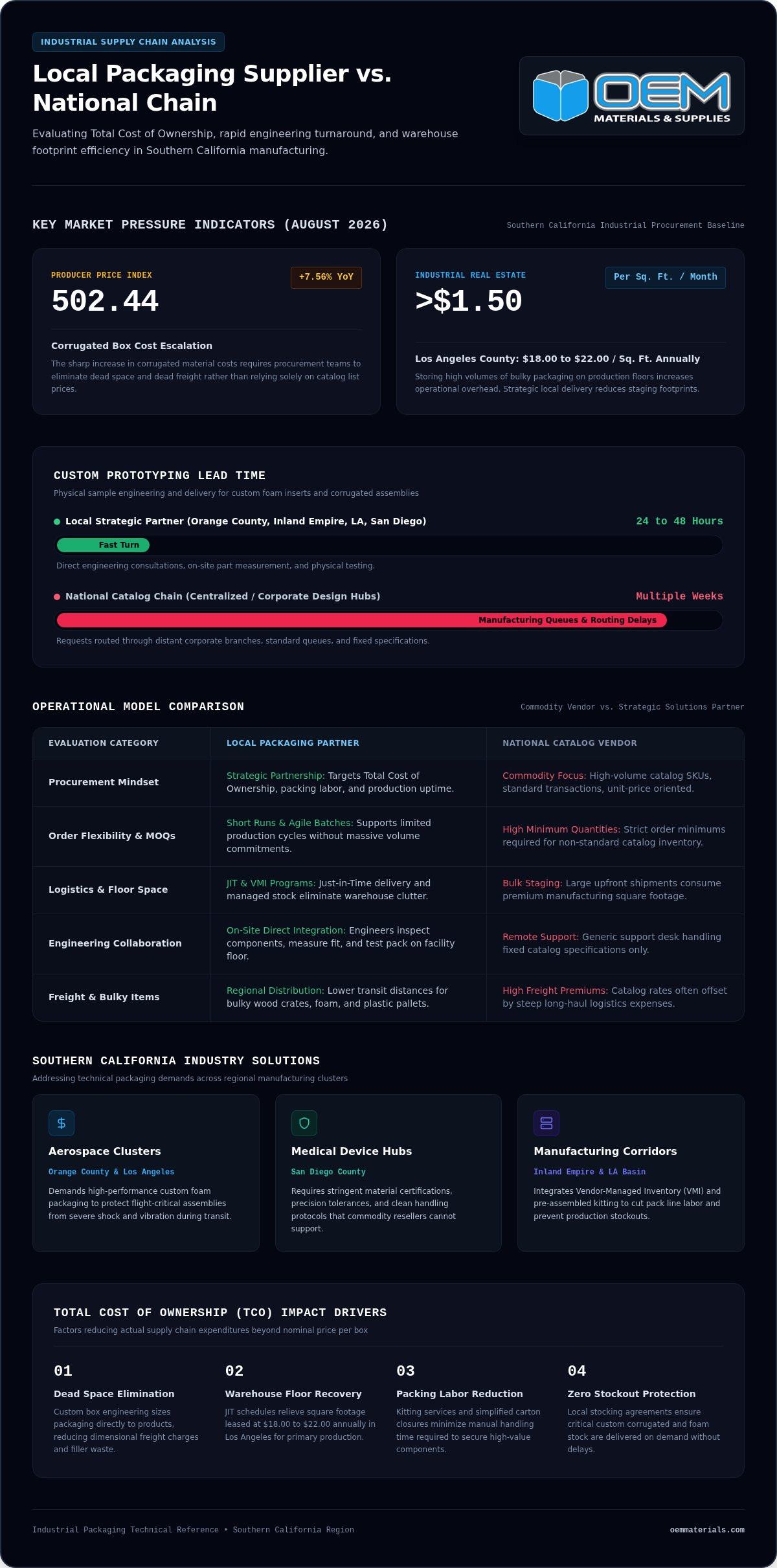
The Producer Price Index for corrugated boxes reached 502.44 in August 2026, a 7.56 percent year-over-year increase that forces procurement teams to look beyond simple unit costs. You’ve likely noticed that while national catalog giants offer convenience, they often lack the responsiveness required for custom engineering or urgent stock needs. The debate over a local packaging supplier vs national chain is no longer just about the price per box; it’s about the total cost of ownership in a market where Southern California industrial lease rates now exceed $1.50 per square foot monthly.
Managing an industrial supply chain requires more than just a vendor; it requires a partner that understands the technical demands of aerospace, medical, and electronics sectors. Discover how choosing between a local packaging supplier vs national chain impacts your industrial supply chain efficiency, total cost of ownership, and custom engineering capabilities. We will analyze the practical differences in freight costs, lead times for custom foam inserts, and how vendor-managed inventory (VMI) programs in Orange County, Los Angeles, and San Diego can reduce warehouse labor and eliminate stockouts. Transitioning to a local technical partner provides the rapid prototyping and streamlined inventory management necessary to maintain high-volume production in 2026.
Key Takeaways
- Understand how a strategic packaging partner improves manufacturing uptime and labor efficiency compared to a standard commodity vendor.
- Discover how local engineering expertise reduces prototyping lead times for custom foam inserts and corrugated designs from weeks to days.
- Compare the logistics of a local packaging supplier vs national chain to see how JIT delivery and VMI programs eliminate warehouse clutter.
- Identify hidden expenses in national catalog pricing by calculating the impact of freight costs on bulky items like plastic pallets and wood crates.
- Learn how to transition to a solutions partner by asking specific questions about their engineering and rapid prototyping capabilities.
Evaluating the Impact of Your Packaging Supply Chain Partner
Choosing between a local packaging supplier vs national chain often defines whether your procurement strategy is transactional or operational. National chains prioritize stock availability of fixed SKUs. While this works for generic supplies, industrial manufacturing requires technical integration. A strategic partner doesn’t just deliver boxes; they analyze how those materials interact with your assembly line and final distribution costs. Comparing a local packaging supplier vs national chain reveals that local partners offer a level of responsiveness that catalog vendors cannot match.
The Commodity Mindset vs Strategic Partnership
National catalog vendors operate on a high-volume, low-touch model. You select a SKU, pay the list price, and receive a shipment. This commodity mindset ignores the total cost of ownership. When you rely on a strategic partner, the focus shifts to identifying efficiency gaps. Replacing standard corrugated boxes with custom-engineered designs can reduce dead space, lowering freight costs and material waste. Strategic partners evaluate your packing labor. They look for ways to reduce the time it takes to secure a component, often through pre-assembled kitting or simplified box closures. This move away from the lowest unit price toward operational savings is what keeps production lines moving.
Identifying Industrial Packaging Needs in Southern California
Manufacturers in Southern California face specific logistical pressures that national vendors rarely address. Industrial lease rates in Los Angeles County range from $18.00 to $22.00 per square foot annually. You can’t afford to use expensive floor space for storing bulky packaging inventory. Proximity to your supplier is critical for maintaining just-in-time production schedules.
Aerospace hubs in Orange County and Los Angeles require high-performance foam packaging to protect sensitive flight components from vibration and shock. Similarly, medical device firms in San Diego demand precision and material certifications that generic resellers cannot provide. A local partner provides on-site consultations to measure parts and design prototypes. This ensures the packaging meets rigorous industry standards before the first production run. This hands-on approach minimizes product damage and prevents manufacturing downtime caused by stockouts or poor-quality materials. By choosing a partner located within the Inland Empire or surrounding counties, you gain an extension of your own engineering team rather than just another vendor on a spreadsheet.
Speed and Flexibility: The Local Advantage in Rapid Prototyping
In the industrial sector, speed is often the difference between meeting a shipping deadline and halting a production line. National chains excel at shipping stock boxes, but their custom capabilities are restricted by rigid manufacturing queues and centralized design teams. When comparing a local packaging supplier vs national chain, the most significant divergence appears during the prototyping phase. A local partner can produce a physical sample and deliver it to your facility in Orange County or the Inland Empire within 24 to 48 hours. This eliminates the multi-week waiting period typical of large scale distributors who must route custom requests through distant corporate offices.
Short Runs and Custom Design Capabilities
Customization doesn’t always mean high volume. Many manufacturers require short runs of corrugated packaging for specialized equipment or limited production cycles. National vendors often impose high minimum order quantities for anything outside their standard catalog. A local partner offers the flexibility to produce small batches, allowing you to test structural designs without committing to thousands of units. This agility is a core component of lean supply chain management, as it prevents the accumulation of obsolete inventory when product dimensions change. You can iterate on designs quickly, ensuring the final package fits the product perfectly before scaling to high-volume production.
Technical Engineering Support for Complex Products
Complex industrial components require more than a generic box. Sensitive electronics and aerospace parts demand custom foam packaging engineered to specific G-force ratings and vibration frequencies. National catalog chains provide standard foam sheets but lack the on-site engineering support to design precision die-cut inserts. Local experts visit your plant, measure the physical part, and optimize material density to ensure maximum protection with minimum waste. This collaborative approach ensures that heavy machinery remains stable in wood crates and fragile sensors stay secure during transit.
The technical gap between a local packaging supplier vs national chain is most evident when product requirements shift mid-stream. A local engineer can pivot production immediately to accommodate a new material specification or a reinforced edge protector. This hands-on collaboration reduces the risk of product damage and ensures your packaging keeps pace with engineering changes. If you are currently facing long lead times for custom designs, you can request a quote for a physical prototype to see the local difference firsthand.
Optimizing Logistics with JIT and Vendor Managed Inventory
Managing industrial packaging inventory is a significant logistical burden for Southern California manufacturers. Bulky items like corrugated boxes and foam inserts consume valuable floor space that could otherwise be used for revenue-generating production lines. When comparing a local packaging supplier vs national chain, the logistics advantage shifts heavily toward the local partner. National chains deliver orders and leave the management to you. A local partner integrates into your operations to eliminate warehouse clutter and prevent stockouts.
Reducing Warehouse Overhead through VMI Programs
Inventory carrying costs in the industrial sector typically range from 20 percent to 30 percent of the inventory’s value annually. You can significantly reduce these overheads by implementing Vendor Managed Inventory (VMI). In this model, your supplier monitors stock levels on-site and automates replenishment based on your actual production usage. This shift simplifies the procurement process for warehouse managers and ensures that critical packaging materials are always available without tying up excess capital in overstock. Freeing up square footage in Los Angeles or Orange County facilities allows for the installation of additional assembly lines or testing equipment.
Just-in-Time Delivery for SoCal Manufacturing Hubs
Geographic proximity allows for JIT packaging delivery cycles that national distributors cannot replicate. Serving manufacturing hubs in Riverside, San Diego, and the Inland Empire requires the ability to react to daily production fluctuations. Local delivery on dedicated trucks avoids the common risks of long-distance freight delays and LTL damage. This responsiveness is vital for maintaining supply chain resilience during seasonal surges or unexpected order spikes.
Beyond delivery, local partners provide value-added services like professional kitting and assembly. National vendors often ship components separately, requiring your staff to spend hours folding boxes, inserting foam, and kitting parts. Outsourcing these tasks to your supplier reduces your internal labor costs and streamlines the final packing process. By choosing a local packaging supplier vs national chain, you gain a partner capable of handling the manual labor associated with packaging preparation. This allows your team to focus on core manufacturing tasks while maintaining a lean and responsive supply chain.
Calculating the Total Cost of Ownership in Packaging
Procurement managers often focus on unit price, yet the lowest invoice amount rarely translates to the lowest operational expense. In an industrial environment, the true cost of a package includes every touchpoint from the moment it leaves the supplier to the moment your customer receives the final product. When comparing a local packaging supplier vs national chain, the financial analysis must extend beyond the line item for materials. National chains often rely on volume-based discounts that appear attractive on a spreadsheet but fail to account for the logistical realities of bulky industrial supplies.
Hidden Costs of National Chain Procurement
Bulky items like pallets and crates are essentially “shipping air.” When a national distributor sends these items via Less-Than-Truckload (LTL) carriers from a remote hub, the freight costs can represent a significant percentage of the total invoice. These shipping fees often negate any unit-price savings. Local delivery on dedicated trucks bypasses these carrier surcharges and eliminates the hidden damage risks associated with multi-stop LTL routes.
Managing a fragmented supply chain with separate vendors for foam, stretch film, and boxes adds significant administrative overhead. Your team spends more time on purchase orders, freight tracking, and invoice reconciliation. There is also the cost of “dead” inventory. To hit the best price tier with a national chain, you may be forced to buy six months of stock, tying up capital and occupying expensive floor space in Los Angeles or Orange County facilities.
Freight, Lead Times, and Inventory Holding Costs
Lead times are a critical factor in the financial equation. A two-week lead time for custom foam inserts from a distant supplier isn’t just a delay; it’s a holding cost for your finished goods. If your production line is ready but your packaging isn’t, you’re paying to store unshipable products. Conversely, using “standard” fitment from a catalog to avoid lead times often leads to product damage. Replacing a high-value aerospace component or medical device due to inadequate packaging fitment is far more expensive than any material savings.
Total Cost of Ownership is the sum of unit price, freight, storage, and labor. By partnering with a local expert who provides custom-engineered solutions, you reduce the labor required for assembly and the material waste from oversized boxes. To see how specialized engineering can lower your operational expenses, you can request a quote for a custom packaging audit based on your specific product weight and annual usage. This data-driven approach ensures your packaging strategy supports your bottom line rather than just filling a warehouse with expensive inventory.
Selecting a Solutions Partner for Southern California Industry
Transitioning from a national catalog vendor to a local strategic partner requires a methodical approach to ensure production continuity. The primary difference between a local packaging supplier vs national chain is the depth of technical integration. While a national chain provides a list of products, a local partner provides a list of solutions. Start by auditing your current packing line to identify hidden pain points like excessive tape usage, product damage, or slow kitting processes.
Transitioning from a Vendor to a Strategic Supplier
Phasing in a new supplier should be done in stages. Begin with high-volume, high-cost items like custom corrugated boxes or foam inserts. Establish clear communication protocols for custom design projects, ensuring your engineering team can collaborate directly with the packaging designer. This direct access eliminates the communication lag common with large distributors. Consider phasing in a Vendor Managed Inventory (VMI) program for your most critical SKUs first. This minimizes disruption while allowing you to test the supplier’s reliability and replenishment accuracy.
When evaluating a potential partner, ask specific questions about their technical capabilities. Inquire about their experience with high-precision industries and their ability to drop-test prototypes. A true solutions partner should offer on-site consultations to measure your physical components and assess your existing warehouse workflow. This hands-on approach ensures the packaging is optimized for both protection and packing speed.
How OEM Materials Supports SoCal Aerospace and Medical Sectors
OEM Materials & Supplies tailors its operations to the unique demands of Southern California manufacturing. We provide heavy-duty crates and custom wood packaging for industrial machinery moving through the Riverside distribution corridor. For aerospace hubs in Los Angeles and Orange County, we engineer precision foam inserts that meet rigorous flight-safety standards. Medical device manufacturers in San Diego rely on our cleanroom-compatible materials and exact material specifications.
The choice between a local packaging supplier vs national chain ultimately impacts your ability to scale and react to market changes. We focus on providing the technical expertise and logistical support necessary for engineering-heavy sectors to thrive. To find immediate cost savings and improve your packing efficiency, contact us today for a comprehensive packaging audit. Please provide your product dimensions, weight, and annual usage requirements to receive a customized quote or prototype designed for your specific application.
Optimizing Your 2026 Industrial Packaging Strategy
The decision between a local packaging supplier vs national chain hinges on the balance between transactional convenience and operational resilience. While national distributors offer a broad catalog, they often fail to provide the custom engineering and hands-on logistics required by high-stakes sectors like aerospace and medical device manufacturing. Prioritizing a local partner provides access to rapid prototyping and just-in-time delivery that directly reduces your total cost of ownership.
OEM Materials & Supplies serves as a technical partner for manufacturers throughout Orange County, Los Angeles, San Diego, and the Inland Empire. We specialize in custom foam inserts, corrugated solutions, and vendor-managed inventory programs that eliminate stockouts and reduce warehouse labor. Our focus remains on protecting your high-value components while streamlining your internal processes.
It’s time to move beyond a commodity vendor and secure a partner that understands your technical requirements. Request a custom packaging quote or prototype from OEM Materials & Supplies by providing your product dimensions, weight, and annual usage. We look forward to helping you achieve a more efficient and reliable supply chain.
Frequently Asked Questions
What are the main benefits of using a local packaging supplier over a national chain?
Speed, lower freight, and custom engineering are the primary advantages. National chains focus on selling stock SKUs from catalogs. Local partners like OEM Materials & Supplies offer hands-on design and on-site consultations to solve specific protection problems. This comparison of a local packaging supplier vs national chain shows that proximity allows for rapid prototyping and faster feedback loops. You get tailored protection for your parts instead of generic sizes that increase shipping costs.
How does Vendor Managed Inventory (VMI) work for industrial packaging?
VMI shifts the responsibility of inventory monitoring to the supplier. A local partner visits your facility in Los Angeles or Orange County to track usage levels and automatically replenish stock. This eliminates the need for manual purchase orders and prevents production-stopping stockouts. By automating replenishment, your warehouse team can focus on assembly and distribution rather than managing stacks of empty corrugated boxes or bulky foam inserts.
Can a local supplier handle high-volume production runs?
Yes, local industrial suppliers are equipped to handle both rapid prototyping and high-volume manufacturing programs. OEM Materials & Supplies manages large scale production for sectors like automotive and aerospace. While national chains focus on stock items, a local partner scales custom-engineered solutions to meet the demands of a high-volume assembly line. This ensures consistent quality control and precision that are often lost when ordering mass-produced commodity supplies.
Why are freight costs so high for national packaging orders?
Freight costs are high because corrugated boxes and foam inserts are bulky and lightweight, meaning they take up significant space in a truck. National chains often ship from remote hubs via LTL carriers, charging high rates for “shipping air.” Local suppliers in Southern California deliver on dedicated trucks, which significantly reduces the impact of transportation surcharges and eliminates the risk of damage common in long-distance transit.
Do local suppliers offer custom engineering for foam and corrugated?
Technical engineering is a primary differentiator when choosing a local packaging supplier vs national chain. Local partners provide specialized engineering support to design custom foam inserts and die-cut corrugated boxes. This ensures fragile electronics or aerospace parts are secured with the correct material density and structural integrity. National catalog vendors typically only offer standard sheets or generic box sizes that lack the specialized protection required for high-value industrial goods.
How much can a company save by switching to JIT packaging delivery?
Savings from Just-in-Time (JIT) delivery depend on variables like your facility’s square footage costs and production volume. By receiving smaller, frequent deliveries, you reduce inventory holding costs and free up expensive warehouse space in San Diego or Riverside. This allows you to reallocate floor space to revenue-generating machinery. JIT also minimizes the risk of inventory obsolescence when product designs or dimensions change unexpectedly during a production cycle.
What industries benefit most from local packaging partnerships in Southern California?
Aerospace, medical device, electronics, and automotive sectors benefit most from these partnerships. These industries require high-performance protection and precision engineering that commodity vendors don’t provide. Manufacturers in the Inland Empire and Orange County often need wood crates for heavy machinery or ESD packaging for sensitive sensors. A local partner understands the specific regulatory and protection standards required by these technically demanding Southern California industries.
What data is needed for an accurate industrial packaging quote?
To provide a precise recommendation, we require the physical dimensions, weight, and fragility of the component. You should also specify the annual usage volume and any environmental requirements, such as cleanroom or ESD standards. Providing details on the shipping method and storage conditions helps us select the right materials, such as high-density foam or double-wall corrugated, to ensure your total cost of ownership remains low and predictable.