
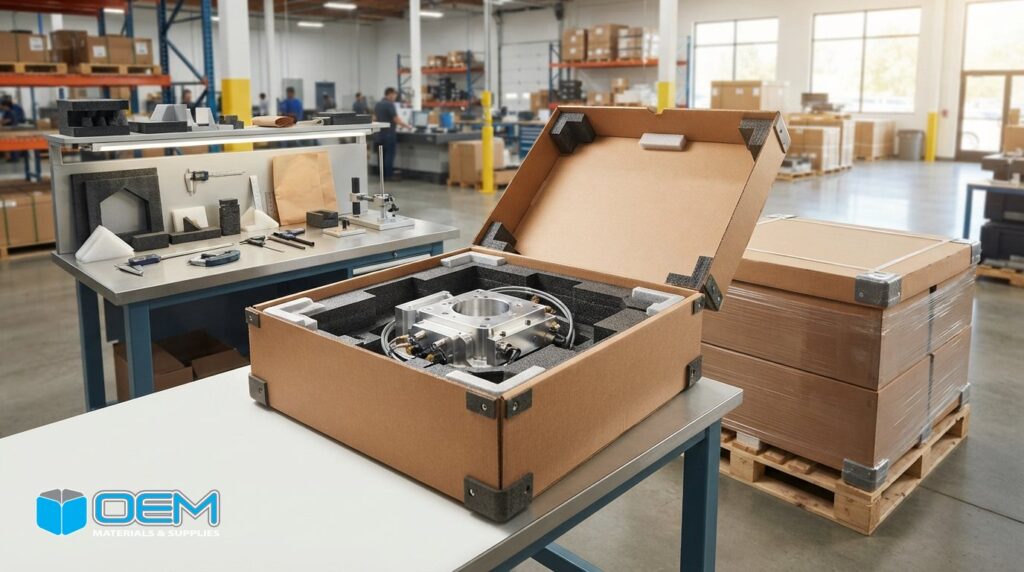
Ordering a thicker catalog carton will not stop bottom pallet layers from crushing during dynamic freight transit. If you oversee industrial shipping lines, you already know that standard commodity packaging fails under real-world logistics stress. Securing dependable heavy duty corrugated boxes orange county facilities require means matching structural board chemistry directly to payload weight instead of guessing with generic stock cartons.
Between costly industrial floor space and demanding delivery schedules, your facility cannot afford freight rejections, crushed sidewalls, or unexpected packaging stockouts. You need reliable structural integrity that protects sensitive aerospace, electronics, and medical hardware without wasteful over-packaging. This guide details how to select, test, and source heavy duty corrugated packaging that eliminates transit damage across Southern California manufacturing hubs. We examine Edge Crush Test ratings, carrier compliance rules under NMFC Item 222, and local inventory strategies that keep your packing lines moving.
Key Takeaways
- Match board architecture to dynamic transit demands by evaluating whether your freight requires top-load Edge Crush Test stacking strength or Mullen puncture resistance.
- Sourcing engineered heavy duty corrugated boxes orange county manufacturers rely on prevents pallet sidewall deflection and eliminates dimensional freight penalties.
- Integrate custom interior foam packaging and edge protectors to isolate shock loads and secure sensitive aerospace, medical, or electronic components.
- Overcome Southern California warehouse space limitations by utilizing vendor-managed inventory and scheduled just-in-time box replenishment programs.
- Streamline procurement cycles by establishing precise cargo dimensions, gross weights, and environmental handling criteria prior to sample prototyping.
Understanding Heavy Duty Corrugated Construction for Industrial Payloads
Standard single-wall cartons perform well for consumer parcel shipping, but they routinely buckle under dynamic freight transit. When payload weights exceed standard 65-pound thresholds, container survivability depends entirely on internal board architecture. Sourcing engineered heavy duty corrugated boxes orange county operations require means looking beyond catalog dimensions to evaluate how multi-layered fluting, heavy-basis-weight linerboards, and adhesive bonding interact under load.
Linerboard weight and water-resistant adhesives directly govern box endurance during storage in unconditioned Southern California warehouses. High ambient humidity softens virgin paper fibers, causing unreinforced cartons to lose vertical load capacity. Selecting the correct board grade balances compressive strength against overall container tare weight, keeping freight costs low without compromising payload safety.
Double-Wall and Triple-Wall Structural Architecture
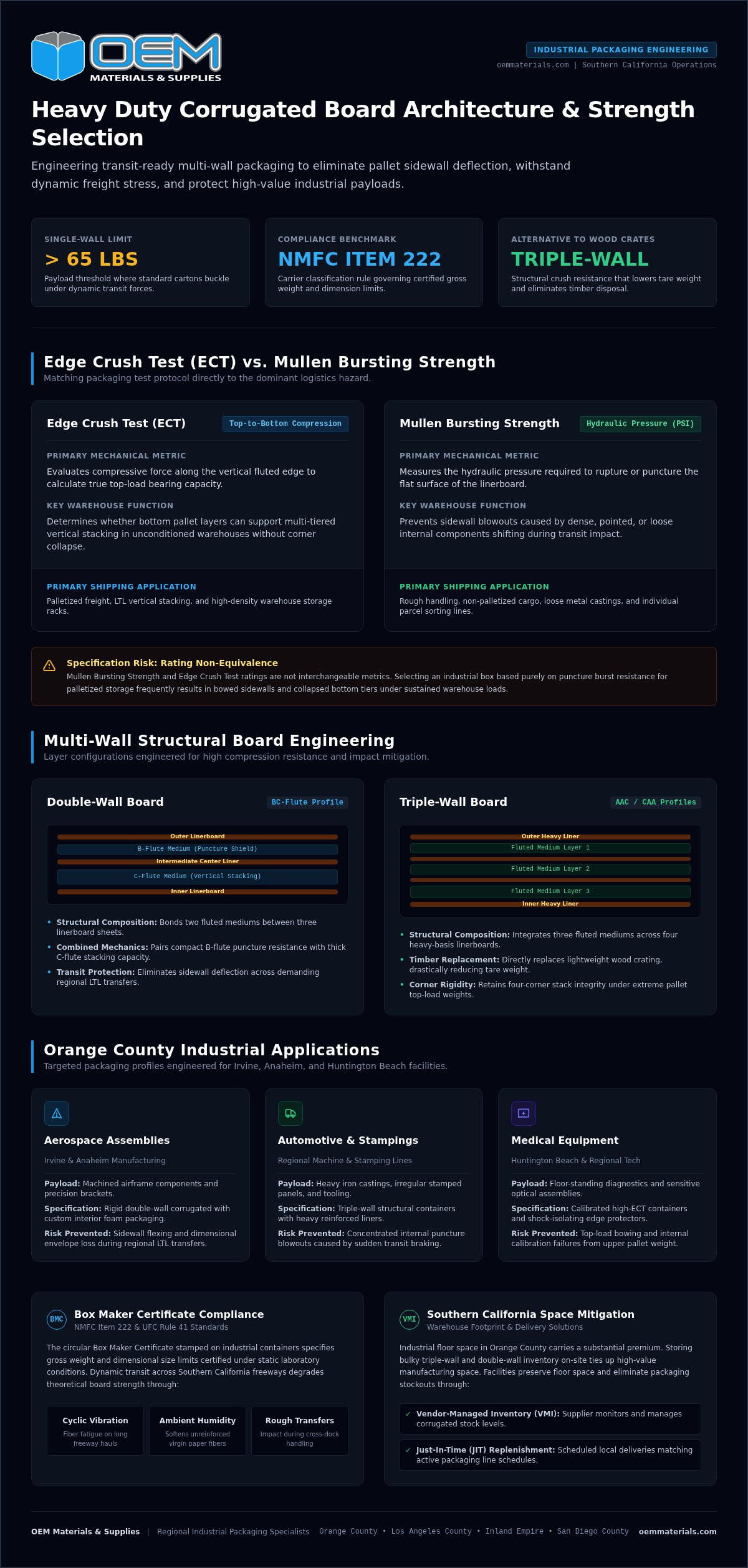
Industrial applications demand multi-wall configurations that distribute top-load compression across multiple vertical fluting profiles. Double-wall board bonds two corrugated mediums between three linerboard sheets. Combining distinct flute profiles, such as a BC-flute mix, pairs the puncture resistance of compact B-fluting with the vertical stacking strength of thicker C-fluting.
Triple-wall board introduces a third fluted layer, utilizing AAC or CAA flute combinations. This massive profile delivers crushing resistance that competes directly with lightweight wood crates. By switching to structural triple-wall containers, operations reduce overall packaging tare weight, eliminate timber disposal issues, and maintain four-corner stack integrity on full pallet loads.
Industrial Applications Across Orange County Facilities
Facilities throughout Irvine, Anaheim, and Huntington Beach face specific shipping hazards based on cargo profiles:
- Aerospace Assemblies: Machined airframe components and precision brackets require rigid double-wall corrugated boxes that prevent sidewall flexing and preserve tight dimensional envelopes during regional LTL transfers.
- Automotive and Metal Stampings: Heavy, irregular iron castings and stamped panels exert intense localized force. They require triple-wall containers with reinforced liners to prevent internal puncture blowouts during abrupt braking.
- Medical Equipment: Floor-standing diagnostics and optical assemblies demand unwavering dimensional stability. Boxes cannot bow under upper pallet loads, or delicate internal alignments will fail.
Deploying application-specific heavy duty corrugated boxes across Orange County manufacturing operations prevents transit failures while eliminating the freight penalties of crude, oversized packaging.
Corrugated Box Strength Ratings: ECT vs. Bursting Strength
Specifying industrial packaging requires understanding the mechanical difference between puncture containment and stacking endurance. Many procurement teams mistakenly treat Edge Crush Test (ECT) and Mullen Bursting Strength as interchangeable metrics. They aren’t. Mullen testing measures hydraulic pressure in pounds per square inch, evaluating how well a box contains shifting internal components with pointed profiles. ECT evaluates vertical top-to-bottom compression along the fluted edge, measuring whether lower tiers can support pallet loads in a high-density warehouse.
Using the wrong rating standard creates catastrophic failures. If you select a carton based purely on burst resistance for palletized storage, the sidewalls often bow under sustained top loads. For regional manufacturers sourcing heavy duty corrugated boxes orange county packaging specialists recommend matching the test protocol to the dominant logistics hazard.
Interpreting Box Maker Certificates on Industrial Containers
The circular Box Maker Certificate (BMC) stamped on the bottom flap certifies compliance with freight standards such as NMFC Item 222 and UFC Rule 41. It lists whether the box was certified under Mullen burst or ECT criteria, along with gross weight and dimensional size limits.
These printed limits reflect static laboratory conditions. Dynamic transit across Southern California highways introduces cyclic vibration, rough cross-docking, and humidity that degrade theoretical strength. Packaging engineers apply safety factors, typically between 3:1 and 5:1, when calculating real-world box compression requirements from the initial BMC rating.
Selecting Between ECT 48, 51, and Heavy Duty 71+ Ratings
Selecting appropriate board strength prevents structural collapse while eliminating unnecessary tare weight. Standard utility boxes stop around 32 to 44 ECT. When moving into industrial payloads, structural thresholds increase significantly:
- 48 ECT to 51 ECT Double-Wall: Rated for gross weights up to 120 to 140 pounds. These grades provide the necessary sidewall column strength for tiered pallet staging of industrial hardware, electronics enclosures, and automotive subassemblies.
- 71 ECT to 80+ ECT Triple-Wall: Engineered for bulk cargo containers and heavy mechanical assemblies. These boards withstand heavy dynamic crushing loads and puncture hazards, replacing timber crates for payloads exceeding several hundred pounds.
Reviewing tested corrugated box options ensures your packaging balances freight classification limits with physical protection. If you need assistance verifying compressive requirements for your pallet patterns, you can request an engineering review from our local team to confirm the right board grade.
Engineering Custom Interior Protection for Fragile Heavy Cargo
A rugged outer shell cannot protect a product if the cargo slams against interior box walls during transit. Dense mechanical parts, robotics, and calibration instruments exert severe localized forces when freight vehicles brake or encounter rough road surfaces. Sourcing heavy duty corrugated boxes orange county packaging lines need is only the first step. True damage prevention requires co-engineering exterior container rigidity with precision die-cut internal cushioning.
Relying on loose-fill dunnage or generic bubble materials fails because heavy payloads migrate through soft packing under continuous vibration. Once shifting starts, pointed metal corners punch through internal packaging layers and directly attack the outer carton score lines. Pairing custom-cut interior components with right-sized cartons stabilizes your payload, shrinks cubic shipping dimensions, and prevents dimensional weight surcharges from regional freight carriers.
Integrating Custom Foam Inserts with Corrugated Shells
Material density must directly correspond to payload mass. Pairing the right foam chemistry with an exterior container ensures that kinetic energy dissipates before reaching sensitive structural points:
- Closed-Cell Polyethylene (PE) Foam: Designed for dense, heavy equipment. Polyethylene resists multiple dynamic drops without bottoming out, locking cast iron, machined aviation blocks, and steel tooling into engineered cavities.
- Open-Cell Polyurethane (PU) Foam: Ideal for sensitive optical, medical, and electronic instrumentation. Its softer cell structure dampens low-frequency transit harmonics without placing crushing pressure on delicate housings.
Explore custom foam packaging options to establish the exact firmness and static loading profiles required to secure your hardware profile within its carton.
Heavy-Duty Pallet and Skid Compatibility
Box performance calculations assume complete, flat support across the bottom panel surface. If an outer container extends past the pallet footprint by even an inch, the unsupported carton corners lose significant vertical stacking strength. This structural loss quickly leads to leaning stacks and crushed cargo in distribution hubs.
Pair large format containers with properly sized heavy duty pallets to maintain a unified base. Securing your double-wall or triple-wall boxes flush to wood or composite runners prevents transit load shifting across regional freight corridors, keeping high-value cargo stable from dock to destination.
Mitigating Southern California Supply Chain and Warehouse Challenges
Warehousing costs across Southern California force operations managers to reconsider bulk material storage. With Orange County industrial vacancy hovering around 6.5 percent and asking lease rates averaging $1.44 per square foot per month NNN, dedicating active floor space to idle packaging drains operating capital. Bulky double-wall and triple-wall cartons consume substantial vertical clearance. When procuring heavy duty corrugated boxes orange county facilities can’t afford to turn expensive manufacturing square footage into storage zones for empty cartons.
Sourcing from distant distributors also introduces freight transit delays that bring packing operations to an abrupt halt. A regional packaging partner solves this by absorbing the inventory holding burden, staging structural packaging locally across Orange County, Los Angeles County, and the Inland Empire.
Vendor-Managed Inventory and Just-In-Time Staging
Establishing localized packaging VMI programs allows facilities to maintain lean on-site inventory while guaranteeing stock availability. Under a vendor-managed inventory agreement, your packaging partner monitors consumption patterns and manages replenishments automatically. Scheduled just-in-time deliveries ensure pallet quantities of assembled or flat-packed boxes arrive exactly when production batches begin, shielding assembly lines against supply disruptions without cluttering aisles.
Optimizing Staging and Handling with Flat-Packed Packaging
Handling flat-packed corrugated bundles correctly preserves structural performance prior to box erection. Industrial cartons ship knocked down flat to maximize truckload density, but warehouse personnel must handle bundles carefully:
- Prevent Flute Crushing: Avoid excessive tension on packaging strapping. Steel or hard plastic banding without corner protection bites into outer sheets, permanently destroying edge fluting and degrading box compression test ratings.
- Protect Storage Footprints: Stack flat bundles uniformly on heavy-duty skids off bare concrete floors to block ground-level moisture migration in unconditioned warehouse spaces.
- Stabilize Pallet Loads: Standardize bundle footprints to simplify automated wrapping with industrial stretch film, creating weather-resistant, dust-free packaging units that transport cleanly across staging bays.
Aligning packaging deliveries with actual production velocity eliminates floor clutter while preventing line stoppages. To review usage data and establish custom delivery cadences for your facility, request an inventory consultation with our Southern California team.
How to Specify and Source Industrial Packaging in Orange County
Precision procurement prevents unexpected freight failures and costly line shutdowns. When sourcing heavy duty corrugated boxes orange county operations managers must provide comprehensive design criteria upfront. Treating structural cartons like standard catalog SKUs leads to mismatched board combinations, improper flute selections, and inflated per-unit costs. Gathering detailed physical and logistical requirements before initiating custom die-lines ensures your packaging performs reliably under field handling conditions.
Collaboration during the design phase also bridges the gap between mechanical requirements and assembly efficiency. Experienced packaging engineers evaluate how components nest, ensuring production teams erect, load, and seal cartons quickly without wasting operator labor.
Key Data Points for Accurate Packaging Quotes
Before requesting production quotes, compile the following baseline specifications to ensure accurate structural calculations:
- Payload Geometry and Mass: Document exact exterior product dimensions, total net weight, and center of gravity. Off-center loads concentrate mechanical pressure onto specific carton panels, requiring targeted reinforcement.
- Transit and Handling Environment: Outline full supply chain touchpoints, including less-than-truckload transfers, rail vibration, export container condensation, and maximum planned warehouse pallet stack heights.
- Production Volumes: Provide realistic annual usage estimates alongside typical production run batch sizes. High-volume runs justify custom rotary die-cut tooling, while lower runs may leverage standard tooling configurations to control initial tooling costs.
Requesting Quotes and Prototypes from OEM Materials & Supplies
Partnering with a Southern California specialist keeps engineering and manufacturing support local. Our packaging engineers analyze your technical requirements to balance flute architecture, burst thresholds, and tare weight, delivering tailored solutions that protect sensitive hardware without packaging over-engineering.
We provide full structural prototyping, including CAD cut samples and physical mockups, to verify internal tolerances and load stability before starting volume production. This physical validation guarantees seamless fitting on your assembly line. Submit your payload parameters, target dimensions, and anticipated volume through our quote request page to consult directly with an industrial packaging engineer.
Build a Resilient Packaging Supply Chain for Your Facility
Eliminating transit damage across high-value aerospace, electronics, and precision manufacturing shipments requires more than standard catalog cartons. Long-term freight survivability depends on matching structural board fluting to dynamic handling shocks, pairing outer containers with engineered foam cushioning, and maintaining flush pallet alignment.
Operating in Southern California means balancing high floor space costs against rigorous shipping deadlines. OEM Materials & Supplies supports regional manufacturing hubs with full-service packaging design, custom prototyping, and dependable vendor-managed inventory programs that deliver cartons right when your packing lines need them. When you source engineered heavy duty corrugated boxes orange county facilities gain structural reliability without sacrificing valuable warehouse floor space to excess packaging storage.
Protect your critical cargo and streamline production schedules. Request a quote for heavy-duty corrugated packaging today by sharing your cargo dimensions, total payload weight, and annual usage to develop tested prototypes with our local engineering team.
Frequently Asked Questions
What is the difference between single-wall, double-wall, and triple-wall corrugated boxes?
Single-wall boxes feature one fluted medium sandwiched between two linerboards, suited for general parcel weights up to 65 pounds. Double-wall board combines two fluted mediums between three liners, delivering increased vertical stacking strength for payloads up to 140 pounds. Triple-wall cartons introduce three fluted layers across four linerboards, producing high-compression structural packaging capable of handling bulk machinery, aerospace parts, and loads exceeding several hundred pounds.
How do I determine whether my payload requires an ECT rating or a Mullen burst rating?
Base your decision on the primary stress your freight encounters during transit. Choose Edge Crush Test (ECT) ratings if your primary concern is top-load compression during palletized warehouse storage or trailer stacking. Select Mullen burst ratings if you are shipping loose, dense, or sharp metal parts that shift internally and could puncture container walls during rough carrier transit.
Can heavy duty corrugated boxes replace wooden crates for industrial machinery?
Yes, structural triple-wall containers frequently replace all-wood crating for industrial assemblies and machinery. When specifying heavy duty corrugated boxes orange county machinery manufacturers often mount triple-wall sleeves to timber skids or plastic pallets. This hybrid setup provides robust sidewall protection, lowers gross tare weight for air and ground freight, and eliminates the disposal challenges associated with full wooden crates.
Why is box overhang on a pallet dangerous for heavy corrugated containers?
Box corners provide the vast majority of a corrugated carton’s vertical stacking strength. When containers overhang a pallet edge, the perimeter loses critical deckboard support. This misalignment induces uneven stress across the vertical fluting, causing sidewalls to buckle under upper tier loads. Keeping containers completely flush with pallet runners preserves intended compression ratings throughout high-density warehouse storage and freight transport.
How does warehouse humidity affect the stacking strength of heavy-duty boxes?
Corrugated board readily absorbs ambient moisture from humid coastal air or unconditioned warehouse environments. As moisture content rises within the paper fibers, vertical fluting softens and loses load-bearing capacity. Prolonged exposure to high humidity can reduce theoretical box compression strength significantly. Packaging engineers compensate by factoring in environmental safety margins or utilizing wet-strength mediums and water-resistant adhesives for humid transit corridors.
What information do I need to provide when ordering custom heavy-duty boxes in Orange County?
When ordering heavy duty corrugated boxes orange county engineering teams need exact exterior part dimensions, total cargo weight, and center-of-gravity details. You should also specify transit methods, anticipated pallet stacking heights, storage environmental conditions, and expected production run volumes. Providing these specific parameters ensures packaging specialists select the appropriate flute profile and ECT rating without costly over-engineering.
How do vendor-managed inventory programs work for bulky industrial corrugated packaging?
Vendor-managed inventory programs shift the storage burden away from your manufacturing floor. A regional packaging partner monitors your carton consumption rates and warehouses bulk stock off-site. As your packing lines consume inventory, scheduled replenishment deliveries arrive just in time for assembly runs. This arrangement prevents expensive line stoppages while keeping valuable Southern California industrial floor space clear for primary production.